William Wynn Westcott
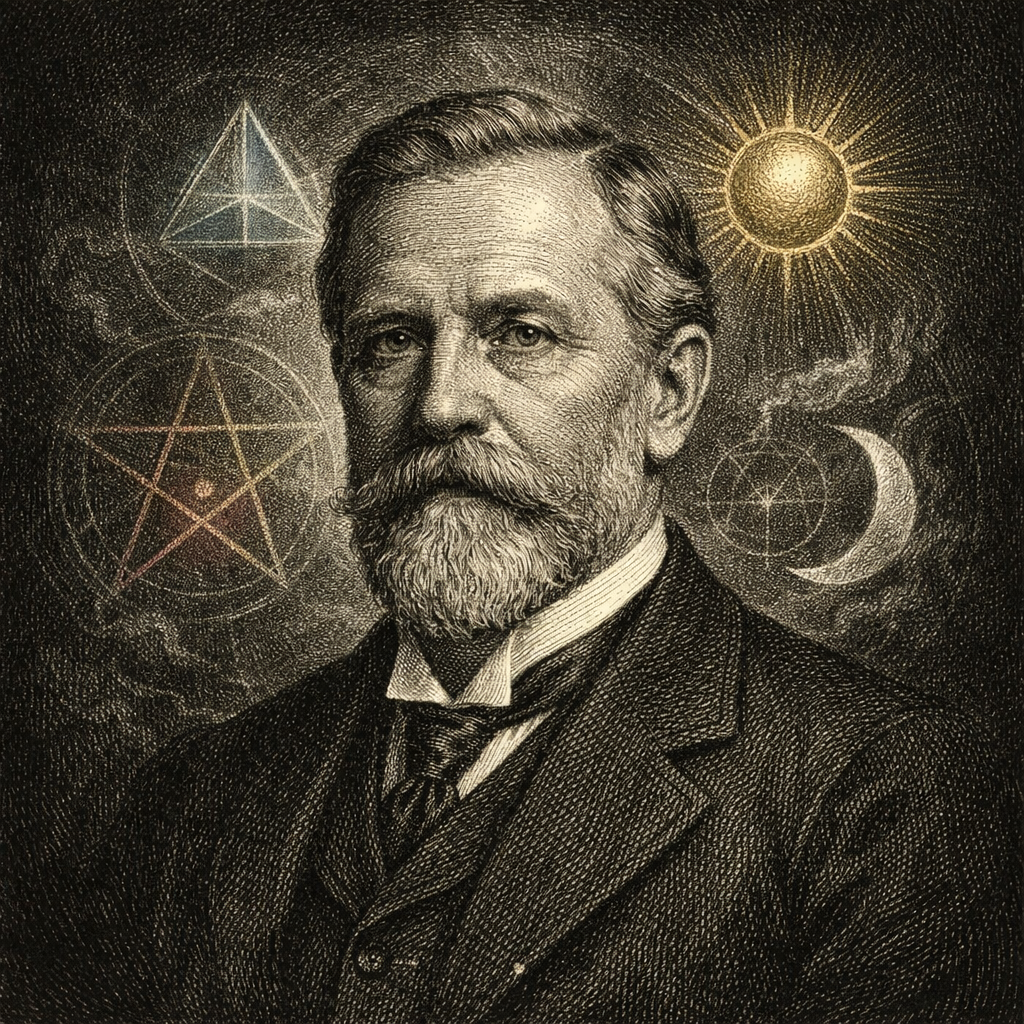
Date range: 1848–1925
Brief Biography
William Wynn Westcott was an English occultist, physician, coroner, Freemason, and one of the three principal founders of the Hermetic Order of the Golden Dawn. Born at Leamington, Warwickshire, he trained in medicine in London and pursued a respectable public career while simultaneously cultivating serious interests in Rosicrucianism, Kabbalah, ceremonial magic, and the broader occult revival of the late nineteenth century. Westcott appears to have taken the early lead in the formation of the Golden Dawn, helping to decode, organise, and promote the materials associated with the so-called Cipher Manuscripts before collaborating with S.L. MacGregor Mathers and William Robert Woodman in establishing the Order. He also wrote, translated, and edited a range of occult texts and played an important role in making esoteric material available in a more structured and teachable form.
Works and Texts
- The Kabbalah Unveiled
- The Cipher Manuscripts
- Collectanea Hermetica
- The Secret Doctrine in Israel
- The Golden Dawn
Place in the Western Esoteric Tradition
Westcott occupies a pivotal place in the Western Esoteric Tradition because he helped turn the diffuse materials of the nineteenth-century occult revival into a functioning initiatory school. If Mathers was often the more dramatic ritual architect, Westcott was the organiser, classifier, editor, and institutional catalyst. He stood at the intersection of Rosicrucianism, Kabbalah, Deean angelic inheritances, Masonic culture, and the wider Theosophical atmosphere of the age, and helped give these strands a workable form through the Golden Dawn. In that sense, his importance lies not merely in original doctrine, but in esoteric administration of a very high order, which is a phrase no one says often enough.
Westcott’s Mystical System
William Wynn Westcott’s mystical system is best understood as a system of esoteric organisation, correspondence, and initiatory pedagogy. He was not primarily a solitary metaphysician in the style of Guénon, nor a cosmic seer in the style of Steiner, nor even quite the ritual dramatist that Mathers became. His special gift lay in collecting materials, arranging them, legitimising them, and embedding them in a graded framework through which a student could proceed. Westcott’s significance therefore lies in the practical architecture of modern occultism: the way hidden knowledge was turned into curriculum, ritual order, and disciplined symbolic study.
At the centre of this system stood the idea that esoteric truth could be transmitted progressively. This is one of the great assumptions of the Golden Dawn world. The student was not expected to master Kabbalah, astrology, tarot, geomancy, alchemy, angelology, and ritual magic as a cheerful heap of unrelated oddments. Instead, these subjects were coordinated within an initiatory ladder. Each grade disclosed certain teachings, symbols, and practices, and each stage placed the initiate more deeply within a cosmos of ordered correspondences. Westcott was deeply involved in the creation of this format, and that role alone makes him one of the major engineers of modern ceremonial esotericism.
A key feature of Westcott’s system is its encyclopaedic impulse. He belonged to the late Victorian occult milieu that loved classification almost as much as it loved secrecy. Symbols, divine names, angelic orders, Hebrew letters, planets, elements, colours, ritual implements, and scriptural or mythic attributions were gathered into networks of meaning. This was not simply an exercise in decorative complexity. The system assumed that reality itself is ordered through correspondences, and that spiritual training consists partly in learning to perceive and work within those relations. The universe was treated as legible if one had the right keys, tables, and lectures, which is a highly appealing proposition to anyone with both mystical longings and filing instincts.
The Kabbalistic Tree of Life provided one of the principal frameworks for this vision. Westcott’s interest in Kabbalah was substantial, and through translation and exposition he helped make Kabbalistic materials more available to English-speaking occultists. In the Golden Dawn context, the Tree became a master diagram through which many other symbolic systems could be integrated. Astrology, tarot, angelology, elemental doctrine, magical ritual, and spiritual ascent could all be mapped onto it. The importance of this cannot be overstated. The Tree of Life functioned not merely as one doctrine among many, but as the central symbolic scaffold of the system. Through it, a bewildering array of traditions could be made to speak to one another.
Westcott’s system also relied upon the authority of transmission. The notorious Cipher Manuscripts are relevant here, whether one treats them as genuine inheritance, partial fabrication, or a splendid exercise in occult myth-making with administrative consequences. Westcott’s role in relation to them was foundational. The manuscripts provided an origin story, a ritual outline, and a claim to legitimacy. In esoteric history, origin stories are often half scholarship and half theatre, but that does not make them unimportant. Westcott understood that an occult order required not only teachings but pedigree. A chain, or at least the appearance of one, mattered.
Rosicrucianism supplied part of that pedigree and much of the atmosphere. Westcott moved within Rosicrucian circles and treated the Rosicrucian ideal as one of hidden wisdom, spiritual refinement, and initiatory transmission. Yet in his hands, Rosicrucianism was not merely a dreamy symbolic inheritance. It was built into institutional form. The Golden Dawn became a practical school in which Rosicrucian themes, Kabbalistic structure, Hermetic philosophy, and ritual magic were fused. This is one reason Westcott matters so much historically: he helped turn literary and symbolic esotericism into a living lodge system.
The influence of Theosophy on the wider milieu is also important, even where Westcott’s own orientation remained more ceremonially Western than Blavatsky’s broader comparative spiritual vision. The late nineteenth century provided a shared esoteric climate in which hidden masters, ancient wisdom, initiation, occult forces, and spiritual evolution had become culturally available themes. Westcott’s system can be read as one answer to that climate: less diffuse, more ordered, more ritually disciplined, and more anchored in ceremonial practice. Where Theosophy often ranged cosmologically, Westcott helped create an order that trained.
His mystical system therefore has a practical rather than purely speculative emphasis. Ritual, lecture, and graded study were all intended to transform the candidate. The initiate was not merely to know more, but to become more balanced, more perceptive, and more capable of spiritual and magical work. The temple setting, symbolic implements, memorised formulae, divine names, and ritual gestures all contributed to this process. Westcott’s contribution lies especially in the conception of the occult order as a pedagogical machine: a place where symbolism is not only admired, but operationalised.
Another important element is mediation through text. Westcott was an editor, translator, compiler, and lecturer. This matters because much of modern esotericism depends not simply on visionary claim but on textual curation. By selecting, translating, and presenting material, he helped shape what later occultists thought the tradition consisted of. In this respect he is not just a participant in the tradition but one of its librarians, and librarians, as civilised people know, are among the most dangerous of all cultural forces.
Westcott’s influence on later developments is considerable even when indirect. Thelema, B.O.T.A., and various strands of modern occultism and neo-paganism all inherited structures, assumptions, and symbolic methods that passed through the Golden Dawn world. Aleister Crowley and Paul Foster Case, though very different from one another, both operated in a space already defined by the Golden Dawn’s graded symbolic universe. Gerald Gardner’s later environment of ritual reconstruction and modern esoteric synthesis also belongs to a world Westcott helped prepare. He did not dictate these outcomes, but he helped construct the workshop in which they became possible.
Westcott’s mystical system, then, is a system of disciplined occult transmission. It unites Kabbalah, Rosicrucianism, ritual magic, correspondences, and initiatory progression within an institutional framework meant to produce transformation through ordered study. His legacy lies less in a single grand metaphysical doctrine than in a durable esoteric form. He helped design one of the most influential delivery systems for Western occultism in the modern period, and the tradition has been living with the consequences ever since.
Antecedent Figures
- Annie Besant
- Charles Webster Leadbeater
- Edward Kelley
- Helena Petrovna Blavatsky
- Johann Valentin Andreae
- John Dee
- Michael Maier
- Papus (Gérard Encausse)
- Robert Fludd
- Éliphas Lévi
Antecedent Traditions
- John Dee's Angelic Magic
- Rosicrucianism
- Occult Revival & Ritual Magic
- Theosophical Society
Succeeding Figures
- Aleister Crowley
- Gerald Gardner
- Paul Foster Case
Succeeding Traditions
- Thelema
- B.O.T.A.
- Neo-Paganism/Wicca