William Preston
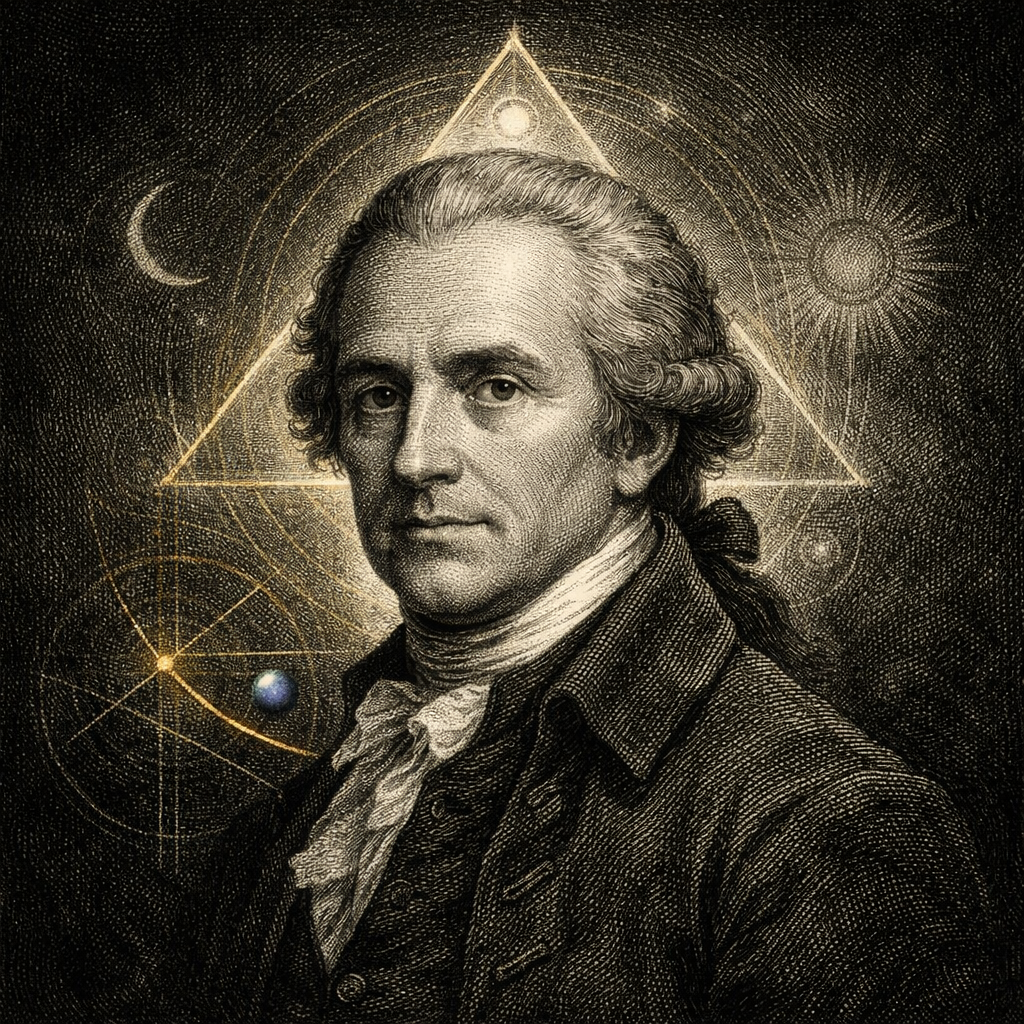
Date range: 1742–1818
Brief Biography
William Preston was a Scottish-born author, lecturer, and Freemason whose writings did much to systematise and popularise eighteenth-century speculative Masonry. Born in Edinburgh and later active in London, he began his career as a printer and man of letters before becoming deeply involved in Masonic life during a period when the Craft was consolidating its rituals, lectures, and public identity. Preston’s great contribution lay in giving Freemasonry a more coherent intellectual and educational form, presenting it not simply as a convivial fraternity or inherited set of customs, but as a structured moral and symbolic system grounded in history, architecture, virtue, and enlightened improvement. His Illustrations of Masonry became one of the most influential books in the English-speaking Masonic world. He died in London in 1818, having helped shape the language through which later Masonry understood itself.
Works and Texts
- The Constitutions of the Free-Masons
- Illustrations of Masonry
- Theatrum Chemicum Britannicum
Place in the Western Esoteric Tradition
Preston occupies an important place in the Western Esoteric Tradition because he helped articulate speculative Freemasonry as a symbolic and initiatory system rather than a mere social association. Drawing upon the inherited mythology of operative guilds, the Rosicrucian and Hermetic atmosphere surrounding learned Masonry, and the broader Christian and moral culture of the eighteenth century, he gave the Craft an educational and interpretive structure that would prove highly durable. His work helped make Masonic symbolism legible as a language of self-cultivation, sacred history, and progressive instruction. In this way, he stands at a formative point between earlier symbolic and esoteric currents and later developments in high-degree Masonry, Christian theosophy, and occult revivalism.
Preston’s Mystical System
William Preston’s mystical system is best understood as a symbolic pedagogy of Freemasonry. He was not a visionary theosopher, an alchemist, or a ritual magician in the more flamboyant styles later associated with Western esotericism. His significance lies elsewhere: in the way he presented Masonry as an ordered school of moral, intellectual, and symbolic formation. For Preston, the lodge was not only a place of fellowship or charitable association. It was a disciplined environment in which the candidate encountered a graduated course of instruction designed to refine conduct, cultivate understanding, and awaken reverence for the order of the universe.
At the centre of his system stands the conviction that Masonic forms are meaningful. Ceremonies, emblems, words, and offices are not arbitrary survivals from an obscure past. They carry moral and philosophical instruction. Preston helped transform the understanding of Masonic ritual from a sequence to be memorised into a body of teaching to be interpreted. This move was crucial. It encouraged Masons to see the Craft as a coherent symbolic language through which architecture, geometry, sacred history, and ethical discipline could be brought into relation.
His emphasis on lectures reveals this educational character. Preston is often associated with the elaboration of Masonic lectures as systematic explanations of the degrees. These lectures did more than gloss ritual details. They organised the material into a progressive scheme of knowledge. The apprentice, fellow craft, and master mason were not merely ranks within an association; they marked stages in a moral and intellectual ascent. Each degree disclosed a broader horizon of meaning, linking practical symbols to wider reflections on virtue, order, and human destiny. Preston’s achievement was to make this progression clearer, more elegant, and more teachable.
The symbolic centre of his Masonic thought is architecture. Like many interpreters of speculative Masonry, Preston treated the builder’s art as both historical inheritance and moral allegory. The tools of the craft became instruments of ethical instruction; the lodge became an image of ordered society; the temple became a figure for the human soul, the moral life, and the work of civilisation. This architectural symbolism is important because it anchors the spiritual dimension of Preston’s system in discipline and construction rather than ecstasy. The Mason is not invited to dissolve into mystical rapture. He is invited to build: to square his conduct, regulate his passions, and participate in a form of inward and social order.
Geometry also plays a notable role in this framework. In eighteenth-century Masonic discourse, geometry was not simply a technical science. It represented proportion, intelligibility, and the rational beauty of creation. Preston’s treatment of Masonry belongs to this older habit of mind in which the mathematical and the moral could still speak to one another. The world is ordered, and that order may be read symbolically. Masonic study becomes a way of aligning the individual with a larger harmony. This does not amount to an occult cosmology in the stronger Hermetic sense, yet it gives his system a contemplative dimension. To reflect on the lodge, the temple, and the science of building is to meditate on order itself.
Preston also strengthened the historical imagination of the Craft. His writings place Masonry within a narrative stretching back through sacred and civil antiquity, connecting the fraternity to ancient wisdom, temple building, and the transmission of useful and moral knowledge. Such historical claims were often more imaginative than evidential, as eighteenth-century Masonic historiography could be gloriously optimistic on that point. Yet their importance lies not simply in factual precision. They gave Masonry a sacred and civil genealogy, allowing members to see themselves as participants in an inherited tradition of moral architecture and enlightened sociability.
This historical vision helped bind together several strands that would matter for later esoteric reception. Operative legend, biblical memory, Renaissance symbolic thought, and polite Enlightenment moralism were not kept in separate rooms. Preston allowed them to meet within a single Masonic discourse. The result was a form of speculative Masonry capacious enough to accommodate both sober moral improvement and more expansive symbolic interpretation. Later high-degree systems, Christian theosophical readings, and occult revivalists would all find something usable in this world, because Preston helped stabilise the idea that Masonic forms bear layered meaning.
A further feature of his system is its concern with decorum and order in lodge life. Ritual precision, disciplined conduct, and proper instruction mattered because the lodge was meant to embody the very harmony it taught. Symbolism without order would become sentiment; sociability without instruction would become mere club life. Preston’s model of Masonry therefore joins fraternity to formality. The lodge is a miniature polity governed by rules, symbols, hierarchy, and mutual obligations. That structure was not incidental. It was itself part of the teaching.
If Preston has a mystical element, it lies in this doctrine of symbolic ascent through ordered participation. Human beings are improved by inhabiting forms that discipline memory, imagination, and conduct. Symbols work gradually. Repetition, lecture, ceremony, and shared tradition shape the inner life. The Mason becomes receptive to meanings that exceed the literal performance of the rite. In this sense Preston’s system is initiatory in the classical Masonic way: inward change occurs through outward form, and moral architecture becomes a mode of self-construction.
His influence on later developments is considerable. By codifying and dignifying Masonic instruction, he helped prepare the soil for richer symbolic interpretations of the Craft in high-degree Masonry and later esoteric currents. Thinkers drawn to Christian theosophy, illuminism, and the occult revival could encounter in Preston a Freemasonry already presented as a serious symbolic discipline. He did not create those later movements, but he gave them a more ordered Craft inheritance to work upon.
Preston’s mystical system, then, is a system of Masonic cultivation. It unites ritual, lecture, history, architecture, geometry, and moral instruction in a graded course of formation. Its ambition is not to disclose hidden worlds in a sensational manner, but to form character through symbol and order. That may sound modest beside later esoteric extravagances, but it proved remarkably durable. Preston helped teach Freemasonry how to explain itself, and in doing so he shaped the imaginative possibilities of the Craft for generations.
Antecedent Figures
- Giordano Bruno
- Giovanni Pico della Mirandola
- Heinrich Cornelius Agrippa
- Johann Valentin Andreae
- Johannes Reuchlin
- King Athelstan (Legendary)
- Marsilio Ficino
- Michael Maier
- Robert Fludd
Antecedent Traditions
- Rosicrucianism
- Operative Masonic Guilds
- Renaissance Christian Kabbalah & Hermetic Magic
Succeeding Figures
- Andrew Michael Ramsay
- Emanuel Swedenborg
- Jacob Boehme
- Jean-Baptiste Willermoz
- Louis-Claude de Saint-Martin
- Martinez de Pasqually
- Papus (Gérard Encausse)
- Éliphas Lévi
Succeeding Traditions
- High-Degree Masonry
- Illuminism & Christian Theosophy
- Occult Revival & Ritual Magic