Was the World Ever Really Enchanted?

There is a familiar account of what happened to the world. Once, the stars spoke, places possessed their own presences, and the events of ordinary life belonged to a larger order. Then scientific explanation gradually displaced these relationships, leaving us better informed but less at home. Those drawn to the esoteric traditions may recognise something of their own dissatisfaction in this account. It offers both an explanation of what feels absent and somewhere to look for its recovery.
Yet an enchanted world might have been a difficult place to live. Invisible powers could threaten as readily as protect, and a universe full of meaning could supply disturbing explanations for personal misfortune. Before we decide what we have lost, we should consider what we imagine our predecessors possessed.

A world alive with meaning
Part of the difficulty lies in the word enchanted. We use it to describe experiences that need not have much in common. Belief in spirits, an understanding of nature through correspondences, and the feeling of wonder before a landscape can all qualify. But someone may believe firmly in malevolent spirits while finding little comfort in the world, just as someone who accepts a physical account of the universe may experience considerable wonder within it.
The historical idea of disenchantment is more specific than the everyday sense of having lost our delight. In his lecture Science as a Vocation, delivered in 1917 and published in 1919, Max Weber associated disenchantment with the conviction that events could, in principle, be understood through calculation. This did not mean that everyone understood the machinery surrounding them. It meant that one could expect an explanation without having to invoke mysterious powers. The passenger need not understand how the tram works to assume that its operation is explicable.
Weber’s larger argument is more complicated than the familiar story of science extinguishing belief. Nevertheless, that story has become one way of interpreting the distance between ourselves and earlier societies. We imagine their world as spiritually inhabited and ours as increasingly available for measurement and use.
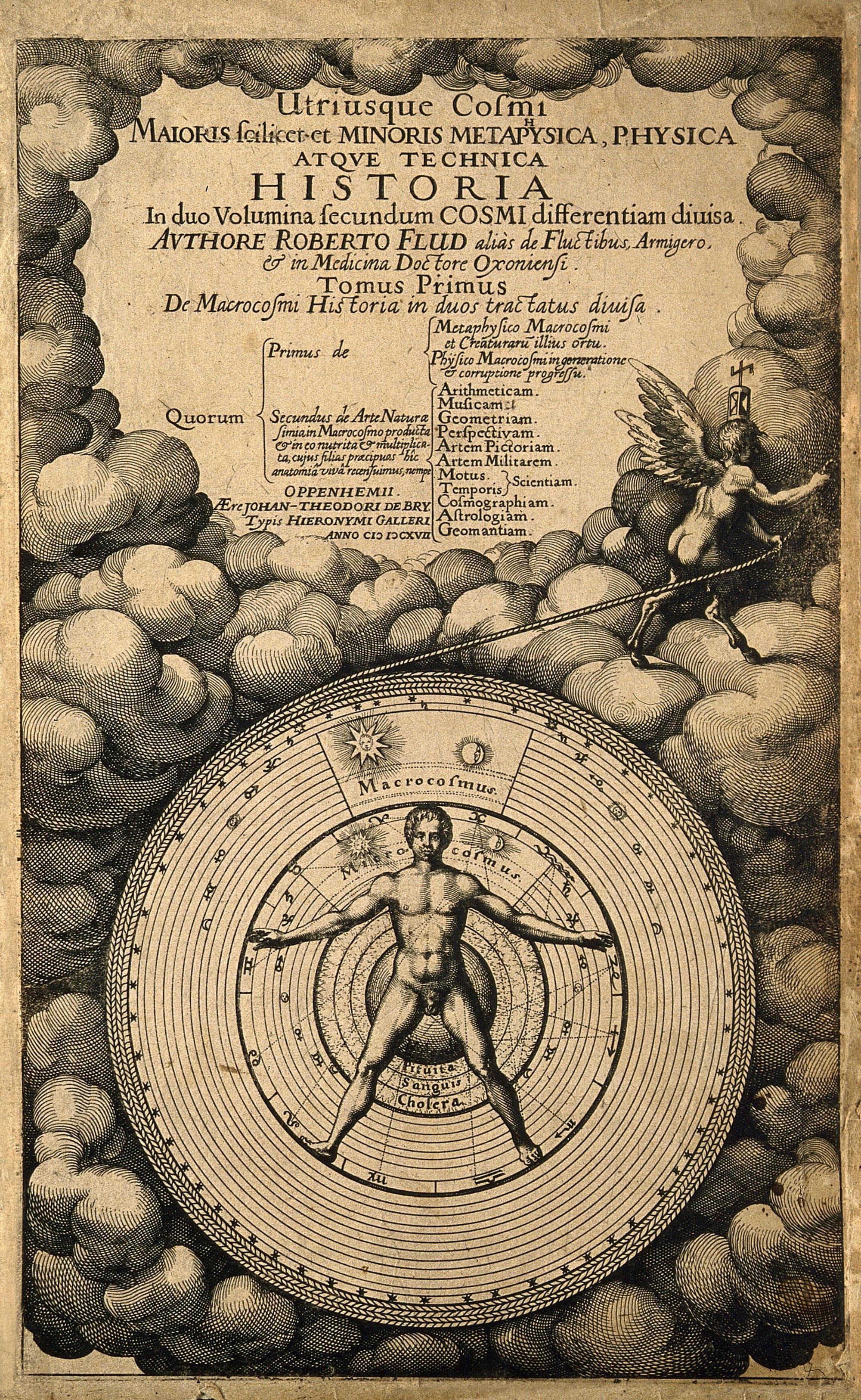
A work such as Robert Fludd’s Utriusque cosmi … historia, issued in parts from 1617, helps explain the attraction. Its elaborate engravings bring the human being into relation with an ordered cosmos. The correspondence between microcosm and macrocosm places human existence within a structure extending beyond the individual. To a reader accustomed to separating physical explanation from spiritual significance, such images can suggest an enviable coherence.
But an engraving shows how an author wished to explain the world. It cannot tell us how consistently his contemporaries experienced it that way. Fludd’s synthesis required considerable intellectual labour; its very elaboration should make us cautious about treating it as the unspoken outlook of an entire age.
Living with invisible powers
A less imposing object brings us closer to the practical demands of an inhabited universe. Seventeenth-century witch bottles were vessels prepared as remedies or protection against witchcraft. Surviving examples and contemporary descriptions associate them with such ingredients as urine, pins, nails and nail clippings. Archaeologists study their contents and places of concealment to understand how these practices operated within households and communities.
Joseph Blagrave’s Astrological Practice of Physick (1671), for example, describes sealing a patient’s urine in a bottle with sharp objects and salt. The procedure was supposed to torment the witch responsible for the illness. Here, an unseen connection between people could account for suffering and provide a means of answering it.
There is ingenuity in this response, and an understandable desire to do something when illness resists explanation or treatment. There is also fear. The person preparing the bottle inhabited a world in which another human being might cause bodily harm through hidden means. What appears to us as an intriguing survival of folk practice may have belonged to an anxious effort to make a household safe.
This does not establish that people in earlier societies lived in perpetual terror. A bottle cannot provide that kind of access to its owner’s emotional life. It does, however, complicate the assumption that invisible relationships necessarily made existence more reassuring. The same connections that promised assistance could expose a person to attack.
Nor should we suppose that everyone accepted the same explanation. The existence of a protective practice establishes that somebody considered it worth performing. It does not establish universal belief, complete confidence or agreement about how it worked. We should allow historical people the uncertainty and inconsistency we readily recognise in ourselves.

The distinction matters when we approach esoteric texts. Their accounts of harmony and participation are often deliberate achievements of thought and practice. Reading them as evidence of a lost, universally shared consciousness obscures the particular people who constructed, defended and sometimes disputed them.
A modern world with spirits in it
The other difficulty with the familiar account is that magic failed to disappear on schedule.
The physicist Oliver Lodge offers a revealing example. His work on electrical phenomena and wireless communication belonged to the development of modern technological society. His investigations of spiritualism and survival after death occupied him alongside those scientific concerns. The University of Liverpool’s archive records his substantial continuing output on psychical research and questions of life and mind.
For Lodge, these interests could form parts of a connected inquiry. His understanding of the ether helped shape an account of the relationship between physical existence and spiritual life. Psychical research appeared to offer an extension of investigation into questions that established physics had not settled. His conclusions remain open to criticism; the historical point is that scientific modernity and the search for spirits could inhabit the same intellectual project.
Lodge alone cannot settle a question about an entire society. He does make it harder to imagine modern history as a straightforward exchange in which scientific knowledge increases while engagement with invisible agencies diminishes.
Jason Ā. Josephson-Storm develops a broader challenge in The Myth of Disenchantment (2017). He examines how accounts of a disenchanted modern world emerged amid continuing occult and spiritualist activity, including within the intellectual environments that helped establish the human sciences. The claim that modern people had left magic behind was itself being made in a world where magic remained conspicuously present.
This does not require us to deny changes in religious authority, education or the public standing of particular beliefs. It asks us to describe those changes more carefully. A practice can lose institutional approval without disappearing. An explanation can become embarrassing in one setting and persuasive in another. People can also employ different explanations according to the problem before them, without resolving every contradiction between them.
The notion of a thoroughly disenchanted society may therefore tell us something about how that society presents itself, as well as what its members believe.
What are we hoping to recover?
There is still a substantial experience behind the longing for enchantment. A person may feel that the explanations available to them leave important aspects of life unaddressed. Knowing how an event occurred does not necessarily settle its personal significance. Understanding the physical properties of a place does not exhaust a relationship formed through memory, ritual or prolonged attention.
It would be careless to treat that dissatisfaction as evidence that earlier people possessed what we lack. It deserves more precise consideration. Someone seeking reassurance that consciousness survives death is asking a different question from someone who wants a less instrumental relationship with the natural world. A ritual calendar, a philosophical cosmology and a claim about spirits offer different possibilities, with different demands upon belief.
The esoteric traditions become more interesting when we preserve these distinctions. Fludd’s engravings can be studied as attempts to make human and cosmic relationships intelligible. Protective objects can disclose how people responded to vulnerability. Lodge can help us understand an effort to extend scientific inquiry towards religious questions. Their differences give us more to consider than a collective label of enchantment would allow.
We may find something valuable in these encounters without accepting every explanation they contain. We may also discover that what attracts us is quite specific: the discipline of observing a place, the recurring obligations of a ritual year, or an account of human life that extends beyond individual preference.
The past supplies abundant examples of people trying to live meaningfully within a world they could only partly understand. Their efforts were varied, sometimes compelling and sometimes troubling. We can learn from them more readily once we cease to imagine that they had already solved the problem.
References and further reading
Blagrave, Joseph. Blagrave’s Astrological Practice of Physick. London, 1671. A contemporary source for the use of witch bottles in treating illnesses attributed to witchcraft.
Fludd, Robert. Utriusque cosmi maioris scilicet et minoris metaphysica, physica atque technica historia. Oppenheim: Johann Theodor de Bry, 1617–1621. Fludd’s illustrated account of the greater world of the cosmos and the lesser world of the human being.
Josephson-Storm, Jason Ā. The Myth of Disenchantment: Magic, Modernity, and the Birth of the Human Sciences. Chicago: University of Chicago Press, 2017. A substantial challenge to the claim that modernity brought about the disappearance of magic.
Lodge, Oliver. Raymond, or Life and Death: With Examples of the Evidence for Survival of Memory and Affection after Death. London: Methuen, 1916. A primary source for Lodge’s attempts to reconcile scientific investigation with belief in survival after death.
MOLA (Museum of London Archaeology). “‘Witch Bottles’ Concealed and Revealed.” An archaeological research project examining the vessels, their contents and their historical uses.
Weber, Max. “Science as a Vocation.” In From Max Weber: Essays in Sociology, translated and edited by H. H. Gerth and C. Wright Mills, 129–156. New York: Oxford University Press, 1946. Originally delivered in 1917 and published in 1919; a central statement of Weber’s account of intellectualisation and disenchantment.
Illustration credit: Robert Fludd, The Microcosm (Man) and the Macrocosm (the World), engraving, 1617. Wellcome Collection, reference 2989i. Public Domain Mark.