Traditionalist School
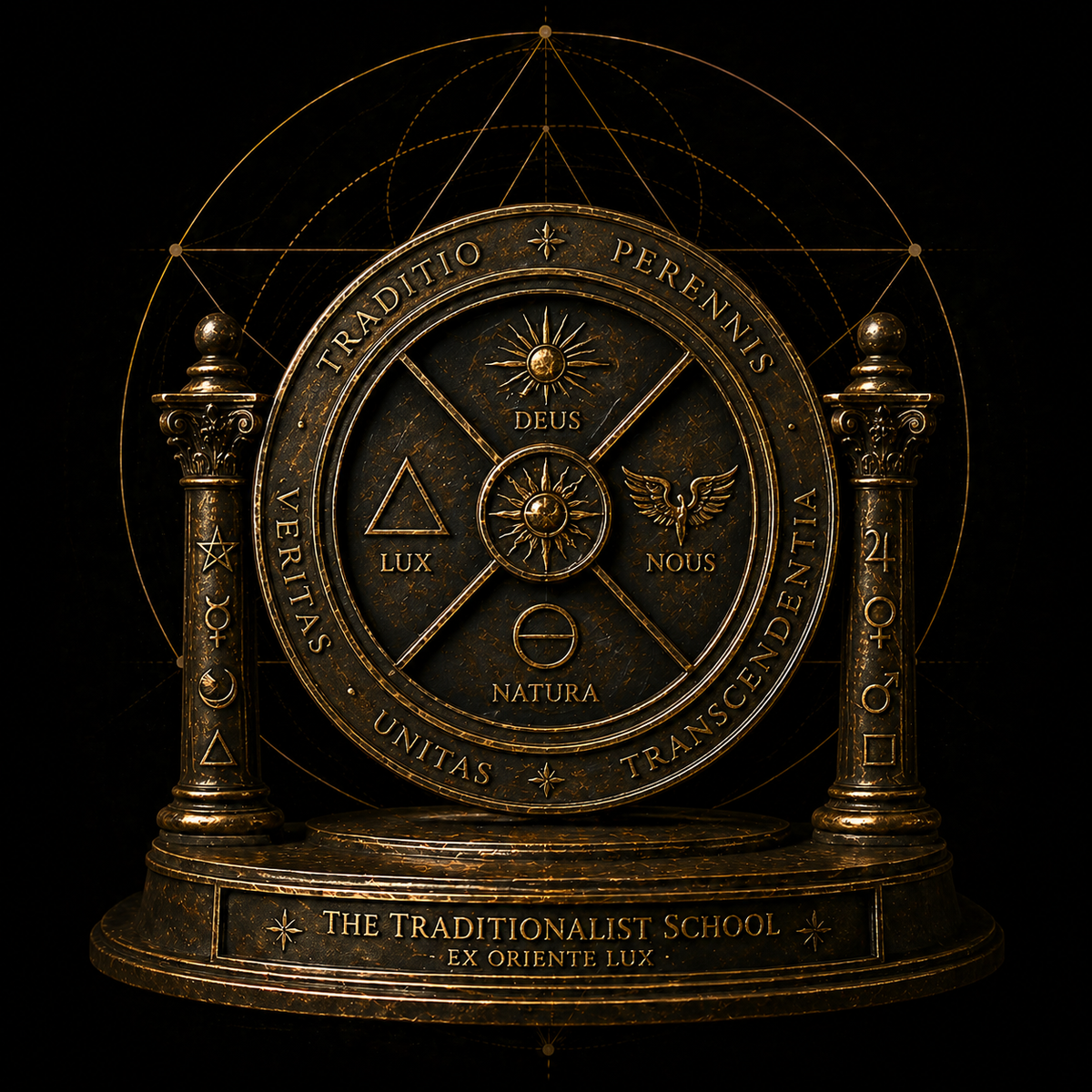
The Traditionalist School, sometimes called Perennialism, is one of the most intellectually rigorous and uncompromising currents to emerge from the wider field of modern esoteric and comparative religious thought. Associated above all with René Guénon, Ananda K. Coomaraswamy, Frithjof Schuon, and later writers such as Titus Burckhardt, Martin Lings, and Seyyed Hossein Nasr, it developed as a severe critique of modernity and a defence of what it understood as primordial metaphysical truth. Traditionalism does not present itself as a new religion, an occult order, or a syncretic spirituality. It claims instead to identify the transcendent unity underlying the great orthodox religious traditions of humanity.
The immediate antecedent of the Traditionalist School in this genealogy is the Theosophical Society. This relationship is real but complicated. Theosophy helped popularise the idea that the world’s religions contain expressions of an ancient wisdom tradition. It also encouraged comparative religious study, the language of spiritual evolution, and the search for esoteric doctrine behind exoteric forms. Traditionalism inherited the premise that there is a perennial wisdom underlying religious diversity, but it rejected much of the Theosophical method and temperament. Where Theosophy tended toward occult synthesis, spiritual evolutionism, hidden masters, and speculative cosmology, Traditionalism demanded metaphysical precision, religious orthodoxy, initiatory legitimacy, and fidelity to received forms. It took the modern appetite for universal wisdom and disciplined it with a stick, because apparently someone had to.
René Guénon was the foundational figure of the movement. His early life included contact with occultist, Masonic, and Theosophical circles in France, but he became increasingly critical of modern occultism. In works such as The Crisis of the Modern World, The Reign of Quantity and the Signs of the Times, and Introduction to the Study of the Hindu Doctrines, Guénon argued that modern civilisation represented a catastrophic departure from traditional metaphysical principles. For him, modernity was characterised by materialism, individualism, sentimentalism, rationalism, secularism, and the loss of authentic intellectual intuition. The modern world had inverted the proper order of reality by placing quantity above quality, matter above spirit, and human opinion above transcendent truth.
Central to Traditionalist thought is the distinction between Tradition and traditions. Tradition, with a capital T, refers to the primordial and transcendent truth that originates beyond human invention. Particular religious traditions are historical expressions of this truth, shaped by revelation, symbol, doctrine, ritual, and sacred law. Traditionalists therefore do not usually advocate a vague blending of religions. On the contrary, they insist that authentic spiritual life requires adherence to a revealed and orthodox tradition. The universal is reached through the particular, not by assembling attractive fragments from everywhere like a spiritual charcuterie board.
This point marks a major difference between Traditionalism and much modern esotericism. Theosophy and later New Age currents often treated religions as reservoirs of symbols and practices that could be comparatively synthesised. Traditionalism, by contrast, argues that sacred forms are not arbitrary containers. They are divinely authorised vehicles of realisation. To detach doctrines, rituals, or symbols from their traditional contexts is to risk reducing them to psychological, aesthetic, or occult curiosities. For the Traditionalist, the sacred is transmitted through form, not despite it. Orthodoxy, ritual, language, art, and lineage matter because they participate in the order they disclose.
Traditionalist metaphysics is strongly hierarchical. Reality is understood as descending from the Absolute through levels of manifestation, with the material world representing the most external and least real mode of being. Human beings, in this view, possess not merely rational faculties but an intellect capable, in principle, of direct knowledge of metaphysical truth. This “intellect” is not the discursive mind or clever analysis. It is a supra-rational faculty of spiritual discernment. The goal of the contemplative life is therefore not belief alone, nor moral improvement alone, but the realisation of truth through the restoration of the human being’s orientation toward the Absolute.
Symbolism plays a central role in Traditionalist thought. Traditionalists regard sacred symbols not as human inventions or decorative metaphors but as objective expressions of metaphysical realities. Architecture, ritual gesture, sacred art, myth, number, geometry, liturgy, and cosmology all reveal aspects of the divine order when properly understood. This makes Traditionalism deeply relevant to the study of Western esotericism, even when Traditionalists themselves were often hostile to modern occultism. Their works on symbolism, sacred art, initiation, and metaphysics have profoundly influenced later scholars, esotericists, architects, artists, and religious thinkers.
Ananda Coomaraswamy extended Traditionalist ideas through his extraordinary work on Indian art, symbolism, metaphysics, and comparative religion. He argued that traditional art was not primarily self-expression but the embodiment of metaphysical principles. Sacred art existed to reveal truth, not to advertise the artist’s personality. This was a direct challenge to modern aesthetic individualism. For Coomaraswamy, the craftsman in a traditional civilisation participated in a sacred order. Art, labour, ritual, and knowledge were integrated. Modernity shattered that integration and replaced it with museums, markets, and lonely geniuses having opinions in public.
Frithjof Schuon gave the Traditionalist School a more explicitly spiritual and universalist form. His writings emphasised the transcendent unity of religions, the distinction between esoterism and exoterism, the role of beauty, prayer, virtue, and metaphysical discernment. Schuon argued that the great religions differ in their forms but converge at the level of esoteric truth. Yet he also insisted that genuine spiritual realisation requires commitment to a particular revealed path. The unity of religions is therefore not a lowest-common-denominator sameness but a unity at the summit, accessible through disciplined fidelity rather than casual comparison.
Traditionalism’s relationship with initiation is also significant. Guénon, in particular, distinguished sharply between authentic initiation and pseudo-initiation. He argued that real initiation requires transmission from a legitimate traditional source and cannot be invented by modern occult groups. This critique was aimed directly at many Western esoteric societies, including those that claimed ancient authority without verifiable continuity. For Guénon, initiation was not symbolic theatre or personal inspiration. It was the transmission of a spiritual influence through a valid chain. This position has made Traditionalism both attractive and irritating to occultists, which is not the worst sign that it has struck a nerve.
The School’s critique of modernity is one of its most enduring and controversial features. Traditionalists argue that the modern world is not merely technologically advanced but spiritually disordered. Its confidence in progress, equality, individual autonomy, industrial production, and scientific reductionism is, from their perspective, a symptom of decline. This critique can be powerful, especially in its analysis of desacralisation, fragmentation, and the loss of symbolic consciousness. It can also become rigid, nostalgic, anti-modern to excess, or politically troubling when applied without discernment. Traditionalist thought must therefore be handled with care. It offers profound metaphysical criticism, but it does not automatically solve the historical and ethical complexities of modern life.
For the history of Western esotericism, the Traditionalist School matters because it represents a disciplined counter-movement within the broader modern search for hidden wisdom. It inherited from Theosophy the idea of a universal wisdom underlying religions, but rejected Theosophy’s eclecticism, occult progressivism, and loose synthesis. It demanded metaphysical exactness, traditional authority, and the recovery of sacred form. Its influence extends into comparative religion, Islamic studies, art history, architecture, symbolism, ecology, and contemporary spiritual thought.
The Traditionalist School has no mapped succeeding tradition here, but its intellectual afterlife is substantial. It has shaped scholars of religion, esoteric interpreters, religious converts, artists, and critics of modern secular culture. Its importance lies not in founding a mass movement, but in articulating one of the most forceful modern arguments for sacred order, metaphysical hierarchy, and the enduring validity of revealed traditions. In a world increasingly tempted to treat religion as psychology, culture, identity, or lifestyle, Traditionalism insists that tradition is not a human construction alone. It is, at its deepest level, the trace of the Real within history.
Antecedent Traditions
· Theosophical Society
Succeeding Traditions
· None mapped