Thoth (Hermes-Thoth)
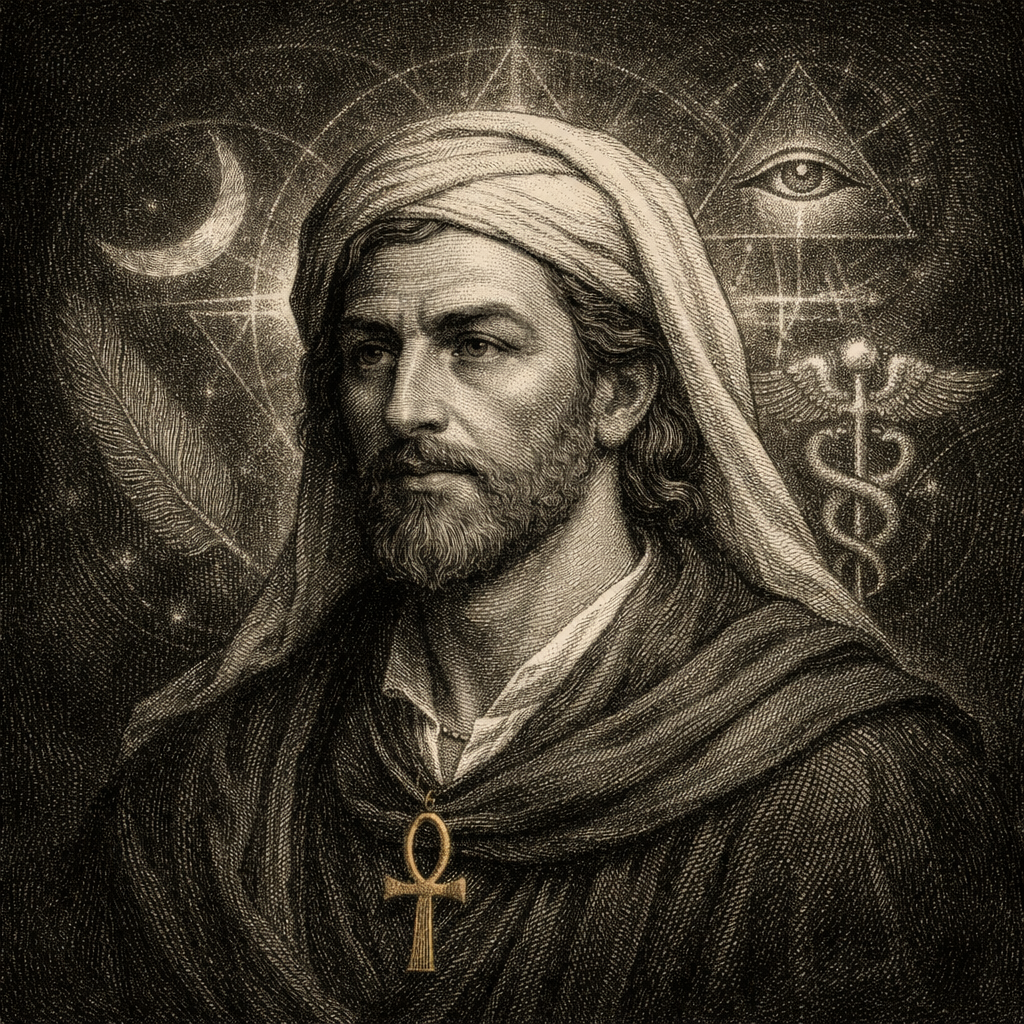
Date range: Attested from the Old Kingdom, c. 24th century BCE; worship continuing into the Greco-Roman period
Brief Biography
Thoth was one of the major deities of ancient Egypt, associated with writing, wisdom, measurement, ritual speech, the moon, calculation, divine record-keeping, and the maintenance of cosmic order. Often represented as an ibis-headed man or as a baboon, he appears in Egyptian religious literature as a scribe of the gods, a mediator in divine disputes, a master of sacred words, and a guardian of knowledge. In funerary contexts he records the judgement of the dead and participates in the ordered passage of the soul through the afterlife. In the Hellenistic and Roman periods, Thoth was identified with the Greek Hermes, producing the composite figure Hermes-Thoth and, eventually, the literary and symbolic persona of Hermes Trismegistus. Through this transformation, Egyptian sacred wisdom entered the long afterlife of Hermeticism, becoming central to late antique and Renaissance imaginings of primordial theology.
Works and Texts
- The Pyramid Texts
- The Book of the Dead
Place in the Western Esoteric Tradition
Thoth stands near the mythic and symbolic prehistory of the Western Esoteric Tradition, less as a historical teacher than as a divine archetype of sacred knowledge, writing, calculation, and revealed wisdom. His later identification with Hermes created one of the most influential acts of religious translation in the ancient Mediterranean, allowing Egyptian priestly authority and Greek philosophical symbolism to converge in the figure of Hermes Trismegistus. The succeeding traditions of late antique Hermeticism and Gnosticism drew deeply upon this imagined Egyptian antiquity, treating sacred speech, divine writing, cosmological knowledge, and the ascent of the soul as mysteries preserved from a primordial age. In Thoth, wisdom is not merely thought; it is inscription, measure, ritual utterance, and the ordering intelligence by which cosmos and soul are kept intelligible.
Thoth’s Mystical System
Thoth’s mystical system is not a system in the later philosophical sense. It is a constellation of sacred functions centred on knowledge, language, measure, and cosmic order. He is the divine scribe, the lord of hieroglyphs, the measurer of time, the reckoner of truth, and the one whose words possess formative power. To treat Thoth as though he had composed a tidy doctrinal manual would be to mistake mythic theology for office paperwork, which, admittedly, is precisely the sort of mistake human beings have been perfecting since the invention of filing cabinets. His significance lies in the way Egyptian religion imagined knowledge itself as sacred, operative, and woven into the structure of the cosmos.
In Egyptian thought, the universe is maintained through ma’at: order, truth, balance, justice, and right relation. Thoth is one of the divine powers most closely connected with this principle. He records, measures, calculates, adjudicates, and speaks in ways that restore order against disorder. His knowledge is therefore not abstract accumulation. It is functional wisdom, the capacity to discern, name, regulate, and stabilise reality. The cosmos is not sustained by force alone, but by correct relation, correct word, and correct measure. Thoth embodies this intellectual and ritual dimension of divine order.
His association with writing is especially important. In Egypt, writing was not merely a convenient administrative technology, though naturally it also enabled bureaucracy, because apparently even sacred civilisation requires forms in triplicate. Hieroglyphic writing carried religious power. Signs could preserve names, make offerings effective, protect the dead, and participate in the realities they represented. Thoth, as patron of scribes and lord of sacred script, stands at the centre of this world of operative inscription. The written word could endure beyond death, carry ritual efficacy, and make invisible powers present. Later Hermetic traditions would inherit this sense that sacred language is not decorative, but transformative.
This gives Thoth a close connection to magic understood as ritualised speech and knowledge. Egyptian ritual depended upon precise names, formulae, gestures, and mythic identifications. To know the correct words was to participate in the order by which divine powers acted. Thoth often appears as the master of such words, a figure whose speech heals, protects, calculates, and restores. He is invoked in relation to the eye of Horus, the pacification of conflict, and the restoration of wholeness after divine injury or disorder. Speech, in this world, is a technology of cosmic repair.
Thoth’s lunar character adds another layer to his symbolism. As a moon god, he is connected with cycles, measurement, time, renewal, and reflection. The moon regulates calendars, marks ritual time, and mediates light in darkness. This lunar role complements his scribal function. To measure time is to make change intelligible; to record events is to place them within an ordered sequence. Thoth governs not the blazing immediacy of solar kingship, but the reflective, periodic, calculating intelligence that makes continuity possible. His wisdom is cool, precise, rhythmic, and observant.
In funerary religion, Thoth’s role becomes especially vivid. In the judgement of the dead, he records the result of the weighing of the heart against the feather of ma’at. This is more than a mythic courtroom scene. It expresses the conviction that the moral and spiritual life of the human being is legible within the order of truth. The heart cannot simply declare itself righteous and hope the universe is too polite to check. Thoth writes the outcome because the soul’s condition is a matter of cosmic record. In this function, he links writing, judgement, truth, and afterlife destiny.
The texts associated with Egyptian funerary religion reinforce this worldview. The Pyramid Texts and later funerary compositions preserve spells, utterances, and ritual knowledge intended to guide, protect, and transform the deceased. These texts do not present death as mere extinction. They imagine a perilous and ordered passage in which knowledge, names, formulae, and divine assistance are essential. Thoth’s presence in this larger religious field marks him as a guardian of transitions: from disorder to order, ignorance to knowledge, mortality to justified existence, and silence to effective speech.
The later identification of Thoth with Hermes changed the history of esotericism. Greek observers, encountering Egyptian religion through their own interpretive categories, recognised in Thoth a divine analogue to Hermes: messenger, mediator, inventor, guide, and patron of cunning intelligence. The result was Hermes-Thoth, and from this syncretic figure emerged the imagined author of Hermetic revelation, Hermes Trismegistus. This was not a simple borrowing of Egyptian doctrine into Greek philosophy. It was a creative translation, a religious and intellectual fusion in which Egyptian antiquity, Greek philosophical language, astrology, alchemy, and spiritual ascent gradually converged.
Through Hermes Trismegistus, Thoth became retroactively transformed into a source of primordial wisdom. Late antique Hermetic texts present divine knowledge as revealed teaching concerning God, cosmos, mind, soul, and salvation. The authority of this teaching was strengthened by its association with Egypt, which Greek and later European writers imagined as an ancient repository of sacred science. The historical Thoth of Egyptian religion and the literary Hermes of Hermetic writings are not identical, but the link between them became immensely productive. It allowed later esoteric traditions to root themselves in an imagined chain of archaic revelation.
For Gnostic and Hermetic currents, the themes associated with Thoth became especially potent: sacred speech, hidden knowledge, cosmic structure, ascent after death, and the liberation of the soul through divine insight. The scribe of the gods became, through long transformation, the sage of sages. His Egyptian functions did not disappear; they were reinterpreted. Writing became revelation; measurement became cosmology; ritual speech became salvific instruction; the guide through divine judgement became a guide through the layered heavens.
Thoth’s mystical system is therefore best understood as a sacred economy of knowledge. Wisdom is measured, spoken, written, enacted, and judged. It orders the cosmos and accompanies the soul. It is at once intellectual and ritual, textual and magical, lunar and moral. Later Hermeticism would develop these themes into philosophical dialogues and initiatory cosmologies, but their deep symbolic ancestry lies in this Egyptian vision of divine intelligence as the power that names, records, balances, and restores. Thoth is the god of the word that works, the measure that orders, and the knowledge that survives death.
Antecedent Figures
- —
Antecedent Traditions
- —
Succeeding Figures
- Hermes Trismegistus
Succeeding Traditions
- Late Antique Hermeticism & Gnosticism