Thomas Aquinas
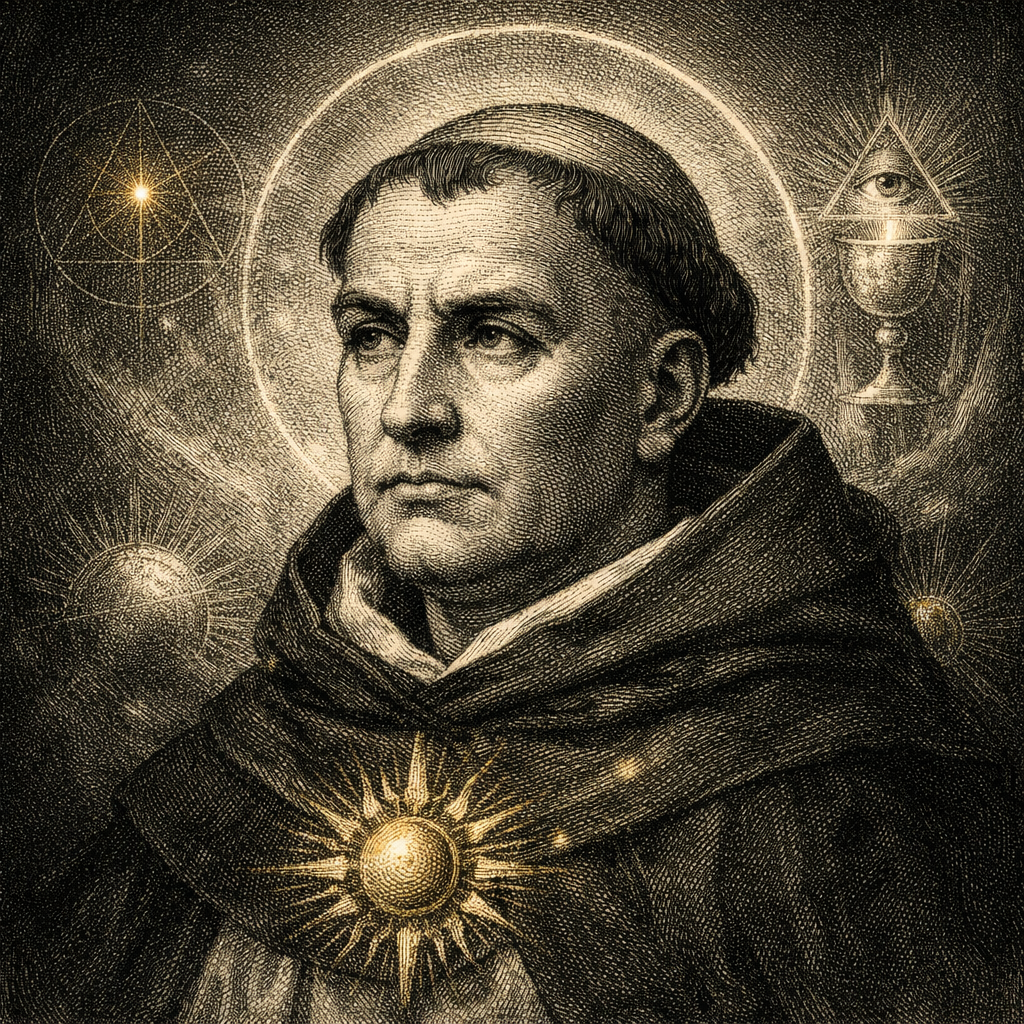
Date range: 1224/25–1274
Brief Biography
Thomas Aquinas was an Italian Dominican theologian and philosopher whose work became the most influential expression of medieval scholastic thought. Born near Aquino in the Kingdom of Sicily, he studied at Naples, entered the Dominican Order against family opposition, and later taught and wrote in the great university centres of Paris, Cologne, Rome, and Naples. Drawing deeply on Aristotle while remaining firmly within Christian theology, he developed a vast synthesis concerned with God, creation, causation, angels, human nature, ethics, law, and the destiny of the soul. His unfinished Summa Theologica became one of the great monuments of Western intellectual history. He died in 1274 on the way to the Second Council of Lyon.
Works and Texts
- Speculum Astronomiae
- Summa Theologica
Place in the Western Esoteric Tradition
Aquinas belongs to the Western Esoteric Tradition indirectly but importantly, because he helped define the metaphysical and theological framework within which later Christian esoteric thought would operate. His doctrines of participation, analogy, hierarchical causation, angelology, celestial influence, and the ordered intelligibility of creation gave later Renaissance thinkers a rigorous vocabulary for discussing hidden powers without dissolving the world into chaos or superstition. The Renaissance Christian Kabbalists and Hermetic philosophers who followed did not merely inherit Christian doctrine in the abstract; they inherited a world already articulated in terms of divine order, natural causality, and graduated being. Aquinas thus supplied part of the intellectual architecture later esoteric thinkers inhabited, revised, and occasionally pushed well beyond his own intentions.
Aquinas’s Mystical System
Thomas Aquinas’s mystical system is not mystical in the loose modern sense of private feeling, atmospheric symbolism, or ecstatic vagueness. It is a disciplined theology of participation, contemplation, and ultimate union with God, grounded in metaphysical clarity and sacramental order. Aquinas is often presented as the great champion of reason, and so he was, but this can mislead if reason is imagined as dry analysis severed from spiritual life. For Aquinas, the life of the intellect is ordered toward beatitude, and beatitude consists in the vision of God. Thought, prayer, virtue, grace, and contemplation all belong to one ordered path.
At the centre of his system stands God as pure act, simple, infinite, and the source of all being. Created things do not exist independently in some metaphysical freehold of their own. They participate in being, receiving existence from the first cause. This doctrine of participation is fundamental. It means that the world is real, ordered, and intelligible, but not self-sufficient. Everything in creation bears the mark of derivation. The many are sustained by the One, and every finite perfection points beyond itself to the plenitude of its cause. This gives Aquinas’s universe a vertical structure. Reality is not flat. It is graduated, and the degrees of being reflect degrees of actuality, perfection, and nearness to the divine source.
From this follows his doctrine of analogy. Human language about God is neither wholly univocal nor wholly equivocal. When one speaks of divine goodness, wisdom, or being, the words do not mean exactly what they mean when applied to creatures, yet they are not empty noises either. They signify according to analogy. This principle is more than a technical solution to a semantic problem. It governs the entire relation between visible and invisible reality. Creation reveals God truly, though never exhaustively. The world is therefore meaningful without being transparent. It can be read, but not mastered.
Aquinas’s cosmology is hierarchical and populated. He accepts a universe ordered through causes, forms, ends, and degrees of perfection. Angels occupy a major place in this order. They are pure intellectual substances, each a distinct species, mediating the richness of divine creation without sharing the material limitations of embodied beings. His angelology became especially important for later esoteric thought because it offered a coherent account of spiritual intelligences within a structured cosmos. If Renaissance thinkers later filled the heavens with correspondences, intelligences, and hidden influences, they did so in part within an inherited Christian universe already alive with graduated spiritual reality.
The same is true of celestial causation. Aquinas allowed that heavenly bodies exercise real influence within the natural order, particularly upon the physical world and upon the bodily conditions in which human life unfolds. At the same time, he insisted that the rational soul is not determined by the stars. This distinction proved enduring. It preserved the meaningfulness of astrology at a natural level while protecting moral agency and providence from astrological fatalism. One can see here why later Hermetic and magical thinkers found scholastic categories so useful. Aquinas helps draw the lines between lawful natural influence, illicit divination, and the freedom proper to rational creatures.
His doctrine of the human person is equally central. The human being is a unity of body and soul, not a soul trapped in a body as in some cruder dualisms. The intellect is capable of universal knowledge because it is ordered toward truth, and the will is ordered toward the good. Yet neither faculty reaches fulfilment by its own unaided power. Nature is good, intelligible, and purposeful, but grace perfects it. This formula is one of the keys to Aquinas’s mystical thought. The spiritual life is not an annihilation of nature. It is its elevation and fulfilment. The virtues prepare the person; grace heals and raises; contemplation directs the mind toward God.
Contemplation holds a high place in Aquinas’s system. The contemplative life is superior to the merely active life because it participates more directly in the intellect’s highest end: the knowledge of God. Yet Aquinas is not advocating escapist interiority. The contemplative life is not a mood, still less a theatrical posture of spiritual intensity. It is the disciplined ordering of the soul through virtue, study, prayer, and grace toward the divine truth. In this sense, his theology is mystical in the strongest classical manner. It is ordered to a union beyond discursiveness, though never against reason. The human person comes to perfection not by abandoning truth for experience, but by being transformed through truth into participation in divine life.
The culmination of this ascent is the beatific vision. No created intellect, Aquinas argues, can see the divine essence by its natural power. God must elevate the intellect by grace. In that vision the blessed know God immediately, not by created likeness or inferential reasoning. This is the true end of human existence. Everything in Aquinas’s system leads here: metaphysics, ethics, sacramental theology, Christology, and prayer. The final union is not absorption into an impersonal absolute, nor is it a merely moral relation maintained at respectable distance. It is a supernatural vision that perfects intellect and will in blessed communion.
Aquinas’s relation to later esotericism lies less in any occult teaching of his own than in the durability of his framework. He provided later thinkers with a language of hidden causation, formal structure, celestial order, spiritual hierarchy, and analogical relation. Even when Renaissance Christian Kabbalists and Hermetic philosophers departed from his caution, they often continued to work within conceptual forms he had helped stabilise. His distinction between lawful natural knowledge and superstition, his account of angels, his metaphysics of participation, and his theology of contemplation all helped make later speculation thinkable in Christian terms.
His mystical system, then, is a theology of ordered ascent. Creation proceeds from God, bears the trace of God, and returns to God. The human being is called to move through knowledge, virtue, grace, and contemplation toward the fulfilment of beatitude. Aquinas gives this movement neither the language of occult initiation nor the romance of hidden fraternities. He gives it something sterner and in many ways more durable: a metaphysics in which the whole universe is intelligible because it is created, and a spiritual doctrine in which the intellect’s highest act is transformed vision.
Antecedent Figures
- —
Antecedent Traditions
- —
Succeeding Figures
- Giordano Bruno
- Giovanni Pico della Mirandola
- Heinrich Cornelius Agrippa
- Johannes Reuchlin
- Marsilio Ficino
Succeeding Traditions
- Renaissance Christian Kabbalah & Hermetic Magic