The World as Analogy: How Esotericism Understands Reality
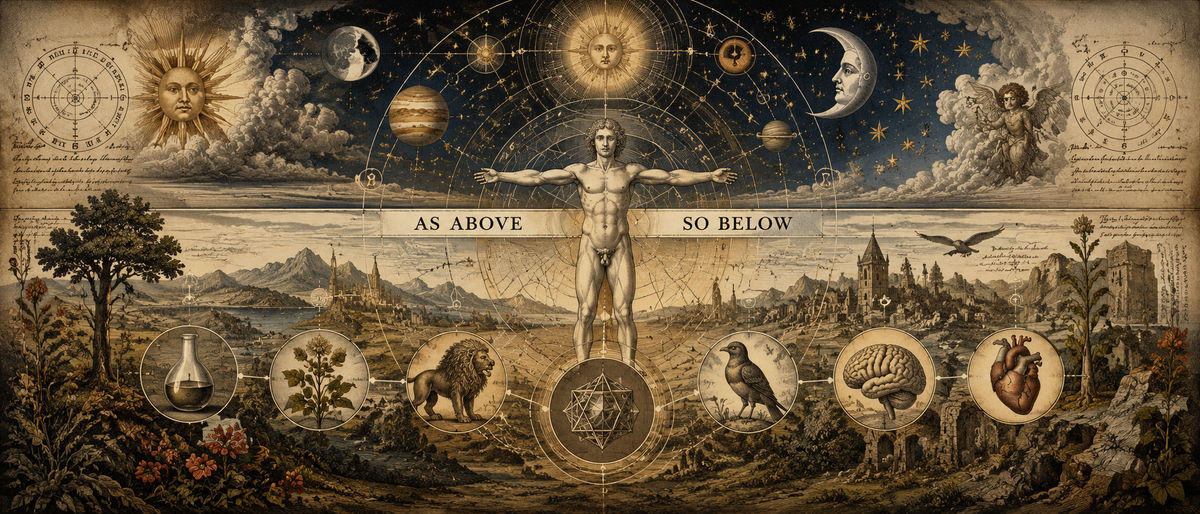
Few ideas are more fundamental to the Western esoteric tradition than the conviction that reality is structured through correspondences. From late antiquity through the Renaissance, and well into the early modern period, philosophers, theologians, physicians, alchemists, and natural philosophers assumed that the world was bound together by networks of meaningful relationships linking different orders of existence. What occurred in the heavens was reflected on earth; what appeared in nature disclosed spiritual truths; the structure of the human being echoed the structure of the cosmos. Correspondences were not regarded as decorative symbols or imaginative associations. They were understood as evidence of an underlying unity that made the universe intelligible.
Planets corresponded to metals. Colours corresponded to virtues. Parts of the human body corresponded to celestial influences. Sacred architecture mirrored cosmic order. The individual soul reflected the structure of the universe itself. Such relationships appear strange to modern sensibilities, but for much of Western history they formed part of a coherent intellectual framework through which reality itself was understood.
To the modern observer these associations often appear arbitrary, poetic, or merely decorative. They can resemble an elaborate symbolic game whose rules were invented and then endlessly elaborated. Yet for most of Western history correspondences were not regarded as metaphorical ornaments. They were understood as clues to the hidden structure of reality. They expressed a conviction that the world was woven together by meaningful relationships and that these relationships could be discovered, contemplated, and sometimes employed.
The doctrine of correspondences rests upon a simple proposition: reality is not composed of isolated entities. It is composed of interconnected levels of being which participate in a common order and therefore reflect one another through patterns of similarity and analogy.
Correspondences do not arise because different things merely resemble one another. They arise because apparently distinct things are understood to share a deeper ontological foundation. Similarity is therefore not accidental but revelatory. It discloses an underlying unity concealed beneath diversity. To recognise a correspondence is not simply to notice a likeness; it is to perceive evidence of participation in a reality more fundamental than the individual forms through which it manifests.
This conviction emerged from several currents of ancient thought. Platonic philosophy supplied the notion that visible things participate in higher and more perfect realities. Stoicism proposed a cosmos permeated by a rational principle that united all things within a living whole. Hermetic literature described the universe as a hierarchy in which every level echoed those above and below it. Although these traditions differed substantially, they converged upon a common intuition: the cosmos is an ordered unity whose parts mirror one another.
The most famous expression of this worldview appears in the Hermetic maxim, “As above, so below.” The phrase is often quoted but seldom examined carefully. In popular usage it has become a vague slogan suggesting that everything is somehow connected. Historically, however, it implied something far more precise. The lower reflects the higher because both emerge from the same underlying order. Similar patterns appear across different scales of existence because reality itself possesses an intrinsic coherence.
The language of microcosm and macrocosm emerged from this conviction. The macrocosm was the greater world: the universe in its totality. The microcosm was the smaller world contained within the human being. Human beings were not merely inhabitants of the cosmos; they were miniature expressions of it. The structures found in nature, society, and heaven were believed to be reflected within the soul.
This idea appears repeatedly throughout the history of Western thought. Ancient philosophers compared the harmony of the soul to the harmony of the cosmos. Medieval theologians described humanity as a nexus linking material and spiritual realities. Renaissance thinkers such as Marsilio Ficino and Giovanni Pico della Mirandola elaborated sophisticated accounts of humanity's mediating position within creation. To understand oneself was therefore, in a meaningful sense, to understand the universe.
Correspondences provided the mechanism through which such understanding became possible.
The modern mind often treats analogy as a weak form of reasoning. Analogies may illustrate an argument, but they do not establish truth. Within traditional cosmologies, however, analogy possessed a far more elevated status. It was considered one of the principal means by which the hidden architecture of reality could be apprehended.
To understand this requires setting aside a modern assumption: that meaningful relationships must be causal relationships. Contemporary thought generally asks whether one thing produces another. Pre-modern thought was often more interested in whether different things revealed the same underlying pattern. Analogy was therefore not opposed to knowledge; it was a mode of knowledge. It sought to discern formal relationships between apparently distinct domains of existence.
Analogy does not claim that two things are identical. Nor does it necessarily claim that one causes the other. Rather, it proposes that different things may participate in a common order. The movement of planets, the structure of a kingdom, the faculties of the soul, and the arrangement of sacred architecture might differ entirely in substance while expressing a similar underlying pattern. Discovering these parallels was not regarded as an exercise in imaginative association but as an act of intellectual perception.
The roots of this approach lie deep within the Platonic tradition. Plotinus argued that reality unfolds through a hierarchy of emanations proceeding from the One. Each level of existence reflects the level above it while expressing it according to its own nature. Similarities between different orders of reality therefore arise not because they directly influence one another, but because they share a common origin. The visible world becomes intelligible precisely because it bears traces of higher realities from which it derives.
Participation provided the metaphysical logic underpinning this vision. Lower realities participate in higher realities without becoming identical to them. A beautiful object participates in Beauty; a just action participates in Justice; the ordered structures of nature participate in the rational order of the cosmos. Correspondences therefore reveal more than resemblance. They reveal a shared participation in principles that transcend any individual manifestation.
From this perspective, analogy is not merely a comparison made by the observer. It reflects a relationship already present within reality itself. The philosopher does not invent correspondences; he discovers them.
This logic persisted throughout the medieval period and reached one of its most sophisticated expressions during the Renaissance. Nicholas of Cusa argued that finite things could never comprehend the infinite directly. Knowledge therefore proceeded through symbols, analogies, and approximations that disclosed aspects of truths transcending ordinary understanding. Correspondences were not arbitrary associations imposed upon reality; they were intellectual bridges linking different levels of being.
Even figures now remembered primarily as architects of modern science inhabited this analogical universe. Johannes Kepler sought mathematical laws governing planetary motion, yet he also understood the cosmos as an expression of divine harmony. His search for celestial order was informed by the conviction that the structures discovered in nature reflected deeper rational principles. The language of correspondence was not confined to magi and mystics. It permeated philosophy, theology, natural science, medicine, music, and cosmology.
Seen in this light, correspondences functioned less as causal explanations than as indicators of participation. The question was not simply what causes a thing, but what larger principle it embodies and through what order it participates in reality as a whole. The universe was understood as a hierarchy of reflections in which the same truths manifested at different scales and in different forms. To recognise an analogy was therefore to glimpse an underlying unity concealed beneath apparent diversity.
This mode of thought reached one of its most elaborate expressions during the Renaissance. Influenced by newly translated Platonic and Hermetic texts, scholars increasingly viewed nature as a symbolic book whose pages could be read. Similarities between things were not accidental. They revealed affinities established by the divine architecture of creation itself.
Here we encounter another important concept: sympathy.
In contemporary usage sympathy refers to emotional identification. Historically the term possessed a much broader meaning. A sympathy was an invisible affinity between different parts of reality. Things influenced one another because they participated in a shared pattern or principle. The cosmos was not conceived as a collection of separate objects but as an interconnected organism whose parts responded to one another.
Sympathy should not be confused with mechanical causation. A correspondential worldview assumed that entities sharing a common principle possessed a natural affinity. The relationship between them was not necessarily one of direct influence but of resonance. Things recognised one another, so to speak, because they participated in the same underlying order. The language is metaphorical, but the principle was treated as entirely real.
Paracelsus argued that healing required an understanding of these hidden relationships. Astrologers sought connections between celestial movements and terrestrial events. Alchemists interpreted transformations in matter as reflections of transformations within the soul. Across these disciplines the assumption remained remarkably consistent: similar things resonate because they derive from common principles.
Modern science would eventually reject many of the specific claims generated by this worldview. Yet it is worth recognising that correspondences emerged from a serious attempt to explain coherence rather than coincidence. They represented a search for order in a universe believed to be fundamentally meaningful.
This search reached beyond practical concerns. Correspondences also provided a framework for spiritual ascent.
If reality consists of interconnected levels, then movement through one level may reveal truths about another. The contemplation of beauty may disclose principles of harmony. The study of geometry may illuminate metaphysical order. Ritual actions may embody cosmic truths. Symbols may serve as bridges between visible and invisible worlds.
The esoteric traditions of the West repeatedly employed correspondences in precisely this way. They transformed the world into a ladder of ascent. Every object, image, number, and narrative possessed the potential to point beyond itself toward larger realities. Knowledge therefore became more than information. It became a process of recognising hidden relationships and recovering awareness of the greater whole.
From this perspective, correspondences were never merely symbolic. They were ontological. They described what reality was believed to be.
The decline of this worldview during the scientific revolution did not entirely extinguish it. The mechanistic model of nature that emerged between the seventeenth and nineteenth centuries proved extraordinarily successful in explaining physical processes, but it often struggled to address questions of meaning, value, and participation. Correspondential thinking retreated from mainstream intellectual life, yet it survived within esoteric, artistic, religious, and philosophical currents.
Indeed, one reason correspondential thinking has proven so resilient is that it addresses a question that modernity never entirely resolved: how are the different dimensions of human experience related to one another? Scientific explanation can describe mechanisms with extraordinary precision, yet questions of meaning, value, beauty, and purpose often seem to belong to a different register. The doctrine of correspondences offered a way of holding these domains together. It suggested that the structures discovered in nature, the patterns perceived in thought, and the realities sought in religion were not separate worlds but different expressions of a single underlying order.
For this reason, correspondences should not be understood merely as a collection of symbolic associations. They constituted a comprehensive vision of reality. The visible world was meaningful because it reflected deeper principles; the study of nature could illuminate metaphysics; and self-knowledge could reveal truths about the cosmos. Whether one accepts these assumptions or not, the doctrine represents one of the most ambitious attempts in Western intellectual history to overcome the division between matter and meaning, knowledge and wisdom, the many and the One.
To study correspondences, therefore, is not merely to examine a curious feature of esoteric thought. It is to encounter a radically different vision of knowledge itself. In that vision, the universe is not a collection of disconnected objects but a tapestry of reflections, affinities, and echoes. The task of the seeker is not simply to acquire information, but to learn how to perceive the pattern.