The Witch-Cult That Was Not, and the Religion That Was
Gardnerian Wicca, modern belief, and the making of sacred tradition
Gardnerian Wicca is one of the clearest modern examples of religious syncretism: the making of a new tradition from older symbols, rituals, myths, practices, and longings. That much may now be said without much fear of contradiction. The more interesting question is what follows from it.
For a long time the discussion has been trapped inside a rather narrow question: was Wicca really ancient? If by that is meant the unbroken survival of a prehistoric or early pagan witch religion, the answer is plainly no. The evidence will not bear so heavy a load. Yet this answer, correct as far as it goes, is not the end of the matter. It is merely the beginning of the more serious one.
A religion may be historically young and still be religiously serious. It may be assembled from inherited materials and still become a living tradition. It may borrow, revise, select, and reinterpret, and nevertheless answer to real spiritual needs. Indeed, much of religious history proceeds in just this fashion, though older traditions have had longer to conceal the joinery beneath incense, stone, and habit.
Gardner brought Wicca into public view in the 1950s as the remnant of an ancient pagan witch-cult, preserved in secrecy through centuries of Christian persecution. That story is no longer persuasive in its simple form. But the collapse of the old origin story does not require us to treat Wicca as a mere imposture. It asks us to look more carefully at how a modern religion came into being, and why it proved capable of belief.
The question is not simply whether Wicca is ancient. The better question is how the figure of the Witch ceased to be only an accusation and became a chosen religious identity.
From Proof to Formation
The usual polemic about Gardnerian Wicca is a quarrel over origins. Did Gardner find a surviving coven in the New Forest? How much did he write himself? How much came from printed occult books? How much was added, corrected, or transformed by Doreen Valiente and others? These are legitimate historical questions. They ought not to be evaded, because sentiment is a poor substitute for evidence, and a still poorer servant of religion.
Yet historical judgement and religious judgement are not identical. A claim about documentary continuity is one thing; a claim about meaning, practice, and sacred encounter is another. To observe that Gardnerian Wicca was formed in the twentieth century is not to say that its rituals were empty, its gods unreal to its devotees, or its practitioners unworthy of respect.
A genealogical approach is useful here, provided it is not used as a club. It asks how present things came to appear natural, authoritative, and true. It does not search for a pure beginning, because pure beginnings are rare creatures and usually die when exposed to archival light. Instead it traces the mixture of circumstances, texts, institutions, habits, and desires through which a form of life becomes possible.
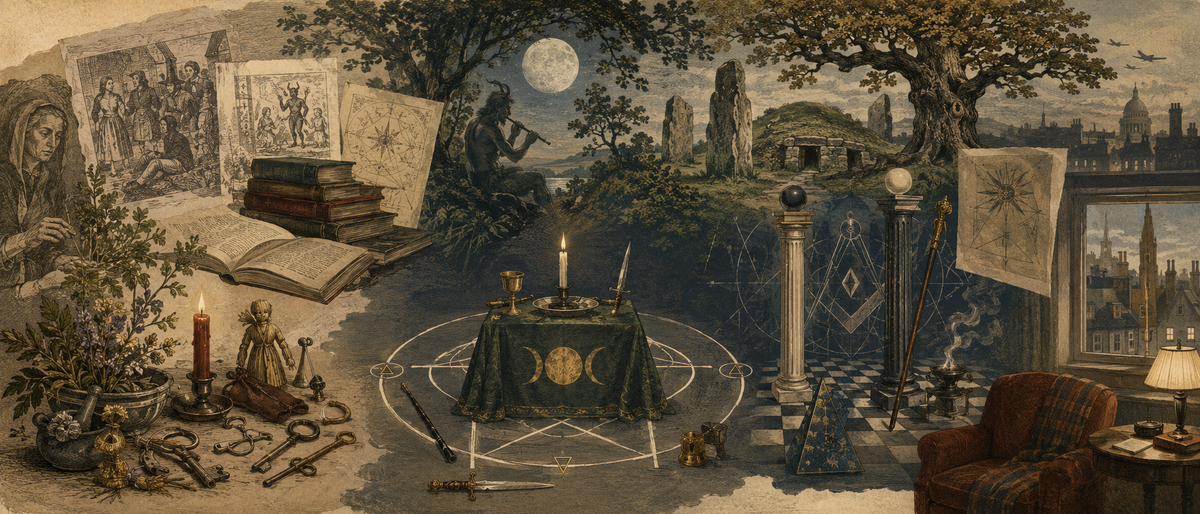
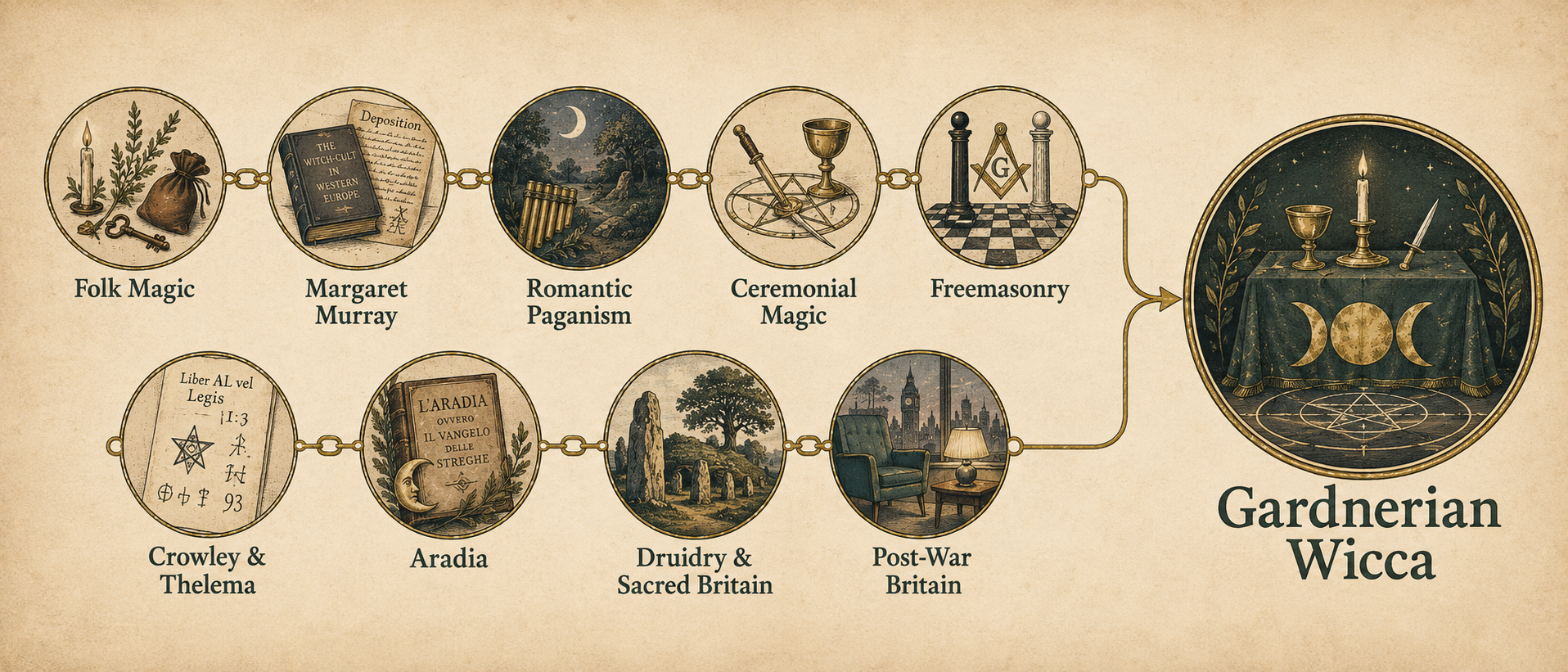
Gardnerian Wicca was neither an untouched survival nor a thing made from nothing. It was a convergence: folk magic, Romantic paganism, ceremonial occultism, Masonic initiation, Crowleyan ritual language, Murrayite anthropology, Leland’s witch mythology, naturism, antiquarian imagination, and the post-war desire for a re-enchanted world. The question is not whether these elements were borrowed. They were. The question is how they came to cohere.
The Usable Past
Margaret Murray and the Reversal of the Witch
The most famous intellectual error behind early Wicca was Margaret Murray’s witch-cult hypothesis. In The Witch-Cult in Western Europe, published in 1921, Murray argued that the witch trials preserved evidence of a surviving pre-Christian fertility religion. The witches, in this reading, were not servants of Satan but adherents of a suppressed pagan cult.
Modern scholarship has treated the thesis severely, and rightly so. Murray used the trial records too trustingly and too selectively. She read documents produced by fear, theology, torture, legal pressure, and fantasy as though they were reliable reports of religious practice. As ordinary history, the argument has collapsed.
As imaginative possibility, however, it was powerful. Murray changed the emotional direction of the figure of the witch. The witch was no longer merely the outcast of Christian demonology. She could be imagined as the priestess of an older religion. The sign was reversed: accusation became memory; stigma became inheritance; devil-worship became pagan survival.
Gardner did not receive an ancient witch religion from Murray. He received a way of imagining witchcraft as religion. That distinction is essential. Murray’s failure as history helped furnish one of the myths by which modern Witchcraft became thinkable.
Leland and the Witch as Counter-Religion
Charles Godfrey Leland’s Aradia, or the Gospel of the Witches, published in 1899, performed a related service. Its claims to preserve Italian witch tradition remain disputed, but its influence is unmistakable. It offered the image of witchcraft as a hidden religion, centred upon a goddess, practised by night, and set against oppression.
Here again we are dealing less with documentary certainty than with imaginative availability. Leland gave modern occultism a witchcraft that was not merely criminal, local, or superstitious, but religious and oppositional. For a generation already inclined to seek wisdom at the margins, that was a potent gift.
Folk Magic and the Figure of the Witch
One of the older streams feeding into Wicca was the European world of folk magic: charms, healing, protective spells, divination, herbal knowledge, and the practical magic of the cunning man or cunning woman. Such figures were not necessarily witches in the demonological sense. They might heal sickness, recover stolen goods, remove curses, prepare charms, or counteract hostile magic. Often they worked quite comfortably within a Christian landscape.
From this world Wicca inherited the idea of magic as craft: something done with words, tools, gestures, timing, intention, and inherited technique. It also inherited the ambiguous social figure of the witch: marginal yet useful, feared yet sought out, dangerous yet protective, standing a little apart from ordinary society.
But folk magic alone does not explain Gardnerian Wicca. The cunning tradition had spells and counter-spells; it did not have the full Gardnerian apparatus of Goddess and God, initiatory degrees, ritual nudity, seasonal festivals, elemental quarters, consecrated tools, and a theology of polarity. Those came from other rooms in the old house.
Romantic Paganism and the Longing for the Old Gods
By the nineteenth century the gods of Greece, Rome, and the countryside had become symbols of all that industrial modernity seemed to lack: beauty, sensuality, nature, instinct, mystery, and delight. Pan, especially, returned with some force in literature and art, not merely as a classical remnant but as the name of something wild beneath the polished surfaces of civilisation.
This Romantic paganism did not usually produce organised religion. It produced poems, pictures, moods, private devotions, theatrical gestures, and a longing for a world alive with presence. It helped prepare the ground for Wicca’s account of immanent divinity: the Goddess in moon and earth, the God in vegetation, animality, death, and return.
Here Wicca belongs not simply to ancient paganism, but to the modern longing for paganism. That longing is itself historically important. The nineteenth and early twentieth centuries were full of attempts to recover what modern life seemed to have mislaid: ritual, season, sacred landscape, bodily freedom, and a cosmos that had not yet been flattened into mechanism.
In esoteric history, nostalgia is often creative. It may misremember the past, but it can also disclose what the present lacks.
Ceremonial Magic and the Construction of Ritual
If Romanticism gave Wicca atmosphere, ceremonial magic gave it form. The Hermetic Order of the Golden Dawn and the wider Western magical revival drew together kabbalah, astrology, tarot, alchemy, Rosicrucian legend, Renaissance magic, Egyptianising symbolism, and Masonic-style initiation. It taught modern occultists how to make ritual out of fragments.
From this world came many of the forms that gave Wicca ritual coherence: the cast circle, consecrated instruments, elemental directions, invocations, graded knowledge, initiatory secrecy, and the conviction that ceremonial action could alter the practitioner. Wiccan ritual often feels older than the twentieth century because some of its materials are older; but they passed through Renaissance texts, Victorian orders, and modern occult handbooks before arriving in the coven.
This is not a small point. Wicca did not inherit ancient pagan ritual whole. It inherited the Western magical tradition’s method of building ritual from the ruins and echoes of antiquity. The antiquity is real in fragments, but not in the tidy form that early apologetics required.
Freemasonry and the Authority of Initiation
Freemasonry mattered not because Wicca is secretly Masonic, but because Masonry provided one of the most successful modern models of an initiatory society. It offered secrecy, degrees, passwords, ritual ordeal, symbolic tools, mythic history, and identity formed through ceremony. One did not merely read Masonry. One passed through it.
Gardnerian Wicca likewise became oath-bound, initiatory, and coven-based. It used degrees. It treated knowledge as something transmitted person to person. It made belonging ceremonial. In this respect, Wicca stands within the broader initiatory culture of the Western esoteric revival.
The content changed, of course. The lodge became the coven. The temple became the circle. The working tools of moral architecture gave way to knife, wand, cup, pentacle, cord, and scourge. Yet the underlying principle remained familiar: ritual does not merely describe the initiate; it makes the initiate.
Crowley, Valiente, and the Problem of Voice
Aleister Crowley’s influence on early Wicca has often been exaggerated by some and minimised by others. The sensible judgement lies between. Gardner met Crowley in 1947, and early Gardnerian material bears traces of Crowleyan language and magical style. Thelema contributed intensity, invocation, will, and a certain high theatrical voltage, which occultists of the period seem to have regarded as indispensable, like bad velvet curtains.
But Wicca did not become Thelema in a woodland cloak. Its centre of feeling moved elsewhere: toward the Goddess, the coven, the seasonal round, polarity, fertility, and the holiness of nature.
Doreen Valiente was decisive in this movement. She was not merely Gardner’s editor, still less his typist. She was a poet and ritual writer of real consequence. Her revisions helped free Wiccan liturgy from the more obvious Crowleyan register and gave it a voice that was simpler, more devotional, and more durable. If Gardner supplied much of the scaffolding, Valiente supplied much of the music.
That may help explain why Wicca endured. It became not simply an occult system, but a liturgical and devotional one. It could be practised, remembered, spoken aloud, and inhabited.
The Sacred Body and the Post-War World
One of Gardnerian Wicca’s distinctive features was ritual nudity, or working skyclad. This should not be explained only by appeal to ancient precedent. It also belongs to early twentieth-century naturism and body culture. For many modern people the body had become clothed, disciplined, industrialised, moralised, and estranged from nature. Naturism presented nakedness as health, liberty, simplicity, and return.
Within Wicca, ritual nudity became a sign of vulnerability, equality, magical power, and naturalness before the gods. Likewise, Wicca’s symbolism of polarity and fertility drew partly on old religious and magical patterns, but also on modern reactions against Victorian sexual restraint. The result was neither ancient fertility religion in pure form nor mere modern permissiveness. It was the ritual sacralisation of embodied life.
The post-war setting must also be kept in view. By the 1950s, institutional Christianity still possessed public authority, but many older certainties had been shaken. The Second World War had not left Europe morally or spiritually unaltered. Empire was receding. The machine age had become difficult to confuse with salvation. At the same time, occult publishing, folklore, archaeology, comparative religion, and popular anthropology had made alternative religious materials more widely available.
Wicca answered a hunger peculiar to that world. It offered ritual without ecclesiastical hierarchy, divinity without remote transcendence, nature without disenchantment, magic without mere superstition, and feminine deity within a religious culture still heavily marked by masculine imagery.
Modernity and the Worth of Belief
We arrive, then, at the more difficult question. If Gardnerian Wicca is modern, syncretic, and partly constructed, does that make it less worthy of respect than older religions? The answer must be no, unless we are prepared to apply the same severity to every religion that has passed through history, borrowed language, absorbed ritual, revised doctrine, adopted institutions, or retold its beginnings. That would leave a rather draughty temple.
Antiquity may give a religion depth, but it does not prove truth. Modernity may reveal construction, but it does not prove falsity. A belief is not made profound by being old, nor made trivial by being recent. The age of a tradition is one fact about it, not the measure of its whole value.
The real distinction lies elsewhere. There is a difference between saying, "We are the unchanged remnant of an ancient witch religion," and saying, "We are a modern initiatory pagan religion, drawing upon older magical, folkloric, ritual, and mythic materials, through which we participate in something we experience as ancient and sacred." The second claim is historically stronger and spiritually more interesting.
Religions live by more than literal antiquity. They live by myth, discipline, worship, community, symbol, memory, and transformation. Their truths are not all of one kind. A historical claim may fail while a ritual world continues to carry meaning. A myth may not be a chronicle and still speak truly about the structure of experience. This is not special pleading for Wicca. It is a plain observation about religious life.
The Witch as a Modern Religious Subject
The most remarkable change accomplished by modern Witchcraft was not the discovery of a lost archive. It was the creation of a new kind of religious person: the modern Witch. This figure is not simply the village charm-worker, nor the demonised witch of the trial records, nor the literary enchantress, though she bears traces of all three. She is an initiate, a ritual practitioner, a devotee of the old gods, a keeper of seasonal rites, and a participant in a sacred cosmos.
That change is historically considerable. The witch moved from criminal accusation to religious identity; from diabolical stereotype to pagan priestess or priest; from object of fear to bearer of a chosen vocation. Few reversals in modern religious imagination are quite so striking.
Seen in this light, Gardnerian Wicca is not merely a bundle of borrowings. It is a disciplined arrangement of inherited materials through which a new religious subject became possible. It gave modern people a grammar for naming themselves, consecrating the body, entering ritual space, honouring nature, invoking deity, and belonging to a hidden yet shared tradition.
A Modern Tradition Made from Old Materials
So what is Gardnerian Wicca? It is not the unbroken survival of a prehistoric fertility cult. The evidence does not support that claim. Nor is it merely a cynical hoax assembled from occult books. That judgement is too thin for the phenomenon.
Gardnerian Wicca is a modern initiatory pagan witchcraft tradition formed from older and newer streams: folk magic, Romantic paganism, ceremonial magic, Masonic initiation, Crowleyan ritual, Murray’s witch-cult theory, Leland’s witch mythology, naturism, Druidic and antiquarian imagination, post-war religious searching, and the literary genius of Doreen Valiente.
Its history is not a straight line. It is a convergence. It claims antiquity, but lives by adaptation. It appeals to the past, but was born in a modern moment of spiritual uncertainty. It gathers fragments, arranges them ritually, and produces something that feels older than itself.
In the strict historical sense, Gardnerian Wicca is a twentieth-century religion. Many of its ingredients are older: some early modern, some medieval, some classical, some folkloric, some Romantic, some Victorian, some post-war. The form, however, is modern. That need not diminish it. It may even be the key to its force.
Gardner and his collaborators gave modern people a ritual shape for longings that had been gathering for generations: the longing for the old gods, for sacred nature, for magic, for feminine divinity, for the body restored to holiness, and for initiation into a world not yet emptied of meaning.
That is not ancient survival in the narrow historical sense. It is modern enchantment with deep roots.
Sources and Further Reading
Ronald Hutton, The Triumph of the Moon: A History of Modern Pagan Witchcraft.
Philip Heselton, Gerald Gardner and the Cauldron of Inspiration.
Doreen Valiente, The Rebirth of Witchcraft.
Owen Davies, "The Hermetic Order of the Golden Dawn and the Origins of Wicca," Yale University Press.
Charles Godfrey Leland, Aradia, or the Gospel of the Witches.
Margaret Murray, The Witch-Cult in Western Europe.
"Wicca," Encyclopedia.com.