The Theatre That Contained the World
The art of memory is now generally encountered as a practical technique. A person imagines a familiar building, places an image in each room and later retrieves the required information by walking through the building in imagination. The method remains effective because spatial order is comparatively easy to remember, particularly when combined with unusual or emotionally arresting images.
For Renaissance practitioners, however, artificial memory could signify considerably more than efficient recall. The arrangement of images within an imagined architecture offered a means of ordering knowledge itself. In its most ambitious forms, the memory system became a representation of the cosmos and of the human mind’s place within it. To construct such a system was to reproduce, within memory, an intelligible order believed to exist in the world.
The distinction is important. A modern mnemonic device is normally judged by the amount of information it allows a person to retain. Renaissance memory systems could also be judged by the quality of the order they imposed. The practitioner was not merely attempting to remember more. He was attempting to remember according to the structure of things.
Places and images
The standard account of the art’s origin appears in Cicero’s De oratore. During a banquet in Thessaly, the poet Simonides of Ceos was called outside shortly before the building collapsed. The bodies of the guests were too badly disfigured for their relatives to identify them, but Simonides remembered where each person had been seated and was therefore able to name the dead. From this episode he inferred that orderly location could preserve what direct recognition could no longer recover.
Whether or not the story records an historical event, it supplied the art of memory with its founding principle: recollection depends upon arrangement. Cicero concluded that anyone wishing to train the memory should “employ places and form mental images of the things” to be remembered (De oratore, II.354).
The most complete surviving classical instructions occur in the anonymous Rhetorica ad Herennium, composed during the first century BCE. Quintilian later discussed the method in Book XI of the Institutio oratoria. These texts established a distinction between natural memory, belonging to the ordinary constitution of the mind, and artificial memory, strengthened by deliberate exercise.
Artificial memory required two elements: loci and imagines. The loci were stable places, usually arranged within a building known to the practitioner. The imagines were representations of the subjects to be recalled. The Rhetorica ad Herennium gives as examples of suitable places “a house, an intercolumnar space, a recess, an arch, or the like.” They should be distinct, moderately sized and neither too bright nor too dark. Similar places placed too closely together could become confused.
A speech might therefore be distributed through an imagined house, with each room or architectural feature containing an image corresponding to part of its argument. The speaker recovered the sequence by mentally revisiting the places. Quintilian describes the process clearly:
“What I have spoken of as being done in a house can equally well be done in connexion with public buildings, a long journey, or the ramparts of a city.”
The architecture need not be imaginary. A practitioner could use a church, monastery, palace, street or public square, provided that its sequence remained stable. Familiarity mattered because the building supplied the order. The images placed within it could be changed as often as necessary, just as writing could be erased from a wax tablet while the tablet itself remained.
The images were not expected to be restrained or realistic. The author of the Rhetorica ad Herennium observes that ordinary events are easily forgotten, whereas something “exceptionally base, dishonourable, extraordinary, great, unbelievable, or laughable” remains in the mind. He therefore recommends images distinguished by exceptional beauty or ugliness, comic costume, violence, blood, mud, crowns, purple cloaks and other visually emphatic details.
This aspect of the method can appear eccentric until its purpose is understood. The practitioner was not illustrating a manuscript for public inspection. He was constructing private images designed to produce a strong impression upon his own imagination. Decorum was less important than memorability.
A simple Renaissance exercise
The classical method continued to be taught during the Renaissance, and its practical operation may be reconstructed from the surviving manuals. Suppose that a sixteenth-century student wished to memorise the principal parts of a speech concerning the government of a city. The speech contains five subjects:
- the authority of law;
- the defence of the city;
- the regulation of trade;
- the education of the young;
- the duties of the magistrate.
The student first selects a building that he knows thoroughly. It might be his own residence, a college, a church or the house of a patron. He establishes a fixed route through it: the front door, the entrance hall, the staircase, the principal chamber and the courtyard. He must always traverse these places in the same order.
At the front door he imagines an enormous book of laws chained across the entrance. Its pages are made of iron, and a crowned judge is attempting to open it with a sword. The image represents the authority and enforcement of law.
In the entrance hall he places an armed soldier carrying a miniature city wall upon his shoulders. Arrows protrude from the wall, while a trumpet sounds beside him. This recalls the defence of the city.
On the staircase he imagines a merchant struggling upwards beneath an absurd quantity of scales, coins, bolts of cloth and barrels of wine. The commercial objects recall trade, while the merchant’s movement up the steps preserves his position in the sequence.
In the principal chamber a schoolmaster writes upon the walls while children read books larger than themselves. One child wears a laurel wreath. This image represents education and its civic benefits.
Finally, in the courtyard the student sees a magistrate with several hands. One carries a set of scales, another a key, another a document and another a purse. The multiple hands recall the several duties of public office.
The student then closes his eyes and walks through the building in imagination. At each place he observes the image and reconstructs the associated argument. He repeats the journey until the images arise without deliberate effort.
If he wishes to remember the speech by subject, the images need only represent its principal arguments. If he wishes to remember its exact words, the task becomes considerably more difficult. The Rhetorica ad Herennium distinguishes between the memory of things, memoria rerum, and the memory of words, memoria verborum. The former preserves the sequence of ideas; the latter requires images constructed from verbal similarities, names, syllables and visual puns.
An image intended to represent virtus, for example, might employ a particular person named Virtus, a familiar emblem of courage or a phonetic association meaningful to the practitioner. Such associations were necessarily personal. The manual warns that images supplied by another person are often less effective than those devised by oneself, since individual minds respond differently to particular figures.
The exercise was therefore both disciplined and inventive. The architectural route remained fixed, but the images depended upon the practitioner’s experience, education and habits of association.
Memory in the Middle Ages
The art survived the end of antiquity through the rhetorical tradition, although its purposes changed. Medieval authors incorporated memory into the moral and religious formation of the individual. Within the scholastic classification of the virtues, memory became a component of prudence: the capacity to act correctly in the present partly depended upon retaining the lessons of the past.
Albertus Magnus and Thomas Aquinas both treated artificial memory in this context. Discussing the “integral parts” of prudence in the Summa theologiae, Aquinas argued that memory should be assisted by suitable sensible images. Spiritual and intellectual matters are not readily retained in themselves because human knowledge ordinarily begins with the senses. Abstract principles should therefore be attached to concrete figures.
A medieval or Renaissance Christian might arrange the virtues and vices within a church known to him. Pride could appear as a crowned figure falling from a tower; avarice as a man attempting to swallow coins; charity as a woman distributing bread; justice as a judge holding a sword and scales. The church supplied the sequence, while the figures translated moral abstractions into visible actions.
This was not necessarily regarded as a secular technique added to religious instruction. The disciplined recollection of moral examples belonged to the formation of conscience. Memory provided prudence with the accumulated material from which practical judgement could proceed.
Frances Yates argued in The Art of Memory that the proliferation of striking religious imagery during the Middle Ages should be considered in relation to mnemonic practice. Her argument must be used cautiously. It cannot be assumed that every painted vice, sculpted virtue or architectural sequence constituted a formal memory system. Nevertheless, medieval mnemonics and religious art drew upon a common understanding of the imagination. Vivid sensible images could impress intellectual and moral truths upon the memory.
From remembering a speech to organising knowledge
The ordinary memory palace had a limited and practical purpose. It allowed a particular body of material to be distributed through a familiar series of places. The architecture did not necessarily make a claim about the subject. A speech on civic government could be placed in a church, a house or a city street without altering its argument.
During the Renaissance, some authors attempted to construct systems in which the places themselves possessed intellectual significance. Knowledge was not merely deposited wherever space happened to be available. It was assigned to locations corresponding to its nature and position within a larger order.
Several traditions contributed to this development. Classical rhetoric supplied the method of places and images. Medieval religious practice connected memory with moral formation. Neoplatonic philosophy provided hierarchical models of reality. Astrology associated the planets with classes of natural and human activity. Christian Cabala offered further systems of divine names, numbers and correspondences. The combinatory art of Ramon Llull demonstrated how a limited set of principles might generate a large number of relations.
Llull’s Ars was not itself a classical memory palace. It employed letters, geometrical figures and rotating combinations to demonstrate relations among divine attributes and the principles of created things. A classical mnemonic preserved a fixed sequence; a Lullian figure systematically produced combinations. Renaissance authors brought the two forms together, creating systems intended both to retain knowledge and to disclose relations within it.
Paolo Rossi’s Logic and the Art of Memory situates this development within the broader history of encyclopaedism, logic, universal language and scientific method. Artificial memory was one expression of a prolonged attempt to determine how knowledge should be classified and whether its internal order could be represented by a finite system of signs.
Giulio Camillo’s theatre
The most celebrated Renaissance attempt to give memory a universal architecture was devised by Giulio Camillo, born around 1480 and active in Venice and northern Italy. Camillo spent much of his career developing what became known as the Theatre of Memory. Its surviving description, L’Idea del theatro, appeared posthumously in 1550.
The material form of the theatre remains uncertain. Contemporary reports indicate that a wooden model was constructed, possibly under the patronage of Francis I of France, but no physical remains have survived. Camillo’s published description is schematic, and manuscript evidence suggests that the project changed during its development. Lina Bolzoni has consequently cautioned against treating any modern reconstruction as definitive.
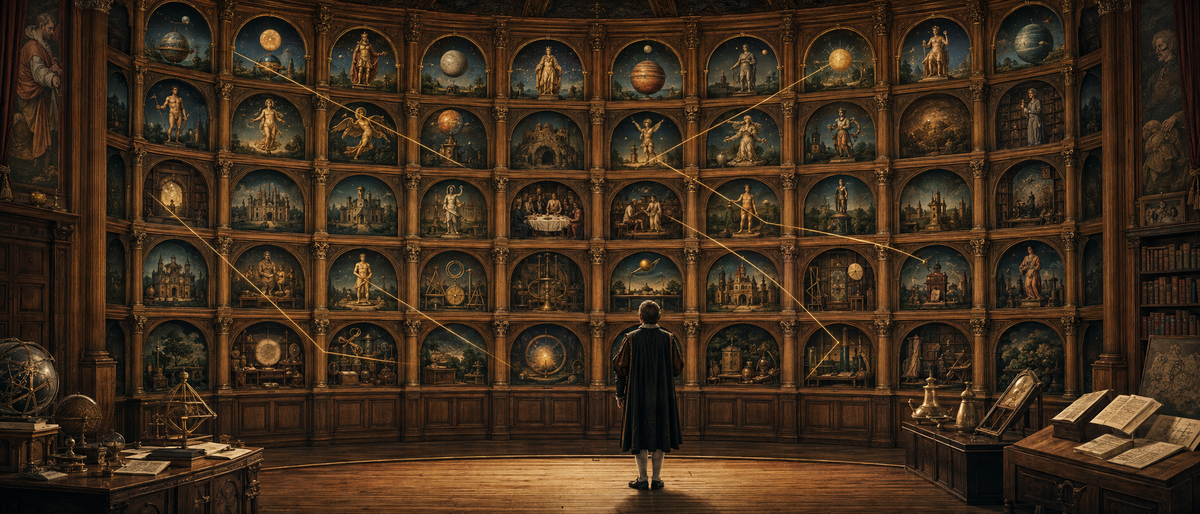
The theatre nevertheless had an identifiable general structure. Camillo reversed the ordinary theatrical arrangement. Instead of sitting in the auditorium and observing action upon the stage, the practitioner stood upon the stage and looked towards a semicircular auditorium. Knowledge was arranged before him as a spectacle.
The auditorium was divided by seven gangways corresponding to the seven planets of traditional cosmology: the Moon, Mercury, Venus, the Sun, Mars, Jupiter and Saturn. Seven horizontal levels crossed these planetary divisions, producing forty-nine principal compartments. The entire arrangement rested symbolically upon the seven pillars of the House of Wisdom described in Proverbs 9:1.
Camillo explained that the theatre would place before its student “the seven measures of the world” as though they were presented in a spectacle. The lowest seats contained the most fundamental principles, while the higher levels represented later stages in the development of nature and human art.
The seven levels were marked by mythological or biblical images: the Planets, the Banquet, the Cave, the Gorgons, Pasiphaë, the Sandals of Mercury and Prometheus. Their sequence followed an ascent from first causes and elemental creation through the natural and psychological constitution of humanity to language, action, art and invention. Camillo describes the governing principle:
“Following the order of the creation of the world, we shall place on the first levels the more natural things.”
Prometheus occupied the final and highest level because the arts were produced by human ingenuity after the natural world had already been formed. The position was therefore chronological rather than derogatory.
Each compartment combined a dominant image with subsidiary material. Drawers, boxes or documents associated with the principal images may have contained extracts from poets, philosophers, theologians and orators. The image served as a mnemonic sign, a classificatory heading and an interpretive emblem.
Camillo’s theatre was therefore not simply an unusually large memory palace. Its architecture expressed a theory of reality. The planets did not function as arbitrary shelf labels. Within Renaissance cosmology, they governed particular materials, bodily organs, temperaments, professions, arts and forms of action. To place a subject beneath Mars, Venus or Mercury was to identify the kind of influence through which it operated.
Walking through Camillo’s theatre
No diary survives in which a pupil records the daily use of Camillo’s structure. Any practical reconstruction must therefore remain partly conjectural. Camillo’s own description, contemporary reports and the established procedures of artificial memory nevertheless allow the probable experience of the theatre to be outlined.
Imagine a learned visitor entering Camillo’s wooden theatre in France or Venice. He does not take a seat. He is conducted to the position normally occupied by actors. Before him rises the complete auditorium, divided vertically by the seven planetary gangways and horizontally by its seven levels.
His first task is not to memorise an isolated list. He must learn the structure of the theatre itself. The seven planets provide the primary vertical order. He becomes familiar with the column governed by Saturn, followed by Jupiter, Mars, the Sun, Venus, Mercury and the Moon. He then learns the progression of levels from the fundamental planetary causes to Promethean art.
The theatre is thus converted into a coordinate system. Any compartment can be identified by the intersection of a planetary power and a stage of creation. The practitioner does not simply remember that an image follows another image. He knows that it occupies, for example, the Mercurial division at the level of the Sandals of Mercury.
Suppose he wishes to study eloquence. He turns towards Mercury, the planetary power traditionally associated with speech, interpretation, writing, ingenuity, commerce and mediation. At the higher levels of this division, he encounters images relating to language and human art. The Sandals of Mercury signify movement, communication and the operations by which the mind passes from one thing to another. Prometheus signifies works produced by human skill.
Behind or beneath the relevant images he may find passages from Cicero, Quintilian, Virgil or contemporary humanist writers. These passages are not merely stored under a heading called “rhetoric.” Their location relates eloquence to a cosmological and psychological order. Language belongs to Mercury; its cultivated forms belong to the later stages of human art; its particular figures and examples occupy subordinate places within that scheme.
If the visitor wishes to consider martial courage, he turns instead towards Mars. There he may encounter mythological figures, bodily qualities, passions, weapons, historical examples and passages of military eloquence. These materials are related because all are interpreted through the same Martian category.
A subject such as love would direct him towards Venus. Questions of generation and natural fertility might appear at the lower levels, while poetry, ornament or cultivated social behaviour would occupy higher positions. The same planetary principle persists, but its expression changes as the theatre ascends from nature towards human art.
The user of the theatre would repeatedly survey these relationships. He might begin with a subject and locate its proper planetary and hierarchical position. He might also begin with a planetary column and inspect the range of things traditionally governed by it. The first movement classified knowledge; the second explored correspondences.
The distinction between vertical and horizontal movement is particularly important. Moving upward within one planetary column displayed the progressive manifestation of a single power. Moving horizontally across one level displayed the differentiated activity of the seven planets at the same stage of creation. The theatre could therefore be read in more than one direction.
As the practitioner learned its structure, he would no longer require the physical model at every stage. The external theatre provided the pattern for an internal one. Its compartments, images and texts could be reconstructed in imagination and traversed during composition, study or recollection.
The result was not perfect or mechanical access to all knowledge. The theatre depended upon prior education. A person unfamiliar with classical mythology, astrology, Neoplatonic cosmology and the literary canon would be unable to interpret many of its images. Camillo’s promise of universality presupposed a highly specific intellectual culture.
Mythological images as instruments of knowledge
Camillo’s use of mythology was not decorative. Mythological figures condensed several meanings within a recognisable form. A single image could collect a narrative, a planetary association, a moral quality, a natural process and a group of textual authorities.
Prometheus, for example, recalled the theft of fire, the transmission of skill to humanity and the capacity to fashion new things. His image could therefore organise knowledge concerning the arts, crafts and productive powers of the human intellect. Mercury could signify eloquence, commerce, interpretation, swiftness and mediation. The Gorgons could be used to distinguish faculties of the soul or operations of the intellect.
Camillo defended the concealment of doctrine within fable by appealing to ancient philosophical practice. Profound teachings, once clearly understood by the initiated student, could be covered with mythological forms to prevent their profanation. The veil did not simply hide meaning. It preserved and concentrated it.
The image consequently performed two apparently contrary functions. It revealed a doctrine to someone trained to interpret it and concealed the same doctrine from someone who saw only the fable. Memory, interpretation and initiation were closely connected.
Giordano Bruno and the shadows of ideas
Giordano Bruno developed the art of memory in a more complex philosophical and combinatory direction. His first Parisian publication, De umbris idearum—On the Shadows of Ideas—appeared in 1582 together with an Ars memoriae. He returned to mnemonic subjects in Cantus Circaeus, Explicatio triginta sigillorum and De imaginum, signorum et idearum compositione.
Bruno combined classical places and images with Lullian wheels, astrological structures and extensive lists of symbolic figures. Instead of distributing a small number of topics through a single familiar building, he attempted to construct an organised vocabulary of images capable of representing a very large number of subjects.
One of Bruno’s systems employed concentric rotating wheels. The divisions of the wheels could contain letters, planetary or mythological figures, actions, attributes and circumstances. Rotating them brought different elements into conjunction. The system could therefore generate composite images rather than relying only upon a previously memorised collection.
Suppose that a practitioner wished to retain a name, proposition or sequence of words. He could assign its initial sounds to figures on one wheel, actions on another and objects or circumstances on a third. The resulting combination might produce an image of Apollo carrying a broken anchor while riding a bull. The scene need not possess narrative plausibility. Its purpose was to unite several mnemonic elements within a single memorable action.
The procedure extended the principle of the Rhetorica ad Herennium. The classical author had recommended extraordinary images because the mind retained the exceptional more readily than the ordinary. Bruno multiplied the available figures and regulated their combination. The imagination became an instrument whose operations could be deliberately organised.
His “shadows of ideas” were not simply false appearances. Human thought does not ordinarily possess divine or intelligible realities directly. It approaches them through sensible things, concepts, signs and images. These are shadows because they present intelligible form under conditions accessible to the embodied mind.
Bruno states that “ideas are the principal forms of things, according to which all things are formed.” The images employed by the memory art were not themselves these ideas. Properly ordered, however, they could direct the mind through the multiplicity of appearances towards their intelligible relations.
This explains the philosophical ambition of Bruno’s mnemonic works. Artificial memory was not valuable solely because it increased storage. It could reform the operations of the mind by providing an ordered series of mediating images. The trained imagination became capable of moving among particulars while preserving their relations to more general forms.
A Brunian session
The practical use of Bruno’s system would have required substantial preparation. The practitioner first memorised the basic divisions of the wheels and the standard figures assigned to them. These might include planetary deities, mythological characters, animals, plants, tools and human actions. Each figure had to remain sufficiently distinct to be recalled quickly.
He then learned the numerical and alphabetical positions of the figures. The system depended upon accurate location. An image could only serve as a sign if the practitioner knew where it belonged and which letter, sound or concept it represented.
When new material was encountered, it was converted into combinations drawn from the established image vocabulary. A sentence might be divided into principal subjects, actions and objects. These would be represented by figures placed in relation to one another. The resulting scene would then be assigned to a mnemonic location or a regulated position upon the wheel.
Recollection reversed the process. The practitioner recovered the composite image, separated its elements and translated them back into the intended words or ideas. Repeated exercise gradually shortened the interval between image and meaning.
Bruno’s art was therefore not an effortless substitute for study. It required the prior memorisation of a complex system before that system could be used to remember anything else. Its promise was not convenience but capacity. Once internalised, the machinery could receive, order and recombine material on a scale beyond that of the ordinary sequence of rooms.
The method also imposed a particular intellectual discipline. New information had to be analysed before it could be placed. The practitioner decided what kind of thing it was, which image could represent it and how it related to surrounding material. Mnemonic encoding was simultaneously an act of interpretation.
Formation of the practitioner
The Renaissance art of memory was inseparable from contemporary theories of imagination. Images were believed to affect the passions, bodily disposition and direction of thought. A person repeatedly contemplating figures of courage, order, beauty or divine power was not necessarily understood to remain unchanged by them.
This possibility was already present in the medieval connection between memory and prudence. A store of rightly ordered examples could assist moral judgement. In the more philosophically ambitious Renaissance systems, the internal order of images could also bring the mind into closer conformity with the order of nature.
Such claims should not be exaggerated. There was no single Renaissance doctrine of memory, and not every practitioner accepted the magical or cosmological implications associated with Camillo or Bruno. Quintilian himself had doubted the usefulness of elaborate images for memorising a continuous speech. Humanist educators frequently preferred repetition, understanding and orderly division of a text.
The surviving evidence nevertheless shows that artificial memory could be treated as an instrument of intellectual formation. Its object was not merely the retention of external data. It trained attention, classification, imagination and the capacity to move between sensible particulars and abstract relations.
Memory, magic and cosmology
Frances Yates made the magical and Hermetic dimensions of Renaissance memory central to her interpretation. In The Art of Memory, published in 1966, she argued that Camillo’s theatre and Bruno’s mnemonic systems transformed the classical art through the influence of Hermeticism, astrology, Cabala and Renaissance magic.
Her account remains foundational, but several qualifications are necessary. The Renaissance “Hermetic tradition” was not a single coherent movement. Camillo and Bruno drew upon different combinations of classical rhetoric, Lullism, Neoplatonism, scholastic psychology, astrology, Cabala and Christian theology. Bruno’s philosophy cannot be reduced to his reading of the Corpus Hermeticum, nor can every use of planetary imagery be classified simply as magical.
The relevant distinction is not between a rational mnemonic technique and an irrational magical addition. Renaissance conceptions of nature often assumed the existence of real sympathies and correspondences among celestial, material and psychological phenomena. Astrology, medicine, natural philosophy and magic shared categories that modern academic disciplines have subsequently separated.
A planetary image could therefore operate on several levels. It could function as a convenient mnemonic label. It could classify a group of conventionally associated subjects. It could also be regarded as a representation of a real power active throughout the cosmos. The same practitioner might employ all three understandings without considering them incompatible.
An architecture of the mind
The Renaissance memory arts occupied a territory now divided among psychology, rhetoric, philosophy, education, information management, religious practice and magic. Their practitioners did not necessarily distinguish sharply between remembering a body of knowledge, understanding its internal relations and forming the character of the person who possessed it.
This explains the repeated use of architectural forms. A building does not merely contain objects. It assigns them positions, establishes paths between them and determines the order in which they can be encountered. A memory theatre or palace imposed comparable relations upon knowledge. Its structure was therefore argumentative. To place planets, virtues, bodily functions and forms of eloquence within a common scheme was to make a claim about their connection.
The practical exercise also clarifies the difference between a memory palace and a modern archive. A written index may be consulted without being memorised. Camillo’s theatre had to be learned, traversed and eventually reconstructed within the imagination. Bruno’s wheels had to become sufficiently familiar that their combinations could be produced and interpreted without continual reference to the printed page.
Modern comparisons with databases and computer interfaces are suggestive, but limited. A database allows information to remain external to its user. Renaissance artificial memory required the individual to incorporate both the information and the structure governing it. The arrangement became a property of the trained mind.
The content was equally inseparable from its organisation. Camillo’s theatre did not merely tell the practitioner where information could be found. It asserted that creation unfolded hierarchically, that planetary powers operated through the several levels of reality and that human arts occupied an intelligible place within the cosmic order. Bruno’s systems similarly assumed that the multiplicity of appearances could be traced through images towards underlying intellectual relations.
The theatre of memory was consequently a philosophical instrument as well as a mnemonic one. A practitioner standing upon Camillo’s stage was presented with an ordered universe. By learning its divisions, filling its compartments and traversing its correspondences, he attempted to reproduce that universe within himself.
The scale of the ambition should not obscure its practical foundation. The entire enterprise began with a simple observation: things are remembered more securely when they are given places and converted into images. Renaissance thinkers extended that observation into a more demanding proposition. If memory depends upon order, then the order chosen for memory will influence the form of knowledge. If that order corresponds to the structure of the world, the trained memory may become more than a storehouse. It may become an image of the world itself.
References
- Aristotle, On Memory and Recollection.
- Cicero, De oratore, II.350–360.
- Anonymous, Rhetorica ad Herennium, III.16–24.
- Quintilian, Institutio oratoria, XI.2.
- Thomas Aquinas, Summa theologiae, II–II, question 49.
- Ramon Llull, selected works concerning the Ars.
- Giulio Camillo, L’Idea del theatro (1550).
- Giordano Bruno, De umbris idearum and Ars memoriae (1582).
- Lina Bolzoni, “Giulio Camillo and the Theater of Knowledge,” Cabinet, no. 65.
- Lina Bolzoni, The Gallery of Memory: Literary and Iconographic Models in the Age of the Printing Press, trans. Jeremy Parzen (University of Toronto Press, 2001).
- Mary Carruthers, The Book of Memory: A Study of Memory in Medieval Culture, 2nd ed. (Cambridge University Press, 2008).
- Paolo Rossi, Logic and the Art of Memory: The Quest for a Universal Language, trans. Stephen Clucas (University of Chicago Press, 2000).
- Frances A. Yates, The Art of Memory (Routledge and Kegan Paul, 1966).
- The classical instructions may be consulted in the public-domain translations of the Rhetorica ad Herennium, Book III and Quintilian’s Institutio oratoria, Book XI.