The Secret Life of the Monad
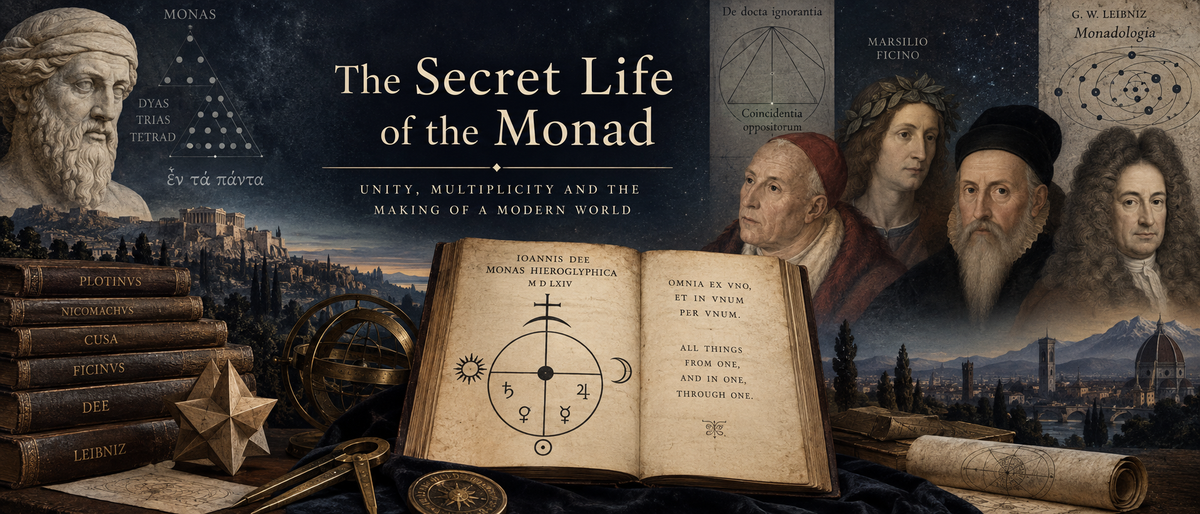
A single word - monad - moves through more than two millennia of Western thought. It can mean a unit, a metaphysical first principle, a geometrical source, a theological analogy, a magical sign or, in Leibniz, one of the innumerable simple substances from which reality is constituted. The continuity is real, but it is not simple. The history of the Monad is best read as the repeated reformulation of a problem: how multiplicity can depend upon, express, or contain unity.
The attraction of one
In 1564 John Dee published one of the stranger small books of the European Renaissance. The Monas Hieroglyphica, printed at Antwerp by Willem Silvius, consists of a prefatory dedication followed by twenty-four theorems devoted to the interpretation of a single sign. Dee's Hieroglyphic Monad combines familiar astronomical and alchemical forms - the signs of the Moon, Sun, the elements and Aries - into a compact figure which he presents as the key to a new discipline. The book moves from point, line and circle through planetary relations, number, proportion, alchemy and finally Christian symbolism. Its difficulty is not accidental. Dee regarded the sign as capable of condensing relations which ordinary discursive language could only unfold slowly and imperfectly (Dee 1564; Josten 1964).
To a modern eye the device can look like an unusually elaborate occult logo. That description misses the intellectual claim. Dee's Monad was intended to be generative as well as representative. Geometry, astronomy, astrology, alchemy and theology could be related because nature itself was assumed to possess an intelligible order. The sign did not merely decorate that order. It attempted to make part of its structure visible.
Dee did not invent the philosophical prestige of unity. The word he chose, monas, already carried a long and complicated history. Following it backwards does not uncover a single doctrine transmitted intact from antiquity to the Renaissance. It reveals something more interesting: a sequence of thinkers repeatedly returning to the relation between the one and the many, and repeatedly changing what 'one' was required to mean.
Number before metaphysics
The Greek monas denotes unity or a unit. Later ancient sources regularly associate the Monad with Pythagoras and the Pythagoreans, often pairing it with the Dyad as the origin of number and multiplicity. Diogenes Laertius, writing many centuries after Pythagoras, reports a scheme in which the Monad and Indefinite Dyad generate numbers, from numbers come points, lines and solid figures, and from these the sensible cosmos. That account became influential, but it should not be projected without qualification back onto the historical Pythagoras. Aristotle's evidence for early Pythagorean number theory is both earlier and different, and modern scholarship has repeatedly warned against treating the elaborate later system as a direct record of sixth-century BCE teaching (Aristotle, Metaphysics I.5 and XIII.6; Burkert 1972).
What can be said with greater confidence is that Pythagorean traditions made number ontologically significant. Number was not merely a tool for counting independently existing things. Numerical relations could describe the structure of things themselves, most famously in musical consonance, where intervals correspond to simple ratios. By the early imperial period, writers such as Nicomachus of Gerasa had made this tendency explicit. Arithmetic could be treated as a science of intelligible order, and the properties of numbers could acquire theological as well as mathematical significance.
The Monad is especially fertile because it hovers between arithmetic and metaphysics. In one sense it is simply the unit from which number is constituted. In another, it is that by virtue of which anything is one thing at all. Once those meanings are allowed to overlap, arithmetic becomes a language for ontology. Multiplicity can be imagined as proceeding from unity without unity itself being exhausted by the process.
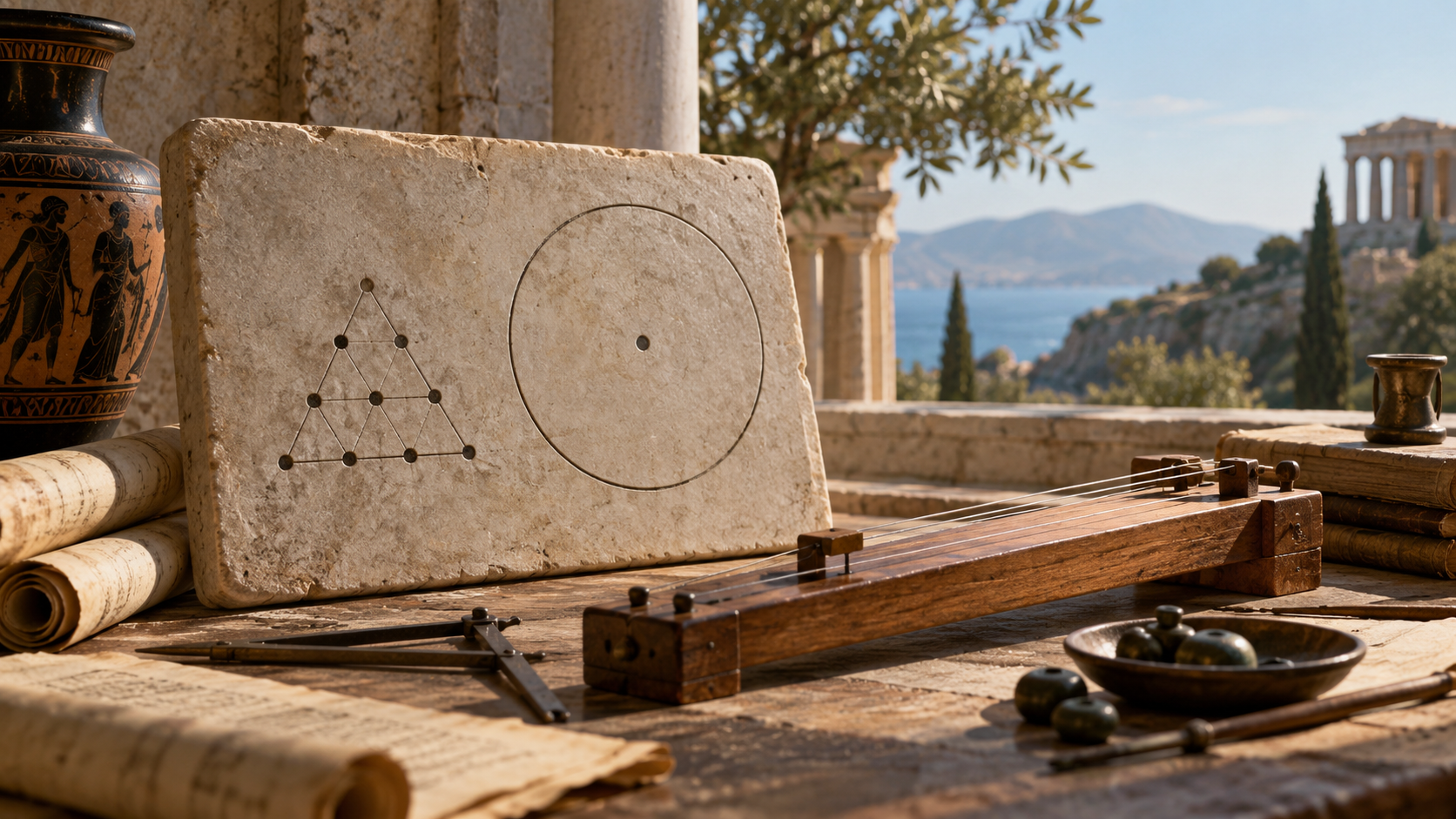
Unity before Dee: number, ratio and the philosophical elevation of the unit.
Plotinus and the One beyond number
Plotinus, writing in the third century CE, gave the problem of unity one of its most influential metaphysical forms. At the summit of his philosophy stands the One, also called the Good. The name is already hazardous. Plotinus does not mean the number one, nor one being among other beings. The One is prior even to Intellect and Being. It is absolutely simple, without internal division, and therefore cannot be adequately described through predicates which distinguish one feature from another (Enneads V.1, V.4 and VI.9).
Everything else nevertheless depends upon it. Intellect derives from the One; Soul derives from Intellect; the ordered sensible cosmos depends in turn upon Soul. The conventional language of 'emanation' can suggest a physical outflow, but the relation is better understood as ontological dependence. Multiplicity is possible because there are levels at which unity is progressively articulated into difference. A thing is intelligible as a thing only insofar as it possesses some unity.
This produces a characteristic Neoplatonic movement. Thought moves outward from simplicity into multiplicity and inward from multiplicity towards its source. Philosophical knowledge and spiritual ascent can therefore share a structure. To understand a complex reality is, at least partly, to discern the order by which its multiplicity is held together. The One is not reached by counting backwards from many objects to a first object. It marks the limit at which ordinary distinctions cease to be adequate.
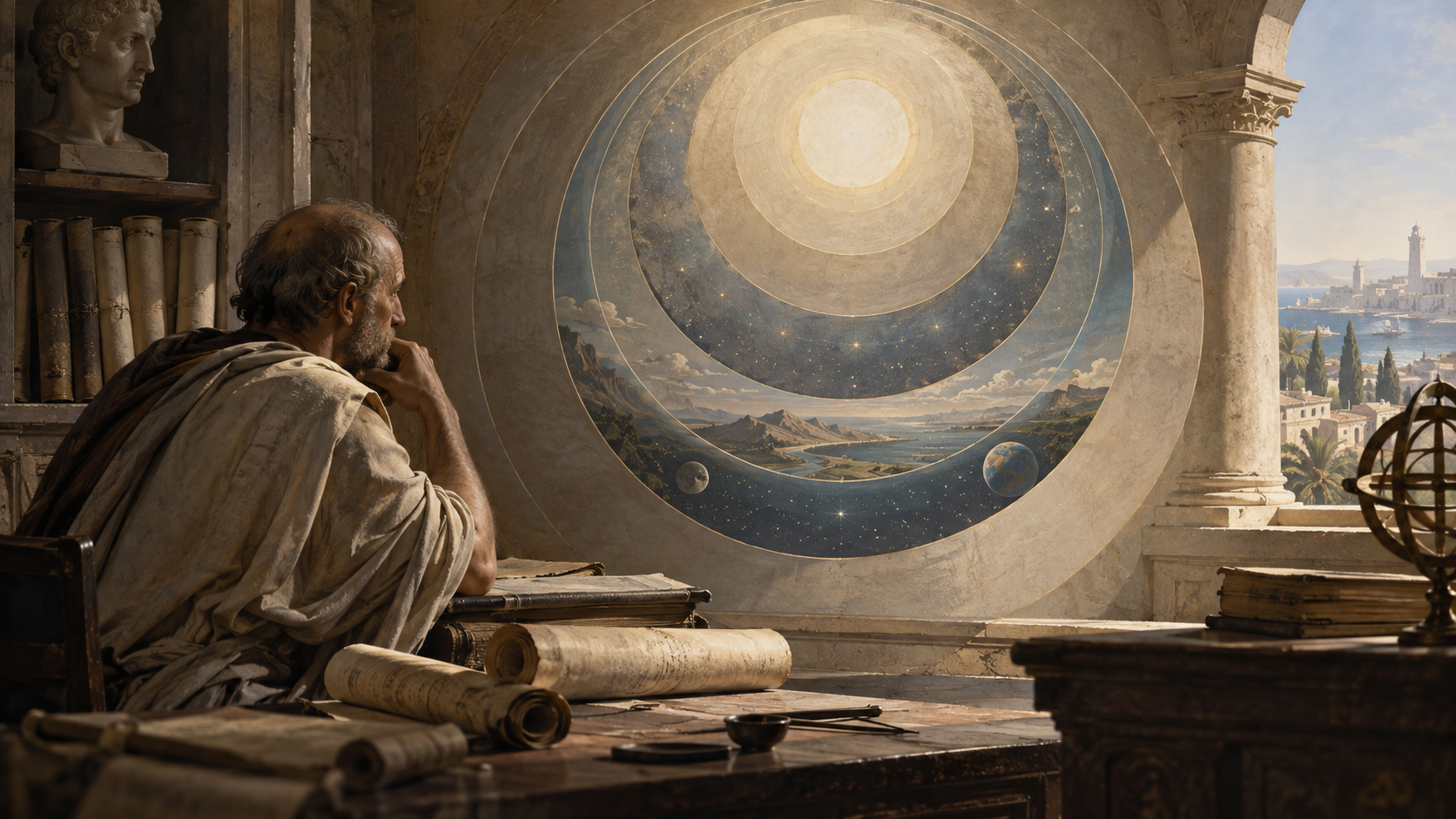
Plotinian unity: multiplicity depends upon a principle that is not itself one member of the series.
Nicholas of Cusa: unity at the limit
Nicholas of Cusa's De docta ignorantia, completed in 1440, reworks the relation between unity, mathematics and theology within a Christian framework. Nicholas begins from the inadequacy of finite knowledge before the infinite. Human reason knows by comparison, proportion and measurement. God, as the absolute Maximum, cannot be placed within a scale of greater and lesser, because anything that could be so measured would already be finite.
Nicholas therefore uses mathematical examples precisely where mathematics begins to expose its own limits. A polygon may acquire more and more sides and increasingly resemble a circle, but no finite multiplication of sides makes it identical with the circle. He similarly considers the behaviour of line, triangle and circle under the conceptual condition of infinity. These are not proofs that God is a geometrical object. They are disciplined analogies for a relation in which finite reason approaches what it cannot comprehend exhaustively (De docta ignorantia I.1-13).
His famous coincidence of opposites belongs to the same strategy. At the level of the absolute infinite, distinctions that apply to finite things cannot be transferred without alteration. Maximum and minimum coincide, not because ordinary contradictions have become interchangeable, but because the infinite is not one finite term opposed to another. Nicholas also describes God as the enfolding, complicatio, of all things and the created order as their unfolding, explicatio. The vocabulary permits him to speak of unity and multiplicity together while maintaining the Christian distinction between Creator and creation.
Cusan mathematics is therefore neither ornament nor disguised physics. It is a form of intellectual discipline. Geometry shows how far proportion can take the mind and, at the same time, where proportion ceases to be sufficient. The One has become the horizon against which finite knowledge learns its own scale.
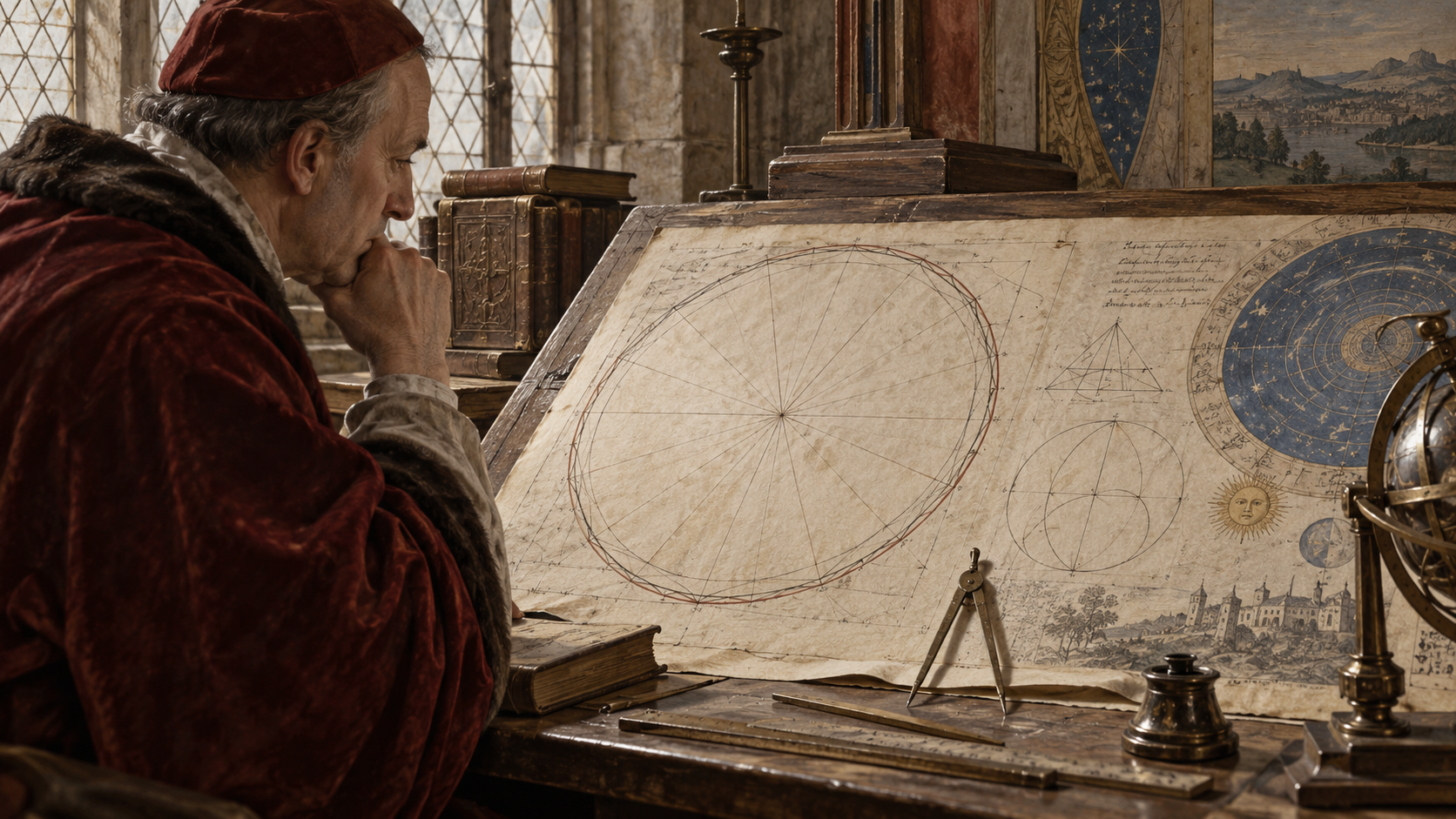
Nicholas of Cusa used mathematics to think at the boundary between finite proportion and divine infinity.
Ficino and the Renaissance recovery of unity
Marsilio Ficino does not offer a doctrine of the Monad comparable to Dee's. His importance lies in the intellectual environment he helped to create. From the 1460s onward, Ficino translated Plato and then Plotinus into Latin, composed his Platonic Theology, and developed a Christian Platonism in which the universe could be understood as a graded order connecting matter, soul, intellect and God. The precise details of Ficino's hierarchy shift across his writings, but mediation and participation are constant concerns. Human soul occupies a particularly important position because it stands between corporeal and incorporeal orders and can turn towards either.
Ficino also contributed to the Renaissance recovery of texts then believed to preserve an ancient theology. His Latin translation of the Corpus Hermeticum, completed before his full Plato translation, helped establish Hermes Trismegistus as a supposed witness to a primeval wisdom subsequently refracted through Orpheus, Pythagoras and Plato. The chronology was wrong. Isaac Casaubon's seventeenth-century philological work would later place the Hermetic texts in the early centuries of the Common Era. The Renaissance consequence of the older dating was nevertheless considerable. It made Platonic metaphysics, Christian theology, Hermetic cosmology and the study of natural sympathies appear historically related as well as philosophically compatible.
This matters for Dee because Renaissance natural philosophy did not yet observe the boundaries imposed by later disciplinary histories. Mathematics could illuminate cosmic order; astrology could be treated as part of the study of celestial causation; natural magic could investigate hidden sympathies in creation; biblical and classical texts could be read alongside one another. None of this meant that every Renaissance Platonist accepted every magical claim. It meant that the intellectual map on which such claims were placed differed sharply from a modern division between science, religion and occultism.
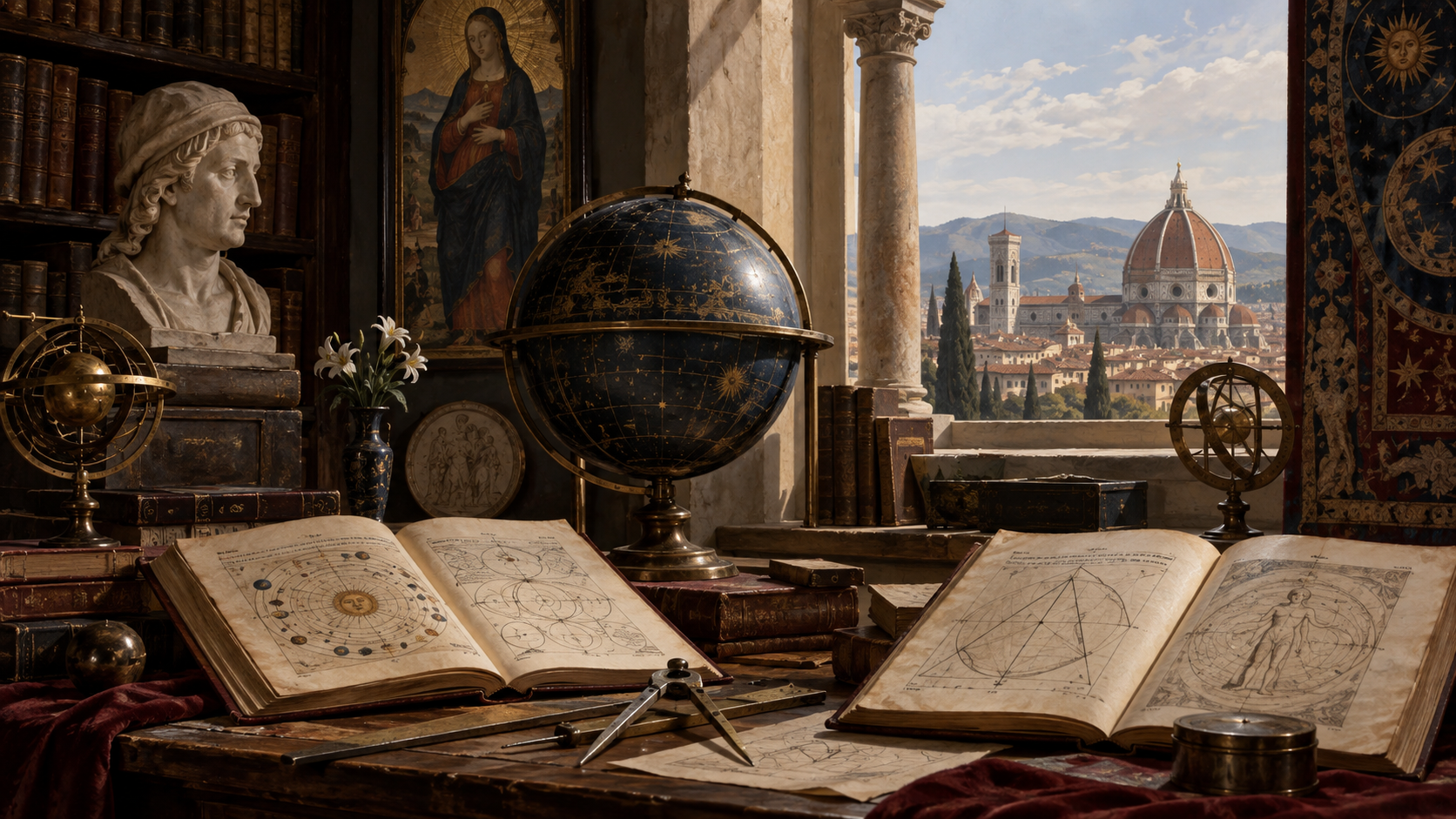
Ficino helped restore a Platonic vocabulary in which hierarchy, participation and cosmic sympathy could again be discussed together.
Dee's compressed cosmos
The Monas Hieroglyphica belongs within this Renaissance habit of synthesis, but it is not simply an illustration of Ficino or Plotinus. Dee was a mathematician with unusually broad interests in astronomy, navigation, astrology, alchemy, optics, antiquarian learning and what he would later describe as supercelestial philosophy. Nicholas Clulee's study of Dee has been particularly important in showing the inadequacy of dividing his career into a respectable mathematical half and an embarrassing occult remainder. Dee's projects are better understood as different applications of a natural philosophy concerned with the hidden order and powers of creation (Clulee 1988).
The Monas begins from elementary geometry. A line presupposes points; a circle presupposes a centre. Dee then identifies the central point and encompassing circle with cosmological meanings, allowing geometrical operations to become the basis of a symbolic construction. The familiar signs of Sun and Moon are joined to a cross of the elements and a curved form associated with Aries. The resulting glyph is then subjected to numerical and proportional analysis across the twenty-four theorems.
The procedure is easy to caricature because it repeatedly crosses categories that modern readers have been trained to separate. A geometrical fact becomes cosmological; an astronomical sign becomes alchemical; numerical relations acquire theological resonance. Yet Dee did not understand himself to be making arbitrary associations. The correspondences were supposed to reflect an order already present in nature. Stephen Clucas has shown how important Pythagorean number symbolism is to the Monas, particularly Dee's attempt to establish a disciplina nova in which mathematics can disclose structures shared by celestial, elemental and alchemical processes (Clucas 2010).
This is where the Monad becomes a particularly apt form. A single sign can be unfolded into a sequence of relations while remaining visibly one. Its unity is not the absence of complexity but the containment of complexity. Dee's twenty-four theorems perform that unfolding for the reader. The symbol is repeatedly disassembled and recombined until it operates less like a picture than a compact machine for thinking.
There is also a specifically hieroglyphic ambition. Renaissance discussions of Egyptian hieroglyphs frequently credited them with the ability to convey intellectual content through images rather than through the sequential conventions of alphabetic language. Dee's 'hieroglyphic' Monad participates in this expectation. The sign promises simultaneity: what a book must explain theorem by theorem may, in principle, be grasped together within the figure.
The promise should not be confused with success. The Monas has generated centuries of disagreement, and its obscurity cannot simply be blamed on modern ignorance. Dee writes elliptically, uses allusion heavily and appears to reserve some interpretative steps. C. H. Josten's annotated translation remains indispensable precisely because even basic relations within the text require reconstruction (Josten 1964). The book nevertheless demonstrates with unusual clarity what could happen when the ancient problem of unity entered Renaissance mathematical magic. The One became drawable.
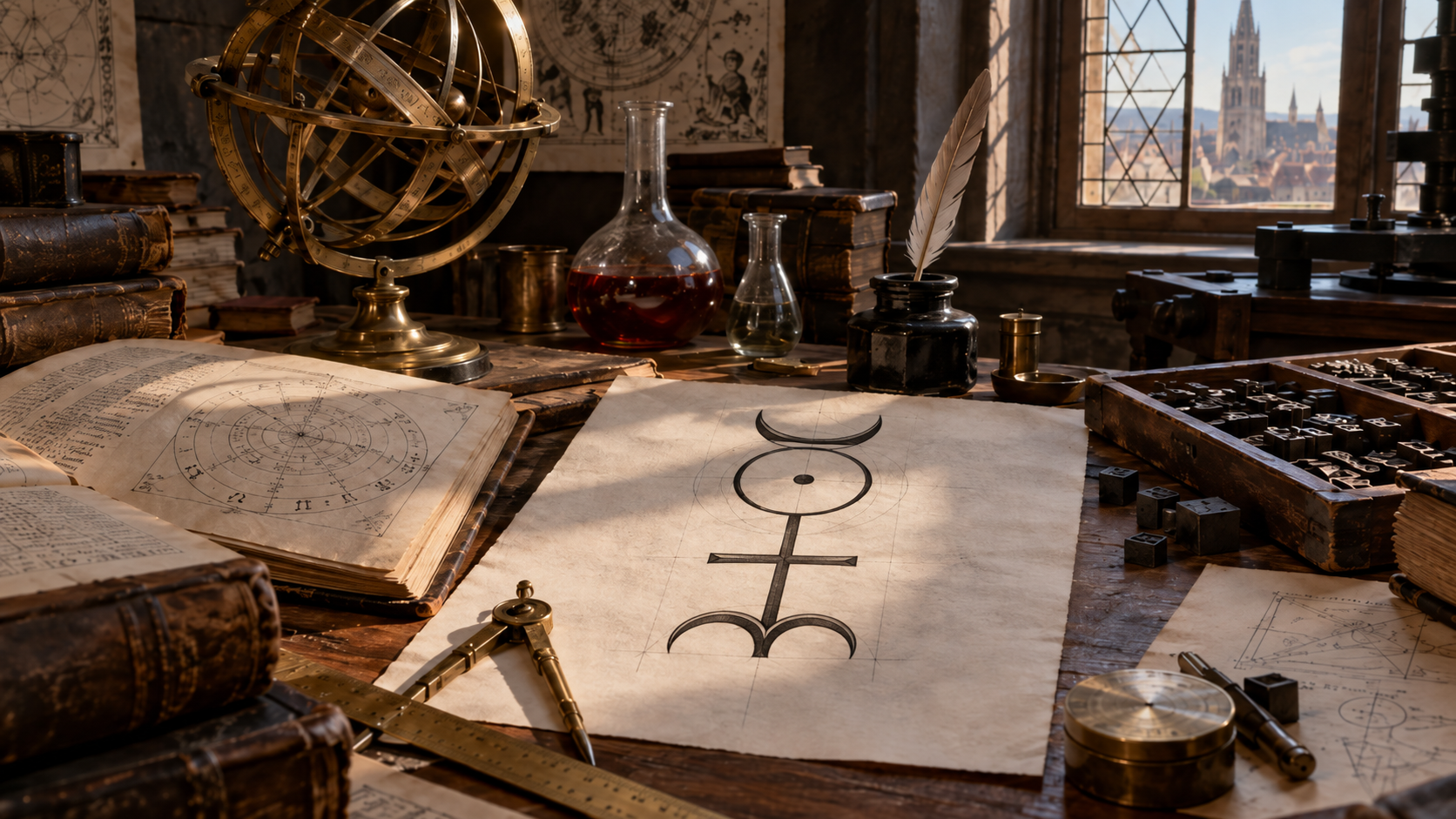
John Dee's Hieroglyphic Monad, 1564: a single constructed sign intended to gather mathematical, celestial, elemental and alchemical relations.
Leibniz: when the Monad becomes many
A century and a half later, Gottfried Wilhelm Leibniz gave the word monad another life. The short work now called the Monadology was written in French in 1714 as a compact statement of his mature metaphysics. Its opening proposition defines the monad as a simple substance entering into composites. 'Simple' here means without parts. Composite things can be analysed into components, and Leibniz therefore argues that there must ultimately be genuine unities which are not themselves aggregates (Monadology, sections 1-3).
These simple substances are not material atoms. Extension implies divisibility, so anything fundamentally simple cannot be extended matter. Monads instead possess internal states of perception and appetition. Each represents the universe from its own point of view, although most do so with vastly less clarity than a rational mind. Change arises from an internal principle rather than from physical parts entering or leaving the monad. Leibniz's famous claim that monads have no 'windows' expresses this absence of direct causal traffic between simple substances (Monadology, sections 7, 14-18).
The coordination we experience among things is accounted for by pre-established harmony. Each monad develops according to its own law, but those developments correspond because the created order has been established as a coherent whole. The metaphysics is thus simultaneously plural and systematic. Reality consists of innumerable centres of unity, each expressing the same universe from a different perspective.
The contrast with Dee is considerable. Dee compresses a cosmos into one hieroglyphic Monad. Leibniz populates the cosmos with monads beyond number. Dee's sign belongs to a Renaissance programme joining mathematics, alchemy and hieroglyphic interpretation; Leibniz is responding to seventeenth-century problems concerning substance, mechanism, extension, mind and the unity of composites. A straight line of influence would obscure more than it explains.
The shared vocabulary nevertheless remains revealing. Both projects confront the difficulty of genuine unity in a world of composites. In Leibniz the question becomes especially sharp because a body understood merely as extended matter appears to be indefinitely divisible. If reality contains genuine substances rather than only heaps, machines and aggregates, there must be something whose unity is intrinsic rather than borrowed from our way of describing it. The ancient language of the monad offered Leibniz a compact name for that requirement.

Leibniz pluralised the Monad: innumerable simple substances, each expressing the universe from its own perspective.
One problem, many lives
There is no single doctrine of the Monad running unchanged from Pythagoras to Leibniz. Even the Pythagorean starting point dissolves under historical scrutiny into early evidence, later reconstruction and Neopythagorean elaboration. Plotinus's One is not an arithmetical unit. Nicholas of Cusa uses mathematical limit to discipline theological thought. Ficino restores a Platonic and Hermetic intellectual environment in which unity, hierarchy and cosmic sympathy can again be discussed together. Dee constructs a hieroglyphic synthesis. Leibniz gives the old name to a universe of individual simple substances.
The changes are not incidental deviations from an original meaning. They are the history. The Monad persists because it can be made to address a recurring family of problems without determining their solution in advance. What is the difference between a genuine unity and a collection? How can multiplicity arise without dissolving order? Can the structure of number illuminate the structure of reality? How does a finite mind think about simplicity that exceeds the categories of finite things? Different periods answer these questions with different intellectual instruments.
The secret life of the Monad lies not in the transmission of a single doctrine, but in the persistence of a problem. Across very different philosophical systems, unity repeatedly becomes the means by which thinkers account for multiplicity, order and coherence. The terms change, the metaphysics change, and the intellectual purposes change with them. What survives is the question of how the many can be understood as belonging to a world that is, in some meaningful sense, one.
References and further reading
Aristotle. Metaphysics. Especially I.5 and XIII.6 for Aristotle's evidence and criticism concerning Pythagorean number theory.
Burkert, Walter. Lore and Science in Ancient Pythagoreanism. Trans. Edwin L. Minar Jr. Cambridge, MA: Harvard University Press, 1972.
Clucas, Stephen. 'Pythagorean Number Symbolism, Alchemy, and the Disciplina Noua of John Dee's Monas Hieroglyphica.' Aries 10, no. 2 (2010): 149-167.
Clulee, Nicholas H. John Dee's Natural Philosophy: Between Science and Religion. London and New York: Routledge, 1988.
Dee, John. Monas Hieroglyphica. Antwerp: Willem Silvius, 1564.
Ficino, Marsilio. Platonic Theology. Trans. Michael J. B. Allen with John Warden; ed. James Hankins. 6 vols. Cambridge, MA: Harvard University Press, 2001-2006.
Josten, C. H. 'A Translation of John Dee's Monas Hieroglyphica (Antwerp, 1564), with an Introduction and Annotations.' Ambix 12 (1964): 84-221.
Leibniz, G. W. Monadology (1714). In Philosophical Essays, trans. Roger Ariew and Daniel Garber. Indianapolis: Hackett, 1989.
Nicholas of Cusa. De docta ignorantia (On Learned Ignorance), 1440. Useful modern translations include those by Jasper Hopkins.
Plotinus. Enneads. Especially V.1, V.4 and VI.9 on the One, Intellect and the return to unity.