The Most Holy Trinosophia and the Problem of Esoteric Reading
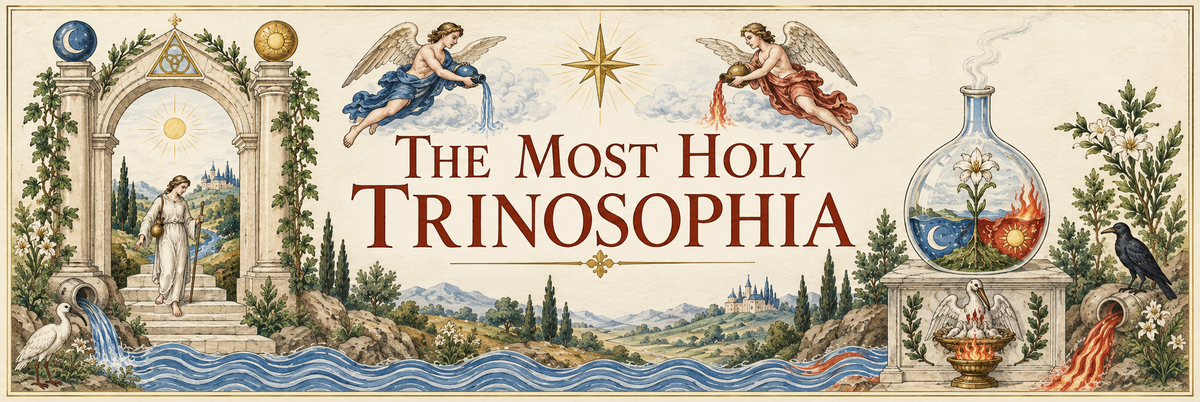
The Most Holy Trinosophia—La Très Sainte Trinosophie in the original French—is a richly illustrated esoteric manuscript produced during the eighteenth century and traditionally attributed to the Comte de Saint-Germain, the elusive courtier, musician and supposed alchemist whose uncertain origins and cultivated mystique later furnished Europe with one of its most durable occult legends. Arranged as a sequence of twelve episodes, it recounts a first-person journey through subterranean chambers, elemental ordeals and scenes of death, purification and rebirth. Whether Saint-Germain had any part in its composition is far from certain, but the attribution has become inseparable from the manuscript’s history—and provides the first of its many mysteries.
The Most Holy Trinosophia presents its reader with a familiar temptation. Its painted emblems, cryptic alphabets, biblical fragments, alchemical colours and ceremonial trials appear to promise that, if each symbol can be correctly identified, the concealed doctrine of the work will become plain. This is how esoteric manuscripts are often approached: the lion is assigned a meaning, the serpent another, the sequence of colours a third, until the work has been converted into a symbolic glossary. The method is attractive because it produces answers. It is less successful at explaining how the manuscript actually works.
The Trinosophia is better read as a constructed initiatory narrative in which images, actions, materials and inscriptions operate together. Its symbols do not form a simple code in which each visible object conceals one invisible meaning. They acquire significance through repetition, alteration and combination. Water cleanses, obstructs, conceals and transforms. Fire threatens the traveller, illuminates the chambers and activates the work. Colours migrate from buildings to garments and from garments to matter. Objects first encountered separately are eventually united. The manuscript does not merely describe transformation; it makes transformation the principle by which it is to be read.
A manuscript in search of an author
The work survives as manuscript 2400 in the Médiathèque Jacques-Chirac at Troyes. The catalogue records it as an eighteenth-century French manuscript under the title La Très Sainte Trinosophie. It is carefully calligraphed and extensively decorated with painted figures, vignettes, coloured initials and inscriptions in several scripts. The manuscript’s unusual visual richness is not incidental to its character. It was conceived as a composite object in which prose, emblem and typography contribute to the same experience. The Biblissima catalogue record dates its production broadly to the eighteenth century, while the Institut de recherche et d’histoire des textes classifies it as a French alchemical manuscript.
Its authorship is much less secure than its modern reputation suggests. The traditional attribution to the Comte de Saint-Germain depends principally upon a note placed at the beginning of the volume. Its writer, signing himself “I. B. C. Philotaume”, claims that the manuscript had belonged to him and was the sole surviving copy of Saint-Germain’s Trinosophia, the original having been destroyed by the Comte during his travels. The nineteenth-century catalogue of the Troyes collection repeated this account and added a suitably adventurous provenance: the volume had belonged to Alessandro Cagliostro, had been seized by the Roman Inquisition at his arrest in 1789, and had subsequently passed into the possession of the Masséna family before being purchased for the library at Troyes.
None of this is impossible, but neither is it independently demonstrated by the manuscript. A note asserting that a work is a unique copy of a lost composition is evidence for the history of the attribution, not proof of authorship. The account of its seizure from Cagliostro also appears to derive from the same tradition rather than from surviving inquisitorial documentation. René Alleau, in the bibliographical enquiry prefacing his 1971 French edition, regarded the attribution to Saint-Germain as doubtful and drew attention instead to parallels with the Egyptian Masonic system associated with Cagliostro. Paul Chacornac and Maurice Heim were similarly unconvinced that the work could be securely assigned to Saint-Germain.
The uncertainty is important because the Comte acquired a formidable posthumous existence. The historical Saint-Germain was a musician, courtier, diplomat, experimenter in dyes and habitual inventor of identities. By the nineteenth and twentieth centuries he had become an immortal adept, Rosicrucian master and custodian of primordial wisdom. These later identities strongly influenced the reception of the Trinosophia. They encouraged readers to treat the manuscript as the personal revelation of an initiate whose authority had already been established by legend.
Manly P. Hall’s 1933 parallel French and English edition did more than any other publication to consolidate that reading. Hall described the work as the sole known mystical writing of Saint-Germain and one of the most important surviving documents of the Hermetic sciences. He proposed three principal keys—alchemy, Kabbalah and Alexandrian Hermetism—and connected the text with Rosicrucianism, Egyptian Freemasonry and the nineteenth-century Lodge of the Trinosophists. His edition made the work available to an English-speaking audience, but his introductory claims belong to the esoteric reception of the manuscript rather than to a critical history of it. His assertion that it preserves the doctrines of Saint-Germain and his associates is precisely what remains to be proved. The complete text of Hall’s edition remains useful, provided that the translation and Hall’s commentary are not mistaken for neutral witnesses.
The prudent designation is therefore The Most Holy Trinosophia, attributed to the Comte de Saint-Germain. The absence of a known author need not diminish the work. It returns attention to the evidence actually before us: a late eighteenth-century manuscript assembled by someone thoroughly conversant with the symbolic resources of alchemy, Christian Scripture, classical mythology and contemporary initiatory culture.

The prisoner and the initiate
The opening section is framed as an address from an imprisoned adept to a disciple named Philochates. Writing from the dungeons of the Inquisition, the narrator promises to disclose the sanctuary of the sublime sciences. He claims to have commanded the spirits governing the world, but to have lost his freedom through a moment of indiscretion. His warning to the disciple concerns two related offences: the abuse of power and the desire to astonish others by revealing what ought to remain concealed.
This prologue should not be read as straightforward autobiography. The prison may invite association with Cagliostro, who was confined by the Inquisition, but it also supplies the work with a literary situation. The narrator possesses knowledge but has been deprived of ordinary agency. His body is confined while his instruction escapes the prison. Secrecy is presented simultaneously as an ethical obligation, a protection against persecution and a condition of transmission.
The claim that the manuscript was painted in prison using the flame of a lamp, a few coins and chemical substances overlooked by the guards is particularly ingenious. It integrates the physical book into its own fiction. The colours on the page become the products of chemical art, manufactured by the imprisoned adept from base materials. The manuscript is therefore made to resemble the process it teaches: matter is manipulated under confinement and converted into a vehicle of illumination. Whether or not the story is historically true, it is thematically exact.
The narrator then recounts his own initiation. At night he approaches the Solfatara near Naples, veiled in linen and carrying a golden bough. The classical reference is difficult to miss. In the sixth book of Virgil’s Aeneid, the Sibyl instructs Aeneas to obtain the golden bough before descending into the underworld. The Trinosophia relocates that descent to one of the most suggestive landscapes available to an alchemical imagination: a volcanic field in which sulphur, fire and subterranean force are visibly present.
After placing the branch upon a triangular iron altar, the traveller is surrounded by smoke and descends into darkness. He awakens in an underground passage furnished with a white robe, a copper lamp and inscriptions directing his course. A crystal star leads him through a sequence of chambers. The setting combines the underworld journey with the spatial grammar of initiation: enclosure, darkness, prescribed movement, successive thresholds and the partial disclosure of knowledge.
The experience is narrated in the first person, but the “I” is less a fully formed character than the subject upon whom the work is performed. We learn almost nothing of his life beyond his trials. His body is immersed, heated, clothed, washed, exhausted, strengthened and recoloured. He functions simultaneously as traveller, candidate and alchemical material.

Elements, colours and the discipline of passage
The early stages of the journey are organised around elemental ordeals. The traveller crosses water after climbing nine steps to a white marble platform. While struggling in the waves, he is approached by a crowned figure offering rescue in a boat whose prow points back towards the shore he has left. He refuses the offer by adapting Psalm 118: “It is better to trust in the Lord than to place confidence in princes.” The crowned guide and his vessel immediately disappear.
This episode is not simply a moral lesson about perseverance. The traveller is offered assistance that would reverse the direction of the work. His refusal establishes an important rule: advancement requires fidelity to the process even when an easier path is presented by an apparently authoritative figure. Kingship, wealth and worldly magnificence recur throughout the manuscript, but they do not by themselves confer wisdom. The initiate must learn to distinguish the splendour of the work from the splendour of power.
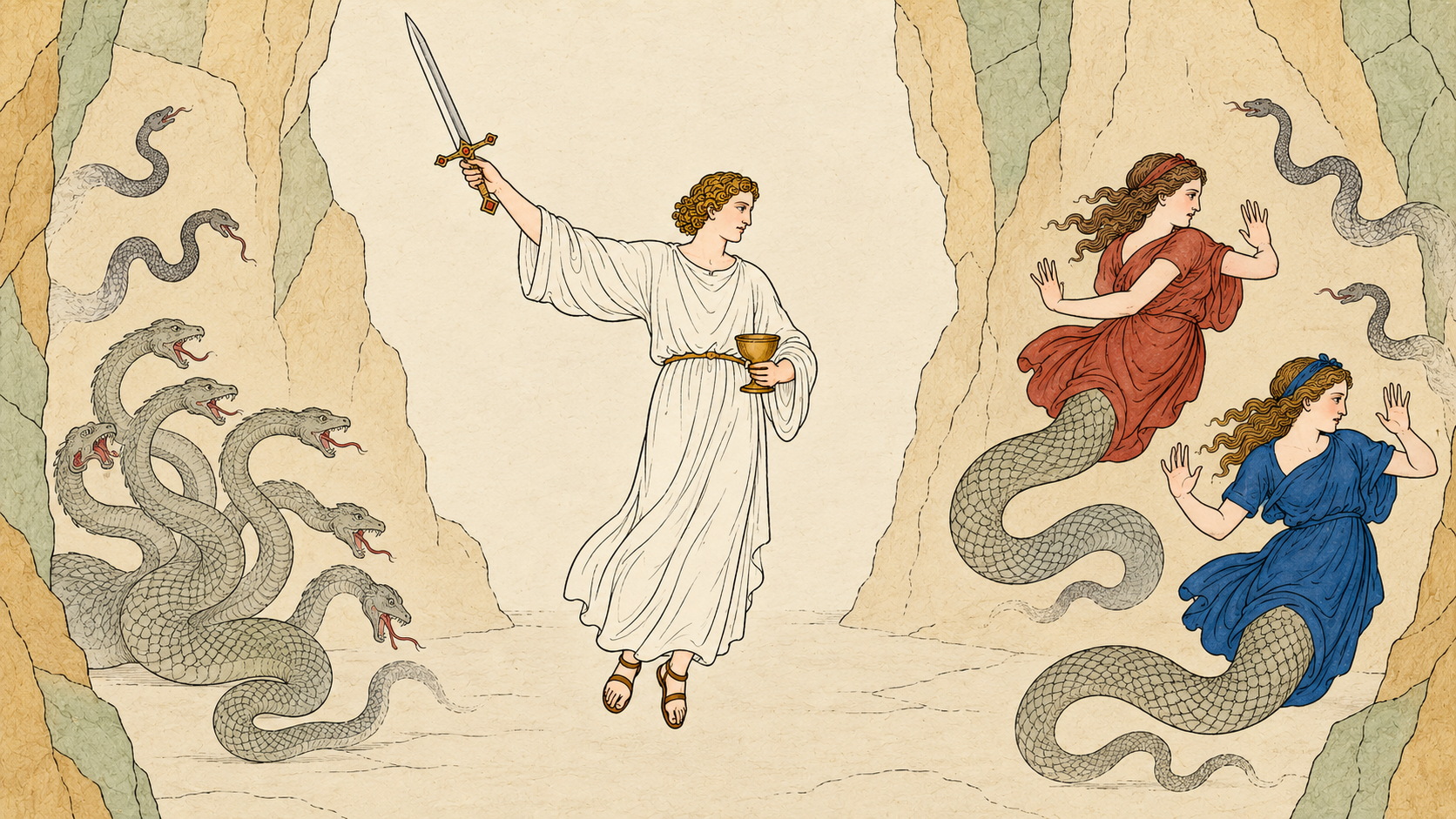
Water gives way to fire. The traveller crosses a lake of burning sulphur and bitumen and enters a circular chamber surrounded by forty columns, each divided between a brilliant white flame and a shadowed black one. At its centre stands a serpent-shaped altar, beside which lie a sword and cup. Commanded to strike the serpent, he obeys. The blow does not kill an animal; it causes the entire chamber to dissolve and propels him upwards through the layers of the earth.
The episode resists reduction to a single mythological identification. The serpent may be read as matter, volatility, cyclical nature, hidden fire or the power to be subdued. The sword may signify separation, judgement or the intervention of will. The cup introduces containment and reception. Their meaning arises from the action performed among them. The traveller takes the cup and strikes with the sword; passive and active instruments must be held together. The result is not destruction but transition.
This attention to process becomes clearer in the Palace of Wisdom. Its four tiers of columns are white, black, green and red. Comparable colour sequences occur throughout alchemical literature, although their number and order are far from uniform. Black commonly marks putrefaction or the nigredo; white purification or the albedo; and red the completion associated with the rubedo. Green can indicate living matter, vegetation, renewal or an intermediate vitality. The Trinosophia does not present these colours as a formal table. It distributes them through architecture, garments, sands, liquids, animals and metals, allowing the state of the work to become visible in its environment.
A venerable figure in the palace rebukes the traveller for hesitating before an altar, bird and torch described collectively as “the symbol of all things”. Because he paused to examine them rather than seizing them at once, the opportunity has passed, and he must complete a longer course. There is a mild irony here. The reader of an emblematic manuscript is naturally inclined to stop and interpret; within the narrative, excessive contemplation delays possession. Knowledge depends upon perception, but perception alone is insufficient. The initiate must act at the appropriate moment.
The subsequent purifications are conspicuously material. The traveller enters an oval steel vessel supported upon three brass feet and immerses himself in its water for prescribed periods. The liquid changes its qualities, becoming corrosive before returning to clarity. He rubs his body with a mass of shining white salt, crosses a lake as thick as cement and enters a black building decorated with images of death and putrefaction. These are not merely spiritual abstractions dressed in alchemical language. They derive their force from the practical vocabulary of vessels, heat, duration, saturation, corrosion, residue and colour change.
This does not make the Trinosophia a laboratory manual. Its operations cannot readily be reproduced as a coherent chemical procedure, and the body of the narrator repeatedly occupies the place of the substance. It is more accurately an alchemical fiction: a narrative that borrows the conditions of material transformation to represent an initiatory transformation of the subject. The distinction between operator and material has deliberately collapsed.

A composite language of wisdom
The manuscript’s multilingual inscriptions have often been cited as evidence of extraordinary erudition or as fragments of a secret universal language. Hebrew, Greek, Latin, Arabic and script resembling Egyptian hieroglyphs or cuneiform appear beside geometrical and alchemical characters. Some passages can be identified; others are corrupt, idiosyncratic or only approximately ancient.
Raphael Patai, in The Jewish Alchemists (1994), noted that the work displays real acquaintance with Hebrew and Aramaic material, although not all of its inscriptions are linguistically sound. This mixture is characteristic of the manuscript as a whole. It is learned without being philologically disciplined. Its author was drawing upon bodies of knowledge that carried antiquity and authority, but did so within an eighteenth-century environment in which Egyptian writing had not yet been deciphered and “hieroglyphic” frequently meant symbolic rather than linguistic.
The Egyptian appearance of the work therefore requires qualification. It precedes Champollion’s decipherment of hieroglyphs in the 1820s. Its Egypt is the sacerdotal Egypt constructed by European antiquarians, Hermetists and Freemasons: a culture imagined to have concealed theology and natural philosophy beneath symbols. Athanasius Kircher’s Oedipus Aegyptiacus and Antoine Court de Gébelin’s Monde primitif are important precedents for this intellectual world. Both treated ancient signs as survivals of a primordial wisdom, although neither possessed a reliable method for reading Egyptian language.
This helps to explain the coexistence of genuine quotation, damaged language and invented script. The inscriptions do not always communicate by being translated. They also establish an atmosphere of antiquity, universality and restricted access. Their visual presence informs the reader that several traditions converge in the work and that no single ordinary language is sufficient to contain its subject.
Manly Hall interpreted this complexity as deliberate cryptographic concealment. There is some warrant for the claim: the manuscript includes ciphers, reversals and incomplete forms. Yet obscurity need not imply that one exact statement has been encrypted beneath every passage. In esoteric literature, concealment can organise the reader’s behaviour as much as protect information. It slows reading, demands comparison, distinguishes the patient from the casual and ensures that interpretation remains part of the initiatory labour.

The architecture of the work
The final stages make the alchemical organisation increasingly explicit. In a palace marked by the image of a butterfly, the traveller sees a man rising from a tomb and reaching towards a golden crown. The butterfly supplies a conventional image of metamorphosis and the liberated soul, while the emerging figure joins resurrection to the completion of the work.
He then pursues a winged bird into an iron tower and encounters a tableau in which a youthful figure carrying a staff entwined by two serpents is chained by an armed man. The figures invite identification with Mercury and Mars. Mercury is mobile, volatile and elusive; Mars is armed, forceful and associated with iron. The scene converts relations among alchemical principles into mythological drama. Volatility is captured and fixed through the agency of the martial metal.
The concluding chamber resembles the interior of a transparent globe resting upon a basin of red sand. Gentle heat fills the enclosure. A moist, saffron-coloured vapour raises the traveller to its summit over thirty-six days and then slowly deposits him upon the floor. His robe, previously green, becomes brilliant red, while the red sand beneath the globe turns black. The resemblance to a heated vessel is unmistakable. The initiate has entered the apparatus and become the substance undergoing circulation.
At the conclusion he returns to the Hall of Thrones. The altar, bird and torch, previously separate, have become a single body. He strikes a golden sun with the sword, reducing it to dust; when he touches the fragments, every particle becomes another golden sun. A voice announces that “the work is perfect”. The doors of immortality open, the cloud covering mortal sight disappears, and the narrator declares: “I saw.”
The ending gathers together the principal movements of the manuscript. Separation gives way to conjunction; one sun becomes many; colour reaches red; the confined body acquires transformed sight. The goal is expressed as immortality and mastery of the elements, but the decisive verb concerns perception. The initiate does not merely learn a proposition. He becomes capable of seeing a world that had previously been veiled.

Reading without solving
The Trinosophia belongs to the crowded borderland between manuscript art, alchemical allegory and initiatory literature. It shares features with the Chymical Wedding of Christian Rosenkreutz, first published in 1616: an elected traveller, a difficult journey, ceremonial spaces, enigmatic inscriptions and transformations represented through material operations. It also reflects the particular conditions of the later eighteenth century, when elaborate Masonic degrees, Rosicrucian systems, biblical Kabbalah and speculative Egyptology supplied a common symbolic vocabulary. Its precise institutional affiliation, if it had one, remains uncertain.
Calling the work Masonic, Rosicrucian, Kabbalistic or Hermetic is therefore less useful than asking what each vocabulary contributes. Its ceremonial architecture is compatible with initiatory Freemasonry, but it is not recognisable as the transcript of an ordinary lodge ceremony. Its colours and operations are alchemical, but they do not constitute a reproducible laboratory recipe. Its Hebrew inscriptions invoke Kabbalistic authority, but they do not amount to a systematic exposition of Kabbalah. Its Egyptian signs confer antiquity without recording Egyptian speech.
The work’s coherence lies in the arrangement of these materials. Each tradition offers a different way of representing the same underlying process: descent, dissolution, purification, conjunction and altered perception. This is probably the most defensible meaning of its “threefold wisdom”. The title need not identify three neatly separated doctrines. It may instead describe a wisdom disclosed through several mutually interpreting forms.
There is consequently no final key that makes the manuscript cease to be obscure. Its symbols can be historically situated and many of its allusions can be identified, but the work was designed to sustain interpretation rather than submit to one exhaustive decoding. To read it well is not to choose between alchemy and initiation, laboratory and temple, image and prose. It is to observe how the manuscript repeatedly converts one into another.
References
Alleau, René, ed. La Très Sainte Trinosophie: édition intégrale du texte du manuscrit unique de la Bibliothèque de Troyes et des variantes des “Annales maçonniques” (1808), précédée d’une enquête bibliographique et historique. Paris: Denoël, 1971.
Faivre, Antoine. Access to Western Esotericism. Albany: State University of New York Press, 1994.
Grillot de Givry, Émile. Witchcraft, Magic and Alchemy. Translated by J. Courtenay Locke. London: George G. Harrap, 1931.
Hall, Manly P., ed. and trans. The Most Holy Trinosophia of the Comte de St.-Germain. Los Angeles: Phoenix Press, 1933.
Hanegraaff, Wouter J. Esotericism and the Academy: Rejected Knowledge in Western Culture. Cambridge: Cambridge University Press, 2012.
Patai, Raphael. The Jewish Alchemists: A History and Source Book. Princeton: Princeton University Press, 1994.