The Library of Impossible Books
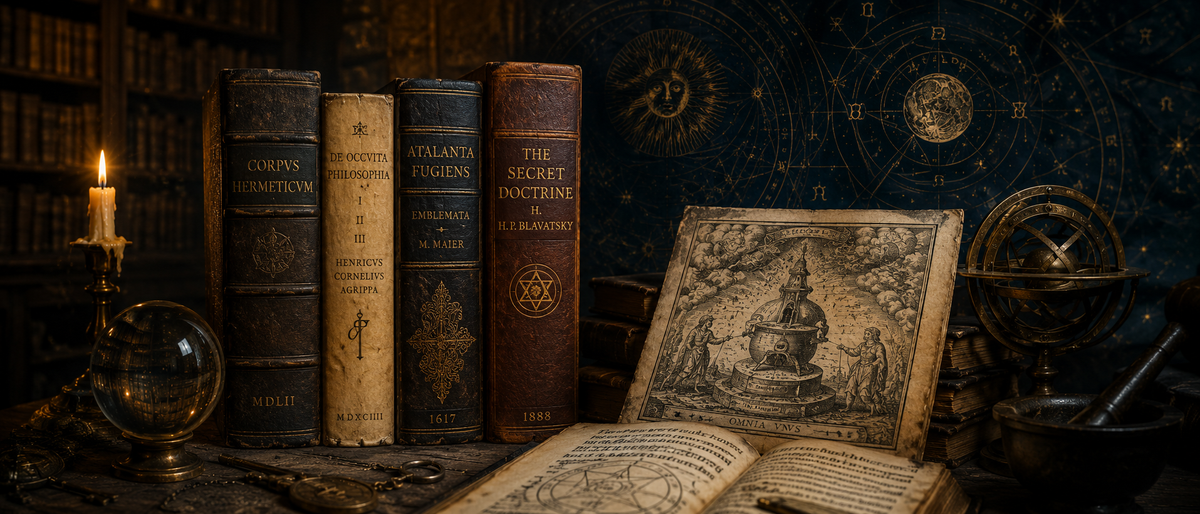
Modern people inherit an extraordinary quantity of knowledge.
We know the age of the universe, the structure of DNA, the composition of distant stars, the history of extinct species, the mechanisms of disease, and the mathematics required to place instruments on other worlds. The accumulation of knowledge since the seventeenth century is one of the great achievements of civilisation.
Yet a visitor wandering through the shelves of the Western Esoteric Tradition may encounter a different understanding of what knowledge is for.
The Corpus Hermeticum, Agrippa's De Occulta Philosophia, Maier's Atalanta Fugiens, and Blavatsky's The Secret Doctrine were written in different centuries and under very different circumstances. They disagree about many things. Their cosmologies are often incompatible. Their authors belonged to worlds separated by language, religion, politics, and culture.
What unites them is not a common doctrine but a common orientation.
Knowledge, in these texts, is rarely presented as the accumulation of information. It is presented as a means of transformation.
To know something truly is to become something.
The distinction appears repeatedly throughout the history of Western thought. Plato did not regard philosophy as an academic discipline. The purpose of philosophy was not merely to possess correct opinions but to reorder the soul. Medieval theology understood knowledge as a path toward wisdom. Renaissance thinkers frequently assumed that understanding the structure of reality carried ethical and spiritual consequences. Even the word contemplation once implied a mode of attention quite different from modern habits of information consumption.
The books of the esoteric tradition emerged from this broader intellectual landscape.
The Corpus Hermeticum concerns itself with consciousness, self-knowledge, and humanity's place within the cosmos. Agrippa sought correspondences linking the visible and invisible dimensions of reality. Alchemical authors treated material processes as mirrors of inner transformation. Nineteenth-century esoteric movements attempted to situate human life within narratives larger than economics, politics, or biology.
The modern reader may find many of the answers unconvincing. That is hardly surprising. Historical distance separates us from the assumptions that produced these works. The universe described by a Hermetic philosopher or Renaissance magus is not the universe described by contemporary physics.
The questions are more difficult to dismiss.
What is consciousness?
Can human beings be transformed?
What is wisdom?
Does reality possess meaning beyond utility?
What role do symbols play in human understanding?
The books persist because these questions persist.
This may explain a curious feature of intellectual history. The practical literature of previous centuries often disappears once its usefulness has expired. Obsolete medical manuals rarely attract devoted readers. Forgotten technical works tend to remain forgotten. The esoteric classics continue to be republished, translated, annotated, criticised, and rediscovered.
Readers return to them for the same reason that readers return to Plato, Dante, or Goethe. Not because they contain information unavailable elsewhere, but because they participate in conversations that remain unfinished.
The Enlightenment altered the character of those conversations. Questions of mechanism, measurement, prediction, and control moved steadily toward the centre of intellectual life. The success of that movement is visible everywhere around us. Modern science and technology stand among humanity's greatest achievements.
Other questions gradually migrated toward the margins.
Questions concerning meaning, symbolism, transformation, wisdom, and participation became harder to situate within institutions increasingly organised around specialised forms of expertise. The questions themselves never vanished. They simply ceased to occupy the same position they once had.
Much of nineteenth-century esotericism can be understood against this background. The Hermetic revival, Theosophy, symbolism, comparative religion, and related movements emerged from a growing sense that something had become fragmented. Their answers differed. Their diagnoses differed. Their shared intuition was that human beings required more than information.
The twentieth century rendered that intuition both more difficult and more urgent. Two world wars, ideological conflict, technological bureaucracy, and global consumer culture transformed the conditions under which questions of meaning could be pursued. Grand syntheses became harder to sustain. The appetite for them did not disappear.
Perhaps this is why certain books continue to survive long after the worlds that produced them have vanished.
They preserve traces of an older conviction: that knowledge should not merely explain reality but orient human beings within it.
Whether that conviction is true remains open to debate.
The library remains open because the question remains open.