Spiritual Alchemy
Spiritual alchemy is one of the most enduring and symbolically rich currents within the Western Esoteric Tradition. It develops from the older art of alchemy, with its laboratory operations, metallurgical imagery, medicinal aspirations, and pursuit of transformation, but interprets these processes as signs of an inward work. In spiritual alchemy, the transmutation of base metals into gold becomes a language for the purification, death, renewal, and perfection of the human being. This does not mean that all alchemists were merely writing psychology in code, which is one of those tidy modern simplifications that makes history easier by making it worse. Rather, it means that alchemical symbolism proved capable of carrying both material and spiritual meanings, often at the same time.
Alchemy had ancient and medieval roots in Hellenistic Egypt, the Islamic world, and medieval Europe, where practical operations involving metals, minerals, distillation, calcination, sublimation, and elixirs developed alongside philosophical and religious speculation. By the Renaissance and early modern period, alchemical language had become increasingly available for spiritual interpretation. The furnace, vessel, matter, fire, mercury, sulphur, salt, dissolution, conjunction, putrefaction, whitening, reddening, and the philosopher’s stone could all be understood as referring not only to substances, but to states and processes within the soul. Spiritual alchemy took seriously the idea that nature and the human being mirror one another, and that transformation in one register could illuminate transformation in another.
The central premise of spiritual alchemy is that the human being is unfinished. The soul, like base matter, is mixed, impure, divided, and bound to lower conditions. Through discipline, suffering, contemplation, illumination, and divine assistance, it may be refined into a more perfect state. The alchemical opus, or work, provides a symbolic map for this process. The nigredo, or blackening, often signifies dissolution, death, confusion, melancholy, or the confrontation with corruption. The albedo, or whitening, suggests purification, clarification, and the emergence of a renewed spiritual condition. The rubedo, or reddening, represents completion, integration, vitality, and the full realisation of the transformed life.
This symbolic pattern became especially powerful because it did not present spiritual development as smooth moral improvement. Alchemy knows that transformation begins in darkness, heat, breakdown, and disorder. The matter must be reduced, dissolved, and exposed before it can be renewed. This gave spiritual alchemy a psychological and existential depth that later mystical and esoteric traditions found compelling. It allowed suffering, failure, obscurity, and inner conflict to be understood not merely as obstacles, but as phases in a larger work. The soul does not become gold by positive thinking and tasteful stationery. It is subjected to fire.
Heinrich Khunrath is one of the key figures in the spiritualisation of alchemy. His Amphitheatrum Sapientiae Aeternae presents alchemy as inseparable from prayer, Christian devotion, divine wisdom, and the contemplative life. Khunrath’s famous imagery, especially the engraving of the alchemist’s laboratory-oratory, captures the union of work and worship. The true alchemist labours both at the furnace and before the altar. This fusion of laboratory and chapel became one of the defining images of spiritual alchemy: nature is investigated, but only through reverence; matter is transformed, but only in relation to divine wisdom; the operator must himself be changed if the work is to be genuine.
Michael Maier also stands as a major figure in the alchemical imagination of the early seventeenth century. His Atalanta Fugiens combines emblem, music, poetry, and commentary into one of the great multimedia works of early modern esotericism, because apparently the seventeenth century invented the concept album and then hid it inside Latin alchemy. Maier’s work exemplifies the emblematic quality of spiritual alchemy. Images, myths, classical references, and symbolic puzzles are not decorative additions to doctrine; they are part of the mode of instruction. The reader is invited to contemplate, decode, and inwardly participate in the work.
The relation between spiritual alchemy and Christian esotericism is especially important. Early modern spiritual alchemy often interpreted the alchemical process through Christian themes of fall, death, resurrection, redemption, and divine wisdom. The philosopher’s stone could be associated with Christ, not simply as metaphor but as a sign of the divine principle that heals division and perfects nature. The alchemical marriage, the reconciliation of opposites, the rebirth of the king, and the restoration of the primordial condition all resonated with Christian mystical and theosophical ideas. This made alchemy a powerful symbolic bridge between natural philosophy and spiritual theology.
Spiritual alchemy also contributed to the emergence and atmosphere of Rosicrucianism. The Rosicrucian manifestos drew upon alchemical, medical, reforming, and Christian esoteric themes, presenting the image of a hidden fraternity devoted to universal renewal. Alchemy in this context was not merely a craft of metals, but a language of reformation: the healing of knowledge, religion, society, and the human being. Figures such as Maier and Robert Fludd helped connect alchemical symbolism with broader Rosicrucian currents. Spiritual alchemy gave Rosicrucianism much of its depth, secrecy, and transformative imagery.
The symbolism of spiritual alchemy also had a long afterlife in modern esotericism, depth psychology, literature, and occult philosophy. Later readers, especially in the nineteenth and twentieth centuries, increasingly emphasised alchemy as a map of inner transformation. This interpretation reached its most famous modern expression in the work of C. G. Jung, who treated alchemical imagery as a symbolic record of psychic individuation. While Jung’s reading should not be projected backward onto all historical alchemy, it does testify to the extraordinary capacity of alchemical symbols to describe inner processes of fragmentation, confrontation, integration, and renewal.
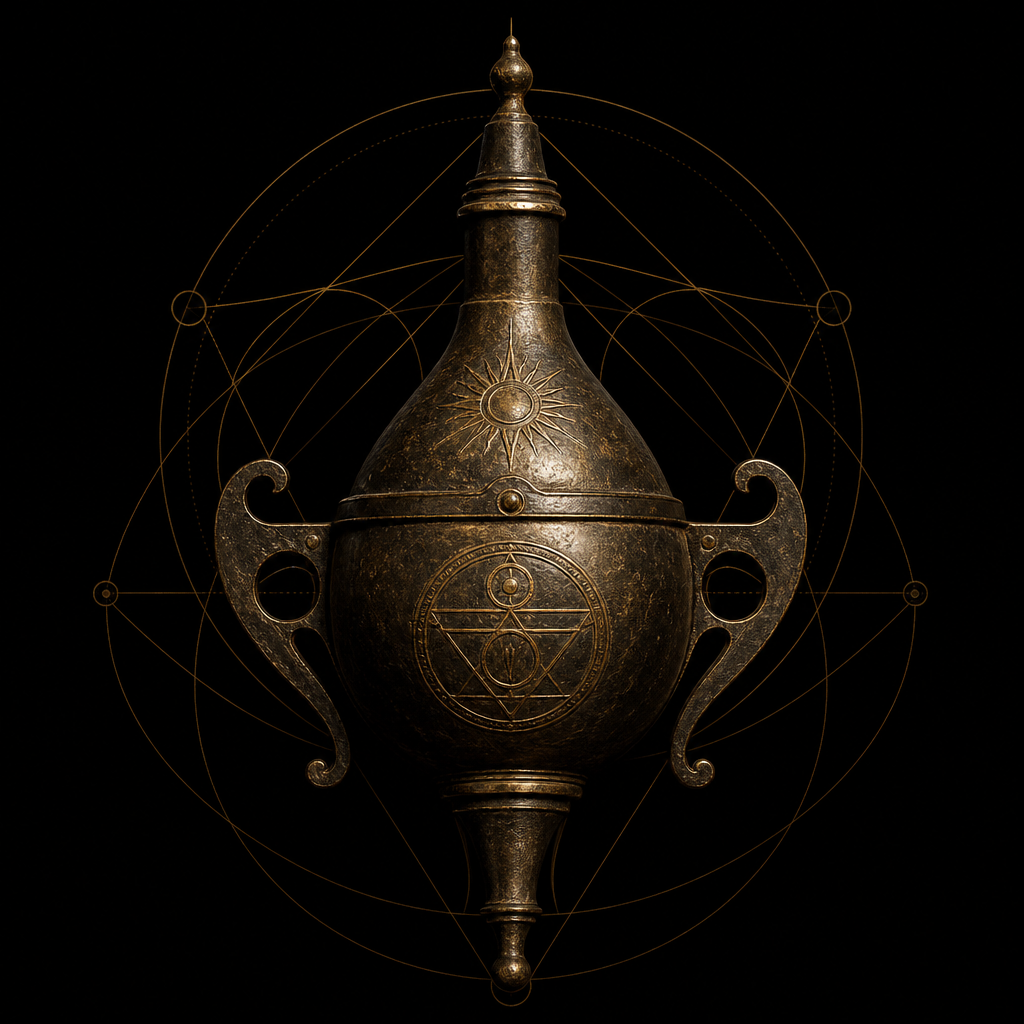
The enduring importance of spiritual alchemy lies in its refusal to separate matter, symbol, and soul. It treats the visible operations of transformation as signs of invisible processes, and it assumes that the human being participates in the same patterns that govern nature. The alchemical vessel becomes the body, the imagination, the soul, the cosmos, and the sacred enclosure of transformation. Fire becomes suffering, discipline, grace, and divine energy. Gold becomes not only a metal, but the image of incorruptible perfection. This symbolic density gave Western esotericism one of its most powerful languages for spiritual change.
Spiritual alchemy should therefore be understood as a major bridge between practical alchemy, Christian mysticism, natural philosophy, and later occult symbolism. Its mapped significance lies especially in its influence upon Rosicrucianism, where the alchemical work became part of a larger dream of spiritual and cultural reformation. It offered the Western Esoteric Tradition a model in which transformation is at once natural, ritual, moral, intellectual, and divine. Few currents have so successfully joined the laboratory, the chapel, the imagination, and the interior life into a single symbolic work.
Antecedent Traditions
· None mapped
Succeeding Traditions
· Rosicrucianism