Speculative Freemasonry
Speculative Freemasonry is one of the most important initiatory and symbolic systems to emerge from early modern Europe. It developed from, or at least through, the structures and vocabulary of operative stonemasonry, but transformed the craft of building into a moral, philosophical, and initiatory discipline. By the early eighteenth century, especially after the formation of the Premier Grand Lodge in London in 1717 and the publication of Anderson’s Constitutions in 1723, Freemasonry had become a fraternal institution whose working tools, lodge organisation, architectural language, and legendary histories were used to teach ethical formation, social harmony, and spiritual reflection. Its genius lay in turning the builder’s art into a symbolic grammar of human improvement.
The transition from operative to speculative masonry was not a single clean event. It unfolded across seventeenth- and early eighteenth-century Britain and Europe, as non-operative gentlemen, antiquarians, clergy, professionals, and intellectuals entered lodges that had once been tied more closely to the building trades. The reasons for this transition remain debated, because history apparently enjoys withholding documentation at exactly the points one most wants it. What is clear is that the lodge became a space in which craft identity, moral instruction, sociability, ritual, and symbolism could be reorganised around the making of the person rather than the making of stonework.
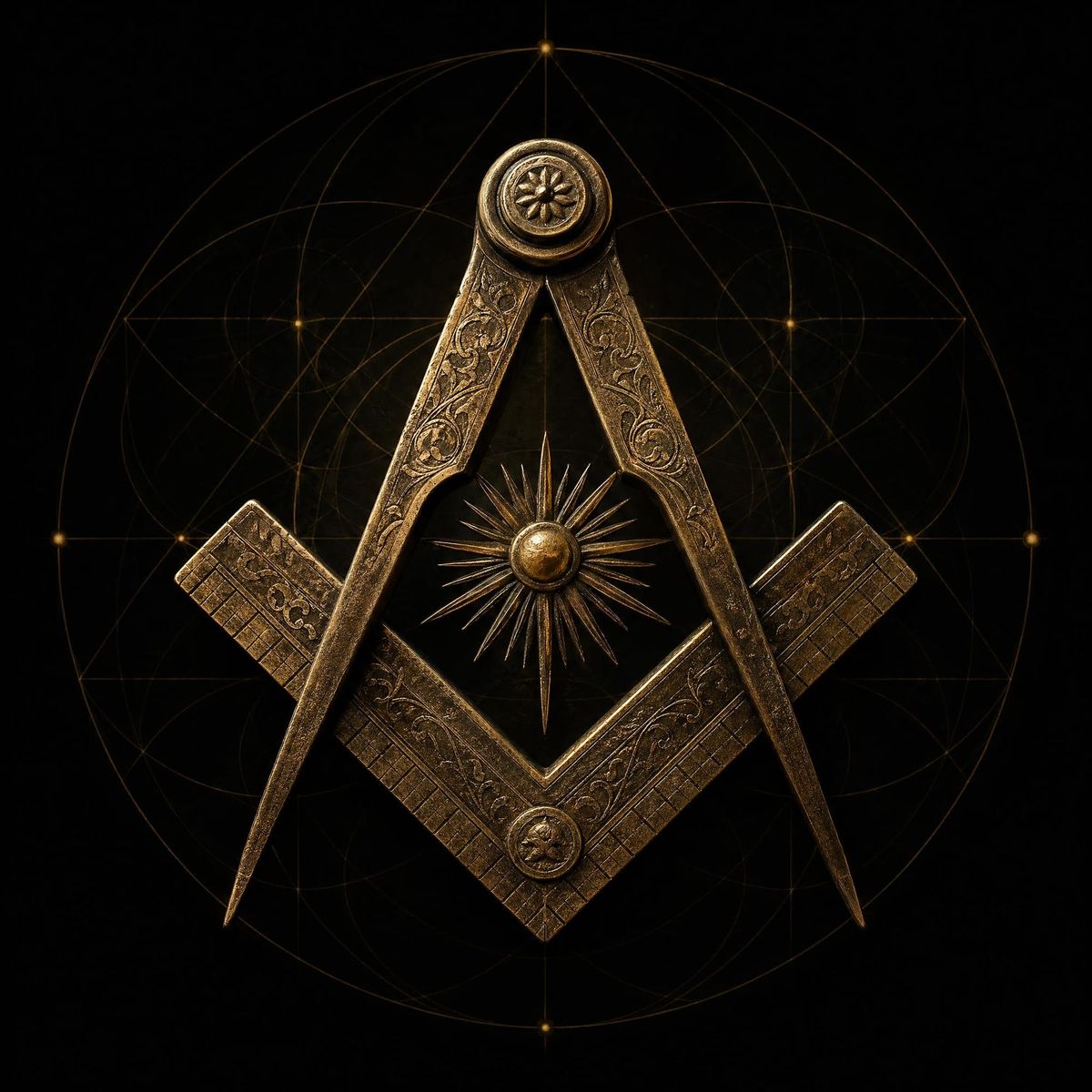
Operative Masonic guilds supplied the fundamental vocabulary. The lodge, the apprentice, the fellow, the master, the square, the compasses, the level, the plumb, the rough and perfect ashlar, and the importance of geometry all derive their force from the world of building. Speculative Freemasonry reinterpreted these elements. The square became an emblem of moral rectitude, the compasses of proper bounds and spiritual measure, the ashlar of the human being shaped from roughness toward refinement. Geometry, once a practical and mathematical art, became a symbol of divine order and intellectual discipline. Architecture became anthropology.
Rosicrucianism contributed a different kind of influence: the dream of hidden wisdom, moral and spiritual reform, symbolic transformation, and fraternity. Freemasonry did not simply emerge from Rosicrucianism, and claims of direct institutional descent are usually more confident than the evidence allows. Yet Rosicrucian themes circulated widely in the same cultural world: the recovery of ancient knowledge, the purification of the self, the reform of society, the value of secrecy, and the use of symbolic structures to communicate truths that cannot be reduced to plain doctrine. These themes helped give speculative masonry an atmosphere of deeper significance beyond convivial association.
Renaissance Christian Kabbalah and Hermetic magic also form part of Freemasonry’s wider intellectual background. Masonic ritual does not simply reproduce Kabbalistic or Hermetic doctrine, and its core symbolic system is more restrained than many later occult readings suggest. Nevertheless, early modern esoteric currents helped shape the symbolic environment in which Freemasonry developed. The macrocosm-microcosm analogy, the sacredness of geometry, the idea of lost wisdom, temple symbolism, divine names, light as knowledge, and initiation as moral and spiritual ascent all belong to the broader Hermetic and Christian esoteric inheritance. Freemasonry absorbed these motifs selectively, often in moralised and architectural form.
The Temple of Solomon became one of Freemasonry’s central symbolic structures. In biblical and later legendary imagination, the Temple represented divine presence, sacred architecture, wisdom, order, and the union of heavenly design with earthly craftsmanship. Freemasonry transformed this temple symbolism into an initiatory drama. The candidate is not merely told about moral improvement; he is placed within a symbolic architecture where building, loss, recovery, obligation, and light become experiences. The temple is both historical image and interior model. It represents the ordered soul, the moral life, the fraternity, and the sacred cosmos.
The early Masonic ritual system developed through degrees, most notably Entered Apprentice, Fellow Craft, and Master Mason. These degrees provide a graded symbolic journey from initiation and moral discipline to intellectual development and confrontation with mortality. The Master Mason degree, with its drama of fidelity, death, and symbolic restoration, became especially important for later esoteric interpretations. It offered a powerful ritual form through which themes of loss, secrecy, death, resurrection, and the recovery of meaning could be explored without formal dogma. This capacity for symbolic depth without doctrinal closure is one reason Freemasonry proved so adaptable.
Freemasonry’s relationship to religion is central to its character. It generally required belief in a Supreme Being while avoiding sectarian theology within the lodge. This allowed men of different Christian denominations, and later broader religious affiliations, to meet within a shared moral and symbolic framework. The lodge became a space where religious language could be retained while confessional conflict was softened. In a Europe still marked by religious division, this was not a trivial achievement. Freemasonry offered a ritualised form of moral universalism, though admittedly one with aprons, passwords, and enough procedural detail to satisfy the bureaucratic instincts of civilisation.
The Enlightenment context also shaped Speculative Freemasonry. Lodges became centres of sociability, philanthropy, education, political discussion, and cosmopolitan exchange. Masonic ideals of brotherhood, tolerance, virtue, self-improvement, and rational order resonated with Enlightenment culture. Yet Freemasonry was never simply rationalist. It held together Enlightenment sociability and older symbolic, biblical, architectural, and esoteric traditions. This combination made it unusually durable. It could appear respectable, moral, and civic, while retaining a ritual and symbolic depth that invited further interpretation.
Speculative Freemasonry’s influence on High-Degree Masonry was direct and profound. Once the basic Craft degrees were established, the eighteenth century saw a remarkable proliferation of additional degrees and systems. These high degrees elaborated themes only implicit or partially developed in the Craft: chivalry, Templar legend, vengeance, restoration, royal arches, priesthood, alchemy, Christian mysticism, Hermeticism, and Kabbalistic symbolism. High-Degree Masonry did not replace the Craft, but expanded the Masonic symbolic universe into more explicitly esoteric and historical forms. Humans, handed three degrees, immediately invented dozens more, because apparently symbolic restraint was too much to ask.
Freemasonry also influenced Illuminism and Christian Theosophy. Masonic lodges provided organisational models, initiatory structures, symbolic languages, and social networks through which esoteric and reforming currents could spread. Figures associated with illuminist, Martinist, and theosophical traditions often interacted with Masonic systems, especially in continental Europe. The lodge offered a form through which spiritual regeneration, moral reform, and hidden knowledge could be ritualised. High-degree systems, in particular, became fertile ground for Christian esoteric speculation.
Its influence on the nineteenth-century Occult Revival was equally important. Modern ritual magic inherited from Freemasonry the graded initiatory order, ceremonial structure, officers, temple layout, passwords, obligations, symbolic progression, and the idea of a disciplined curriculum of ascent. The Hermetic Order of the Golden Dawn, for example, borrowed heavily from Masonic forms while filling them with Kabbalistic, Hermetic, Enochian, Tarot, and alchemical content. Even where later occult orders moved beyond Freemasonry doctrinally, they often retained its organisational skeleton.
Speculative Freemasonry should therefore be understood as both a fraternal institution and a symbolic engine. It did not create the Western Esoteric Tradition, nor should every square and compasses be forced into occult significance like a conspiracy theorist trying to interpret a street sign. Yet Freemasonry provided one of the most successful ritual frameworks for transmitting moral, philosophical, and esoteric themes in modern Europe. Its power lies in its disciplined ambiguity: it teaches through symbol rather than doctrine, ritual rather than lecture, architecture rather than abstraction. It turns the building of stone into the building of the self, and in doing so became one of the central carriers of Western initiatory symbolism.
Antecedent Traditions
· Rosicrucianism
· Operative Masonic Guilds
· Renaissance Christian Kabbalah & Hermetic Magic
Succeeding Traditions
· High-Degree Masonry
· Illuminism & Christian Theosophy
Occult Revival & Ritual Magic