S.L. MacGregor Mathers
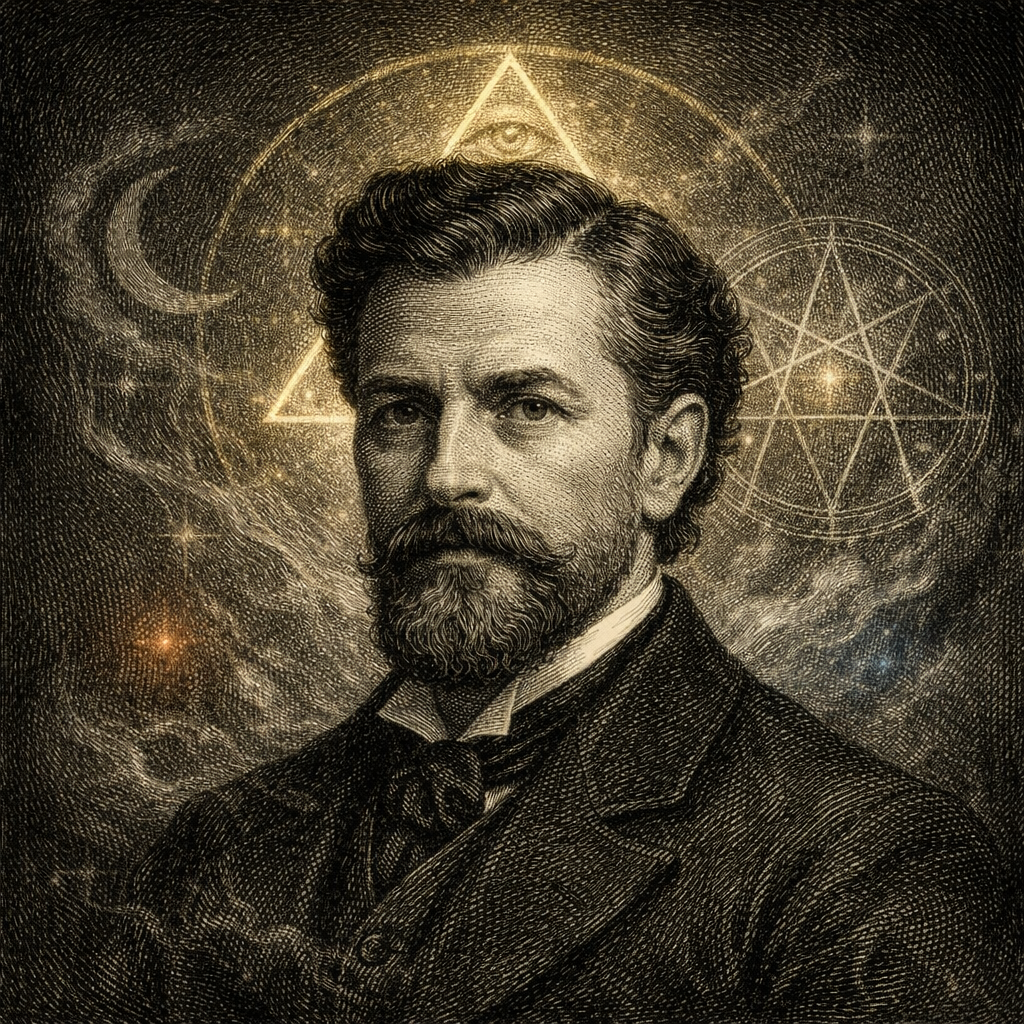
Date range: 1854–1918
Brief Biography
Samuel Liddell MacGregor Mathers was a British occultist, translator, ritualist, and one of the principal architects of the late nineteenth-century occult revival. Born in London, he developed a deep interest in ceremonial magic, Kabbalah, Rosicrucian lore, tarot, alchemy, and the symbolic sciences, and became a central co-founder of the Hermetic Order of the Golden Dawn in 1888 alongside William Wynn Westcott and William Robert Woodman. Mathers was the chief ritual systematiser of the Order, shaping its initiatory structure, magical teachings, and practical curriculum. Later living largely in Paris, he oversaw splinter developments of the movement and remained an influential, controversial, and often embattled figure within modern esotericism until his death in 1918. His significance lies in his role as an organiser of occult knowledge: he gathered diverse symbolic and ritual materials into a coherent initiatory framework that strongly influenced modern ceremonial magic.
Works and Texts
- The Kabbalah Unveiled
- The Cipher Manuscripts
- Collectanea Hermetica
- The Secret Doctrine in Israel
- The Golden Dawn
Place in the Western Esoteric Tradition
Mathers occupies a decisive position in the Western Esoteric Tradition because he helped convert older symbolic, magical, and mystical materials into a modern initiatory system capable of training practitioners stage by stage. He inherited elements from Deean angelic magic, Rosicrucianism, occult revival culture, ritual magic, and the Theosophical atmosphere of the late nineteenth century, but his distinctive contribution was synthetic and organisational. He gave these currents a graded structure, a ritual language, and a practical programme of magical work. Through the Golden Dawn, his influence passed directly into Thelema, B.O.T.A., and modern neo-pagan and occult traditions. In Mathers, the esoteric archive became an operative school.
Mathers’s Mystical System
S.L. MacGregor Mathers built a mystical system whose defining quality was synthesis under initiatory discipline. He did not simply collect occult curiosities, nor did he present esotericism as a loose field of symbolic speculation. His central labour was to gather materials from many sources and arrange them into an ordered path of training. Kabbalah, tarot, astrology, geomancy, alchemy, Enochian material, Rosicrucian mythology, Egyptian motifs, Christian symbolism, and ritual magic were brought together within a graded initiatory framework. The result was one of the most influential constructions in modern esotericism: a ceremonial path in which knowledge, symbolism, and magical practice were linked to the progressive transformation of the initiate.
At the centre of this system stood the Hermetic Order of the Golden Dawn. Mathers treated initiation as the structural core of esoteric development. Spiritual and magical knowledge was not to be encountered in a random or purely private way, but through formal progression. The aspirant moved through grades, each associated with symbolic teachings, ritual obligations, meditative practices, and increasingly advanced magical operations. This gave the system both coherence and drama. The student was not merely studying doctrine but entering a symbolic cosmos step by step, internalising its structure through repeated ceremonial action.
The chief organising map of this cosmos was the Kabbalistic Tree of Life. For Mathers and the Golden Dawn tradition, the Tree offered a universal framework through which many branches of esoteric knowledge could be coordinated. Its sephiroth and paths became points of relation for elemental forces, planets, zodiacal signs, angelic hierarchies, divine names, tarot trumps, colours, magical weapons, and states of consciousness. The importance of this cannot be overstated. The Tree of Life allowed Mathers to build a system in which disparate symbolic traditions could be treated as expressions of one ordered pattern. It provided a grammar for occult synthesis.
This synthesis was not purely intellectual. Ritual was the means by which the symbolic structure of the cosmos became experientially active. Golden Dawn ceremonies were designed to place the candidate within a dramatised sacred order. Temple officers, coloured stations, divine names, elemental emblems, and scripted movements all expressed metaphysical principles through enacted form. Mathers understood ritual as transformative because it reorganised consciousness through symbol, gesture, and repetition. The initiate did not simply hear about higher realities but entered a ceremonial environment that represented them and sought to align the participant with them.
Ceremonial magic, in Mathers’s system, therefore functioned as both discipline and operation. The magician sought purification, balance, concentration, and the awakening of latent faculties, but also the controlled invocation of spiritual powers. Practices such as pentagram and hexagram rituals, assumption of god-forms, skrying, pathworking, and angelic work were embedded in a larger framework of correspondences. Magical action was not meant to be arbitrary. It depended upon knowledge of the symbolic relations linking the human being, the ritual temple, and the wider cosmos. The trained will, properly directed within an ordered symbolic field, became the operative centre of the system.
One of Mathers’s most important inheritances was the Deean and Kelleyan legacy of angelic magic. Through Golden Dawn teaching, Enochian material entered modern ceremonial practice in a highly structured way. This material was not treated merely as antiquarian residue. It became part of an initiatory ascent in which the magician engaged spiritual hierarchies, divine names, and visionary exploration. Mathers did not simply preserve such material; he repositioned it within a modern magical curriculum. In doing so, he helped ensure that John Dee’s angelic world would remain a living current in later occultism.
Rosicrucianism also shaped the atmosphere of Mathers’s system. The Golden Dawn inherited the Rosicrucian ideal of hidden wisdom, spiritual regeneration, and graded access to deeper truths. Yet this was reworked in a more explicitly practical direction. Rosicrucian symbols were not only contemplative emblems; they were woven into a school of ritual practice. Initiation became less a matter of literary manifesto and more a matter of ceremonial progression. This shift is crucial for understanding Mathers’s place in the tradition. He moved esotericism from the world of texts and societies of symbolic aspiration into a tightly organised temple culture.
Mathers also understood occultism as a science of correspondences. His writings and ritual papers reveal a sustained effort to classify, align, and correlate. This impulse gave modern ceremonial magic much of its distinctive texture. The occult world, in his presentation, was neither chaotic nor merely mystical. It was ordered, diagrammable, and capable of disciplined transmission. Such system-building had its limitations, and at times it imposed a formidable apparatus upon materials of very different historical origin. Yet its effectiveness was undeniable. Later practitioners inherited not an archive of fragments but a working machine of esoteric interpretation.
The goal of Mathers’s system was not knowledge alone. It was spiritual and magical ascent. The initiate was to become more balanced, more disciplined, more perceptive, and more capable of contact with higher orders of being. The language of adeptship, the Holy Guardian Angel, and the attainment of higher consciousness all formed part of the horizon toward which the work moved. The magical path was thus ethical, symbolic, ritual, and visionary at once. It demanded self-mastery as well as technical skill.
Mathers’s influence on later esotericism came precisely from this integration. Aleister Crowley inherited and reworked his ceremonial structures; Paul Foster Case carried the Golden Dawn’s symbolic and Kabbalistic methods into B.O.T.A.; broader streams of neo-pagan and occult practice absorbed his ritual forms, correspondential methods, and initiatory assumptions. Even where later movements rejected Mathers personally or revised his doctrines, they continued to operate within a field he had helped define.
Mathers’s mystical system may therefore be described as an initiatory architecture of ceremonial correspondences. It unites Kabbalah, magic, ritual, symbolism, and spiritual training within a graded path aimed at transformation. Its enduring importance lies in its form as much as its content. Mathers gave modern Western esotericism one of its most workable ritual languages, and the consequences of that achievement have been extensive.
Antecedent Figures
- Annie Besant
- Charles Webster Leadbeater
- Edward Kelley
- Helena Petrovna Blavatsky
- Johann Valentin Andreae
- John Dee
- Michael Maier
- Papus (Gérard Encausse)
- Robert Fludd
- Éliphas Lévi
Antecedent Traditions
- John Dee's Angelic Magic
- Rosicrucianism
- Occult Revival & Ritual Magic
- Theosophical Society
Succeeding Figures
- Aleister Crowley
- Gerald Gardner
- Paul Foster Case
Succeeding Traditions
- Thelema
- B.O.T.A.
- Neo-Paganism/Wicca