Rudolf Steiner
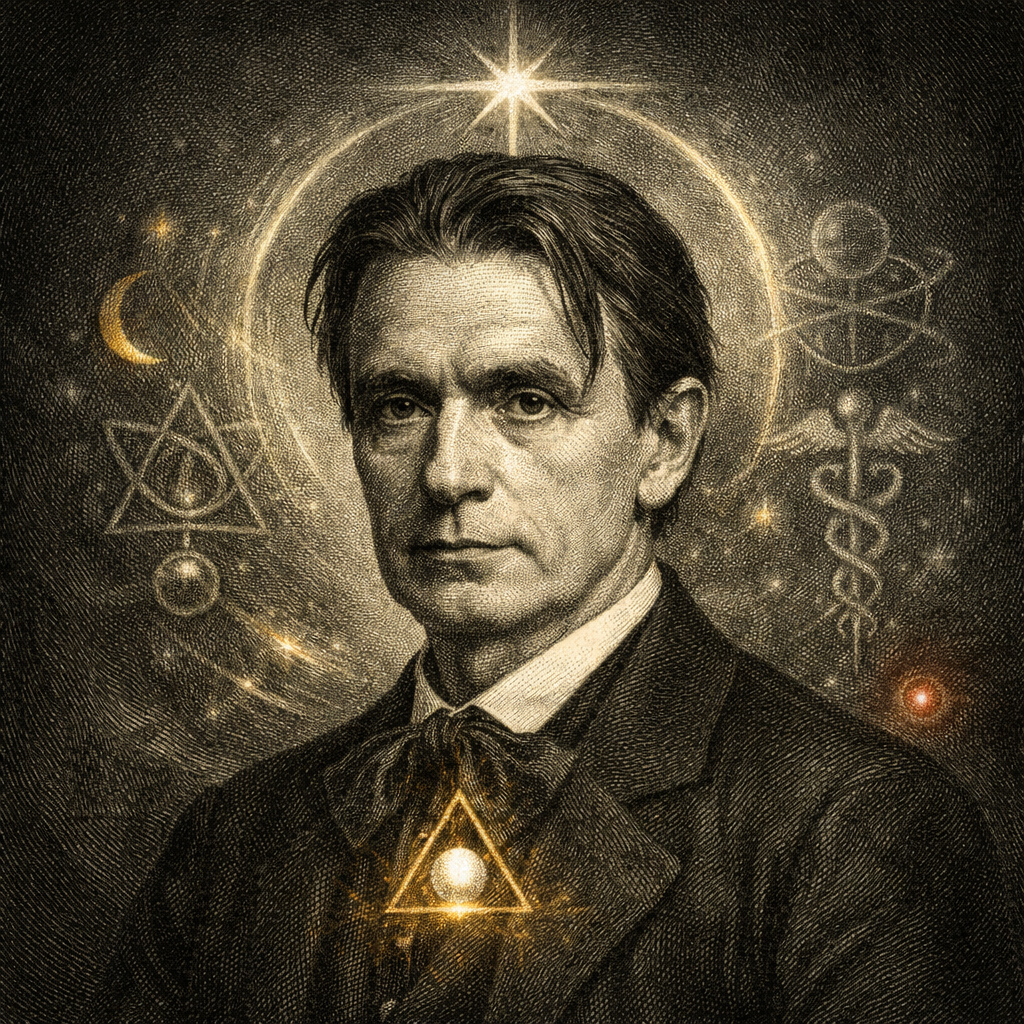
Date range: 1861–1925
Brief Biography
Rudolf Steiner was an Austrian philosopher, esoteric teacher, lecturer, and founder of Anthroposophy, a spiritual movement that developed from, and eventually separated itself from, the Theosophical Society. Born in what is now Croatia and educated in the Austro-Hungarian intellectual world, Steiner first gained attention through his editorial work on Goethe’s scientific writings and his philosophical writings on knowledge, freedom, and spiritual perception. In the early twentieth century he became a leading figure in German-speaking Theosophy before breaking with the Society in 1912–13, largely over doctrinal and organisational disputes, including the promotion of Jiddu Krishnamurti as a world-teacher. Steiner’s later work extended his esoteric worldview into education, agriculture, medicine, architecture, drama, movement, and social theory. He died in Dornach, Switzerland, in 1925, leaving behind a vast corpus of lectures and writings centred on spiritual science and the disciplined development of higher knowledge.
Works and Texts
- Knowledge of the Higher Worlds and Its Attainment
Place in the Western Esoteric Tradition
Steiner occupies a major modern position in the Western Esoteric Tradition as the creator of Anthroposophy, a system that reworked Theosophical themes through a more explicitly Christian, European, evolutionary, and initiatory framework. His antecedent connection to the Theosophical Society is crucial: from Blavatsky, Besant, and Leadbeater he inherited the modern language of spiritual evolution, hidden worlds, subtle bodies, clairvoyant investigation, and initiatory ascent. Yet Steiner redirected these themes toward what he called spiritual science, insisting that supersensible knowledge could be cultivated through disciplined exercises rather than accepted as revelation or belief. His place in the tradition lies in making esotericism systematic, pedagogical, and practical, extending occult cosmology into cultural institutions and everyday domains with a confidence only the twentieth century could have made seem administratively plausible.
Steiner’s Mystical System
Rudolf Steiner’s mystical system is built around the disciplined development of spiritual perception. He did not present Anthroposophy as a set of beliefs to be accepted on authority, nor as a loose collection of occult impressions. He described it as Geisteswissenschaft, or spiritual science: a methodical investigation of supersensible reality undertaken by trained consciousness. This claim is central to understanding both the ambition and the controversy of Steiner’s work. He sought to bring esoteric knowledge into the form of a modern path, one that retained initiation, clairvoyance, and cosmic hierarchy while presenting them as matters of disciplined cognition rather than passive faith.
The starting point of Steiner’s system is the human being as a developing spiritual organism. Ordinary consciousness, in his view, is only one stage in a much wider field of possible perception. Human beings possess latent faculties through which they may come to know higher worlds, but these faculties must be awakened ethically, imaginatively, and intellectually. The path is therefore neither sentimental mysticism nor uncontrolled visionary enthusiasm. Steiner repeatedly emphasised preparation: concentration, meditation, moral purification, attention to thought, reverence for truth, and disciplined inner observation. Higher knowledge requires transformation of the knower.
In Knowledge of the Higher Worlds and Its Attainment, Steiner lays out this path in a practical and initiatory form. The aspirant is instructed to cultivate inner stillness, symbolic meditation, self-command, and an attentive relation to the world of growth, decay, feeling, and thought. These practices aim to refine consciousness until it becomes capable of perceiving realities normally hidden by sensory and intellectual habit. Steiner’s language often describes stages of initiation, including preparation, enlightenment, and initiation proper. These are not presented merely as ceremonies performed upon the candidate, but as changes in the structure of consciousness itself.
A key distinction in Steiner’s system is between sensory knowledge and supersensible knowledge. Modern consciousness is trained to recognise only what can be measured, externally observed, or logically inferred from physical phenomena. Steiner accepted the value of disciplined thinking, but rejected the idea that material perception exhausts reality. For him, the world includes etheric, astral, and spiritual dimensions, each corresponding to different aspects of life, soul, and spirit. The etheric body bears the forces of life and growth; the astral body relates to sensation, desire, and inner experience; the ego or “I” is the centre of self-conscious spiritual development. The human being is thus a layered entity, participating simultaneously in physical and supersensible orders.
This anthropology is inseparable from Steiner’s cosmology. Human evolution is not only biological or cultural, but cosmic and spiritual. Steiner described vast stages of planetary and human development, drawing upon and revising Theosophical evolutionary schemes. The human being passes through long arcs of incarnation, karma, and spiritual education, gradually developing freedom, self-consciousness, and moral insight. Unlike some forms of occult determinism, Steiner placed strong emphasis on the emergence of individual freedom. His earlier philosophical work on freedom remained important to his esotericism: true spiritual development requires conscious participation, not submission to mechanism, instinct, or external authority.
Christ occupies a central role in Steiner’s mature system. This is one of the chief ways Anthroposophy diverged from the broader Theosophical milieu. Steiner interpreted the Christ event as a cosmic turning point in the spiritual evolution of humanity, not simply as a historical episode within ecclesiastical Christianity. Christ, in his account, enters earthly evolution as a transformative spiritual reality, making possible a new relationship between the human ego, freedom, love, and the spiritual worlds. This Christocentric orientation gave Steiner’s system a distinctively Western and Christian-esoteric character, even though it remained far outside ordinary church doctrine. One can almost hear the committees sharpening their pencils.
Steiner’s use of clairvoyance also shaped his system. He claimed that spiritual realities could be directly investigated by trained perception, and much of his vast lecture corpus consists of reports on cosmic history, spiritual beings, life after death, reincarnation, karma, biblical interpretation, and the occult significance of cultural development. This gives Anthroposophy its peculiar mixture of method and revelation. Steiner insists on disciplined inquiry, yet the resulting content often depends heavily on his own claimed supersensible perception. His followers treated these insights as a basis for practical cultural work, while critics have frequently questioned the epistemic status of such claims. The tension is built into the structure, because apparently even spiritual science enjoys creating governance problems.
The practical extension of Anthroposophy is one of Steiner’s defining features. He did not confine esotericism to private meditation or initiatory circles. Waldorf education, biodynamic agriculture, anthroposophical medicine, eurythmy, architecture, speech formation, and social threefolding all emerge from his conviction that spiritual science should reshape culture. Education, for example, is grounded in a developmental view of the child as body, soul, and spirit; agriculture is interpreted through cosmic and earthly rhythms; medicine addresses physical, etheric, astral, and egoic dimensions of the human being. Whether one accepts these applications or not, they show the scale of Steiner’s ambition. Esoteric knowledge becomes a cultural programme.
Symbol and imagination are also central to his path. Steiner regarded imagination, inspiration, and intuition as higher modes of cognition, not mere fantasy. Imagination perceives spiritual pictures; inspiration apprehends spiritual meaning; intuition enters into direct spiritual communion with beings or realities. This sequence gives his system a structured account of ascent. The aspirant moves from disciplined thought and moral preparation toward symbolic perception, then toward deeper forms of participation in spiritual reality. The imagination is therefore trained rather than indulged. It becomes an organ of knowledge.
Steiner’s place in the Western Esoteric Tradition rests on this attempt to modernise initiation without abandoning hierarchy, discipline, or sacred cosmology. He inherited Theosophical ideas of evolution, subtle bodies, karma, and hidden masters, but transformed them through German idealism, Goethean science, Christian esotericism, and his own theory of spiritual cognition. His mystical system is not a retreat from modernity in the simple sense. It is an effort to overcome modern materialism by expanding the meaning of knowledge itself. The modern error, for Steiner, is not disciplined inquiry, but the confinement of inquiry to the physical world.
Anthroposophy thus presents the human being as a participant in cosmic evolution, capable of awakening higher faculties through ethical and contemplative discipline. Its aim is knowledge, freedom, and spiritual responsibility. The path begins with attention and self-mastery, proceeds through imaginative and supersensible perception, and culminates in conscious participation in the spiritual ordering of life. Steiner’s system remains one of the most institutionally consequential forms of modern esotericism, precisely because it refused to remain a private doctrine and insisted on building schools, farms, buildings, therapies, and communities from its metaphysical claims.
Antecedent Figures
- Annie Besant
- Charles Webster Leadbeater
- Helena Petrovna Blavatsky
Antecedent Traditions
- Theosophical Society
Succeeding Figures
- —
Succeeding Traditions
- —