Robert Fludd
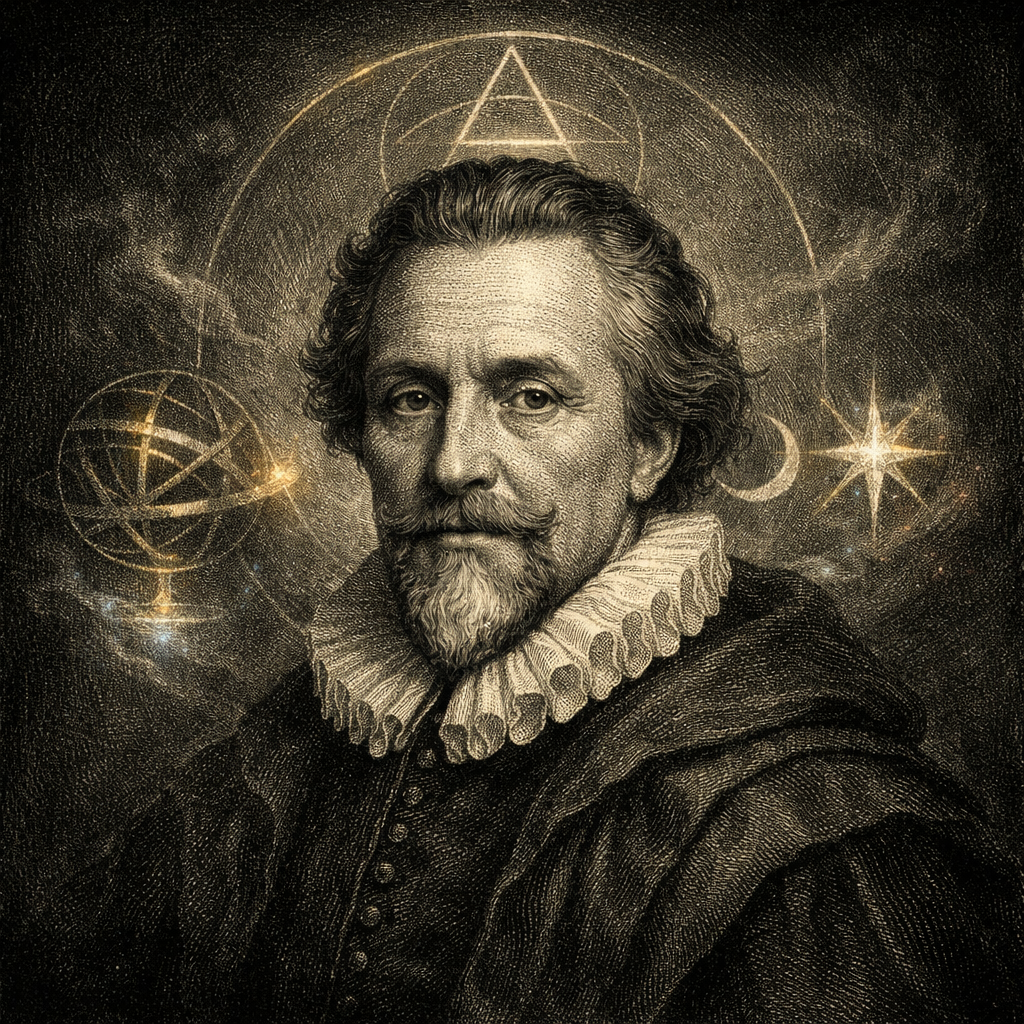
Date range: 1574–1637
Brief Biography
Robert Fludd was an English physician, natural philosopher, Hermetic writer, and one of the most visually distinctive esoteric thinkers of the early seventeenth century. Educated at St John’s College, Oxford, and later active as a London physician, he developed a vast symbolic cosmology that drew upon Renaissance Hermeticism, Christian Kabbalah, Paracelsian medicine, alchemy, music theory, sacred geometry, and Rosicrucian speculation. Fludd became closely associated with the defence of Rosicrucian ideas in England, though he repeatedly insisted that the Brotherhood itself remained hidden. His writings present the universe as a divinely ordered macrocosm reflected in the human microcosm, governed by proportion, light, harmony, and spiritual correspondence. He died in London in 1637, leaving a body of work whose diagrams alone could keep a symbolic historian gainfully overwhelmed for years.
Works and Texts
- Fama Fraternitatis
- Confessio Fraternitatis
- The Chymical Wedding
- Utriusque Cosmi Historia
Place in the Western Esoteric Tradition
Fludd occupies a major transitional position in the Western Esoteric Tradition, gathering Renaissance currents of Christian Kabbalah, Hermetic magic, angelic speculation, spiritual alchemy, and Lutheran mystical reform into a grand cosmological synthesis. He belongs to the Rosicrucian moment in which esoteric learning was imagined not simply as private illumination, but as a means of universal reformation: medicine, religion, philosophy, and the arts were to be reintegrated within a sacred view of creation. His influence flowed into later speculative Freemasonry, illuminist theosophy, and ceremonial occult revivalism because he supplied a powerful symbolic vocabulary of temple, cosmos, harmony, initiation, and hidden wisdom. In Fludd, the universe becomes a diagram of divine order, and the human being its interpretive key.
Fludd’s Mystical System
Robert Fludd’s mystical system is an immense Christian-Hermetic cosmology built upon correspondence, hierarchy, harmony, and the unity of divine wisdom. His thought is difficult to compress because it was itself an act of expansion. Fludd did not write as a tidy doctrinal architect arranging a few clean propositions into a modest cabinet of ideas. He wrote as though the entire universe were a sacred instrument whose strings, measures, lights, shadows, organs, planets, elements, angels, and bodily fluids had to be placed into visible relation. The result is one of the most elaborate symbolic systems of early modern esotericism.
At the centre of Fludd’s worldview is the relation between macrocosm and microcosm. The greater world and the human being mirror one another because both proceed from the same divine source and both are ordered by the same principles. The cosmos is not a dead expanse of matter. It is a living, structured, hierarchical manifestation of divine wisdom. The human being is not merely an observer within this order, but a condensed image of it. Anatomy, psychology, astronomy, music, alchemy, and theology therefore belong together, because each discloses the same underlying pattern at a different level of reality.
This doctrine of correspondence gives Fludd’s system its coherence. The planets correspond to faculties, organs, metals, virtues, diseases, spiritual powers, and states of the soul. The visible world points beyond itself, not because it is unreal, but because it is symbolic by nature. Created things are signatures of the divine order that produced them. To know the world properly is therefore to read it, and to read it properly is to move from surface appearance to inner relation. This is the Hermetic imagination at full stretch: nature as book, body as temple, cosmos as scripture, and every proportion a possible clue left by God for the spiritually literate.
Fludd’s cosmology is also deeply concerned with light and darkness. Creation unfolds through a drama of divine illumination entering the primal obscurity of matter. Light is not only physical brightness; it is metaphysical intelligibility, life, spirit, and order. Darkness is not simply evil, but the unformed potential into which divine activity impresses structure. This symbolic polarity allowed Fludd to think creation, knowledge, and regeneration in parallel. The soul’s ascent requires a movement from obscurity to illumination, from dispersion to harmony, from the confusion of fallen perception to restored spiritual understanding.
Music and proportion occupy a privileged place in this ascent. Fludd inherited the ancient and medieval idea that cosmic order is harmonic. The universe is built according to number, measure, and ratio; music reveals these relations in audible form. In his diagrams and writings, the monochord becomes a model of cosmic structure, linking the divisions of sound to the levels of creation. This is not aesthetic decoration. Harmony is an ontological principle. The same proportional order that governs music also governs the heavens, the body, and the soul. To understand harmony is to glimpse the hidden grammar of creation, a rather more ambitious project than assembling a playlist and calling it a mood.
Alchemy also forms part of Fludd’s system, though in a spiritual and cosmological register. Chemical processes symbolise and participate in transformations that occur across nature and within the human being. Separation, purification, conjunction, and perfection are not confined to laboratory substances. They express a universal pattern of restoration. Fludd’s alchemy is thus tied to medicine, theology, and spiritual regeneration. The physician who understands only the body understands too little; the true healer must grasp the relation between bodily disorder, cosmic influence, spiritual imbalance, and divine order.
This medical dimension is one of Fludd’s distinctive features. As a physician, he brought esoteric cosmology into the interpretation of health and disease. The human body was governed by visible and invisible influences, by humours, spirits, celestial correspondences, and internal harmony. Illness could therefore be read as a disturbance in the microcosm. Healing required restoration of balance, not merely mechanical intervention. However strange some of Fludd’s medical assumptions now appear, they belonged to a coherent early modern attempt to preserve the unity of body, soul, cosmos, and God against increasingly mechanistic forms of explanation.
Fludd’s relation to Rosicrucianism is central to his esoteric profile. The Rosicrucian manifestos announced a hidden fraternity devoted to universal reform, Christian wisdom, healing, and the recovery of ancient knowledge. Fludd defended the Rosicrucian ideal and interpreted it as a genuine expression of divine and philosophical truth, even while the historical existence of the Brotherhood remained elusive. For him, Rosicrucianism represented the possibility of restoring sacred science: a reformation deeper than politics, broader than church controversy, and more exacting than bookish curiosity. It promised the reunion of piety, knowledge, medicine, and wisdom under divine illumination.
Fludd’s symbolic universe also helped prepare later initiatory readings of architecture and sacred space. His images of cosmic order, temple symbolism, divine geometry, and human ascent made his work attractive to later currents of speculative Masonry and ceremonial occultism. He did not found Freemasonry, and the temptation to make every interesting seventeenth-century esotericist into a secret architect of the Craft should be resisted with a firm hand and perhaps a locked cabinet. Yet his vocabulary of measure, harmony, hidden wisdom, and the temple of creation resonated strongly with later Masonic and Rosicrucian interpretations.
His disputes with more mathematically and mechanically minded thinkers, including Johannes Kepler and Marin Mersenne, reveal the changing intellectual world in which he worked. Fludd defended a symbolic, qualitative, and analogical cosmos at a time when natural philosophy was moving toward quantification, experiment, and mathematical abstraction. He was not simply backward-looking; he was trying to preserve a sacred ontology of nature against what he saw as reductive explanation. The conflict was not merely between science and superstition, that lazy modern morality play with all the nuance of a dropped brick. It was between two ways of imagining what knowledge is for and what kind of world knowledge reveals.
Fludd’s mystical system is therefore a Christian-Hermetic science of total relation. God, cosmos, nature, body, soul, number, sound, light, medicine, and symbol all belong to one ordered field. The work of the adept, physician, philosopher, or Christian seeker is to perceive these relations and be transformed by them. His writings remain important because they preserve, with almost overwhelming visual richness, a world in which knowledge had not yet been divided into sealed compartments. In Fludd’s cosmos, wisdom is integrative: to know the human being is to know the world, to know the world is to read the divine order, and to read that order rightly is to begin the work of restoration.
Antecedent Figures
- Edward Kelley
- Giordano Bruno
- Giovanni Pico della Mirandola
- Heinrich Cornelius Agrippa
- Heinrich Khunrath
- Johann Arndt
- Johannes Reuchlin
- John Dee
- Marsilio Ficino
- Michael Maier
- Philipp Jakob Spener
Antecedent Traditions
- Renaissance Christian Kabbalah & Hermetic Magic
- John Dee's Angelic Magic
- Spiritual Alchemy
- Lutheran Mysticism & Pietism
Succeeding Figures
- Arthur Edward Waite
- Elias Ashmole
- Emanuel Swedenborg
- Jacob Boehme
- James Anderson
- Louis-Claude de Saint-Martin
- Martinez de Pasqually
- S.L. MacGregor Mathers
- William Preston
- William Wynn Westcott
Succeeding Traditions
- Speculative Freemasonry
- Illuminism & Christian Theosophy
- Hermetic Order of the Golden Dawn