René Guénon
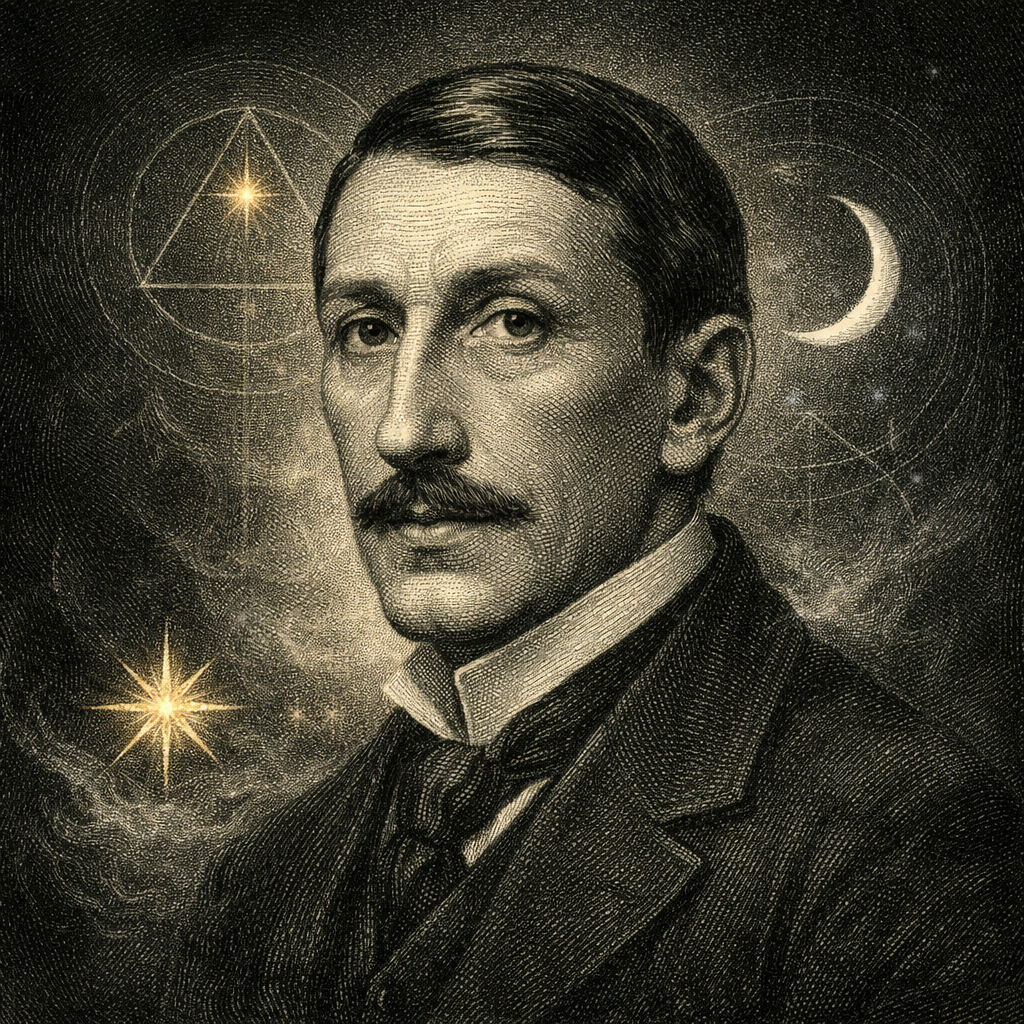
Date range: 1886–1951
Brief Biography
René Guénon was a French metaphysician, critic of modernity, and one of the principal architects of what later came to be called the Traditionalist School. Born in Blois, he moved in his early years through several occult and esoteric circles in Paris before turning decisively toward a more rigorous articulation of perennial metaphysical principles, sacred symbolism, initiation, and the distinction between authentic tradition and modern pseudo-spirituality. His major works attacked the intellectual and spiritual assumptions of the modern West while presenting traditional doctrines, especially those of Hinduism, Islam, and esoteric Christianity, as expressions of universal truth. In 1930 he settled permanently in Cairo, where he embraced Islamic life and continued writing until his death in 1951. His influence extended widely across twentieth-century religious thought, esotericism, and critiques of modern civilisation.
Works and Texts
- The Crisis of the Modern World
- The Hermetic Tradition
Place in the Western Esoteric Tradition
Guénon occupies an unusual place in the Western Esoteric Tradition because he was less a practitioner of occult arts than a severe diagnostician of the spiritual confusions that had overtaken them in the modern age. He inherited, at least biographically, the aftermath of the nineteenth-century occult revival and the broad milieu associated with Theosophy, but he spent much of his career subjecting such movements to a withering critique. His contribution lies in reasserting the primacy of metaphysical principle, authentic initiation, sacred symbolism, and doctrinal orthodoxy over eclectic speculation and spiritual improvisation. In the wider esoteric map, he represents a turn from experimentation toward principle: a demand that esotericism be grounded in real tradition rather than modern invention.
Guénon’s Mystical System
René Guénon’s mystical system is best understood as a metaphysics of principial order rather than a visionary or devotional spirituality in the ordinary sense. He did not offer an emotional religion, nor a practical magical handbook, nor a romantic celebration of hidden wisdom. His work is structured by a severe distinction between the Absolute and the contingent, between principial knowledge and discursive opinion, between authentic initiation and pseudo-esoteric imitation. For Guénon, the modern world had fallen into confusion because it had lost contact with first principles and had substituted quantity, analysis, and restless novelty for wisdom.
At the centre of his thought stands the idea of Tradition, written conceptually with a capital letter whether or not typography cooperates. Tradition, in Guénon’s usage, does not mean inherited custom in the sociological sense. It means the transmission of supra-human principles through forms capable of preserving and communicating them. A true tradition is rooted in revelation or in an origin beyond merely human invention, and it maintains a doctrinal, symbolic, and initiatic structure through which the human being may be reconnected to transcendent reality. This makes Guénon’s system deeply anti-modern, but not merely nostalgic. His argument is not that the past was charming and the present vulgar, though he would not have found the second part controversial. His point is that reality has an immutable structure, and civilisation becomes disordered when it forgets that structure.
This concern gives rise to his famous critique of the modern world. In The Crisis of the Modern World and related works, Guénon describes modernity as a civilisation of inversion. Quantity displaces quality, analysis displaces contemplation, secularism dissolves sacred order, and the lower powers of individualism and materialism eclipse higher forms of knowledge. The modern West, in his account, has mistaken the fragment for the whole and the peripheral for the central. Science, politics, and economics become dominant not because they are evil in themselves, but because they usurp the place once held by metaphysical intelligence. The result is not progress in any deep sense, but disintegration.
Against this disorder, Guénon affirms the possibility of principial knowledge. This is not knowledge gained through sensory accumulation or conceptual system-building alone. It is intellectual intuition in the classical metaphysical sense: a direct apprehension of universal truths. Guénon’s “intellect” is therefore not equivalent to cleverness, argument, or academic dexterity. It is the faculty through which immutable principles are known. Metaphysics, in this framework, is not speculative philosophy but knowledge of the universal. One sees here why Guénon often found modern philosophy insufferably provincial. It spends its energy circling the conditions of thought while neglecting the reality that thought is meant to know.
A second major feature of his system is the distinction between exoterism and esoterism. Every complete tradition, in Guénon’s view, possesses an outward and an inward dimension. The exoteric dimension concerns ordinary religious life, moral order, communal worship, and doctrinal belief as addressed to the broad body of adherents. The esoteric dimension concerns the inward path of realisation, where symbols, rites, and doctrines are understood more deeply and employed as means of spiritual ascent. Esoterism is not a rival religion hidden behind the public one; it is the inner dimension of the same truth. This idea allowed Guénon to interpret very different religious traditions through a common formal lens while insisting that authentic esoterism must remain attached to a real traditional form.
Hence his insistence on initiation. Initiation, for Guénon, is not a mood, a self-description, or the feeling of having read three impressive books and bought a ring. It is a real transmission. An initiatic organisation preserves symbolic forms, rites, and spiritual influences that connect the individual to a chain extending beyond the merely personal. Without such transmission, one may have intellectual curiosity or mystical sentiment, but not esoterism in the strict sense. This is why Guénon was so hostile to what he regarded as pseudo-initiation: modern occult societies, improvised spiritual orders, and syncretic movements that mimicked the outer appearance of esoteric structure while lacking principial legitimacy.
Symbolism also occupies a crucial place in his system. Guénon treated symbols as objective and polyvalent expressions of metaphysical truth. A genuine symbol is not an arbitrary sign or a decorative curiosity. It is a form capable of manifesting multiple levels of reality at once. Traditional cosmology, sacred geometry, myths, rites, and doctrinal formulas all possess symbolic force because the universe itself is ordered according to principial correspondences. Symbolism thus mediates between the sensible and the intelligible. It gives concrete form to truths that transcend conceptual language, and in doing so it becomes an instrument of contemplation and initiation.
Guénon’s own religious trajectory led him increasingly toward Islamic esoterism, especially Sufism, which he regarded as one of the still-living traditional forms through which authentic metaphysical realisation remained possible. Yet his outlook was never narrowly confessional. He consistently argued that orthodox traditions share a transcendent unity at the level of principles, even while differing legitimately in doctrine, rite, and form. This conception later nourished the broader Traditionalist current associated with figures such as Frithjof Schuon and others, though Guénon himself remained more austere, less literary, and less inclined to ornament.
His place in the Western Esoteric Tradition therefore rests on a paradox. He rejected much of what modern people casually label “esoteric”, especially when it took the form of occult eclecticism, spiritual sensationalism, or doctrinal vagueness. Yet he did so in the name of a far more exacting esoterism: one grounded in metaphysical principle, sacred form, initiation, and symbol. Guénon’s mystical system is, in essence, a doctrine of return to the centre. The human problem is dispersion; the remedy is reintegration through principial knowledge, legitimate tradition, and inward realisation. Whether one agrees with him or not, he gave the twentieth century one of its most formidable statements of sacred order against the confusions of modern life.
Antecedent Figures
- Annie Besant
- Charles Webster Leadbeater
- Helena Petrovna Blavatsky
Antecedent Traditions
- Theosophical Society
Succeeding Figures
- —
Succeeding Traditions
- —