Renaissance Christian Kabbalah & Hermetic Magic
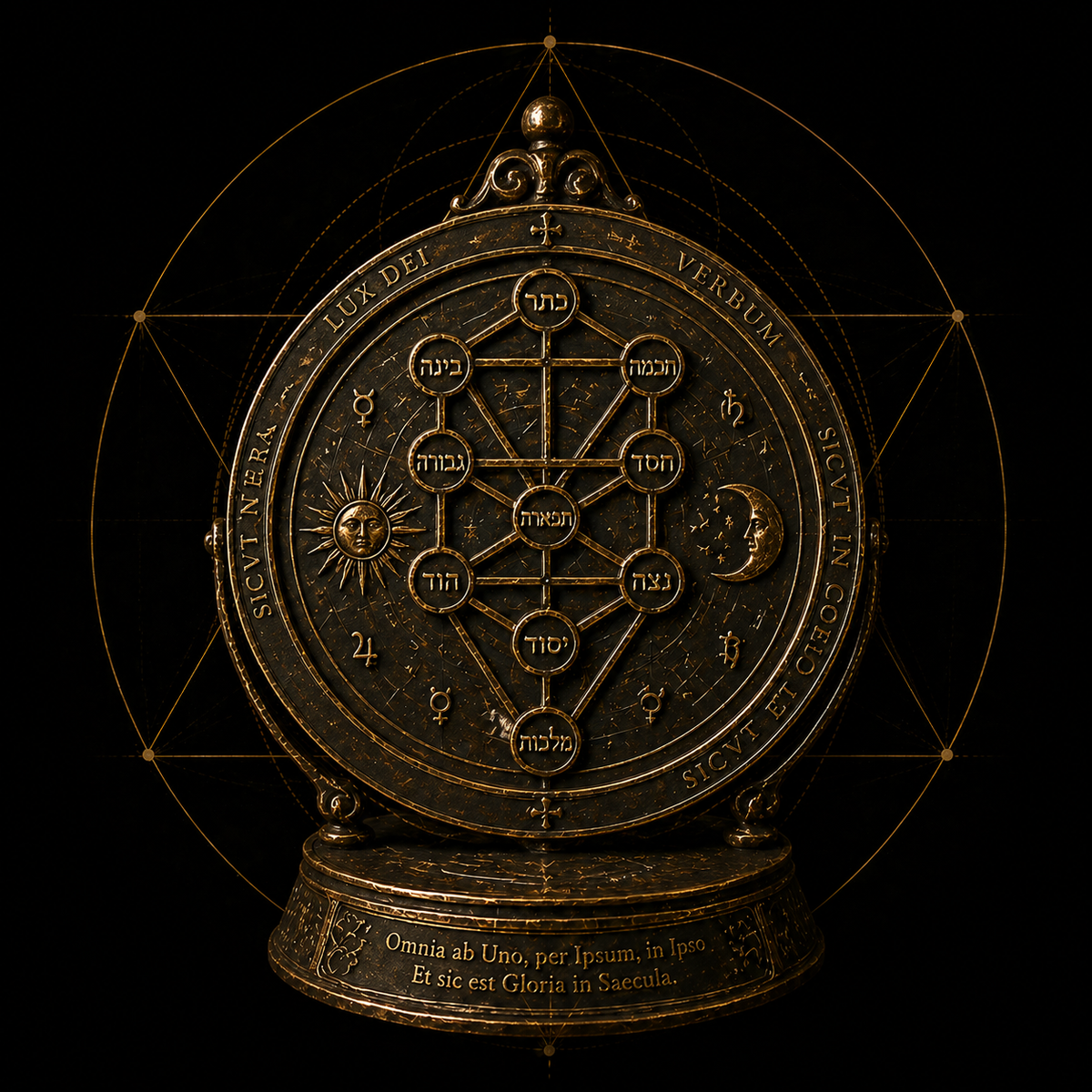
Renaissance Christian Kabbalah and Hermetic magic form one of the great synthetic moments in the history of the Western Esoteric Tradition. Emerging in fifteenth- and sixteenth-century Europe, this current drew together late antique Hermeticism, Neoplatonism, Jewish Kabbalah, scholastic theology, Islamic astral magic, Christian doctrine, and humanist philology into an ambitious vision of universal wisdom. Its leading figures did not see themselves as inventing a new religion or indulging in marginal fantasy. They believed they were recovering an ancient theology, a prisca theologia, which had been partially disclosed to sages, prophets, philosophers, and priests across antiquity. The Renaissance mind, never knowingly under-confident, imagined itself capable of reconciling Plato, Moses, Hermes, Christ, Kabbalah, astrology, and magic into one magnificent intellectual machine.
The rediscovery and translation of the Corpus Hermeticum by Marsilio Ficino in the fifteenth century was central to this development. Ficino and his circle believed the Hermetic writings were extremely ancient, predating Plato and perhaps even Moses. Modern scholarship has shown that these texts belong to late antiquity, not remote Egyptian antiquity, but their Renaissance reception mattered enormously. They seemed to offer evidence of a primordial philosophical theology: a doctrine of divine mind, cosmic order, spiritual ascent, and humanity’s capacity to know God. Hermeticism gave Renaissance thinkers a way to imagine ancient wisdom as both philosophical and religious, both pagan and compatible with Christianity.
Ficino’s contribution extended beyond translation. His work on Platonic theology, natural magic, and astral influence established a model of magic as learned participation in the hidden sympathies of nature. Ficino was careful to distinguish his approach from demonic magic. He defended a form of natural or spiritual magic grounded in the belief that the cosmos is animated and ordered by correspondences. Music, images, herbs, stones, planetary timing, and ritualised attention could help align the human soul with celestial influences. This was not yet the fully ceremonial magic of later occult systems, but it helped legitimise the idea that the learned philosopher could work within the spiritual structure of nature.
Giovanni Pico della Mirandola added Christian Kabbalah to this synthesis. Encountering Jewish Kabbalistic materials through translation, instruction, and intellectual exchange, Pico argued that Kabbalah confirmed the truth of Christianity and provided a profound key to scripture, theology, and magic. His famous Oration on the Dignity of Man presents humanity as a uniquely free and self-fashioning being, capable of descending into the lower orders or ascending toward divine union. This anthropology harmonised powerfully with Hermetic and Neoplatonic themes. The human being was not fixed in the cosmic hierarchy, but capable of transformation through knowledge, discipline, and divine illumination.
Christian Kabbalah was, however, a deeply ambivalent development. On one hand, it introduced Christian scholars to the symbolic richness of Jewish mystical thought: the divine names, the sefirot, the Hebrew letters, angelic hierarchies, numerical interpretation, and the hidden layers of scripture. On the other hand, it often appropriated Kabbalah for Christian apologetic purposes, detaching it from Jewish law, practice, and communal meaning. Pico, Reuchlin, and later Christian Kabbalists treated Kabbalah as an ancient confirmation of Christian doctrine. This was historically consequential, but not religiously neutral. It opened Kabbalah to wider European esoteric use, while also distorting it through the theological ambitions of its new interpreters. Humanity, naturally, discovered someone else’s sacred tradition and immediately tried to use it as evidence for its own paperwork.
Heinrich Cornelius Agrippa represents the mature encyclopaedic form of Renaissance occult philosophy. His De occulta philosophia libri tres systematised magic into three broad levels: natural, celestial, and ceremonial or divine. Natural magic concerned the hidden properties of things in the material world. Celestial magic dealt with stars, planets, numbers, harmonies, and astral correspondences. Ceremonial magic involved divine names, angelic powers, sacred rites, and the higher structures of spiritual mediation. Agrippa drew on Ficino, Pico, Reuchlin, Kabbalah, Hermeticism, astrology, scholastic categories, and grimoire traditions to produce one of the most influential magical syntheses in Western history.
The structure of Renaissance magic depended heavily on the doctrine of correspondence. The world was understood as a hierarchy of interrelated levels: divine, intellectual, celestial, and material. Each level reflected and influenced the others. Plants, stones, animals, metals, planets, angels, numbers, letters, and divine names could be arranged into symbolic and operative relationships. The magician’s task was to understand these correspondences and work lawfully within them. Magic, in this sense, was not conceived merely as coercion or miracle, but as the art of joining lower things to higher causes through knowledge of hidden bonds.
Scholastic theology provided both constraint and structure. Renaissance magicians had to argue that their practices did not violate Christian doctrine, summon demons, or usurp divine power. The scholastic distinction between natural causation and demonic intervention was therefore crucial. Ficino and others sought to present learned magic as a legitimate extension of natural philosophy and pious contemplation. Agrippa’s work is more expansive and at times more dangerous, but even he often frames magic within a Christian cosmos governed by divine order. The need to defend magic intellectually gave Renaissance occult philosophy much of its systematic character.
Islamic astral magic also shaped this current profoundly. Through texts such as the Picatrix, Renaissance thinkers inherited elaborate theories of talismanic images, planetary timing, celestial virtues, suffumigations, and astral correspondences. This technical material merged with Hermetic and Neoplatonic cosmology, producing a learned magic that sought to unite philosophy, astrology, ritual, and material practice. Renaissance Christian Kabbalah and Hermetic magic therefore did not simply revive ancient Greek or Egyptian wisdom; they received antiquity through Arabic, Jewish, medieval Christian, and humanist channels. Its glamour was ancient, but its machinery was Renaissance.
John Dee’s angelic magic, Paracelsianism, Rosicrucianism, and Speculative Freemasonry all drew, in different ways, from this Renaissance synthesis. Dee inherited its universalist ambition, its mathematical and angelological concerns, and its desire for a divine language of creation. Paracelsianism transformed the magical reading of nature through medicine, alchemy, and the doctrine of signatures. Rosicrucianism absorbed the dream of universal reformation grounded in hidden wisdom, alchemy, and Christian esotericism. Speculative Freemasonry later inherited fragments of this symbolic universe through geometry, temple imagery, moral allegory, and the wider culture of learned esotericism.
The importance of Renaissance Christian Kabbalah and Hermetic magic lies in its power of synthesis. It gathered late antique Hermeticism, medieval Kabbalah, scholastic theology, Islamic astral magic, and Christian humanism into a framework that made esoteric knowledge appear intellectually serious, spiritually elevated, and culturally ambitious. It established the template for much later Western occultism: the learned adept, the universal correspondence system, the sacred alphabet, the ritual use of divine names, the magical cosmos, the dignity of the human being, and the possibility of ascent through disciplined knowledge. Even when later traditions rejected, simplified, or secularised its assumptions, they continued to operate within the conceptual world it helped create.
Antecedent Traditions
· Late Antique Hermeticism & Gnosticism
· Medieval Kabbalah
· Islamic Astral Magic
· Scholastic Theology
Succeeding Traditions
· Paracelsianism
· Rosicrucianism
· John Dee's Angelic Magic
Speculative Freemasonry