Proclus
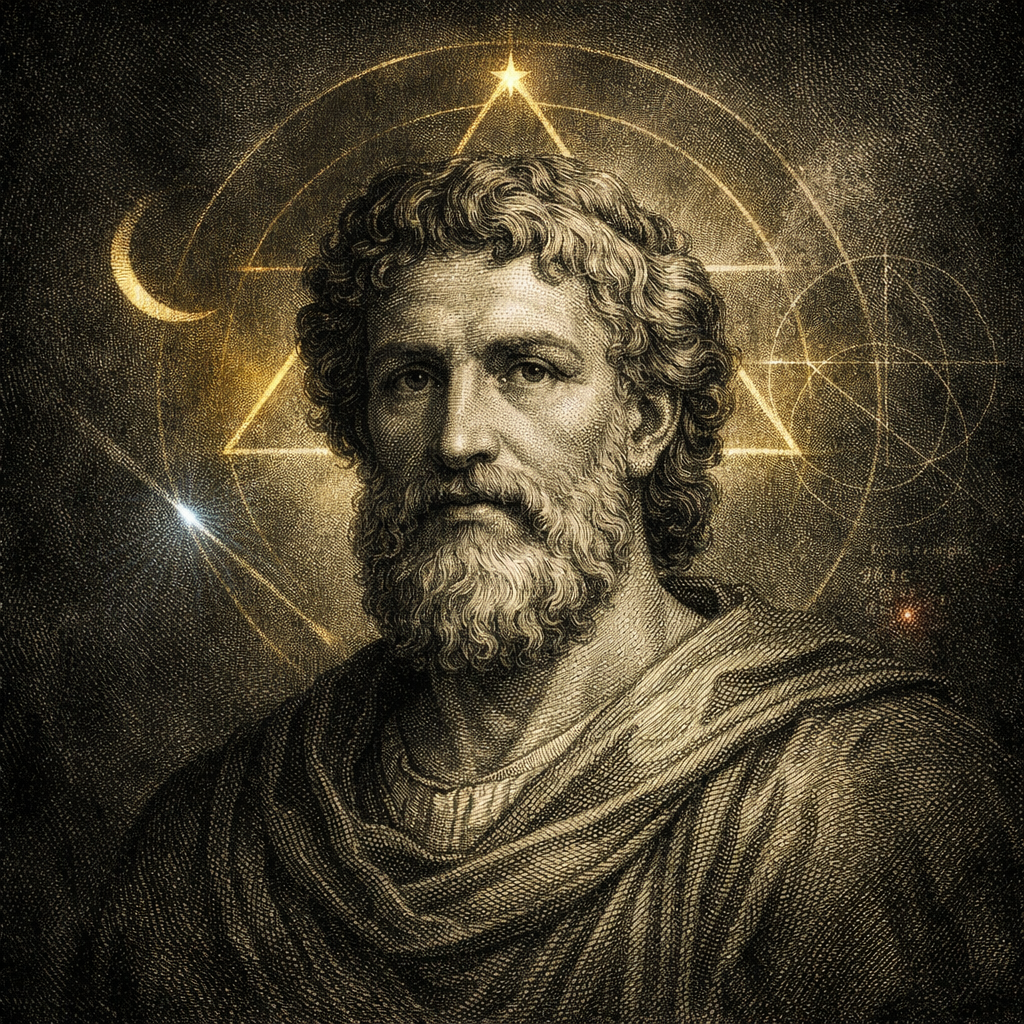
Date range: 412–485
Brief Biography
Proclus was a late antique Greek philosopher and one of the greatest systematisers of Neoplatonism. Born in Constantinople and educated in Xanthus, Alexandria, and Athens, he became head of the Platonic Academy in Athens and developed an immense philosophical synthesis drawing together Plato, earlier Platonists, theology, mathematics, and ritual philosophy. His writings shaped the final great flowering of pagan metaphysics in late antiquity, and his influence extended far beyond his own school into Byzantine, Islamic, Jewish, Christian, and Renaissance thought. Although formally a philosopher, Proclus belongs to the history of esotericism because he articulated a hierarchical cosmos alive with divine procession, symbolic participation, and the possibility of the soul’s ascent through contemplation and sacred mediation. He died in Athens in 485.
Works and Texts
- The Enneads
- De Mysteriis Aegyptiorum
- The Elements of Theology
Place in the Western Esoteric Tradition
Proclus occupies a central place in the Western Esoteric Tradition as one of the most powerful architects of sacred hierarchy, emanation, and return. If Plotinus gave late antiquity a profound metaphysical vision, Proclus gave that vision fuller structure, greater precision, and a more explicit theology of mediation. His universe is layered, living, and symbolic, filled with divine orders, intelligible principles, and ritual correspondences that later Hermetic, Gnostic, theurgic, and astral traditions could readily inhabit. Even where later esoteric movements simplified or recast his ideas, they often retained his basic conviction that reality descends through ordered levels and that the soul may rise again by intellectual purification, symbolic participation, and divine assistance.
Proclus’s Mystical System
Proclus’s mystical system is a vision of reality ordered by procession, mediation, and return. At its summit stands the ineffable first principle, the One, beyond being and beyond thought. Yet Proclus does not leave the universe suspended between absolute transcendence and mere multiplicity. His great achievement was to describe, in extraordinary detail, how the many emerge from the One without severing their dependence upon it, and how all things remain secretly oriented toward their divine source.
The governing pattern of his metaphysics is the triad of remaining, procession, and reversion. Every reality remains in its cause, proceeds from it into distinct existence, and reverts toward it in desire and fulfilment. This pattern applies at every level of being. The universe is therefore not a heap of disconnected entities but a dynamic order in which each level both derives from what is higher and transmits influence to what is lower. Reality is a chain of participation, and nothing is wholly cut off from the divine. This conception became immensely important for later esoteric traditions because it provided a rigorous account of correspondence without collapsing all distinctions into vagueness.
Between the One and the world of bodies, Proclus posits a richly articulated hierarchy. He multiplies the levels of divine reality more extensively than Plotinus had done, introducing the henads, divine unities that stand beyond being yet communicate the powers of the One in distinct modes. These henads allow Proclus to integrate the many gods of Hellenic religion into a philosophical system without reducing them to mere allegory. The gods are not rivals to the first principle; they are modes of divine manifestation and channels of causal order. This feature of Proclus’s thought is especially significant for the history of esotericism, because it legitimates a world in which plurality of divine forms, names, and powers can coexist within metaphysical unity.
Below the divine orders lies Intellect, the realm of stable forms and intelligible life. Here Proclus elaborates the inner articulation of being, life, and intellect, distinguishing carefully between levels of intelligible and intellective reality. Such distinctions can appear forbiddingly technical, but their purpose is deeply spiritual. Proclus wished to show that reality is not a blunt ladder of levels; it is an internally living order whose richness reflects the inexhaustibility of the divine source. Soul then occupies the mediating position between the intelligible and the sensible, capable of descending into temporal life yet always retaining some orientation toward what is above. Human beings belong to this drama because the rational soul is not merely a psychological faculty but a participant in the universal movement of return.
The soul’s ascent is central to Proclus’s mystical vision. Like earlier Platonists, he teaches that the soul becomes assimilated to what it contemplates. Immersion in lower things scatters consciousness and binds it to temporal succession; contemplation of higher realities restores unity and recollection. Ethical discipline, philosophical study, and contemplative purification are therefore indispensable. One does not ascend by curiosity, and certainly not by the modern fantasy that reading three difficult books and owning a candle has made one a hierophant. The soul must be purified, ordered, and reoriented so that it may turn from images toward principles and from multiplicity toward the divine source.
Yet Proclus differs from Plotinus in giving a more explicit place to ritual and theurgy. Contemplation remains essential, but it is not always sufficient. The gods exceed the power of discursive thought, and divine union cannot be achieved by intellectual effort alone. Sacred rites, symbols, invocations, and material correspondences may serve as vehicles of divine presence because the cosmos itself is woven through with signatures of higher realities. Material things are not spiritually inert. Stones, plants, numbers, hymns, and ritual actions can participate in divine orders when properly understood and enacted. Theurgy, in this framework, is not coercive magic but a sacred cooperation with the cosmos’s own structure of participation.
This is one of Proclus’s most important contributions to the esoteric imagination. He supplies a philosophical justification for symbolic action. Ritual works, not because matter has autonomous occult power, but because the whole universe is bound together by causal and analogical relations descending from the gods. Symbols are effective when they participate in the realities they signify. That conception would prove foundational for later Hermetic and magical thought, where the visible world is treated as a network of signatures, correspondences, and operative likenesses.
Proclus also developed a powerful theology of myth and sacred interpretation. Traditional myths are not dismissed as false stories for the childish. They conceal truths that must be read at different levels. Their language is symbolic, adapted to the soul’s varied capacities, and capable of disclosing divine realities when interpreted correctly. This hermeneutic approach would echo through later esoteric traditions, many of which regard ancient myths, scriptures, and images as layered vehicles of hidden wisdom rather than flat narratives. In Proclus, allegory and metaphysics become closely allied.
The overall shape of Proclus’s mystical system is therefore both philosophical and liturgical. The world is a sacred order of mediated presences. The human soul belongs within that order and can rise through purification, contemplation, symbolic understanding, and divine assistance. The goal is not merely intellectual mastery but likeness to the divine and eventual union according to the soul’s capacity. Proclus does not abolish hierarchy in the name of immediacy; he regards hierarchy as the very grammar of return. Divine reality is communicated through order, and ascent occurs through ordered participation.
For later Western esotericism, Proclus offered an extraordinarily fertile inheritance: a hierarchical universe, operative correspondences, divine multiplicity within unity, the spiritual value of symbols, and a serious account of ritual mediation. His thought helped define the metaphysical conditions under which Hermeticism, theurgy, astral magic, symbolic cosmology, and sacred exegesis could all be intellectually sustained. He did not found those later traditions outright, but he gave them a structure solid enough to survive many centuries of reuse, translation, and cheerful historical misapplication.
Antecedent Figures
- —
Antecedent Traditions
- —
Succeeding Figures
- Hermes Trismegistus
Succeeding Traditions
- Late Antique Hermeticism & Gnosticism
- Islamic Astral Magic