Plotinus
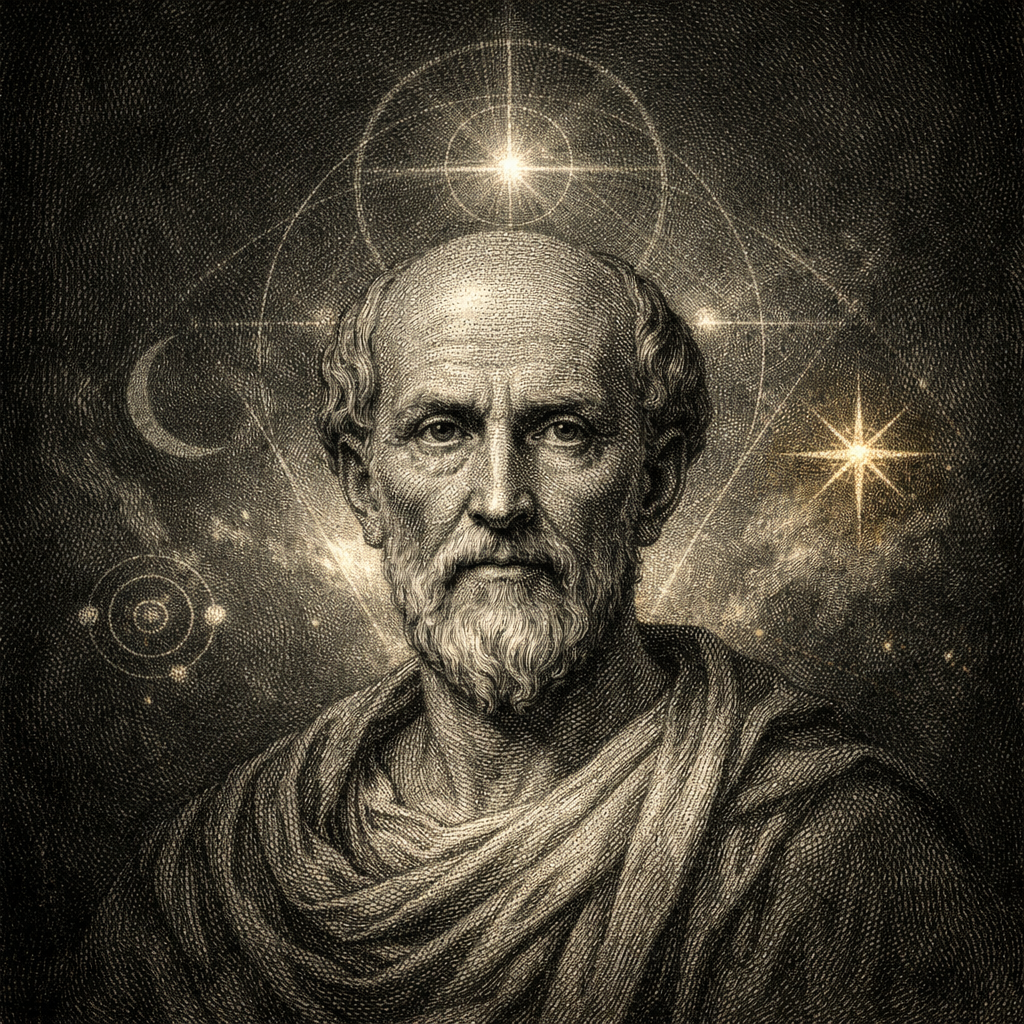
Date range: c. 204/5–270
Brief Biography
Plotinus was a major philosopher of the third century CE and the principal founder of what later came to be called Neoplatonism. Born probably in Egypt and educated in Alexandria under Ammonius Saccas, he later settled in Rome, where he taught a circle of students and developed a powerful metaphysical account of reality, soul, intellect, and mystical ascent. His writings were collected and arranged after his death by his disciple Porphyry as the Enneads, a work that became one of the most influential philosophical texts of late antiquity. Although Plotinus was not an occult author in the practical sense, his vision of emanation from the One, the soul’s descent and return, and the contemplative ascent beyond discursive thought profoundly shaped Christian, Islamic, Jewish, Hermetic, and later esoteric metaphysics.
Works and Texts
- The Enneads
- De Mysteriis Aegyptiorum
- The Elements of Theology
Place in the Western Esoteric Tradition
Plotinus occupies a foundational position in the intellectual ancestry of the Western Esoteric Tradition because he gave late antique spirituality one of its most durable metaphysical architectures. His account of reality as a graded procession from the ineffable One through Intellect and Soul provided a philosophical grammar for later doctrines of emanation, spiritual hierarchy, symbolic ascent, and contemplative return. Even where later Hermetic, Gnostic, theurgic, and astral-magical traditions departed from his suspicion of ritual compulsion or material mediation, they often moved within a cosmos whose vertical structure had been clarified by Neoplatonic thought. In this sense, Plotinus helped supply the metaphysical atmosphere in which figures such as Hermes Trismegistus could be received, interpreted, and integrated into later esoteric systems.
Plotinus’s Mystical System
Plotinus’s mystical system begins with a radical claim about the source of all reality: the first principle is beyond being, beyond intellect, and beyond every name that thought can assign to it. This principle, which Plotinus calls the One or the Good, is not a supreme object within the universe, nor a god among gods, nor even a highest being in the ordinary sense. It is the absolute simplicity from which all multiplicity derives. The One does not deliberate, create by choice, or fashion the world as a craftsman handles matter. Reality proceeds from it by overflowing abundance, as light radiates from the sun without diminishing its source.
This doctrine of procession is central to Plotinus’s metaphysics. From the One proceeds Intellect, the realm of pure thought and intelligible form. Intellect is the first determinate reality: it contains the Platonic Forms, not as abstract classifications, but as living intelligible principles. In Intellect, knowing and being are united. To think truly is to participate in what is real, and what is most real is most fully knowable. From Intellect proceeds Soul, the principle of life, motion, and order that mediates between the intelligible and sensible realms. Soul gives structure to the cosmos and animates living beings, extending the intelligible order into the world of time and change.
The visible world, for Plotinus, is not an evil prison in the strongest Gnostic sense. It is lower than the intelligible world because it is dispersed, unstable, and dependent, but it remains an image of higher order. Beauty in the sensible world matters because it reveals form shining through matter. A beautiful body, a harmonious proportion, or an ordered cosmos can awaken memory of the intelligible source from which all order descends. The world is therefore ambiguous: it can entangle the soul in illusion, appetite, and forgetfulness, but it can also become a sign of the higher realities from which it derives.
The human soul occupies a dramatic position within this structure. It belongs by nature to the intelligible realm, yet it is also involved in body, sensation, passion, and temporal life. Plotinus presents the soul’s condition as descent rather than simple fall. The soul has become absorbed in what is external to itself, mistaking the lower for the higher and the image for the source. The task of philosophy is therefore therapeutic and transformative. It recalls the soul to its own higher identity and teaches it to turn inward, upward, and beyond itself.
The path of return begins with purification. Ethical discipline is not a mere social convenience; it frees the soul from domination by appetite and distraction. The virtues train the soul to recover order, self-mastery, and likeness to the divine. Plotinus inherits the Platonic idea that the soul becomes what it contemplates. If it fixes itself upon bodily things, it becomes dispersed and heavy. If it turns toward intelligible reality, it becomes more unified, luminous, and free. Moral life is therefore inseparable from metaphysics. To live well is to align the soul with the order from which it came.
Beauty plays a privileged role in this ascent. Plotinus’s famous account of beauty treats it as the radiance of form, not simply as pleasing arrangement. The encounter with beauty can stir the soul into recognition, drawing it away from passive enjoyment toward contemplation of the intelligible. The lover of beauty must learn to move from bodily beauty to the beauty of soul, from noble conduct to the beauty of intellect, and finally beyond all determinate beauty to the source from which beauty itself proceeds. This ascent does not abolish the lower stages, but it refuses to rest in them.
The culminating aim is union with the One. This union is difficult to describe because it exceeds ordinary knowledge. Intellect still involves a distinction between knower and known, but the One lies beyond such distinction. The soul’s highest experience is therefore not discursive reasoning, symbolic interpretation, or visionary spectacle, but a form of immediate presence in which multiplicity falls away. Porphyry reports that Plotinus attained this union several times, though such reports should not be treated as spiritual gossip with sandals. The philosophical point is clear: the soul’s final fulfilment is not the acquisition of information but the recovery of unity.
Plotinus’s attitude toward ritual and theurgy distinguishes him from some later Neoplatonists. He placed primary emphasis on contemplation, purification, and inward ascent. Later thinkers, especially Iamblichus, would argue more strongly for the necessity of ritual action, divine symbols, and theurgic mediation. The supplied association with De Mysteriis Aegyptiorum therefore belongs to a neighbouring but distinct development in late antique Neoplatonism. Plotinus’s own system is less ritualised and more inwardly philosophical. Yet his metaphysical hierarchy made later theurgic and Hermetic systems intelligible by providing a graded universe through which divine influence, symbolic correspondence, and spiritual ascent could be conceptualised.
The esoteric importance of Plotinus lies in this architecture of emanation and return. Later traditions would transform it repeatedly: Christian theologians would adapt it to doctrines of creation and deification; Islamic philosophers and mystics would integrate it into accounts of intellect and emanation; Jewish Kabbalists would develop their own symbolic hierarchies of divine manifestation; Renaissance Hermeticists would use Neoplatonic structures to interpret magic, astrology, and symbolic philosophy. Plotinus did not design these later systems, but he helped define the vertical imagination on which many of them depended.
Plotinus’s mystical system is therefore a philosophy of origin, descent, purification, and return. The human being is not an isolated creature stranded in a meaningless world, but a participant in a living hierarchy of reality whose deepest source is beyond thought. The soul’s work is to remember, purify, contemplate, and finally transcend even intellectual vision. In that movement from multiplicity toward unity, Plotinus gave Western esotericism one of its most enduring metaphysical patterns.
Antecedent Figures
- —
Antecedent Traditions
- —
Succeeding Figures
- Hermes Trismegistus
Succeeding Traditions
- Late Antique Hermeticism & Gnosticism
- Islamic Astral Magic