Philipp Jakob Spener
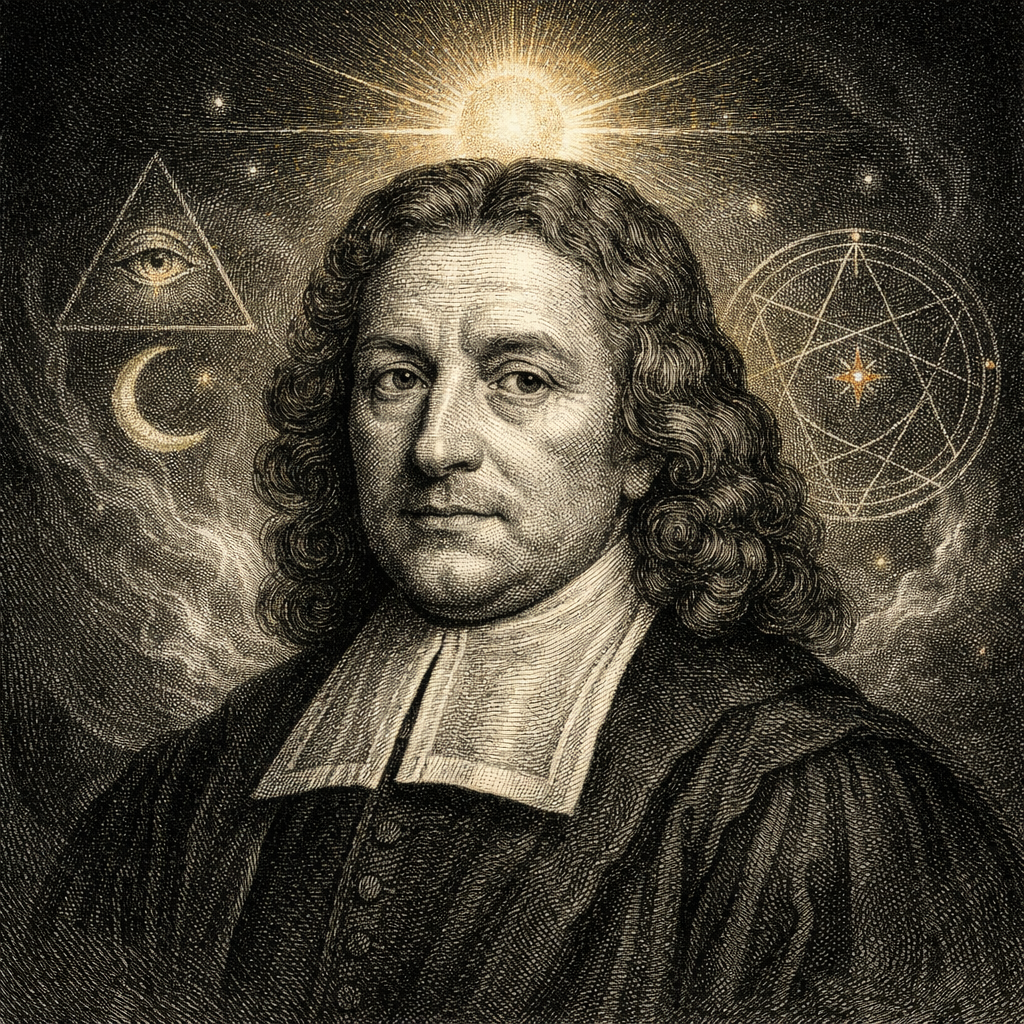
Date range: 1635–1705
Brief Biography
Philipp Jakob Spener was a German Lutheran theologian, reformer, devotional writer, and the principal founding figure of Pietism. Born in Rappoltsweiler in Alsace, he was educated within orthodox Lutheranism but became increasingly convinced that formal doctrinal correctness, though necessary, was insufficient without lived piety, spiritual rebirth, and the practical renewal of Christian life. As a pastor in Frankfurt, Dresden, and Berlin, Spener advocated more serious Bible study, moral discipline, pastoral care, and active lay participation in the life of the Church. His most influential work, Pia Desideria, became a manifesto for reform within Lutheranism and helped launch a movement that would reshape Protestant spirituality across Europe. In the broader history of Western esotericism, Spener’s importance is indirect but substantial: he helped foster a devotional and inward religious atmosphere that would influence later Rosicrucian, illuminist, and theosophical currents concerned with spiritual rebirth, inner transformation, and the religion of the heart.
Works and Texts
- True Christianity
- Pia Desideria
Place in the Western Esoteric Tradition
Spener occupies an important supporting place in the Western Esoteric Tradition as a major architect of Lutheran Mysticism & Pietism, even where the supplied antecedent fields are blank. His work helped create a religious culture that valued inward regeneration, spiritual seriousness, heartfelt devotion, scriptural immersion, and the transformation of life rather than mere confessional formalism. This did not make Spener an esoteric author in the strict sense. He was a church reformer, not a ceremonial magician or visionary theosopher. Yet the devotional climate he helped shape proved highly significant for later currents such as Rosicrucianism, Illuminism & Christian Theosophy, and related traditions in which inward rebirth, spiritual illumination, and the hidden life of the soul became central concerns. Spener’s importance lies in the fact that he helped prepare the soil in which more overtly esoteric forms of inward Christianity could later grow.
Spener’s Mystical System
Philipp Jakob Spener’s mystical system, if that term may be used broadly, is best understood as a theology of inward renewal. He did not construct a speculative cosmology of emanations, hierarchies, or occult correspondences. Nor did he present a technical doctrine of initiation. His concern was more practical and pastoral: the restoration of living Christianity through repentance, rebirth, scriptural devotion, and sanctified conduct. Yet precisely because he emphasised the transformation of the heart over the mere possession of correct doctrine, his thought belongs to the wider history of inward religion that intersects at points with the Western Esoteric Tradition.
The central problem for Spener was spiritual deadness. He believed that much of contemporary Christianity had become formal, polemical, and complacent. Orthodoxy had preserved right teaching, but right teaching alone had not produced sufficiently transformed lives. The Church, in his view, suffered from a dangerous gap between confession and practice. This concern does not make him anti-doctrinal. Spener remained a committed Lutheran. But he insisted that doctrine must issue in regeneration, love, discipline, and visible holiness. Religion that remained merely intellectual was inadequate.
This emphasis led him toward the idea of rebirth. For Spener, the Christian life begins not simply with nominal membership in the Church, but with an inward renewal wrought by grace. The believer must be changed from within. Faith is not only assent to revealed truth; it is the living principle by which the soul is reoriented toward God. This theme gave Pietism its particular tone. The true Christian is not merely instructed, but awakened. The heart must be softened, the will corrected, and the life brought into conformity with the divine intention.
Scripture was central to this process. Spener believed that the Bible should not remain the preserve of scholars and preachers alone, nor function merely as a quarry for doctrinal disputes. It should be read devotionally, prayerfully, and communally. One of his most famous reforms was the encouragement of collegia pietatis, small gatherings for Bible reading, edification, mutual exhortation, and spiritual conversation. These groups aimed to deepen Christian life through shared study and practical devotion. In this respect, Spener’s thought anticipates many later forms of small-group religious renewal. It also contributes to the wider esoteric theme that truth must be embodied in a committed circle of seekers, not left as inert public abstraction.
The idea of the “priesthood of all believers” also takes on renewed importance in his work. Spener did not abolish clerical office, but he insisted that lay Christians should play a more active role in spiritual life. Believers were not to be passive recipients of ecclesiastical administration. They were to participate actively in study, prayer, exhortation, and moral renewal. This has an obvious ecclesiastical meaning, but it also bears on the broader history of inner religion. Authority is no longer confined purely to institutional hierarchy. The awakened Christian conscience acquires a more active and responsible place in spiritual life.
Spener’s system is therefore moral and spiritual rather than speculative. The goal is sanctification: the visible formation of the Christian character in love, humility, patience, obedience, and sincerity. This makes his theology deeply practical. The proof of religion lies in transformed life. Yet this practicality is not merely ethical in a dry sense. It is animated by a strong sense of inward divine action. Grace works within the person; the heart becomes the site of renewal; the Christian life becomes a progressive deepening of spiritual reality. In this sense, Spener stands near the border where confessional theology shades into experiential and affective mysticism.
His relation to Johann Arndt is especially important, even if the antecedent fields here are empty. Arndt’s True Christianity was one of the great devotional precursors of Pietism, stressing inward transformation, imitation of Christ, and the necessity of genuine spiritual life. Spener absorbed and extended this emphasis. If Lutheran orthodoxy preserved the skeleton of doctrine, Arndt and Spener insisted upon restoring the flesh and breath of lived Christianity. Spener did so in a more programmatic and reforming way, seeking not only individual renewal but ecclesial renewal.
This gives his system a quietly radical quality. He did not call for schism or a rejection of the established Church. He worked within Lutheranism. But his insistence on heartfelt religion, practical holiness, and small circles of intensified devotion inevitably shifted the centre of gravity away from institutional formalism alone. That shift would have enormous consequences. Once Christianity is increasingly judged by inward vitality, experiential authenticity, and visible transformation, a space opens for later movements that intensify those same concerns in more mystical, illuminist, or theosophical directions.
Spener’s influence on later traditions must therefore be understood as atmospheric as much as doctrinal. Rosicrucian and illuminist currents often flourished where there already existed dissatisfaction with dead formalism and a desire for inward reform. The same broad religious climate that nourished Pietism could also nourish more esoteric forms of Christian renewal. Spener himself remained far more restrained than such later currents. He was no occult reformer in disguise. Yet the language of inward illumination, rebirth, spiritual seriousness, and the religion of the heart made later developments more conceivable and more compelling.
His system is also marked by hope for reform rather than apocalyptic despair. The Church, though deficient, could be renewed. Believers could be deepened. Theology could be reconnected to life. This hopeful tone distinguishes him from later anti-modern or crisis-driven thinkers. Spener believed that spiritual renewal was possible through faithful pastoral practice, communal devotion, and a more earnest appropriation of scripture. There is something almost irritatingly constructive about him, especially to minds that prefer their religious criticism wrapped in cosmic collapse.
In the wider history of inward spirituality, Spener stands as a mediator between older devotional theology and later forms of Christian interiority. He helped make subjectivity religiously serious, though not in a purely individualistic way. The inward life mattered because it was the field in which grace worked and sanctification became visible. This emphasis would later echo, directly or indirectly, in movements concerned with illumination, inward transformation, and hidden wisdom. Not every path that leads away from sterile formalism ends in esotericism, of course, but many esoteric currents are nourished by the same dissatisfaction.
Spener’s mystical system may therefore be described as practical devotional regeneration. It is centred on the rebirth of the heart, the living appropriation of scripture, the sanctification of life, and the reform of the Christian community through active, inwardly awakened believers. Its tone is pastoral rather than occult, reforming rather than speculative, but its impact on the broader spiritual history of Europe was considerable. In the Western Esoteric Tradition, Spener matters less as a direct esoteric master than as a formative presence in the history of inward Christianity: one of the men who helped teach Europe that religion must be lived from within.
Antecedent Figures
- —
Antecedent Traditions
- —
Succeeding Figures
- Emanuel Swedenborg; Jacob Boehme; Johann Valentin Andreae; Louis-Claude de Saint-Martin; Martinez de Pasqually; Michael Maier; Robert Fludd
Succeeding Traditions
- Rosicrucianism; Illuminism & Christian Theosophy