Paracelsianism
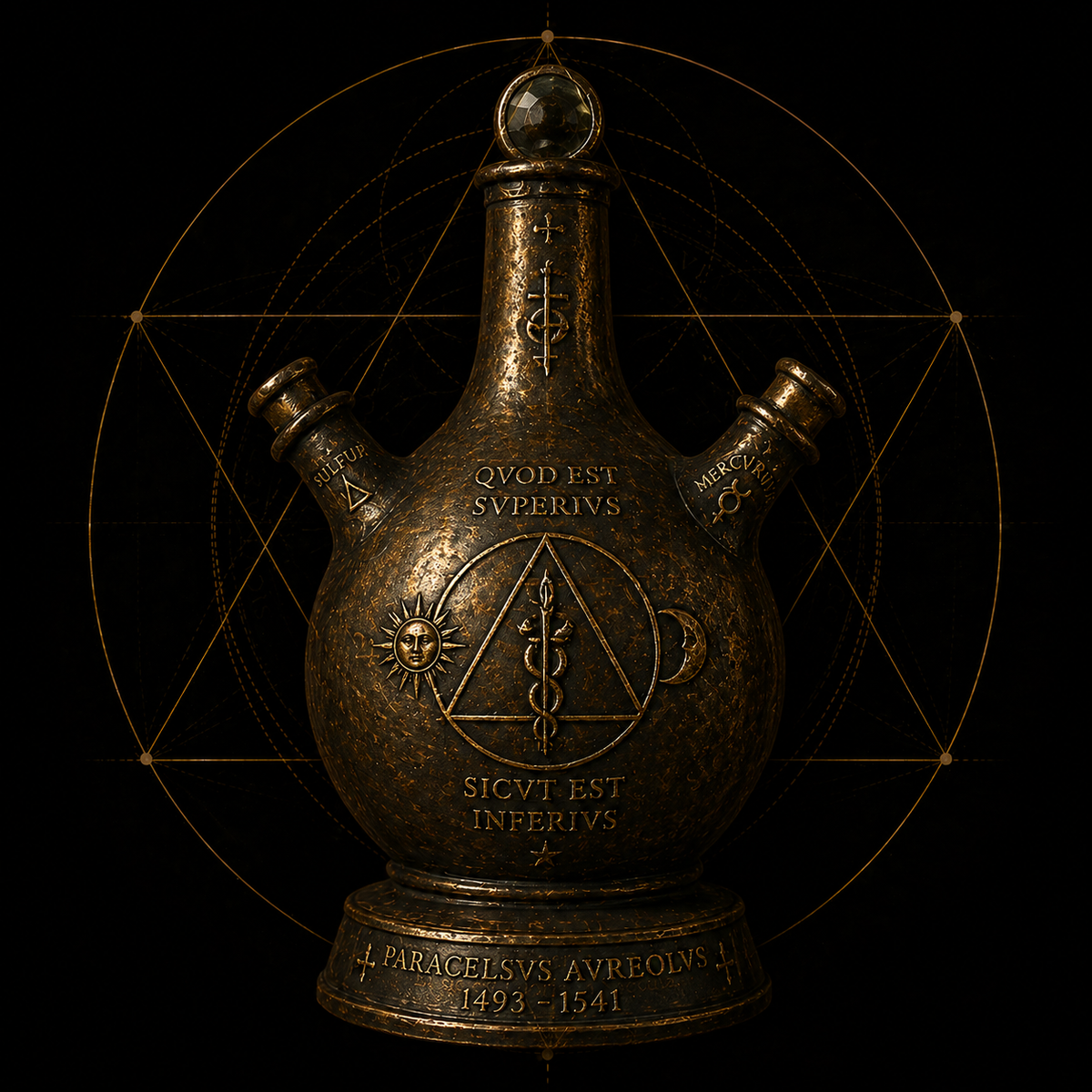
Paracelsianism was one of the most disruptive and generative currents in early modern esoteric thought. Centred on the work and posthumous influence of Theophrastus von Hohenheim, known as Paracelsus, it challenged the learned medical establishment, reconfigured alchemy, and reshaped the relationship between medicine, nature, spirit, and divine knowledge. It emerged from the Renaissance world of Christian Hermeticism, natural magic, alchemy, and reforming religious culture, but it pushed these currents in a distinctively practical and medical direction. Paracelsianism was not merely a set of doctrines about healing. It was a vision of nature as a living, divinely ordered field of signs, powers, correspondences, diseases, remedies, and spiritual meanings.
Paracelsus rejected much of the inherited Galenic medical system that dominated university medicine. He attacked its reliance on the four humours, its scholastic abstractions, and its deference to ancient authorities. In place of this, he argued for a medicine grounded in experience, observation, chemical remedies, and a deeper understanding of nature’s hidden processes. This was not modern empirical medicine in any simple sense, although later histories have sometimes tried to recruit him as a premature scientist wearing an inconveniently mystical hat. Paracelsus combined practical observation with astrology, alchemy, theology, folk healing, spiritual anthropology, and a powerful belief that nature was a divine text to be read by the properly trained physician.
One of the central Paracelsian doctrines is the tria prima: salt, sulphur, and mercury. These were not simply ordinary substances, but principles through which material things could be understood. Salt represented fixity, body, and solidity; sulphur represented combustibility, soul, and active transformation; mercury represented volatility, spirit, and mediation. This triadic model reinterpreted alchemy and natural philosophy by offering a new language of composition, corruption, disease, and cure. It also provided a powerful symbolic structure for later alchemical and esoteric traditions, where physical processes and spiritual transformations could be read through the same set of principles.
Paracelsianism also transformed the meaning of alchemy. Earlier alchemical traditions had long included both material and spiritual dimensions, but Paracelsus and his followers emphasised the medical use of alchemical processes. The goal was not only the transmutation of metals or the pursuit of gold, but the preparation of remedies through separation, purification, extraction, and recombination. The laboratory became a place where the physician could uncover the virtues hidden within natural things. This approach helped give rise to iatrochemistry, or chemical medicine, and altered the intellectual status of alchemy. Alchemy became not merely a speculative or artisanal practice, but a reforming medical science aimed at healing the body by understanding the inner signatures and powers of nature.
The doctrine of signatures is especially important to the Paracelsian worldview. Nature, in this view, bears visible signs of its invisible properties. The form, colour, texture, habitat, or behaviour of a plant, mineral, or animal may indicate its medicinal or spiritual virtue. The physician must learn to read these signs. This is not arbitrary symbolism, but a claim about the structure of creation: God has marked things with indications of their use, and nature communicates through analogy. Later esoteric traditions would find in this doctrine a compelling expression of the broader principle of correspondence. The world becomes a symbolic field in which outer form and inner virtue are linked.
Paracelsian anthropology also had lasting esoteric significance. The human being was understood as a microcosm, a little world reflecting the greater world. Disease was not merely an imbalance of humours, but could arise from astral, spiritual, moral, elemental, or chemical causes. The physician therefore needed more than technical skill. He required knowledge of the heavens, the elements, the invisible body, the virtues of remedies, and the spiritual condition of the patient. The true physician was, in Paracelsian terms, a reader of nature and a servant of divine wisdom. This elevated medicine into a sacred vocation, even if Paracelsus himself was not always a model of bedside serenity, or indeed of serenity in any known category.
The relationship between Paracelsianism and Renaissance Christian Kabbalah and Hermetic magic is clear. Paracelsus inherited the Renaissance conviction that the cosmos is alive with hidden powers and correspondences, that the human being mirrors the universe, and that ancient or divine wisdom may be recovered through disciplined knowledge of nature. Yet he redirected this inheritance toward healing and chemical transformation. Where Ficino’s magic often aimed at harmonising the soul with celestial influences, and Agrippa’s occult philosophy sought encyclopaedic mastery of cosmic correspondences, Paracelsianism treated nature as a medicinal and alchemical revelation. Its practical orientation gave it a distinctive force.
Paracelsianism also influenced later Rosicrucian and alchemical thought, even though the present nodal map does not list a succeeding tradition for it. Historically, its themes of healing, reform, hidden wisdom, divine nature, and alchemical medicine resonated strongly with seventeenth-century esoteric Christianity. The Rosicrucian manifestos imagined a learned fraternity devoted to universal reformation, medicine, and the recovery of divine wisdom. That vision is difficult to understand without the Paracelsian atmosphere that preceded it. Even when Paracelsus is not named, the dream of a reformed medicine grounded in spiritualised nature is unmistakably present in the wider early modern esoteric imagination.
The influence of Paracelsianism extended into natural philosophy, chemistry, medicine, alchemy, and religious dissent. Its followers developed diverse and sometimes conflicting versions of his thought. Some emphasised chemical medicine; others pursued spiritual alchemy, apocalyptic reform, magical healing, or Protestant theosophy. This diversity makes Paracelsianism difficult to define narrowly. It was less a school with fixed doctrines than a movement of reforming impulses: against scholastic medicine, against sterile authority, toward experience, nature, divine signs, chemical transformation, and the possibility that the world itself is a book of hidden wisdom.
Its enduring importance within the Western Esoteric Tradition lies in the way it joined the practical and the symbolic. Paracelsianism insisted that esoteric knowledge was not only contemplative or initiatory, but therapeutic. The hidden powers of nature mattered because they could heal. The alchemical laboratory mattered because it could release virtues concealed in matter. The doctrine of correspondence mattered because it could guide the physician toward remedies. The human body mattered because it reflected the cosmos. In this current, medicine, magic, alchemy, theology, and natural philosophy do not sit in separate compartments. They form a single effort to understand and restore the harmony of the created world.
Paracelsianism should therefore be understood as a major early modern reorientation of esoteric thought toward nature, body, and cure. It inherited the Renaissance Hermetic and magical cosmos, but gave it a sharper medical and alchemical purpose. It made the physician into an interpreter of divine nature, the laboratory into a site of revelation, and healing into an act of cosmic restoration. Its later influence cannot be reduced to institutional succession, because its ideas diffused widely through early modern medicine, alchemy, Rosicrucianism, and occult philosophy. Even where the map records no succeeding tradition, Paracelsianism remains one of the great catalytic forces in the development of Western esoteric modernity.
Antecedent Traditions
· Renaissance Christian Kabbalah & Hermetic Magic
Succeeding Traditions
· None mapped