Papus (Gérard Encausse)
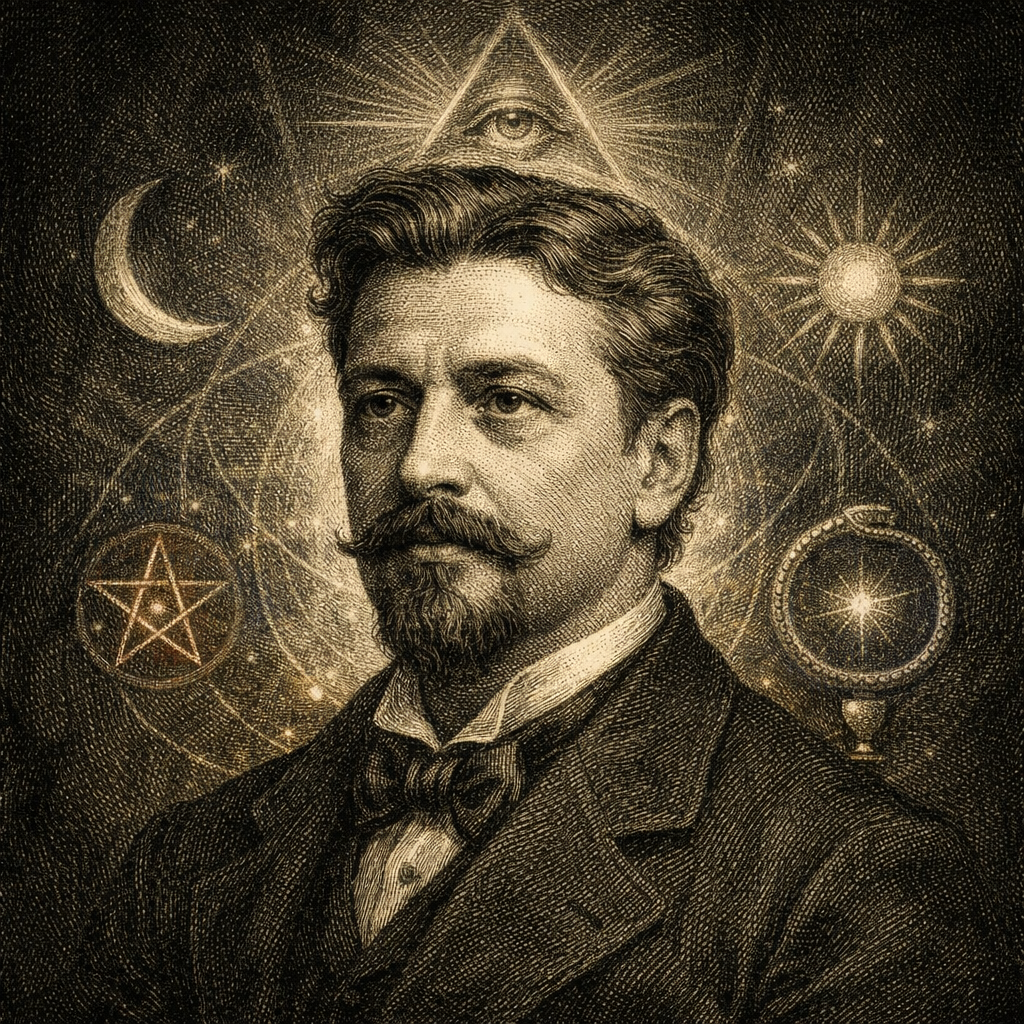
Date range: 1865–1916
Brief Biography
Gérard Encausse, better known by his pseudonym Papus, was a French physician, occultist, writer, organiser, and one of the central architects of the late nineteenth-century occult revival. Born in Spain and raised in France, he became a prolific populariser and systematiser of esoteric ideas at a time when Paris was a major centre of magical, theosophical, Martinist, and Hermetic experimentation. Papus drew together materials from Christian theosophy, Martinism, ceremonial magic, tarot, Kabbalah, occult medicine, and high-degree initiatory traditions, and he did so with unusual energy, institutional ambition, and literary productivity. He was instrumental in the revival of Martinism, helped found and shape important occult bodies, and became a key intermediary between earlier French esoteric currents and the broader international occult milieu of the fin de siècle. He died in 1916, leaving behind a body of work that helped define modern occultism as a structured field of study, practice, and initiatory identity.
Works and Texts
- Dogme et Rituel de la Haute Magie
- The Tarot of the Bohemians
Place in the Western Esoteric Tradition
Papus occupies a major place in the Western Esoteric Tradition as a synthesiser of nineteenth-century occultism. He inherited currents from speculative and high-degree Masonry, Martinism, Christian theosophy, occult tarot, and grimoire-based ceremonial magic, and reassembled them into a modern esoteric worldview that was portable, teachable, and organisationally effective. His importance lies not only in original doctrine, but in synthesis and transmission. Papus helped shape the form in which many readers first encountered the occult revival: as a connected body of symbols, correspondences, grades, traditions, and initiatory possibilities. Through his writings and institutions, he became one of the key bridges linking the earlier French occult revival to later developments in Modern Qabalah, Golden Dawn-style ceremonial magic, Thelema, Wicca, and broader twentieth-century esotericism.
Papus’s Mystical System
Papus’s mystical system is best understood as an initiatory synthesis. He was not the founder of a wholly new doctrine in the way that some earlier theosophers or visionaries had been. His genius lay in gathering multiple strands of Western esotericism and arranging them into a practical, intelligible, and compelling whole. In his hands, Martinism, tarot, ceremonial magic, Kabbalah, Masonic symbolism, occult medicine, and the older language of correspondences were woven together into a modern esoteric framework suited to the needs of the late nineteenth century.
At the heart of Papus’s thought lies the conviction that the visible world is the outer expression of deeper spiritual laws. Human beings do not live in a universe of mere matter, but in a symbolic cosmos structured by correspondences, hierarchies, and hidden relations. The spiritual task is therefore one of reading and participating in that order. Symbols are not decorative curiosities. They are instruments of knowledge. Tarot, Kabbalah, magical signs, ritual forms, and traditional doctrines all function as keys to a concealed structure of reality.
This symbolic approach was paired with a strongly initiatory sensibility. Papus believed that esoteric knowledge should not be treated as mere speculation or intellectual amusement. It required discipline, study, and graded transmission. The initiate is not simply a reader of occult books, but a participant in a path of interior and doctrinal development. This is one of the reasons Papus was so active in organisational work. He understood that occultism, left to casual dabbling, quickly degenerates into spiritual tourism with better robes. Institutions, degrees, and lineages gave form to a more serious ideal of transmission.
Martinism was central to this vision. Papus played a decisive role in reviving and codifying Martinism as a modern initiatory current. The tradition he presented drew especially upon Louis-Claude de Saint-Martin, Martinez de Pasqually, and Jean-Baptiste Willermoz, though often through a nineteenth-century occult lens. The core theme remained reintegration: the fallen human being must recover the path back toward divine truth. Papus treated initiation as a means of awakening the interior being, restoring contact with spiritual reality, and reorienting the person away from merely external existence. In this respect, he inherited the Christian theosophical language of inward repair, even while embedding it within the more eclectic atmosphere of the occult revival.
Tarot was another major pillar of his system. In The Tarot of the Bohemians, Papus treated the tarot not simply as a fortune-telling device, but as a symbolic book of universal wisdom. He connected the cards to Kabbalah, number, cosmic order, and initiatory doctrine. The tarot becomes, in his hands, a portable mandala of esoteric truth: a diagram of relations between the human, cosmic, and divine worlds. This interpretive move helped shape the modern occult understanding of tarot and influenced later readers across the entire twentieth-century esoteric field.
Papus’s use of Kabbalah was likewise synthetic and interpretive rather than philologically exact. Like many occultists of his era, he approached Kabbalah as a universal key to symbolic and metaphysical order. The sefirotic tree, letter mysticism, and the logic of emanation were reworked into a practical framework for magical and initiatory understanding. What mattered to Papus was not strict historical fidelity to Jewish Kabbalah as such, but the usefulness of Kabbalistic structures in articulating the hidden architecture of the cosmos. This gave his work wide applicability, if not always perfect historical restraint.
Ceremonial and magical elements also have an important place in his system. Papus did not reduce occultism to passive contemplation. Ritual, symbol, invocation, and operative forms all belonged to the work of spiritual development. Yet he generally sought to integrate such practices into a wider initiatory and moral framework rather than presenting magic as a free-standing technique of power. The true operator should possess doctrinal understanding, ethical seriousness, and a place within a tradition. This keeps Papus closer to the respectable end of occult revivalism, though “respectable” must of course be used here with the appropriate historical caution.
His medical background also coloured his thought. Papus was interested in the human being as a layered organism in which body, vitality, psyche, and spirit interact. This contributed to a broader occult worldview in which healing, magnetism, subtle forces, and spiritual development could all be related. The human person is not reducible to physiology, nor is spirituality detached from embodied existence. As with many fin-de-siècle esoteric thinkers, there is an effort to bring science, occultism, and spiritual anthropology into some kind of workable relation, with results that range from stimulating to gloriously overconfident.
Papus also belongs to the broader effort to democratise occult knowledge without entirely trivialising it. Earlier esoteric currents often remained fragmented, private, or difficult of access. Papus wrote textbooks, manuals, expositions, and summaries. He made occultism readable. This was one of his greatest strengths. It was also, inevitably, one of the ways the occult revival became scalable, because nothing says “secret wisdom” quite like a thriving publishing programme and multiple orders with stationery.
The ethical and spiritual aim of Papus’s system remains reintegration and illumination. The human being is called to move beyond material limitation and recover awareness of the divine order. Symbols train the intellect, rituals discipline the will, initiation shapes the inner life, and study gives coherence to experience. Unlike purely devotional systems, Papus’s path is encyclopaedic and integrative. Unlike purely magical systems, it usually maintains a stronger concern for spiritual ascent and initiatory legitimacy. His system therefore stands at a crossroads: part Christian theosophy, part occult science, part symbolic pedagogy, part ritual revival.
Papus’s influence on later traditions was enormous. Golden Dawn-style currents, modern Qabalah, Thelema, tarot occultism, and modern witchcraft all developed in a world partly prepared by the kind of synthesis Papus advanced. He did not determine those traditions outright, but he helped establish the vocabulary through which they could understand themselves: correspondences, initiation, symbolic books, occult science, esoteric history, and the recoverability of hidden wisdom through disciplined study.
Papus’s mystical system may therefore be described as synthetic initiatory occultism. It unites Martinist reintegration, occult tarot, Kabbalistic structure, ritual magic, and symbolic pedagogy into a coherent modern esoteric programme. Its strength lies in integration and transmission rather than radical originality. In the history of the Western Esoteric Tradition, Papus stands as one of the principal organisers of the occult revival: a man who took many scattered esoteric inheritances and turned them into a functioning modern language of initiation.
Antecedent Figures
- Andrew Michael Ramsay; Antoine Court de Gébelin; Elias Ashmole; Emanuel Swedenborg; Jacob Boehme; James Anderson; Jean-Baptiste Alliette (Etteilla); Jean-Baptiste Willermoz; Louis-Claude de Saint-Martin; Martinez de Pasqually; William Preston
Antecedent Traditions
- Speculative Freemasonry; Illuminism & Christian Theosophy; High-Degree Masonry; Renaissance Grimoires; Early Tarot
Succeeding Figures
- Aleister Crowley; Annie Besant; Arthur Edward Waite; Charles Webster Leadbeater; Dion Fortune; Gerald Gardner; Helena Petrovna Blavatsky; S.L. MacGregor Mathers; William Wynn Westcott
Succeeding Traditions
- Thelema; Neo-Paganism/Wicca; Modern Qabalah; Hermetic Order of the Golden Dawn; Theosophical Society