Moses de León
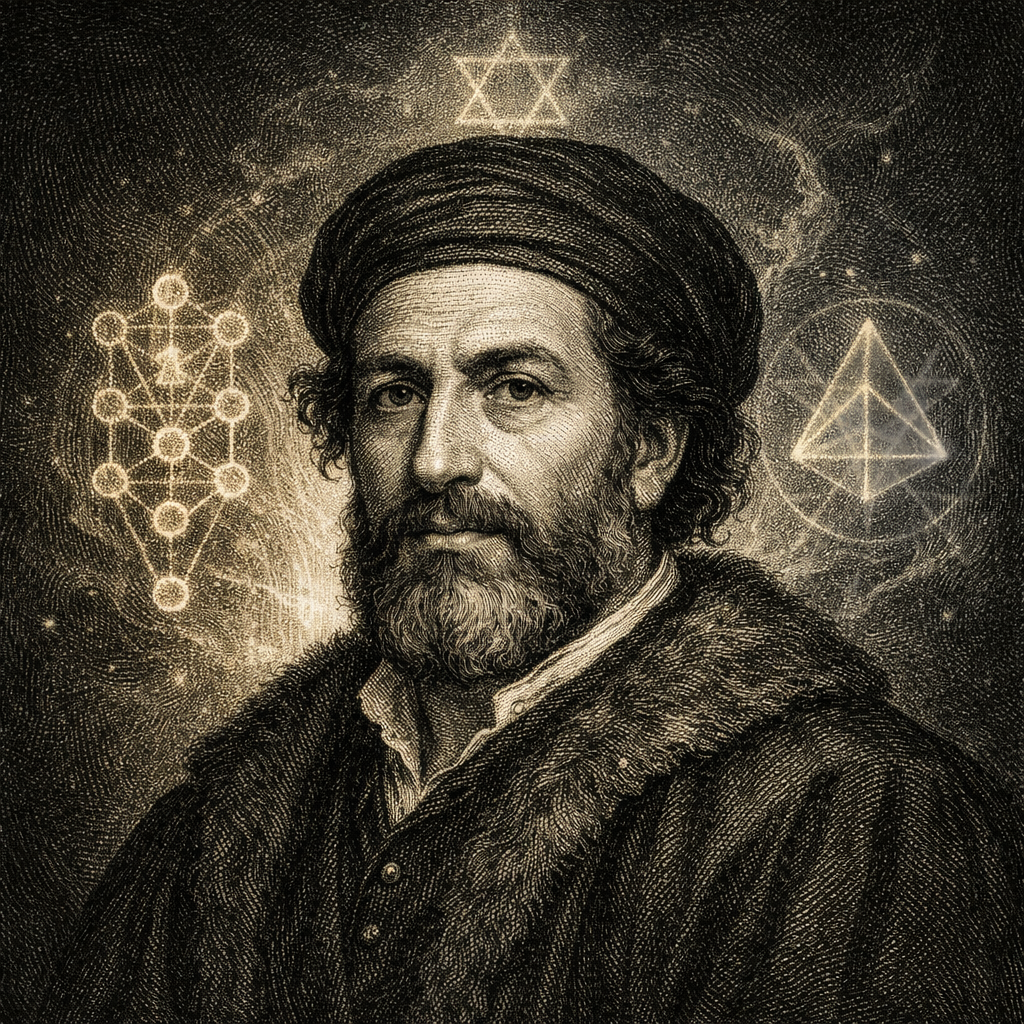
Date range: c. 1240–1305
Brief Biography
Moses de León was a Castilian Jewish mystic, writer, and one of the most consequential figures in the history of Kabbalah. Active in thirteenth-century Spain, he wrote in the intellectually fertile environment of medieval Iberian Judaism, where philosophy, mysticism, scriptural interpretation, and esoteric speculation were all in vigorous circulation. He is most famously associated with the Zohar, the great classic of Kabbalistic literature, which he either composed, compiled, redacted, or at the very least decisively transmitted in the form by which it became known. Presented pseudepigraphically as ancient teachings of Rabbi Shimon bar Yochai and his companions, the Zohar transformed the language of Jewish mysticism by offering a richly symbolic vision of divine emanation, sacred interpretation, cosmic exile, and spiritual repair. Through that work, Moses de León became one of the decisive architects of later Kabbalistic and esoteric thought.
Works and Texts
- The Zohar
- Life of the Future World
Place in the Western Esoteric Tradition
Moses de León occupies a major place in the Western Esoteric Tradition as one of the principal mediators of medieval Kabbalah into the broader symbolic history from which Renaissance esotericism later drew. The Zohar gave form to a visionary and exegetical mysticism in which scripture, divine emanation, sacred language, and the drama of cosmic exile and restoration were woven together into a profound symbolic universe. Although his primary significance is within Jewish mysticism, the later history of Christian Kabbalah and Hermetic thought would repeatedly turn to ideas associated with the Zohar and the Kabbalistic worldview it helped codify. Through later readers such as Ficino, Pico, Reuchlin, Agrippa, and Bruno, Moses de León’s symbolic world became one of the great subterranean sources of Western esoteric speculation.
Moses de León’s Mystical System
Moses de León’s mystical system is a visionary Kabbalah of emanation, sacred interpretation, and cosmic repair. At its centre lies the conviction that scripture is infinitely more than literal discourse. The Torah is a living divine body, layered with hidden meanings, symbolic structures, and spiritual energies. To read it properly is not merely to extract information. It is to enter a sacred universe in which every word, letter, and image participates in the mystery of God’s manifestation. In this sense, Moses de León’s mysticism is inseparable from exegesis. Interpretation is itself a spiritual act.
The most important framework for understanding this system is the doctrine of the sefirot. In Kabbalistic thought, the divine is not exhausted by simple abstraction. God as utterly hidden transcendence remains beyond comprehension, yet divine life is also manifest through a structured series of emanations or attributes. These sefirot are not separate gods, nor merely poetic metaphors. They are the dynamic modes through which the divine becomes knowable, active, and present in creation. The Zoharic world associated with Moses de León presents them as a living, interrelated structure of wisdom, judgement, mercy, beauty, kingship, and more, often rendered through intensely symbolic and even dramatic language.
This gives his system a profoundly relational character. The divine world is not static. The sefirotic structure is alive with tension, harmony, flow, imbalance, concealment, and restoration. Divine attributes interact, and these relations are mirrored in the spiritual, ethical, and ritual life of the human being. Mysticism is therefore not escape from the world into blank transcendence. It is participation in a cosmic drama of separation and reunion. The human being matters because human action can affect the relation between the visible and invisible worlds.
One of the defining features of the Zoharic imagination is its treatment of exile. Exile is not only a political or historical condition of the Jewish people. It becomes a cosmic and theological principle. The divine presence, often figured as the Shekhinah, is itself in a condition of estrangement within the fractured order of the world. This gives Kabbalistic symbolism an unusual emotional and metaphysical intensity. Human sin, disorder, and spiritual negligence are not merely moral failings; they contribute to cosmic dislocation. Conversely, faithful action, prayer, contemplation, and ritual observance can aid in restoration.
This restorative principle is one of the most important elements in Moses de León’s mystical system. Later Kabbalistic language would speak more explicitly of tikkun, repair, but the basic logic is already present. The religious life is not simply obedience for its own sake. Commandments, prayer, study, and pious intention participate in the harmonisation of the divine order. The human being becomes a mediator between worlds. This is not magic in the vulgar sense of forcing divine power to obey human will. It is a sacred reciprocity in which earthly devotion corresponds to heavenly alignment.
The Shekhinah occupies a central place in this symbolic world. Often described in feminine imagery, the divine presence is represented as both immanent and vulnerable, near and estranged, glorious yet exiled. The Zohar uses nuptial and erotic symbolism to describe the relations within the divine life and the restoration of harmony between masculine and feminine principles. This is one of the most striking aspects of the tradition associated with Moses de León. Divine reality is not described only in abstract metaphysical terms. It is rendered through vivid symbolic language of union, longing, fruitfulness, and estrangement. The result is a mysticism of extraordinary imaginative power.
Sacred language is equally central. Hebrew words, scriptural phrases, and symbolic associations carry depths that ordinary reading cannot exhaust. The text of Torah becomes a field of revelation in which hidden correspondences may be uncovered through inspired interpretation. This exegetical method is not academic commentary in the modern sense. It is contemplative unveiling. The mystic does not merely analyse a verse; he enters into its spiritual resonance, discovering within it connections to the sefirot, the soul, the divine names, and the hidden architecture of creation. The scriptural text is alive because the divine voice remains active within it.
The pseudepigraphic character of the Zohar also matters. By presenting the work as the teaching of the ancient Rabbi Shimon bar Yochai and his circle, Moses de León places the text within a sacred past. This is not a casual literary flourish. Antiquity confers authority, and the hidden wisdom of the Zohar is framed as an ancient revelation preserved in secret. Esoteric traditions are often very fond of claiming venerable ancestry, because apparently saying “I wrote this last year in Castile” lacks the required apocalyptic glamour. Yet the strategy does more than impress the credulous. It situates the text within a chain of transmission and invites the reader into an atmosphere of recovered hidden wisdom.
The mystical anthropology implicit in this system is equally rich. The soul is not merely an isolated inner self. It is linked to the divine world and bears within it layers, degrees, and potentials. Human beings can ascend spiritually through prayer, contemplation, and scriptural insight, but they also remain responsible agents within the world of action. The ideal mystic is therefore not simply a private contemplative. He is one whose life, devotion, and study contribute to the restoration of cosmic balance. This union of inward knowledge and ritual responsibility is one of the most distinctive strengths of Kabbalah.
Moses de León’s significance for later Western esotericism lies precisely here. The Zoharic vision offers a model of hidden wisdom in which divine emanation, sacred language, symbolic interpretation, and cosmic restoration are all inseparably linked. Renaissance Christian Kabbalists found this deeply attractive because it offered a rich symbolic theology that could be adapted to Christian metaphysical and mystical concerns. Later Hermetic and esoteric writers inherited not only specific Kabbalistic concepts, but also the broader conviction that scripture, language, and the cosmos were structured symbolically and could be read as a sacred text.
His mystical system may therefore be described as exegetical theosophy. It unites divine emanation, scriptural symbolism, sacred language, cosmic exile, and restorative human action into a living contemplative vision. The Zohar does not offer a tidy manual. It offers a symbolic world: luminous, difficult, allusive, and spiritually charged. In the history of the Western Esoteric Tradition, Moses de León stands as one of the great figures who helped establish the idea that hidden wisdom is not merely a secret doctrine, but a way of reading reality itself.
Antecedent Figures
- Hermes Trismegistus
Antecedent Traditions
- Late Antique Hermeticism & Gnosticism
Succeeding Figures
- Giordano Bruno; Giovanni Pico della Mirandola; Heinrich Cornelius Agrippa; Johannes Reuchlin; Marsilio Ficino
Succeeding Traditions
- Renaissance Christian Kabbalah & Hermetic Magic