Module 1: What is the Western Esoteric Tradition?
Reading:
The Western Esoteric Tradition represents a recurring mode of thought rather than a unified doctrine, serving as a conceptual map for recognizing specific patterns of ideas across different historical moments. The modern scholarly articulation of this field is deeply rooted in the foundational work of Antoine Faivre, who established a rigorous framework for studying esotericism by identifying its intrinsic, formal characteristics across diverse traditions.
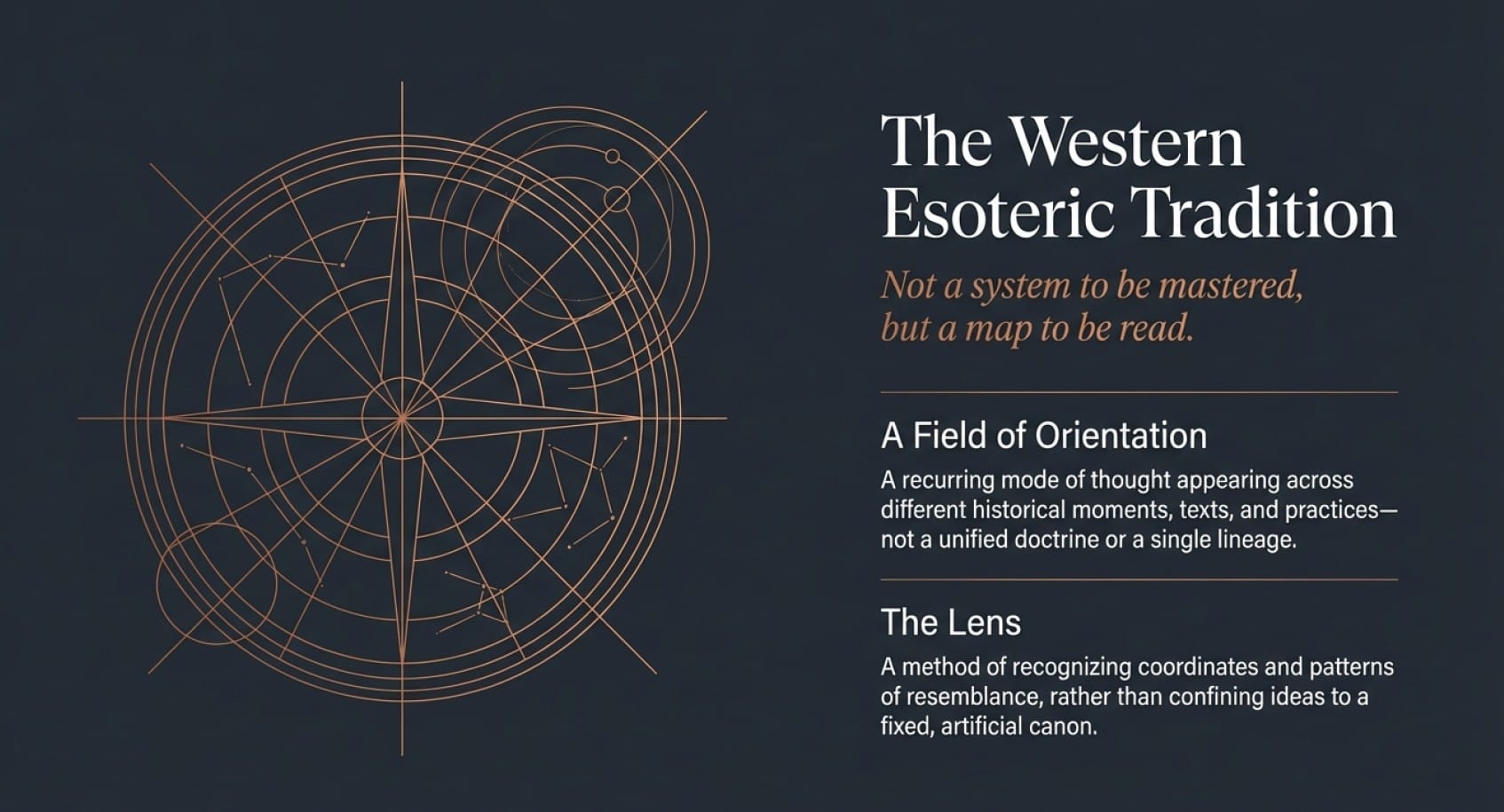
The phrase “Western Esoteric Tradition” presents itself as a category, yet behaves more like a field of orientation. It suggests a body of teachings, but closer inspection reveals not a unified doctrine, nor a single lineage, but a recurring mode of thought that appears across different historical moments, texts, and practices. It is less a system to be mastered than a map to be read—a set of coordinates by which certain kinds of ideas may be recognised, rather than contained.
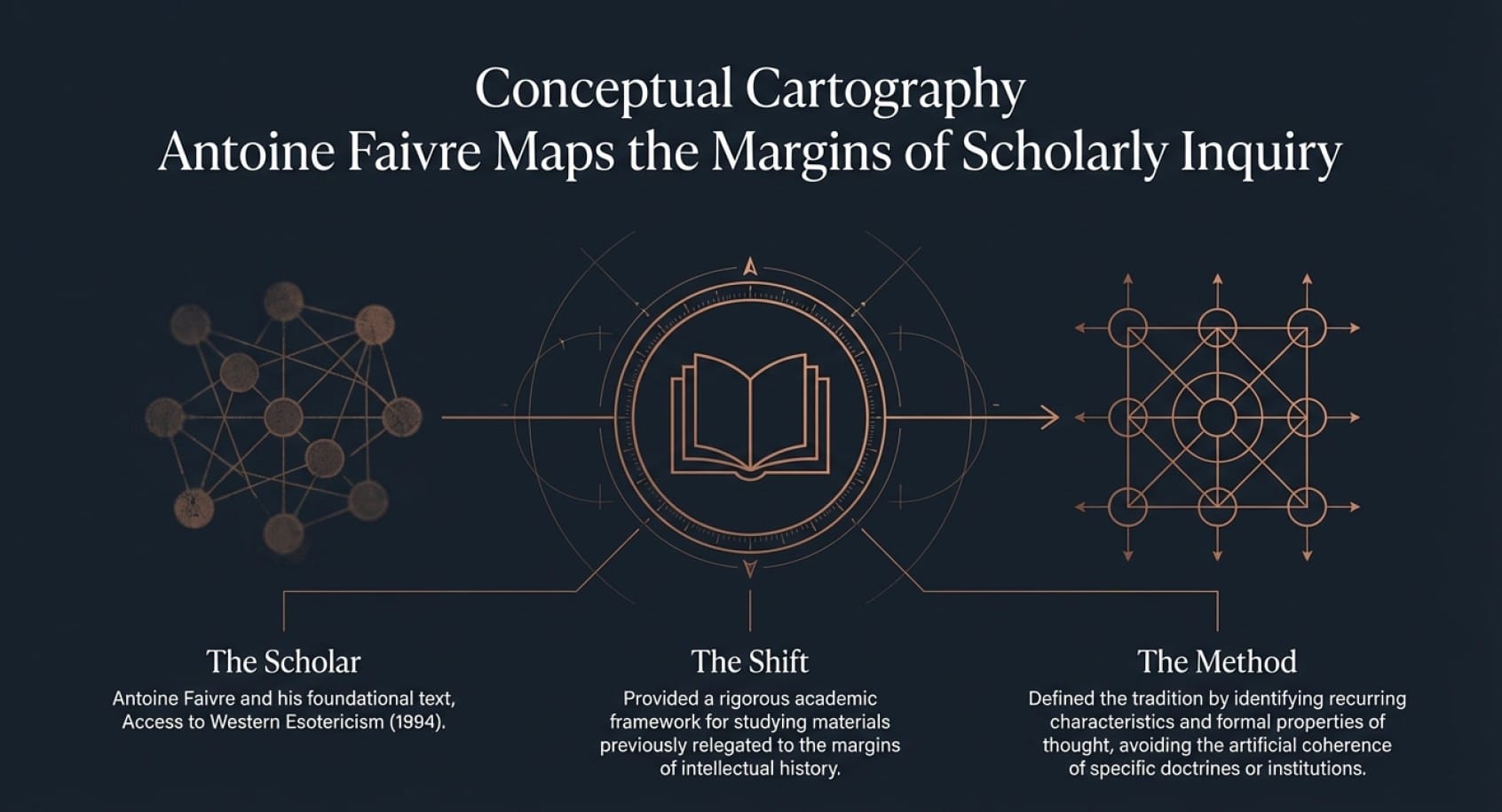
The modern scholarly articulation of this field is most closely associated with Antoine Faivre, whose work in the late twentieth century sought to provide a rigorous framework for studying materials long relegated to the margins of academic inquiry. In Access to Western Esotericism (1994), Faivre proposed that esotericism should not be defined by specific doctrines or institutions, but by identifying recurring characteristics—formal properties of thought—that appear across otherwise diverse traditions. His approach avoids the artificial coherence of a fixed canon and instead traces patterns of resemblance.
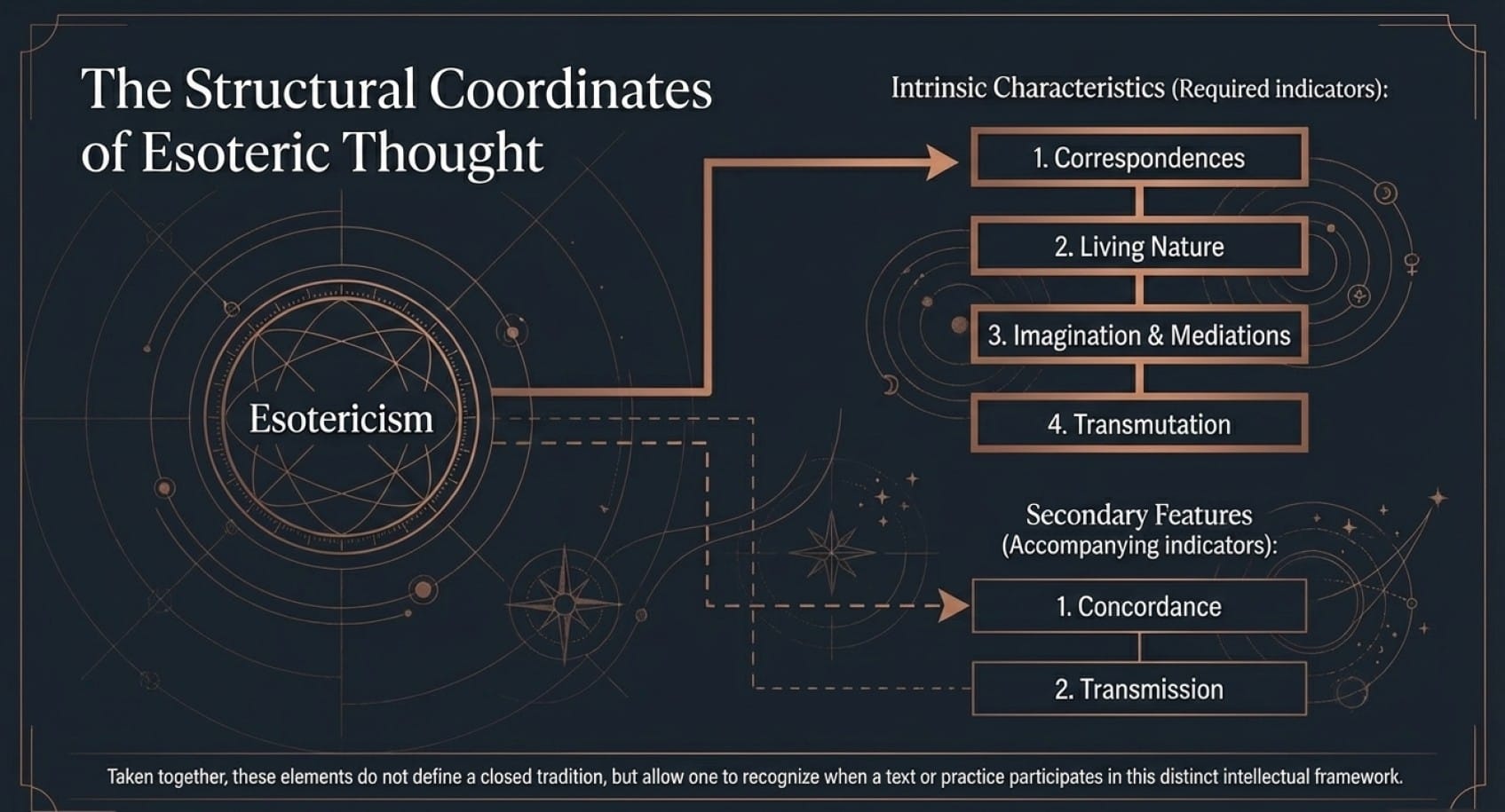
Faivre identified four intrinsic characteristics that serve as reliable indicators of esoteric thought: correspondences, living nature, imagination and mediations, and the experience of transmutation. He also noted two secondary features—concordance and transmission—which often accompany them. Taken together, these elements do not define a closed tradition, but they allow one to recognise when a text, practice, or system participates in this distinctive intellectual and symbolic framework.
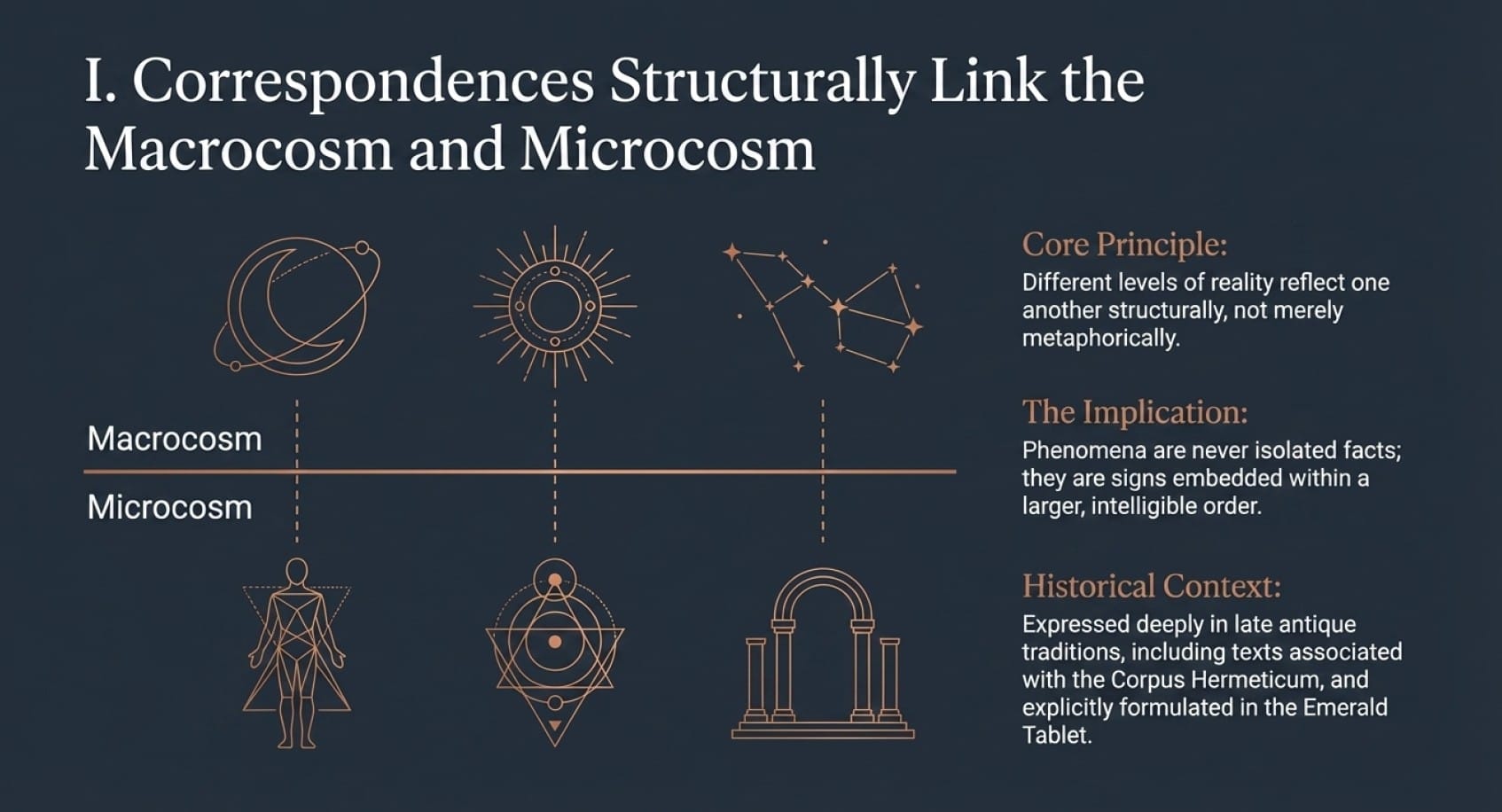
The first of these characteristics is correspondence. This is the principle that different levels of reality reflect one another in meaningful ways. The relationship between macrocosm and microcosm—the universe and the human being—is not merely metaphorical but structural. Patterns observed in the heavens are understood to be mirrored in the body, the soul, or the organisation of sacred space. This principle is expressed in various Hermetic and late antique traditions, including texts associated with the Corpus Hermeticum, though it is more explicitly formulated in related Hermetic materials such as the Emerald Tablet. Correspondence permits a symbolic reading of reality, in which phenomena are not isolated facts but signs embedded within a larger, intelligible order.
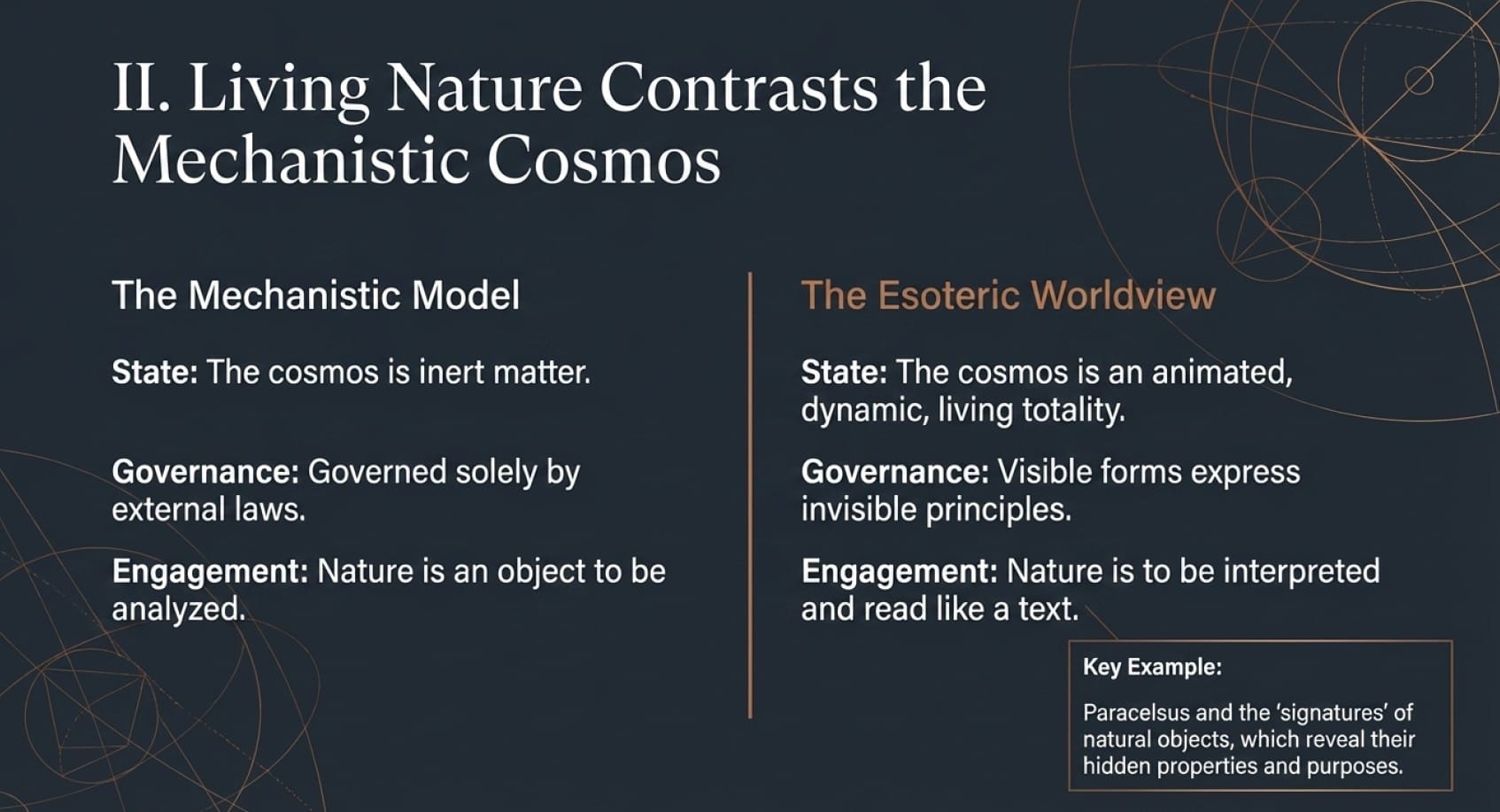
Closely related is the second characteristic: the notion of living nature. In contrast to the mechanistic models that would later dominate scientific thought, the esoteric worldview understands nature as animated, dynamic, and suffused with meaning. The cosmos is not inert matter governed solely by external laws, but a living totality in which visible forms express invisible principles. In the writings of Paracelsus, for instance, natural objects bear “signatures” that reveal their hidden properties and purposes. To study nature, in this context, is not merely to analyse it, but to interpret it—to read it as one would read a text.
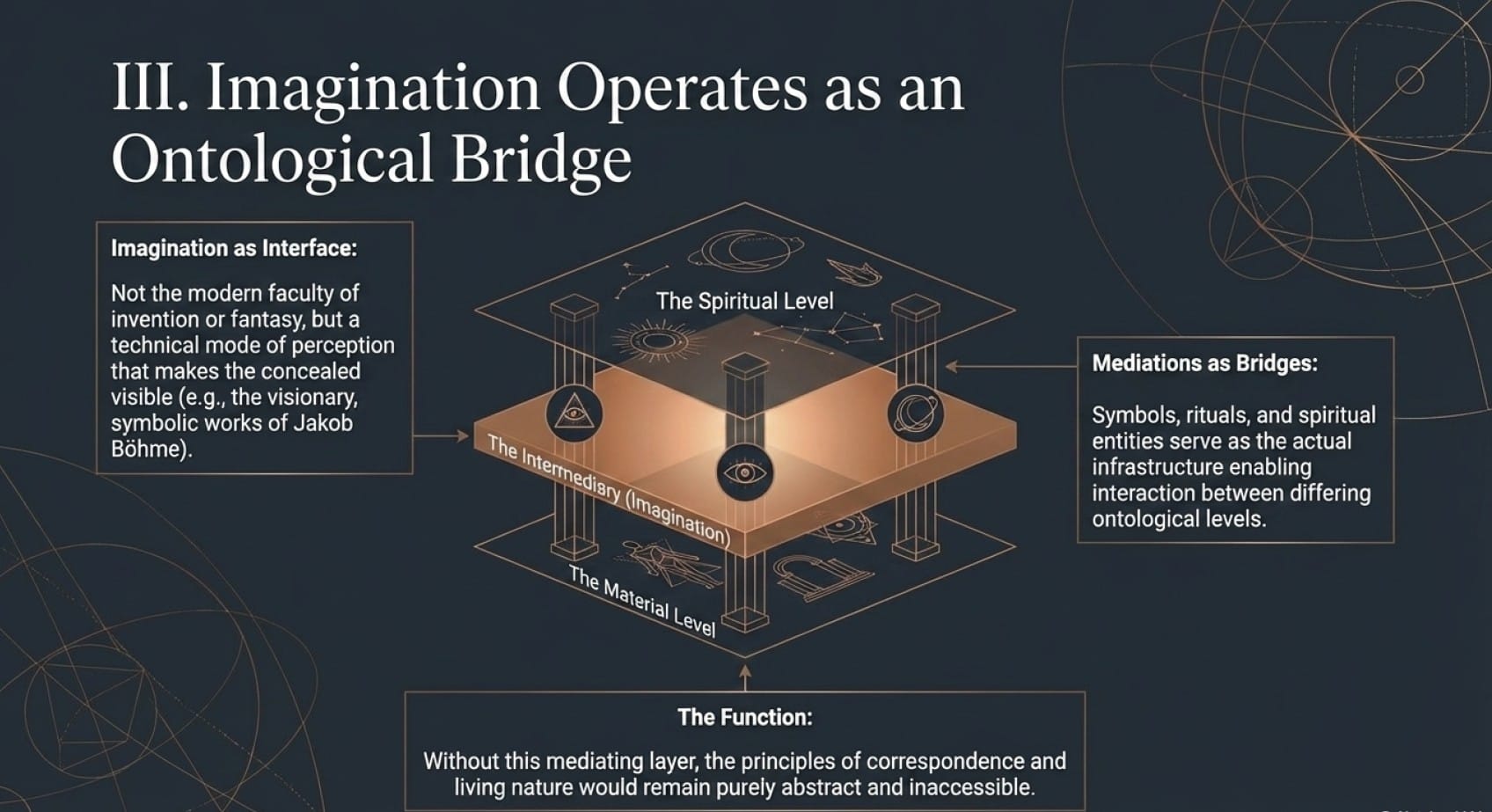
The third characteristic, imagination and mediations, requires careful handling, as the modern sense of “imagination” tends to obscure its technical meaning in esoteric discourse. Here, imagination is not the faculty of invention or fantasy, but a mode of perception that allows access to intermediary levels of reality. It operates between the material and the spiritual, making visible what would otherwise remain concealed. In the visionary works of Jakob Böhme, for example, symbolic images are not subjective projections but vehicles of insight into deeper structures of being. Mediations—whether in the form of symbols, rituals, or spiritual entities—serve as bridges, enabling interaction between different ontological levels. Without this mediating function, the principles of correspondence and living nature would remain abstract and inaccessible.
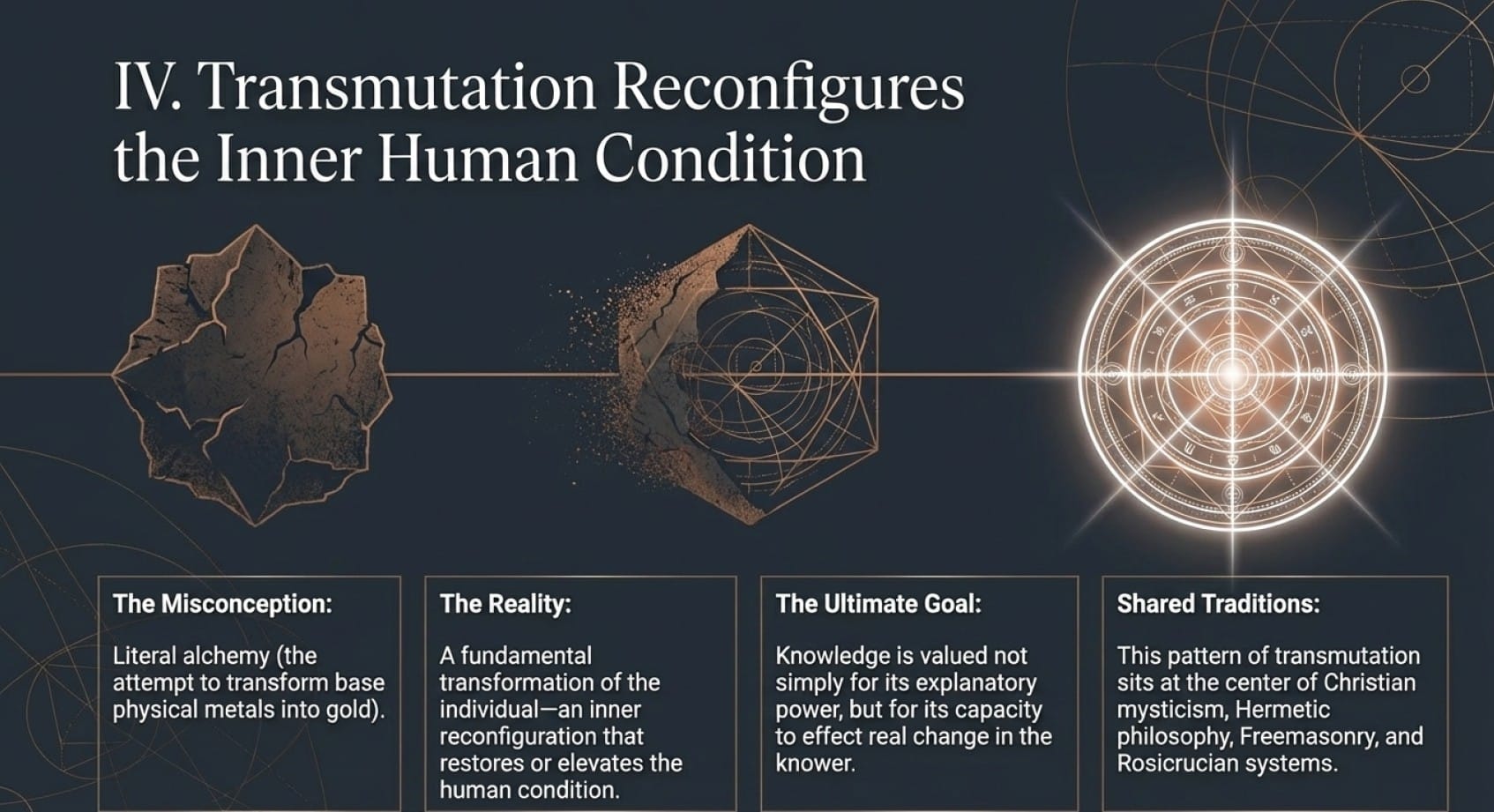
The fourth intrinsic characteristic is the experience of transmutation. While commonly associated with alchemical attempts to transform base metals into gold, the concept extends far beyond material processes. In esoteric thought, transmutation signifies a fundamental transformation of the individual—an inner reconfiguration that restores or elevates the human condition. Alchemical texts, often read literally in popular imagination, are more accurately understood as symbolic narratives of this process. The same pattern appears in Christian mysticism, Hermetic philosophy, and initiatory systems such as those found within Freemasonry and Rosicrucian traditions. In each case, transformation is not incidental but central: knowledge is valued not simply for its explanatory power, but for its capacity to effect change in the knower.
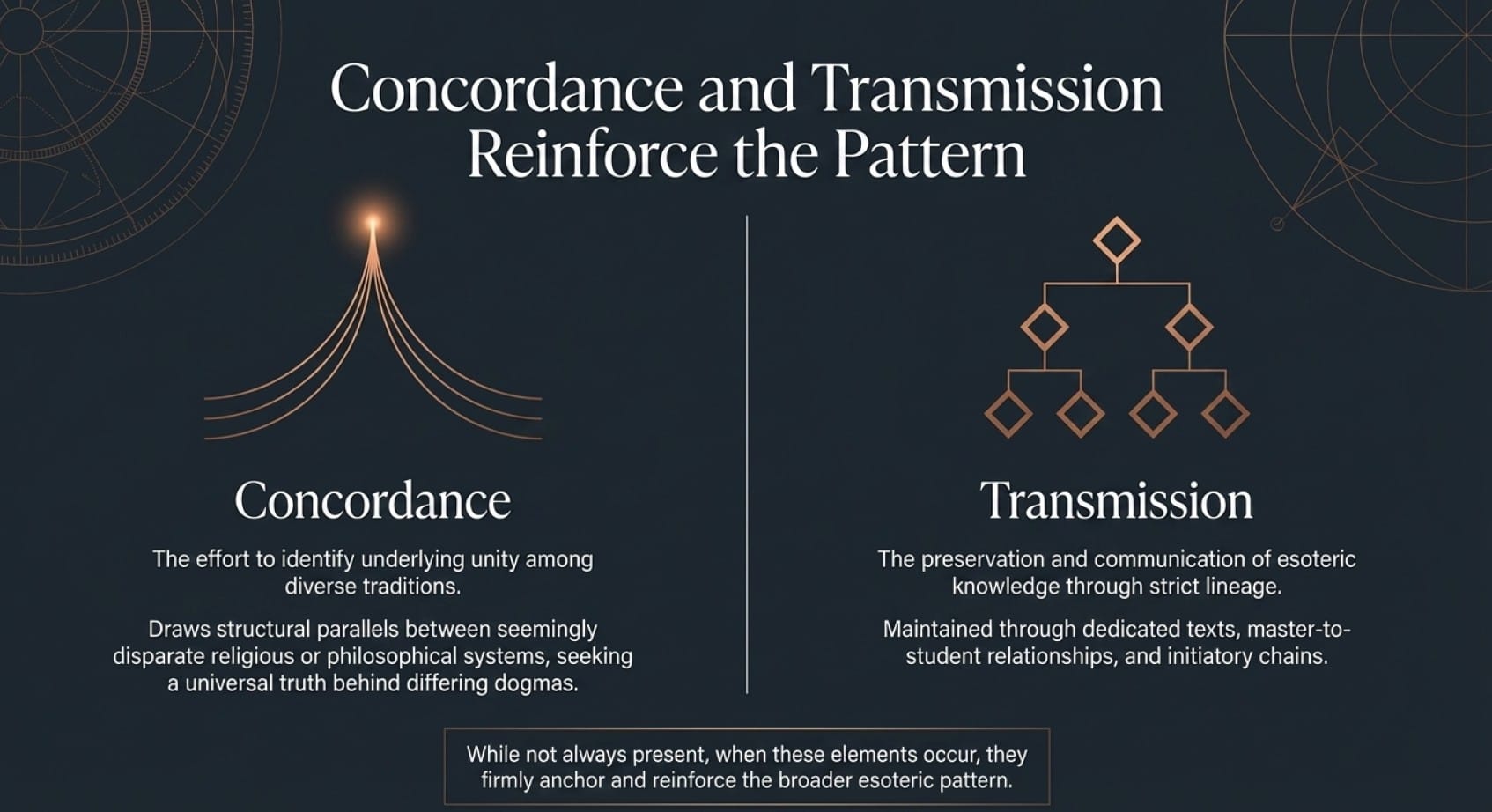
Faivre’s two secondary characteristics further refine this map. Concordance refers to the effort to identify underlying unity among different traditions, often by drawing parallels between disparate religious or philosophical systems. Transmission, meanwhile, emphasises the importance of lineage—whether through texts, teachers, or initiatory chains—in preserving and communicating esoteric knowledge. These elements are not always present, but when they are, they reinforce the broader pattern.
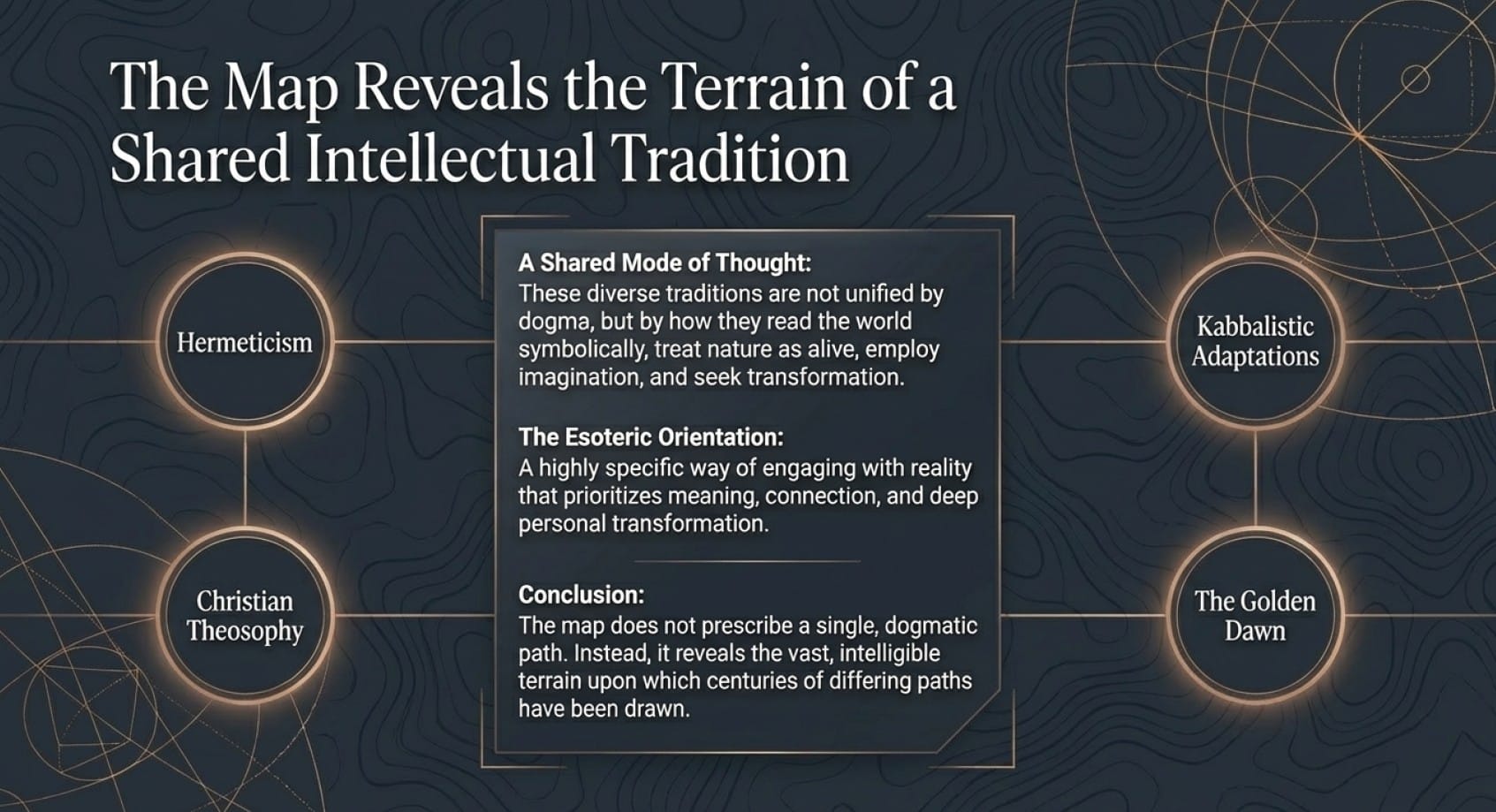
From this perspective, the Western Esoteric Tradition includes a wide range of materials: Hermetic writings, alchemical treatises, Christian theosophy, Kabbalistic adaptations within Christian contexts, and the symbolic and ritual systems of groups such as the Hermetic Order of the Golden Dawn. These are not unified by agreement on doctrine, but by participation in a shared mode of thought—one that reads the world symbolically, treats nature as alive, employs imagination as a cognitive faculty, and seeks transformation as its ultimate aim.
It follows that the Western Esoteric Tradition cannot be reduced to a checklist of beliefs or practices. It is better understood as an orientation—a way of engaging with reality that prioritises meaning, connection, and transformation. To recognise it is to perceive a pattern across texts and centuries; to study it is to learn how that pattern operates. The map does not prescribe a single path, but it does reveal the terrain upon which many such paths have been drawn.
Check your understanding
What Is the Western Esoteric Tradition?
A short test of orientation, correspondence, and symbolic reading.
Terms
Drag a term into a blank, or tap a term and then tap the blank.