Modern Qabalah
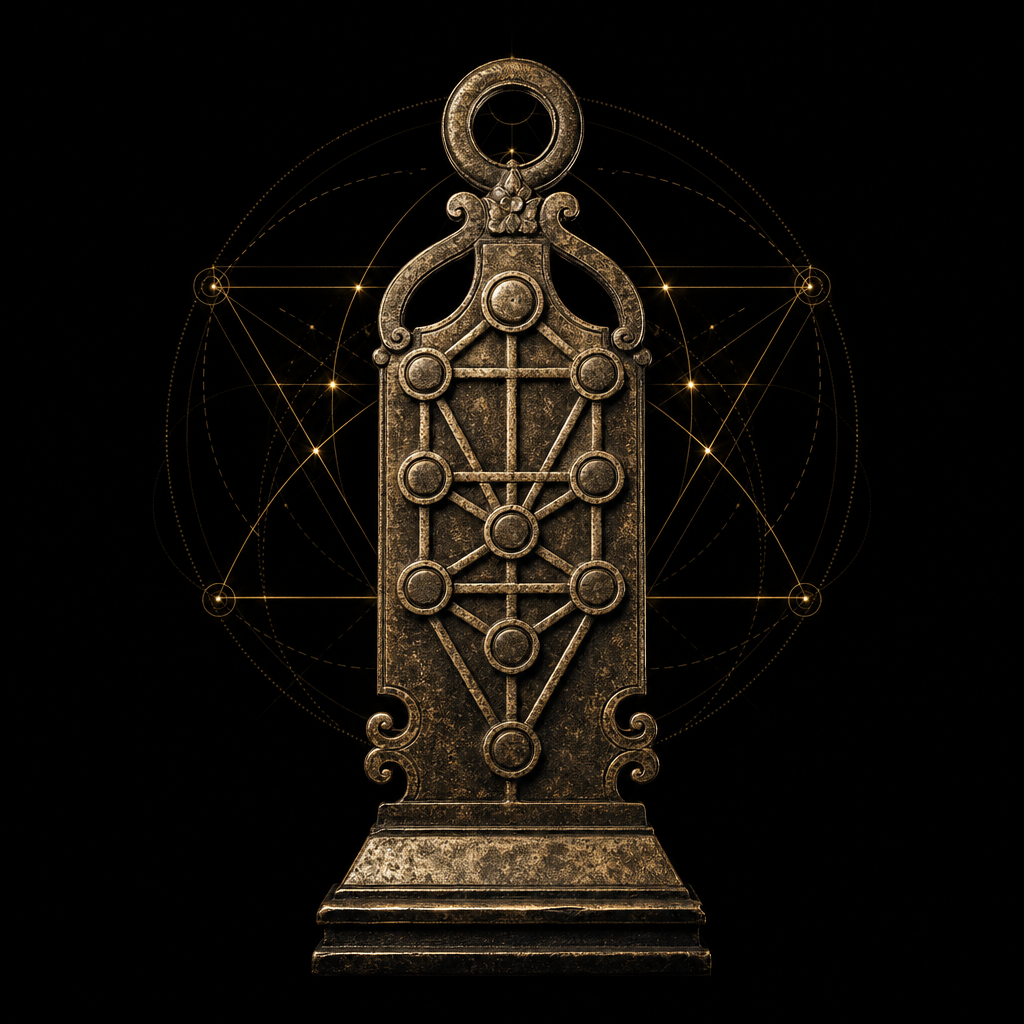
Modern Qabalah is the form of Kabbalistic symbolism that developed within modern Western esotericism, especially from the nineteenth-century Occult Revival onward. It should be distinguished carefully from Jewish Kabbalah, though it draws heavily, and often selectively, from Kabbalistic sources. Jewish Kabbalah is a complex religious, exegetical, mystical, and theosophical tradition rooted in Hebrew scripture, rabbinic interpretation, medieval Jewish thought, ritual practice, and communal life. Modern Qabalah, by contrast, is largely a Western occult adaptation. It treats Kabbalistic structures, especially the Tree of Life, as a universal symbolic map capable of organising magic, psychology, tarot, astrology, alchemy, mythology, and spiritual development. The spelling “Qabalah” is often used to signal this esoteric and Hermetic adaptation, because apparently even transliteration must pick a side in the metaphysical culture wars.
The immediate antecedent of Modern Qabalah is the Occult Revival and Ritual Magic of the nineteenth century. Earlier Christian Kabbalah had already reinterpreted Jewish Kabbalistic materials within Christian theological and magical frameworks during the Renaissance. Figures such as Pico della Mirandola, Johannes Reuchlin, and later occult writers treated Kabbalah as a key to hidden correspondences, divine names, angelology, creation, and sacred language. The Occult Revival inherited these earlier Christian and Hermetic uses, but reorganised them into a more systematic modern occult framework. In this environment, Qabalah became less a specific theological tradition and more a master architecture of symbolic relations.
Éliphas Lévi was central to this transformation. He presented Kabbalah as a universal key to magic, religion, symbolism, and the structure of the invisible world. Lévi associated the twenty-two Hebrew letters with the tarot trumps and treated the Kabbalistic Tree of Life as a framework for understanding magical correspondences. His work was not historically precise in the modern academic sense, but its influence was enormous. Lévi helped establish the idea that Qabalah could unify the major symbolic systems of Western occultism. Later magicians and esoteric orders would develop this idea with far greater technical elaboration.
The Tree of Life became the central diagram of Modern Qabalah. Its ten sephiroth and twenty-two connecting paths were interpreted as a map of divine emanation, cosmic structure, psychological development, magical force, and spiritual ascent. Kether, Chokmah, Binah, Chesed, Geburah, Tiphareth, Netzach, Hod, Yesod, and Malkuth came to represent not only stages or aspects of divine manifestation, but also levels of consciousness and modes of experience. The Tree could be read from the top downward as a process of emanation into manifestation, or from the bottom upward as the path of return from ordinary embodied life toward spiritual realisation. This double movement gave Modern Qabalah much of its practical appeal.
Modern Qabalah is essentially synthetic. It links the sephiroth and paths with planets, elements, zodiac signs, tarot cards, divine names, archangels, angelic orders, colours, magical weapons, parts of the soul, mythic figures, alchemical processes, and ritual formulae. This system of correspondences allows the practitioner to place diverse traditions into a single symbolic grid. Mars, Geburah, severity, red, iron, warlike deities, the Tower card, and particular divine names may be grouped together as expressions of a common force. Such correspondences are not merely decorative lists. They are intended to guide meditation, ritual, invocation, visualisation, and interpretation. Naturally, once one has arranged the universe into tables, the temptation to mistake the table for the universe becomes almost heroic.
The Hermetic Order of the Golden Dawn gave Modern Qabalah its most influential practical form, even though the mapped relationship here places Modern Qabalah directly after the broader Occult Revival. The Golden Dawn used the Tree of Life as the organising framework for its grade system, ritual symbolism, tarot teachings, colour scales, elemental work, planetary magic, and inner order practices. Through the Golden Dawn and its successors, Qabalah became the central grammar of modern ceremonial magic. Even occultists who later rejected Golden Dawn authority often retained its Qabalistic structure.
Modern Qabalah also transformed tarot interpretation. The association of the twenty-two major arcana with the Hebrew letters and the paths of the Tree became foundational for many occult tarot systems. The minor arcana were similarly related to the sephiroth across the four worlds or four elemental suits. This produced a highly structured symbolic reading of tarot as more than divination. The deck became a portable Tree of Life, a set of meditative images, and a map of spiritual and psychological processes. Modern tarot, especially in the Rider-Waite-Smith and Thoth traditions, cannot be understood apart from this Qabalistic framework.
Another important feature of Modern Qabalah is its relationship to psychology. In the twentieth century, especially through writers such as Dion Fortune, Israel Regardie, and later occult and psychological interpreters, the Tree of Life came to be read as a map of consciousness. The sephiroth could represent psychic functions, developmental stages, archetypal patterns, or modes of inner integration. This psychological reading did not replace magical or metaphysical interpretation, but it broadened Qabalah’s appeal. It allowed modern seekers to treat the Tree as a disciplined symbolic system for self-knowledge, even when they were less committed to traditional theology or ceremonial magic.
The distinction between appropriation and adaptation is important here. Modern Qabalah has often drawn from Jewish tradition without sufficient attention to Jewish religious context, Hebrew language, rabbinic interpretation, or the lived continuity of Jewish mysticism. Some occult writers universalised Kabbalah so completely that its Jewishness became almost invisible. This is a serious limitation. At the same time, Modern Qabalah has become a real and historically significant current in its own right. It is not Jewish Kabbalah, but a Western esoteric system constructed from Kabbalistic, Hermetic, Christian, magical, and psychological materials. Its legitimacy should not rest on pretending to be something it is not.
Modern Qabalah’s enduring power lies in its flexibility. It can function as cosmology, theology, ritual map, meditative tool, symbolic dictionary, magical operating system, or psychological model. This flexibility explains both its usefulness and its risks. It can clarify relations among symbols and practices, but it can also encourage over-systematisation. Once every god, colour, planet, card, emotion, metal, and mystical experience has been assigned to a sephirah, one may begin to suspect that reality itself has been bullied into compliance. Yet the system persists because it offers a rare combination of structure and openness. It gives the esoteric imagination a skeleton without entirely imprisoning it.
For the Western esoteric tradition, Modern Qabalah marks the transformation of Kabbalistic symbolism into a universalised occult framework. It emerged from the Occult Revival’s desire to synthesise inherited materials into coherent systems of practice and interpretation. Its Tree of Life became one of the central diagrams of modern magic, linking tarot, astrology, alchemy, ritual, psychology, and mystical ascent. It has no mapped succeeding tradition here, but its influence runs through much of twentieth- and twenty-first-century occultism. Modern ceremonial magic, occult tarot, esoteric psychology, and many forms of contemporary Western spirituality continue to speak in its symbolic language.
Modern Qabalah is therefore best understood neither as a faithful continuation of Jewish Kabbalah nor as a mere distortion of it. It is a modern Western esoteric construction, indebted to Jewish sources but reshaped by Christian Kabbalah, Hermeticism, occult revivalism, and ritual magic. Its value lies in its capacity to organise symbolic thought and spiritual practice, provided its historical limits are recognised. At its strongest, Modern Qabalah offers a profound map of relation: between language and cosmos, self and divinity, symbol and transformation, descent and return. At its weakest, it becomes a spreadsheet of the sacred. Western occultism, being what it is, has made vigorous use of both possibilities.
Antecedent Traditions
· Occult Revival & Ritual Magic
Succeeding Traditions
· None mapped