Michael Maier
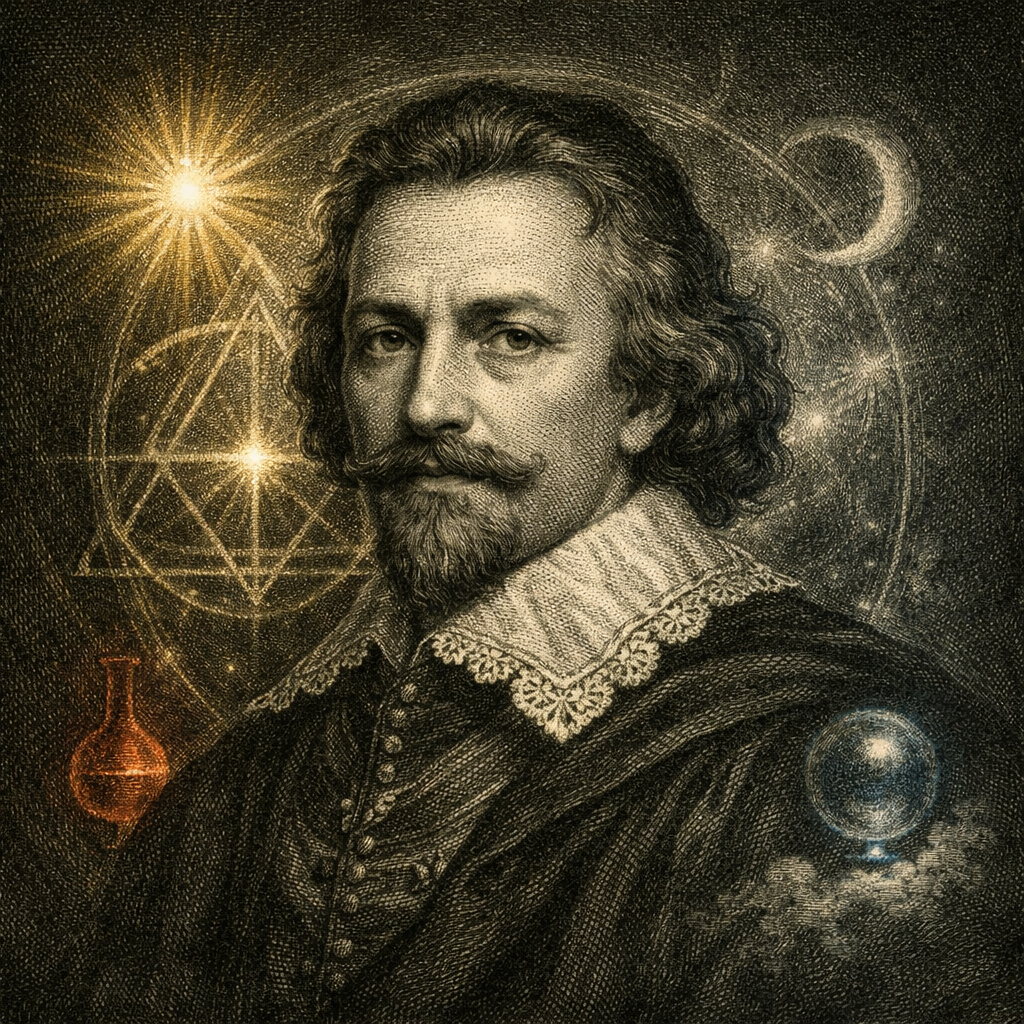
Date range: 1568–1622
Brief Biography
Michael Maier was a German physician, alchemist, poet, diplomat, and one of the most important literary defenders of early Rosicrucianism. Educated in medicine and active in the courts of Rudolf II and later German princely circles, he belonged to the dense intellectual world of late Renaissance alchemy, Paracelsian medicine, emblem literature, Christian esotericism, and reformist speculation. His writings sought to present alchemy as a noble philosophical and spiritual discipline, not merely a craft of furnaces or metallic transmutation. Works such as Atalanta Fugiens and Symbola Aureae Mensae combine myth, music, emblem, poetry, history, and allegory into a sophisticated defence of alchemical wisdom. Maier died in 1622, shortly after the first Rosicrucian manifestos had stirred Europe’s imagination, leaving behind one of the richest symbolic corpora of early modern alchemy.
Works and Texts
- Amphitheatrum Sapientiae Aeternae
- Atalanta Fugiens
- Symbola Aureae Mensae
Place in the Western Esoteric Tradition
Maier occupies a central place in the Western Esoteric Tradition as one of the great literary alchemists of the Rosicrucian age. His work gave alchemy a learned, poetic, and emblematic form suited to an era fascinated by hidden wisdom, universal reform, and the recovery of ancient philosophy. Although the supplied antecedent fields are empty, Maier’s writings belong to the same broad world of Christian alchemy, Hermetic philosophy, Paracelsian medicine, mythographic interpretation, and Rosicrucian expectation that shaped the early seventeenth century. His significance lies in the way he transformed alchemical doctrine into symbolic theatre: image, music, fable, and text become instruments for contemplating the hidden processes of nature and the soul. Through his relation to Rosicrucianism, Maier influenced the symbolic language later associated with Johann Valentin Andreae and Robert Fludd.
Maier’s Mystical System
Michael Maier’s mystical system is a poetic and emblematic alchemy of nature, wisdom, and transformation. He was not a mystic in the narrow sense of private ecstasy or visionary rapture. His esotericism worked through learned allegory, symbolic image, classical myth, musical structure, and the philosophical interpretation of alchemical process. Maier’s achievement lies in giving alchemy one of its most elegant public forms, turning a tradition often accused of secrecy, obscurity, and fraud into a disciplined symbolic science rooted in nature, antiquity, and Christian moral imagination.
At the centre of Maier’s system is the conviction that alchemy reveals the hidden processes of nature. The alchemist does not invent transformation; he discovers and assists processes already present within creation. Nature is alive with concealed powers, governed by lawful patterns that can be known only by those who combine experiment, patience, symbolic literacy, and spiritual seriousness. This places Maier within the larger Hermetic and Paracelsian world in which nature is not dead matter but a theatre of divine wisdom. Metals, plants, bodies, planets, myths, and moral states can all become signs of one hidden order.
The alchemical opus, for Maier, is both material and symbolic. It concerns the transformation of substances, but its meaning cannot be confined to physical operations. Alchemical stages such as dissolution, conjunction, putrefaction, purification, and perfection describe processes in matter and in the human being. This does not make the laboratory irrelevant, as though alchemy were merely psychology dressed up in mineral costume. Rather, Maier inhabits a worldview in which outward and inward transformations mirror one another. The work in the vessel and the work in the soul belong to the same pattern of nature’s regeneration.
Atalanta Fugiens is the supreme expression of this vision. It is an extraordinary fusion of emblem book, musical composition, poetic epigram, mythological commentary, and alchemical instruction. Each emblem presents an image, motto, epigram, discourse, and a short musical fugue. The work does not teach by simple definition. It requires contemplation. Meaning emerges through the interplay of sight, sound, text, and interpretive labour. The reader is not spoon-fed doctrine, a mercy rarely granted in alchemical literature and almost certainly against the guild rules of deliberate obscurity. Instead, the seeker must learn to perceive patterns across symbolic registers.
The use of music is especially important. The fugue form is not merely decorative. It reflects pursuit, imitation, relation, and transformation. The title’s image of Atalanta fleeing and Hippomenes pursuing evokes the dynamic of desire and attainment, concealment and revelation. Alchemical wisdom is elusive. It must be followed through signs that run ahead of literal understanding. Music becomes an analogue of cosmic order: harmony, counterpoint, rhythm, and proportion disclose truths that prose alone cannot contain. Maier’s alchemy is therefore multisensory and contemplative.
Classical myth plays a major role in Maier’s system. Figures such as Atalanta, Hippomenes, Hercules, Jason, Medea, Saturn, Venus, and others are not treated merely as literary ornaments. They are read as veiled repositories of natural and alchemical wisdom. Myth becomes an ancient language of transformation. This approach reflects a Renaissance habit of interpreting pagan fable as encoded philosophy. For Maier, the myths conceal truths about generation, corruption, purification, union, and the hidden virtues of nature. The poet and the alchemist meet because both work through veiled speech.
The symbolic density of Maier’s writings also reflects his defence of alchemy as an ancient and noble discipline. In Symbola Aureae Mensae, he presents alchemical wisdom through a lineage of sages and traditions, giving the art historical dignity and intellectual breadth. Alchemy is not the invention of charlatans or isolated furnace-workers. It is a golden table at which the wise of many nations may be seated. This historical imagination matters because early modern alchemy constantly had to defend itself against charges of deceit. Maier responds by embedding alchemy in antiquity, learning, medicine, poetry, and philosophy.
Rosicrucianism gave Maier’s alchemical vision a reformist and fraternal horizon. He was one of the most important early defenders of the Rosicrucian manifestos, treating the Rosicrucian idea as consonant with true philosophy, piety, and the reform of knowledge. He did not reduce Rosicrucianism to a simple organisation with an address, membership list, and meeting schedule, because apparently he understood that mystery collapses rather quickly once it is forced to fill out paperwork. Instead, he saw in the Rosicrucian current an image of learned and spiritual renewal, closely aligned with the alchemical search for hidden wisdom.
For Maier, reform begins with right understanding of nature and right ordering of the seeker. False alchemists pursue gold in the most vulgar sense. True philosophers seek wisdom through the disciplined contemplation of nature’s mysteries. This distinction between sophistical greed and philosophical alchemy runs throughout early modern defences of the art. Maier’s system insists that the alchemist must be morally and intellectually qualified. Alchemy is degraded when it becomes a scheme for enrichment; it is elevated when it becomes a sacred science of transformation.
His Christian framework is present but often mediated through symbol rather than direct doctrinal exposition. Maier’s universe is providentially ordered. Nature is created by God and filled with divine wisdom. The alchemical work, properly understood, does not compete with religion but discloses the hidden processes by which creation manifests transformation, death, rebirth, and perfection. The philosopher reads nature as a book written by divine intelligence. The work of interpretation is therefore devotional as well as intellectual, even when it proceeds through pagan myth and enigmatic imagery.
The importance of emblematic method cannot be overstated. Maier’s images do not simply illustrate concepts already clear in prose. They generate contemplation. The emblem holds together contradictions and layered meanings: king and queen, sun and moon, dragon and child, death and birth, flight and pursuit, fire and water. The mind is forced to dwell within symbolic tension. This is one of the reasons his work remained powerful for later esoteric readers. It does not merely state that alchemy is transformative; it makes the reader undergo a form of interpretive transformation.
Maier’s relationship to Robert Fludd and Andreae belongs to the wider Rosicrucian and reforming context of the early seventeenth century. Andreae gave Rosicrucian myth a literary and moral form; Fludd developed a vast symbolic cosmology; Maier gave alchemy a musical, emblematic, and mythographic brilliance. Together, these figures helped define the imaginative atmosphere in which Rosicrucianism could function as a myth of hidden wisdom, spiritual renewal, and learned fraternity. Maier’s distinctive contribution was to make alchemy sing, quite literally in Atalanta Fugiens, which is either genius or the most elaborate way imaginable to avoid writing a plain manual.
Maier’s mystical system may therefore be described as emblematic Christian alchemy. It rests upon the belief that nature is a living book, that ancient myth conceals philosophical truth, that music and image can disclose hidden order, and that transformation is the governing pattern of both matter and the soul. His work is not systematic in the scholastic sense, but it is coherent in its symbolic method. He teaches by resonance, allegory, pursuit, and contemplation. In the history of the Western Esoteric Tradition, Maier stands as one of the great artists of alchemical meaning: a physician-poet who turned the laboratory of nature into an emblematic theatre of wisdom.
Antecedent Figures
- —
Antecedent Traditions
- —
Succeeding Figures
- Johann Valentin Andreae; Robert Fludd
Succeeding Traditions
- Rosicrucianism