Medieval Kabbalah
Medieval Kabbalah represents one of the most sophisticated and influential mystical systems in the Western Esoteric Tradition. Emerging within Jewish communities of medieval Provence and Spain, especially from the twelfth and thirteenth centuries onward, it developed a complex symbolic theology of creation, scripture, divine manifestation, and human spiritual practice. It was not originally a universal occult philosophy detached from its religious setting, but a deeply Jewish mode of mystical interpretation, rooted in Hebrew scripture, rabbinic tradition, ritual observance, sacred language, and speculation on the hidden life of God. Later Christian and occult adaptations would transform it considerably, sometimes illuminating it and sometimes cheerfully misunderstanding it with the confidence only outsiders can manage.
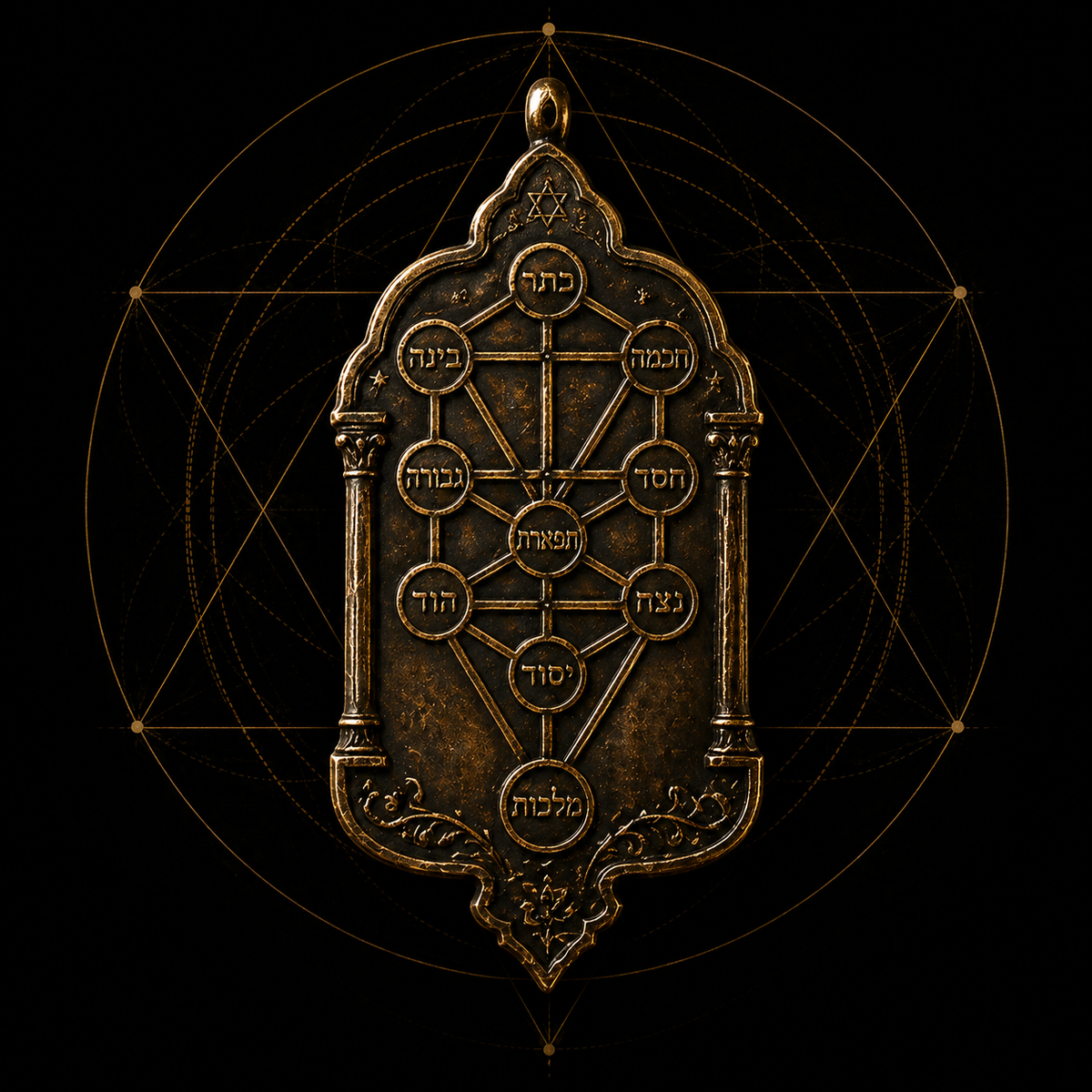
The central concern of Medieval Kabbalah is the relationship between the infinite divine reality and the created world. Kabbalists used the term Ein Sof, the Infinite, to refer to God beyond all attributes, names, images, and conceptual grasp. Yet this unknowable divine source becomes manifest through the sefirot, the ten dynamic attributes or emanations through which divine life unfolds. The sefirotic structure allowed Kabbalists to speak of God as both utterly transcendent and intimately present within creation. It provided a symbolic map of divine process, cosmic order, scriptural meaning, and the inner life of the soul.
This doctrine of emanation places Medieval Kabbalah in conversation with earlier late antique and Neoplatonic currents, though it should not be reduced to them. Kabbalah did not simply borrow a philosophical scheme and attach Hebrew labels to it. It transformed inherited patterns of emanation, hierarchy, and symbolic correspondence within a Jewish theological frame. The sefirot are not merely abstract metaphysical levels; they are living divine powers, scriptural mysteries, ethical principles, and ritual realities. They structure creation, shape the soul, and provide the symbolic grammar through which scripture can be read at ever deeper levels.
The Zohar, traditionally attributed to the second-century sage Rabbi Shimon bar Yochai but historically associated with thirteenth-century Castile and the circle of Moses de León, became the most important literary monument of Medieval Kabbalah. Written largely in an artificial Aramaic, it presents itself as a mystical commentary on the Torah, but it is far more than commentary in the ordinary sense. It unfolds a vast symbolic world in which biblical narratives disclose hidden divine processes, human actions affect the harmony of the sefirot, and the study of scripture becomes a form of spiritual participation in the inner life of God. The text is poetic, mythic, erotic, exegetical, and theosophical, which is a great deal to ask of any book, but the Zohar has never shown much interest in modesty.
Another major current is associated with Abraham Abulafia, whose ecstatic or prophetic Kabbalah differs in emphasis from the theosophical-symbolic Kabbalah of the Zohar. Abulafia developed techniques involving Hebrew letters, divine names, breathing, vocalisation, and meditative permutation. His aim was not primarily the contemplation of the sefirotic world, but the attainment of prophetic union or intellectual illumination. This strand of Kabbalah is particularly important for later esoteric traditions because it presents sacred language as a disciplined method of transformation. The Hebrew alphabet becomes not only a scriptural medium, but a technology of consciousness, linking sound, thought, breath, and divine name.
Medieval Kabbalah also intensified the esoteric reading of scripture. The Torah was understood as a living symbolic body, containing layers of meaning beyond the literal surface. Letters, words, numerical values, names, repetitions, and apparent irregularities could all disclose hidden realities. This hermeneutic gave later esoteric traditions a powerful model for reading sacred texts as encoded structures of metaphysical knowledge. It also established the idea that language itself participates in creation. Hebrew was not merely one sacred language among others; for Kabbalists, it was bound to the very structure by which God creates and sustains the world.
The relationship between divine and human action is another crucial feature. Medieval Kabbalah often presents ritual observance, prayer, ethical conduct, and intention as acts with cosmic consequence. Human beings can assist in the restoration or harmonisation of divine flow. This does not mean that humanity controls God in a crude magical sense. Rather, it means that human action participates in a network of correspondence between below and above. The commandments become not only obligations, but symbolic and theurgic acts that sustain the bond between creation and its divine source. This theurgic understanding of religious life would later prove highly attractive to Christian Kabbalists and Renaissance magicians, although they often removed it from the Jewish law that gave it its original coherence.
Medieval Kabbalah’s antecedent relationship to Late Antique Hermeticism and Gnosticism is best understood at the level of shared structures and inherited environments rather than direct identity. It develops concerns already present in earlier Jewish mysticism and late antique religious speculation: emanation, ascent, divine names, angelic mediation, hidden wisdom, and cosmic hierarchy. Yet it gives these themes a distinctive Jewish form. Unlike many Gnostic systems, Kabbalah does not typically reject creation as the work of an ignorant or hostile demiurge. Creation is troubled, fractured, and in need of repair, but it remains rooted in divine life. The world is not simply a prison; it is a field of concealment, revelation, and restoration.
Its succeeding influence on Renaissance Christian Kabbalah and Hermetic magic was immense. Thinkers such as Pico della Mirandola and Johannes Reuchlin encountered Kabbalah as a source of ancient wisdom that, they believed, could confirm Christian truths and empower a universal theological synthesis. This Christian reception was selective and often distorting, but historically decisive. Through it, Kabbalistic symbolism entered the mainstream of Renaissance esotericism, becoming linked with Hermeticism, magic, astrology, angelology, and Neoplatonic metaphysics. From there, Kabbalistic structures would pass into Rosicrucianism, ceremonial magic, the Golden Dawn, modern Qabalah, and much of modern occult thought.
The enduring significance of Medieval Kabbalah lies in its extraordinary capacity to unite theology, cosmology, language, ritual, and interpretation. It offered a model of reality in which the divine is hidden yet manifest, scripture is historical yet infinite, language is symbolic yet creative, and human life participates in cosmic restoration. Few traditions have provided later esotericism with so rich a symbolic architecture. Even when later movements detached Kabbalah from its Jewish roots, simplified its doctrines, or rearranged its symbols into new systems, they continued to draw upon the depth and power of its central insight: that the visible world is woven from hidden divine patterns, and that sacred knowledge begins by learning to read those patterns rightly.
Antecedent Traditions
· Late Antique Hermeticism & Gnosticism
Succeeding Traditions
· Renaissance Christian Kabbalah & Hermetic Magic