Martinez de Pasqually
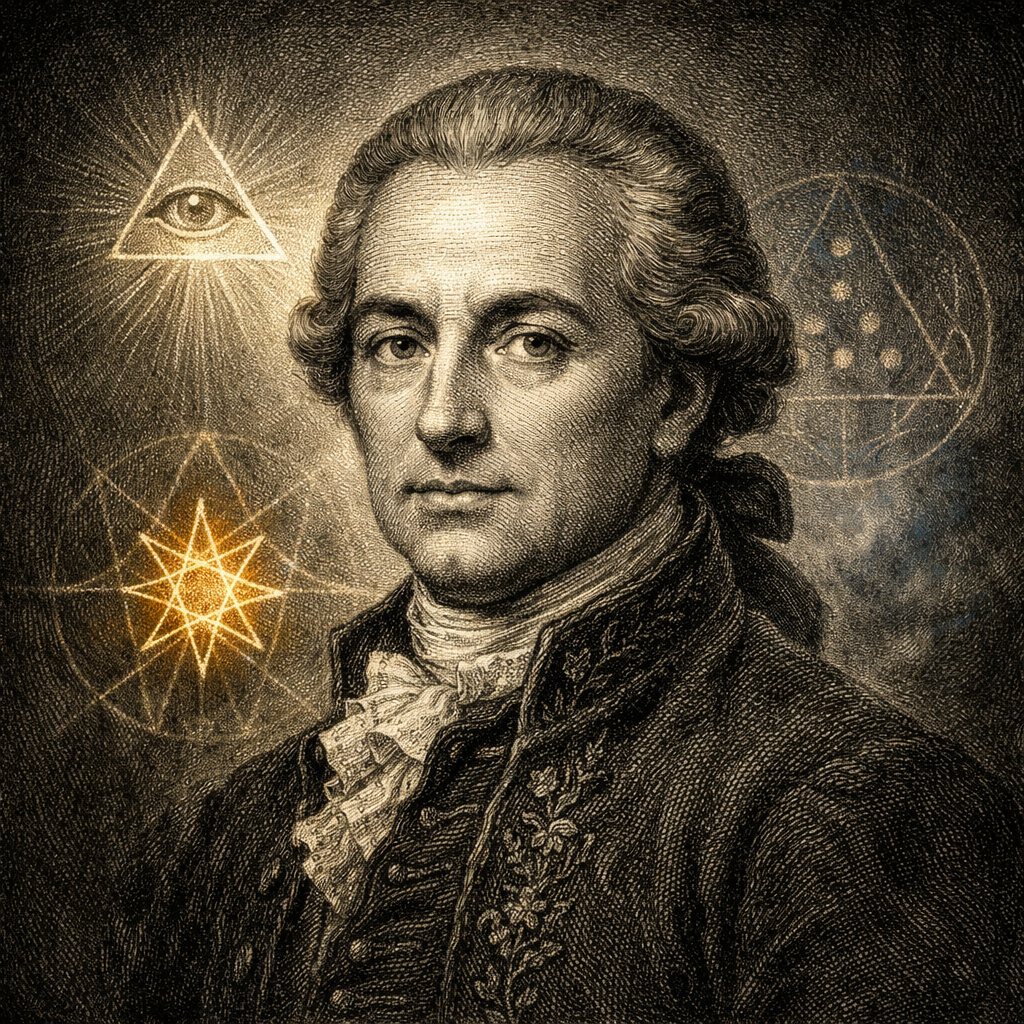
Date range: c. 1727–1774
Brief Biography
Martinez de Pasqually was an eighteenth-century theurgist, initiatory teacher, and founder of the Ordre des Chevaliers Maçons Élus Coëns de l’Univers, one of the most influential currents of Christian esoteric Masonry. His life remains historically obscure, with uncertain origins and a career reconstructed largely through Masonic records, correspondence, and the testimony of his disciples. Active in France during the middle decades of the eighteenth century, he developed a highly distinctive doctrine of the fall, the exile of spiritual beings, the role of humanity as a repairing agent, and the possibility of reintegration through theurgical operations. His teachings deeply influenced Jean-Baptiste Willermoz and Louis-Claude de Saint-Martin, even as those followers developed his ideas in different directions. Martinez died in Saint-Domingue in 1774, leaving behind a difficult, fragmentary, and powerful system whose afterlife was central to Martinism, Illuminism, and Christian theosophical esotericism.
Works and Texts
- Aurora
- Heaven and Hell
- Treatise on the Reintegration of Beings
- Tableau Naturel
Place in the Western Esoteric Tradition
Martinez de Pasqually occupies a major place in the Western Esoteric Tradition as the architect of a Christian theurgical system centred on fall, repair, and reintegration. Drawing upon the symbolic and institutional world of high-degree Masonry, Rosicrucian currents, speculative Freemasonry, and Christian mystical traditions, he developed an initiatory path in which ritual action sought to restore the human being to a lost primordial office. His work gave later Illuminism and Christian theosophy one of their most compelling doctrines: that humanity’s present condition is the result of a cosmic rupture, and that spiritual practice must participate in the repair of that rupture. Through Willermoz, Saint-Martin, Papus, and later occult revival currents, Martinez’s doctrine of reintegration became one of the most important esoteric interpretations of the fall and return of beings.
Pasqually’s Mystical System
Martinez de Pasqually’s mystical system is a Christian theurgy of reintegration. Its central claim is that the visible human condition is the consequence of a primordial fall involving spiritual beings and humanity, and that the purpose of initiation is to restore the fallen being to its original divine relation. This is not a mild doctrine of ethical improvement. It is a dramatic cosmology of rupture, exile, mediation, and repair. The human being is not merely a sinner needing forgiveness or an ignorant creature needing instruction. Humanity is a displaced spiritual agent whose true task is to participate in the restoration of divine order.
The foundation of Pasqually’s system is set out in the doctrine associated with the Treatise on the Reintegration of Beings. The title itself indicates the central movement of his thought. Creation, fall, and redemption are understood through the problem of separation from the divine source and the possibility of return. Beings have become estranged from their proper state. The world is marked by disorder because spiritual rebellion and misalignment have disturbed the original order. Reintegration is the process by which beings are restored to their rightful place through divine assistance, ritual action, purification, and the recovery of spiritual authority.
This gives Pasqually’s system a strongly cosmological character. The human being is situated within a universe populated by spiritual hierarchies, fallen powers, angelic agencies, and divine operations. The visible world is not the whole of reality, and ordinary life is not spiritually neutral. It is the field in which the consequences of the fall are experienced and in which the work of restoration must begin. The initiate enters this drama not as a passive believer, but as an operative participant. Spiritual knowledge is therefore inseparable from action.
Theurgy is the defining method of Pasqually’s system. Through ritual operations, prayers, invocations, signs, circles, names, and ceremonial disciplines, the initiate seeks contact with divine and angelic powers who can assist in the work of repair. This is not magic in the sense of arbitrary manipulation of invisible forces for personal advantage. At least in Pasqually’s own ideal framing, it is a sacred operation conducted under divine authority. The operator must be morally and ritually prepared, because the work concerns the re-establishment of lawful relation between humanity and the spiritual world.
The Élus Coëns, the initiatory order founded by Pasqually, embodied this system in a graded structure. The order used Masonic forms, but its aim exceeded ordinary Masonic morality or fraternity. The degrees instructed the candidate in a deeper account of cosmic history and spiritual responsibility. The initiate was gradually brought into a framework in which ritual action, doctrinal understanding, and personal purification were joined. Masonry provided the organisational and symbolic vessel; Pasqually filled it with a theurgical doctrine of restoration.
Humanity’s role is especially important. In Pasqually’s cosmology, the human being has a priestly and mediating office. The original human was created to maintain order, command rebellious spirits, and serve as a minister of divine law. The fall damaged this office, leaving humanity weakened, embodied, and subject to confusion. Yet the office is not entirely lost. Initiation seeks to awaken and restore the spiritual powers required for the work of reintegration. The initiate becomes, in principle, a repairing agent within a disordered cosmos.
This anthropology gives Pasqually’s system its distinctive seriousness. The candidate is not invited merely to acquire hidden information. He is called to recover a lost function. The work is demanding because the fall is not external to the individual. Disorder lives in the will, the passions, the imagination, and the relation between the human being and the invisible world. Moral purification is therefore indispensable. Without the correction of the self, ritual becomes empty or dangerous. Humanity, predictably, has always had a gift for wanting celestial authority without doing the interior housework first.
Prayer occupies a central place alongside ceremonial operation. The theurgist does not act autonomously. Divine assistance must be sought, received, and obeyed. This distinguishes Pasqually’s system from forms of occultism that imagine the operator as a self-sufficient wielder of power. The initiate acts within a hierarchy of dependence. He is empowered only insofar as he is restored to lawful relation with God and the divine agents. The highest operation is therefore not domination, but alignment.
The doctrine of signs and manifestations is another important element. The Élus Coëns operations sought visible or perceptible signs confirming contact with spiritual agencies. These manifestations were not incidental theatrics; they served as evidence that the invisible order had responded. This feature of Pasqually’s system later became one of the points of divergence among his heirs. Saint-Martin increasingly turned away from dependence on external signs toward inward prayer and contemplative reintegration. Willermoz preserved the doctrine within a more stable chivalric-Masonic ritual architecture. The tension between operative theurgy and inward spirituality would become one of the defining features of the Martinist inheritance.
Pasqually’s system is also deeply Christian, though in a highly esoteric mode. Christ is central as the repairing and reconciling principle through whom reintegration becomes possible. The fall is cosmic, but restoration depends upon divine mediation. The initiate’s work is not a substitute for redemption; it is a participation in the order made possible by divine action. This Christian framework distinguishes Pasqually from purely philosophical or natural-magical systems. His cosmos is structured by sin, exile, providence, grace, and return, even when expressed through ceremonial forms that startled the more tidy-minded guardians of respectable religion.
The relation between Pasqually and Freemasonry is essential. Eighteenth-century Masonry provided a language of grades, initiation, secrecy, fraternity, temple symbolism, and moral ascent. Pasqually used that language but radicalised it. The lodge became a site where the deeper drama of cosmic fall and restoration could be enacted. The temple was not simply an emblem of moral self-improvement; it became an image of the lost divine order to be restored. The initiate was not merely a brother among brethren; he was a spiritual worker participating in the repair of creation.
His influence on Willermoz and Saint-Martin shows the breadth of his legacy. Willermoz translated Pasqually’s doctrines into the Rectified Scottish Rite and the CBCS, giving them chivalric stability and institutional endurance. Saint-Martin interiorised them, developing the path of the “Unknown Philosopher” in which prayer and inward regeneration replaced elaborate ceremonial operation. Later Martinism, especially through Papus, drew from both streams, preserving Pasqually’s name as a source of initiatory authority even when the original theurgical practice was no longer fully understood or transmitted.
Pasqually’s mystical system may therefore be described as operative Christian reintegration. It begins with a cosmic fall, interprets humanity as a displaced spiritual agent, and proposes ritual initiation as a means of restoring lawful relation between the human being, the angelic order, and God. Its symbols are Masonic, its theology Christian, its method theurgical, and its goal the repair of being. It is one of the most ambitious esoteric systems of the eighteenth century, and also one of the most difficult to reconstruct cleanly. Naturally, the manuscript trail is uneven, the biography shadowy, and the later receptions tangled, because no proper esoteric lineage would dream of making things administratively convenient.
Antecedent Figures
- Andrew Michael Ramsay; Elias Ashmole; James Anderson; Jean-Baptiste Willermoz; Johann Arndt; Johann Valentin Andreae; Michael Maier; Philipp Jakob Spener; Robert Fludd; William Preston
Antecedent Traditions
- Rosicrucianism; Speculative Freemasonry; High-Degree Masonry; Lutheran Mysticism & Pietism
Succeeding Figures
- Annie Besant; Charles Webster Leadbeater; Helena Petrovna Blavatsky; Papus (Gérard Encausse); Éliphas Lévi
Succeeding Traditions
- Romanticism; Occult Revival & Ritual Magic; Theosophical Society