Marsilio Ficino
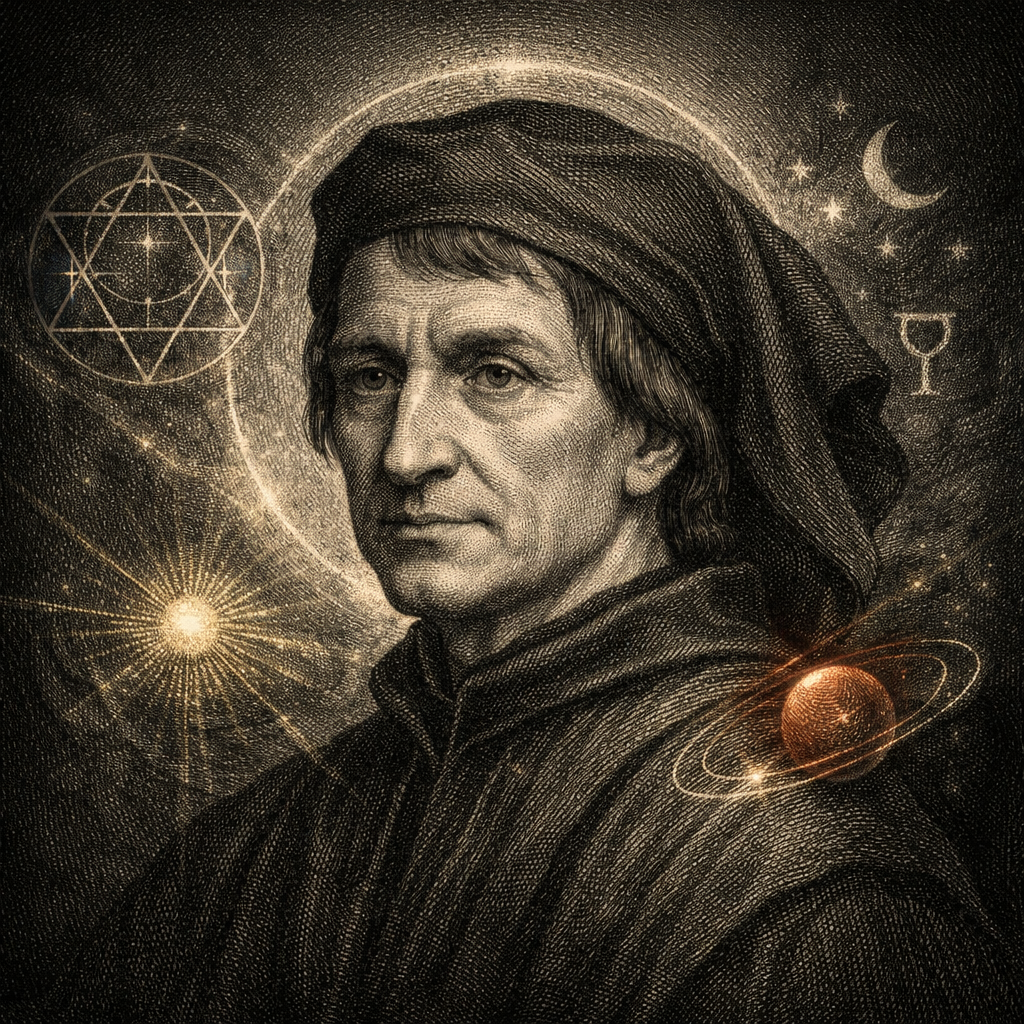
Date range: 1433–1499
Brief Biography
Marsilio Ficino was an Italian humanist, priest, philosopher, translator, and one of the foundational figures of Renaissance Platonism. Born near Florence and patronised by Cosimo de’ Medici, he became the great mediator through whom much of ancient Platonic, Neoplatonic, and Hermetic thought entered the intellectual bloodstream of the Renaissance West. Ficino translated Plato into Latin, rendered key works of Plotinus and other Platonists, and translated the Corpus Hermeticum, helping to establish the idea of a primordial sacred wisdom underlying philosophy, religion, and the structure of the cosmos. His own writings, especially Theologia Platonica and De vita libri tres, sought to reconcile Platonism, Christianity, astrology, medicine, music, and the care of the soul. He died in 1499, leaving behind an intellectual synthesis that profoundly influenced Renaissance esotericism, Christian Platonism, natural magic, and the later symbolic imagination of the Western Esoteric Tradition.
Works and Texts
- De occulta philosophia libri tres
- Oration on the Dignity of Man
- De arte cabalistica
- De vita libri tres
- De Umbris Idearum
- The Expulsion of the Triumphant Beast
Place in the Western Esoteric Tradition
Ficino occupies a central place in the Western Esoteric Tradition as the great Renaissance synthesiser of Platonic philosophy, Christian theology, Hermetic wisdom, and astral-natural magic. Drawing upon late antique Hermetic and related currents, medieval scholasticism, and the broader recovery of ancient wisdom that characterised the Renaissance, he helped create an intellectual world in which the soul, cosmos, divine intellect, celestial influence, and spiritual ascent could be understood as parts of one ordered whole. His work became a major conduit through which Hermeticism, Platonism, and theories of cosmic sympathy entered later Paracelsianism, Rosicrucianism, Dee’s angelic and symbolic universe, and the wider field of early modern esoteric speculation. Ficino’s special importance lies in his conviction that philosophy was not merely abstract reasoning, but a therapy of the soul and a path toward divine likeness.
Ficino’s Mystical System
Marsilio Ficino’s mystical system is a Christianised Platonic theology of ascent. Its centre is the human soul, poised between matter and spirit, capable of descending into worldly entanglement or rising toward divine contemplation. Ficino’s thought is animated by the conviction that the cosmos is a living, hierarchically ordered whole, and that human beings may participate in that order through philosophy, prayer, beauty, music, contemplation, and rightly governed contact with celestial influences. He is therefore one of the great architects of a sacred cosmology in which theology, psychology, medicine, and natural magic converge.
At the heart of Ficino’s worldview stands the doctrine of the soul’s dignity. Humanity occupies a middle place in creation. The soul is not imprisoned in matter in a merely negative sense, but situated at the pivot of the cosmos, capable of relating to both the lower and higher orders. This middle position gives the human being unusual significance. The soul can gather the world into itself through knowledge, imagination, and love, while also turning upward toward God. Ficino’s anthropology is therefore dynamic. Human beings are neither fixed beasts nor already perfected angels. They are creatures of ascent.
This ascent is deeply Platonic. Ficino’s translations and commentaries on Plato, Plotinus, and related authors convinced him that the ancient Platonists had preserved profound truths compatible with Christianity. Beauty in the world awakens desire, desire leads to love, and love can become the means by which the soul rises from visible forms to invisible realities. The experience of beauty is not trivial ornament. It is metaphysical summons. The beautiful body, harmonious melody, noble character, or radiant image may stir the soul into remembrance of its higher origin. In this way, Ficino’s thought gives eros a spiritual role. Love becomes a ladder rather than a trap.
Closely connected with this is his doctrine of prisca theologia, the “ancient theology.” Ficino believed that divine truth had been disclosed in partial form through a chain of ancient sages including Hermes Trismegistus, Orpheus, Pythagoras, Plato, and others, before reaching fulfilment in Christianity. This notion gave the Renaissance esoteric imagination one of its most powerful frameworks. Ancient pagan wisdom was no longer merely alien or erroneous. It could be read as preparatory, symbolic, or fragmentary revelation. Ficino’s translation of the Corpus Hermeticum was especially decisive here, because it gave Renaissance readers access to texts they believed preserved primordial theology of immense antiquity.
The cosmos in Ficino is alive with sympathy. The universe is not a machine of indifferent parts. It is a graduated order in which all levels of being are linked through correspondences. The stars, planets, elements, humours, temperaments, sounds, images, and spiritual dispositions participate in an interconnected whole. This doctrine of cosmic sympathy made possible Ficino’s distinctive form of natural magic. He did not advocate coercive or demonic magic in the crude sense. Rather, he proposed that human beings might align themselves with beneficent celestial and natural influences through music, images, perfumes, herbs, diet, prayer, and ritualised modes of life.
This leads directly to De vita libri tres, where Ficino explores medicine, astrology, melancholy, and the cultivation of spiritual and bodily balance. The work is especially concerned with scholars, whose contemplative life was thought to render them vulnerable to Saturnine melancholy. Ficino seeks remedies not only in physical substances, but in harmonising the soul with more life-giving cosmic influences, especially solar and Jovial qualities. Here his philosophy becomes therapeutic. The care of the soul and the care of the body are not sharply separated, because the human being is a composite living within a sympathetic cosmos. Music, light, proportion, and elevated thought can all become forms of medicine.
A key concept in this system is spiritus, the subtle spirit or intermediary principle linking body and soul. Spiritus serves as a mediating vehicle through which sensory impressions, imagination, emotion, and celestial influence operate. It plays an essential role in Ficino’s psychology, medicine, and magic. Because spiritus is impressionable, it can be shaped, purified, and strengthened. Images, melodies, scents, and planetary correspondences affect the person through this medium. This gives Ficino’s natural magic its distinctive theoretical basis. The operator does not violently compel nature; he works through the subtle channels by which nature is already interwoven.
Ficino’s mysticism remains under explicitly Christian governance. He was a priest, and his ultimate goal was not occult spectacle but divine ascent. Natural magic, when legitimate, was for him subordinate to religion and philosophy. The soul must be purified, directed, and protected. Celestial influences may aid human flourishing, but they do not replace grace. This is one of the reasons Ficino is so important. He provides a model of esoteric thought in which natural magic is intellectually serious and spiritually framed, rather than severed from theology altogether. He helped make it possible for later thinkers to imagine a world in which stars, symbols, music, and prayer might all belong to a single sacred science.
His interest in melancholy also reveals something profound about his system. Ficino understood that the contemplative life brings both elevation and danger. The same inwardness that prepares the soul for ascent can expose it to despondency, isolation, and imbalance. His philosophy is therefore not merely triumphant. It is pastoral in an intellectual sense. He recognises that the seeker requires regimen, beauty, and rightly ordered environment. If later occultists sometimes rushed happily toward symbols, correspondences, and astral operations with all the restraint of children in a fireworks shed, Ficino was more cautious. He wanted harmony, not intoxication.
The influence of Ficino on later esotericism was enormous. Agrippa inherited much from his synthesis of Platonism, natural magic, and cosmic correspondence. Reuchlin and Pico worked in an adjacent world of Christian Kabbalah and ancient theology. Dee’s mathematical and symbolic cosmology belongs to a culture transformed by Ficinian possibilities. Rosicrucianism and later Hermetic currents drew upon the ideal of hidden wisdom and universal reform sustained by sacred correspondences. Even when later traditions departed from Ficino’s Christian restraint, they continued to inhabit the cosmological house he helped build.
Ficino’s mystical system may therefore be described as a theology of spiritual ascent within a living cosmos. It unites the dignity of the soul, the attraction of beauty, the ladder of love, the harmony of the universe, the medicinal use of cosmic sympathy, and the recovery of ancient wisdom under a Christian horizon. His enduring significance lies in the breadth and elegance of that synthesis. He gave the Renaissance, and much of later esotericism, a universe in which philosophy could heal, beauty could elevate, the stars could incline without enslaving, and the soul could still remember that it was made for more than dust.
Antecedent Figures
- Abraham Abulafia; Albertus Magnus; Hermes Trismegistus; Moses de León; Thomas Aquinas
Antecedent Traditions
- Late Antique Hermeticism & Gnosticism; Medieval Kabbalah; Islamic Astral Magic; Scholastic Theology
Succeeding Figures
- Edward Kelley; Elias Ashmole; James Anderson; Johann Valentin Andreae; John Dee; Michael Maier; Paracelsus; Robert Fludd; William Preston
Succeeding Traditions
- Paracelsianism; Rosicrucianism; John Dee's Angelic Magic; Speculative Freemasonry