Louis-Claude de Saint-Martin
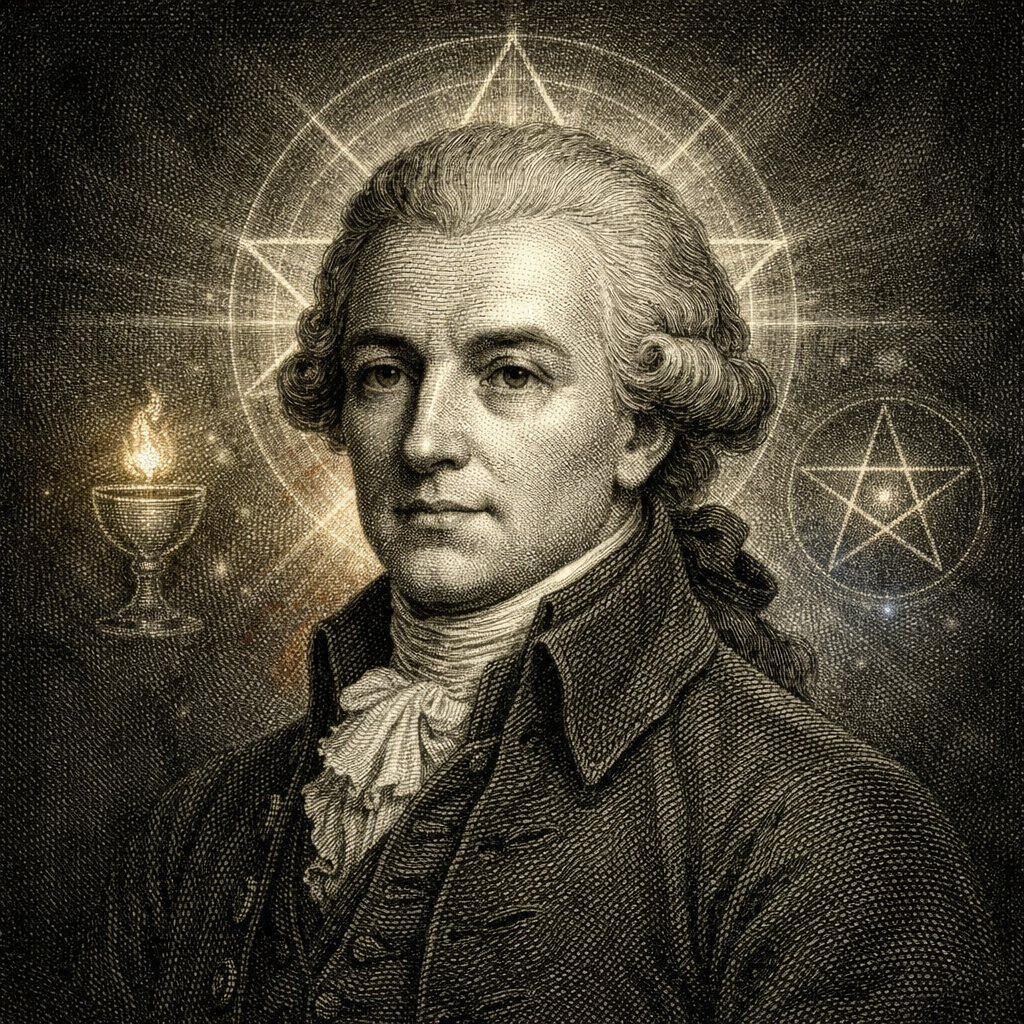
Date range: 1743–1803
Brief Biography
Louis-Claude de Saint-Martin was a French philosopher, mystic, and esoteric writer best known as the “Unknown Philosopher,” a title that reflects both his literary persona and his preference for inward spiritual work over public display. Born in Amboise and originally trained for a legal and military career, he became associated with the theurgical order of Martinez de Pasqually’s Élus Coëns before gradually developing a more interior and contemplative path. Saint-Martin moved away from elaborate ceremonial operations toward a spirituality centred on prayer, inner transformation, divine reintegration, and the restoration of the human soul to its original relation with God. Writing during the late Enlightenment and through the upheavals of the French Revolution, he became one of the most influential voices in Christian esotericism, shaping later Martinism, Romantic spirituality, and modern occult revival thought.
Works and Texts
- Aurora
- Heaven and Hell
- Treatise on the Reintegration of Beings
- Tableau Naturel
Place in the Western Esoteric Tradition
Saint-Martin occupies a central place in the Western Esoteric Tradition as a major representative of inward Christian esotericism. He stands at the intersection of Rosicrucian and Masonic symbolic culture, Christian theosophy, speculative religion, and the doctrine of reintegration inherited from Martinez de Pasqually, yet he redirected these influences away from external ritual action toward interior regeneration. His writings helped define a path in which the true temple is the human soul, the true operation is prayerful transformation, and the true restoration is the recovery of divine likeness. Through later receptions in Romanticism, occult revival, and Theosophical circles, Saint-Martin became one of the most important transmitters of the idea that esotericism must be lived inwardly rather than merely performed ceremonially.
Saint-Martin’s Mystical System
Louis-Claude de Saint-Martin’s mystical system is a theology of inward reintegration. Its core principle is that humanity has fallen from an original state of divine intimacy and now exists in estrangement, fragmentation, and exile. The purpose of spiritual life is to reverse that condition, not by speculative reasoning alone, and not primarily by outward ritual, but by the inner return of the soul toward its divine source. Saint-Martin is therefore one of the great witnesses to what might be called the interior turn in Western esotericism: the movement from operative theurgy toward contemplative transformation.
His earliest formation came through Martinez de Pasqually and the Élus Coëns. Pasqually’s doctrine described a cosmic fall involving humanity and spiritual beings, and taught that the work of reintegration required ritual operations, divine assistance, and the restoration of the human being to its original dignity. Saint-Martin received this doctrine deeply, but he increasingly concluded that the most important work could not depend upon ceremonial complexity alone. He did not deny the reality of the spiritual order described by Pasqually. Rather, he translated its essential drama into the language of the heart. The true operation became interior.
This shift is crucial. In Saint-Martin’s thought, the soul itself is the theatre of restoration. The fall is not merely a distant metaphysical event; it is a living condition of disordered will, spiritual blindness, and separation from divine truth. Humanity suffers from dispersion. The inward centre has been lost beneath passions, illusions, pride, and attachment to the external world. Reintegration therefore begins with recollection. The soul must turn back from multiplicity toward its origin. This is not an escape from the world by indifference, but a recovery of the divine principle within.
Prayer has a central role in this process. For Saint-Martin, prayer is not merely petition or devotional sentiment. It is the soul’s active orientation toward God, the means by which the inward bond with the divine is rekindled. His spirituality is often marked by warmth, longing, and intensity, yet it is not emotionally loose or vague. He insists upon purification, sincerity, moral seriousness, and spiritual discipline. The heart must be opened, but it must also be corrected. Inner prayer is thus an instrument of transformation, not a soft religious mood.
The image of the “inner man” is one of the most important features of Saint-Martin’s mystical system. The human being is not exhausted by external personality, social identity, or rational discourse. Beneath these lies a deeper principle capable of communion with divine truth. Spiritual life consists in awakening this inner man, restoring his lost dignity, and allowing divine light to become active within him. This anthropology connects Saint-Martin with earlier currents of Christian theosophy, especially Jacob Boehme, whose influence on him was profound. From Boehme he drew a richer symbolic understanding of the relation between God, nature, and the soul, though Saint-Martin generally wrote in a more lucid and less volcanic idiom.
His doctrine is therefore strongly Christocentric, though not narrowly confessional in a polemical sense. Christ is the principle of restoration, the mediator through whom humanity may recover its true place. Yet Saint-Martin’s Christology is deeply interior. Christ must be born within the soul. Redemption is not simply an external event to be accepted intellectually; it is an inward work of regeneration. The restored soul becomes capable of perceiving divine truth, participating in divine love, and re-entering the living order from which it had become estranged.
Saint-Martin also emphasises that the visible world is symbolic. Nature is not spiritually empty, nor merely mechanical. It bears traces of the divine order, though these traces are obscured by the fallen state of both the world and the perceiver. The external world can therefore serve as a book of signs, but only if the inward eye has been opened. This gives his thought an affinity with broader esoteric ideas of correspondence, while preserving his insistence that true interpretation begins with moral and spiritual transformation rather than with clever decoding alone.
A major aspect of his importance lies in his critique of purely external religion and externalised occultism alike. He distrusted a Christianity reduced to ceremony, formalism, or doctrinal dispute, but he also became wary of esotericism reduced to operations, secret techniques, or spiritual theatrics. The hidden life of the soul mattered more than spectacle. This is one reason he became so influential for later Martinist and illuminist traditions. He offered an esotericism of seriousness and interiority, one that did not depend upon elaborate institutional machinery, however much later generations would inevitably build some around him, because apparently no call to inward simplicity can survive long without someone adding grades and titles.
His relation to Boehme is especially significant. Saint-Martin translated and absorbed Boehmean themes of divine manifestation, inward regeneration, and the drama of the soul. Yet he remained distinctively himself. If Boehme can feel like a cosmic thunderstorm in prose, Saint-Martin more often writes as a philosopher of the heart. He seeks clarity of inward orientation, a practical path of restoration, and a language adequate to the soul’s longing for its origin. In this way he helped make Christian theosophical ideas more spiritually accessible without stripping them of depth.
The influence of Saint-Martin extended widely. Romanticism found in him a model of spiritual inwardness and symbolic depth. Later occult revival movements, including Papus and modern Martinism, drew on his name and authority in constructing initiatory lineages. Theosophical and esoteric readers valued his emphasis on the inner life and the universality of spiritual restoration. Even where later movements exaggerated or systematised his legacy, they did so because he had articulated one of the most enduring possibilities within Western esotericism: that the highest work is performed not in the laboratory, the lodge, or the temple alone, but in the sanctified interior of the human being.
Saint-Martin’s mystical system may therefore be described as inward Christian reintegration. It begins from the reality of the fall, insists upon the restoration of the inner man, privileges prayer and interior transformation over ceremonial operation, and seeks the rebirth of divine life within the soul. Its atmosphere is one of recollection, longing, and spiritual seriousness. In the history of the Western Esoteric Tradition, Saint-Martin stands as one of the clearest voices reminding us that hidden wisdom, if it is genuine, must end in the restoration of the heart.
Antecedent Figures
- Andrew Michael Ramsay; Elias Ashmole; James Anderson; Jean-Baptiste Willermoz; Johann Arndt; Johann Valentin Andreae; Michael Maier; Philipp Jakob Spener; Robert Fludd; William Preston
Antecedent Traditions
- Rosicrucianism; Speculative Freemasonry; High-Degree Masonry; Lutheran Mysticism & Pietism
Succeeding Figures
- Annie Besant; Charles Webster Leadbeater; Helena Petrovna Blavatsky; Papus (Gérard Encausse); Éliphas Lévi
Succeeding Traditions
- Romanticism; Occult Revival & Ritual Magic; Theosophical Society