Late Antique Hermeticism & Gnosticism
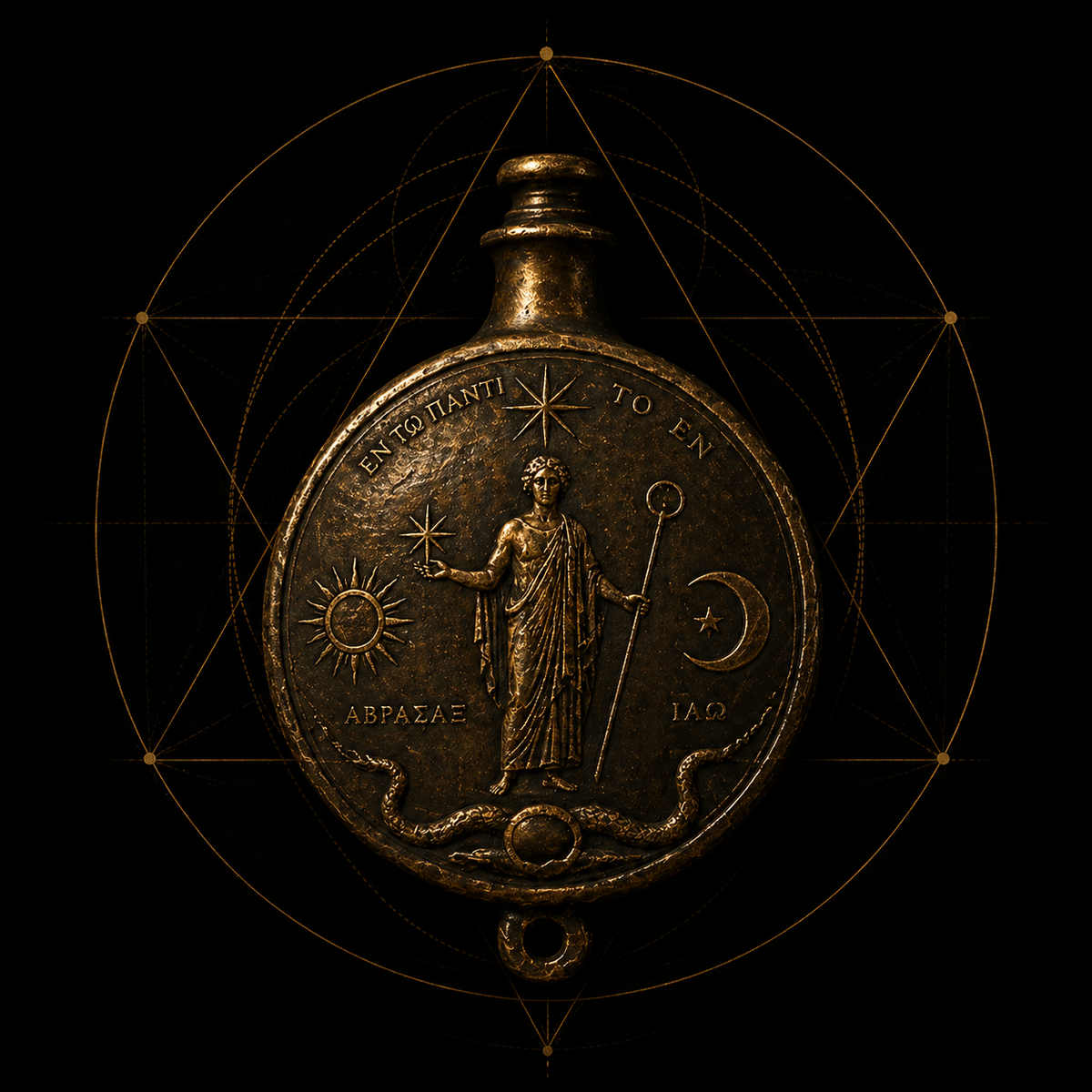
Late Antique Hermeticism and Gnosticism occupy a crucial position in the formation of the Western Esoteric Tradition. They emerged from the dense religious and philosophical environment of the eastern Mediterranean in the first centuries of the Common Era, where Greek philosophy, Egyptian religion, Jewish mystical speculation, astrology, ritual practice, and emerging Christian thought all interacted. Neither Hermeticism nor Gnosticism should be treated as a single, uniform movement. Each is better understood as a family of related texts, myths, doctrines, and spiritual practices. Yet they share certain major concerns: the hidden structure of reality, the divine origin or potential of the human being, the problem of embodiment, and the possibility of liberation through revealed knowledge.
Hermeticism is associated above all with the figure of Hermes Trismegistus, the “thrice-great” Hermes, a syncretic fusion of the Greek Hermes and the Egyptian Thoth. The Hermetic writings present themselves as revelations of ancient wisdom, usually in the form of dialogues between a divine teacher and a disciple. Their themes include cosmology, divine mind, the creation of the world, the nature of the human being, spiritual rebirth, and ascent to the divine. The Corpus Hermeticum and the Asclepius do not offer a single systematic doctrine, but they do present a coherent religious-philosophical atmosphere: the universe is alive, ordered, intelligible, and saturated with divine presence.
A central Hermetic idea is that the human being occupies a special place in the cosmos. Humanity is both earthly and divine, bound to the material world yet capable of knowing the divine intellect from which all things proceed. This dual status gives Hermetic spirituality its distinctive tension. The human being is not simply a fallen creature in need of external rescue, nor merely a rational animal within nature. The human being is a microcosm, a living image of the greater order, capable of awakening to its true origin. Knowledge, in this context, is transformative. To know the divine is not merely to acquire doctrine; it is to be changed by recognition.
Gnosticism, by contrast, often gives sharper expression to the alienation of the soul within the material world. The term “Gnosticism” covers a wide range of movements and texts, many preserved through hostile reports by heresiologists and, more directly, through the Nag Hammadi library. Gnostic myths commonly describe a transcendent divine fullness, or pleroma, from which a crisis or error results in the formation of the lower cosmos. The material world is frequently governed by ignorant or hostile powers, sometimes associated with a demiurge who mistakes himself for the highest God. The human being contains a divine spark trapped within this lower order, and salvation comes through gnosis: revelatory knowledge of one’s origin, condition, and path of return.
The distinction between Hermeticism and Gnosticism matters. Hermetic texts are often more positive toward the cosmos, seeing it as a beautiful living order created by divine mind, even if the soul must rise beyond material attachment. Gnostic texts, depending on the school, can be more radically dualistic, treating the visible world as a prison, deception, or defective construction. Yet both traditions speak the language of awakening, ascent, hidden knowledge, and divine origin. Both assume that ordinary perception is inadequate and that the human being must undergo a profound reorientation in order to understand reality. In this shared terrain, late antique esotericism takes recognisable shape.
The intellectual background of these traditions is deeply indebted to Hellenistic philosophy. Platonic and Neoplatonic ideas of emanation, hierarchy, cosmic intellect, and the ascent of the soul are everywhere present, though often transformed through myth and revelation. Egyptian religion contributed the figure of Hermes-Thoth, the prestige of ancient priestly wisdom, and a ritual imagination in which sacred speech, images, and divine mediation possess real power. Early Jewish mysticism contributed angelology, apocalyptic ascent, scriptural reinterpretation, divine names, and the idea of hidden wisdom disclosed to the worthy. The result was not a neat synthesis, because history rarely provides neatness unless a textbook has bullied it into shape, but a creative religious matrix from which later esoteric traditions would repeatedly draw.
One of the most enduring contributions of Late Antique Hermeticism and Gnosticism is the doctrine of correspondence between human being and cosmos. The human person is not isolated from the wider order of reality. Body, soul, mind, planet, angel, element, and divine principle may all be understood as parts of an interconnected whole. This vision would become central to later astrology, magic, alchemy, Kabbalah, and Renaissance Hermeticism. The macrocosm-microcosm relationship, so often repeated in later esoteric literature, finds one of its most fertile early expressions here.
These traditions also helped establish the theme of spiritual ascent through ordered levels of reality. In Hermetic texts, the soul may rise beyond planetary powers toward divine mind. In Gnostic systems, the soul must pass through hostile or ignorant archons and recover its origin in the divine fullness. This pattern of ascent, whether framed philosophically, mythically, ritually, or initiatically, became one of the great recurring motifs of Western esotericism. It is visible in later Kabbalistic speculation, in Christian mystical ascent, in magical initiatory systems, and in the graded structures of modern occult orders.
Their influence on Medieval Kabbalah, Islamic astral magic, and Renaissance Christian Kabbalah and Hermetic magic is especially significant. Medieval Kabbalah would develop its own Jewish theological and symbolic structures, yet it inherited and transformed late antique concerns with emanation, hidden divine realities, sacred language, and cosmic hierarchy. Islamic astral magic drew upon the late antique inheritance of astrology, Hermetic cosmology, and planetary mediation. Renaissance Hermeticism, especially after the translation of the Corpus Hermeticum, treated Hermetic writings as ancient theological philosophy and used them to support a grand synthesis of magic, Christianity, Kabbalah, and Platonic metaphysics.
Late Antique Hermeticism and Gnosticism therefore stand as one of the great junction points in the Western Esoteric Tradition. They gathered earlier currents, including Hellenistic philosophy, Egyptian religion, and Jewish mysticism, and transmitted them in forms that later ages could reinterpret. Their lasting importance lies not in doctrinal uniformity, but in the powerful set of esoteric assumptions they helped to establish: that reality is layered, that the human being has a hidden divine dimension, that knowledge can transform the soul, that the cosmos is filled with signs and powers, and that salvation or illumination requires awakening from the merely visible world into a deeper order of being.
Antecedent Traditions
· Hellenistic Philosophy
· Egyptian Religion
· Early Jewish Mysticism
Succeeding Traditions
· Islamic Astral Magic
· Medieval Kabbalah
· Renaissance Christian Kabbalah & Hermetic Magic