King Athelstan (Legendary)
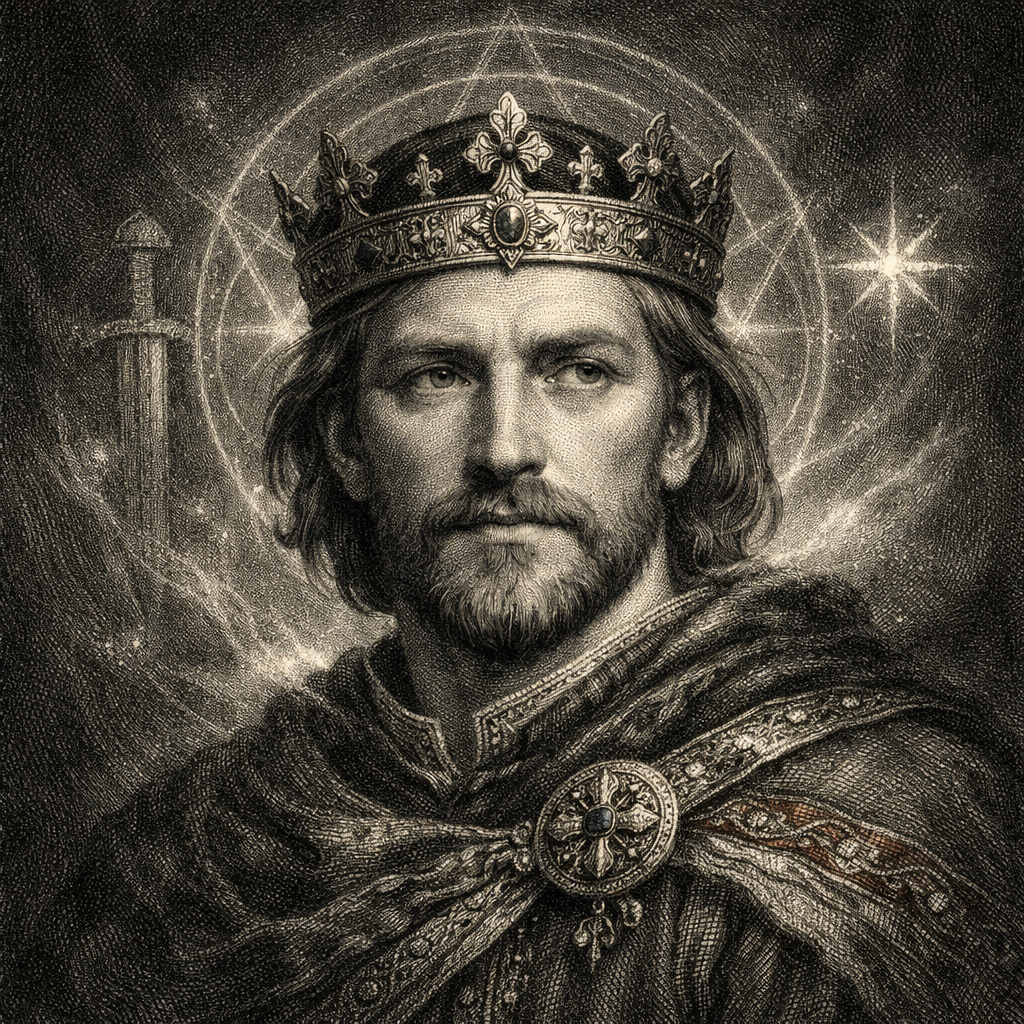
Date range: Historical Athelstan 894–939; Masonic legendary tradition developed in medieval and early modern manuscript sources
Brief Biography
King Athelstan was the first king to rule over a recognisably unified England, reigning from 924 to 939, and later became an important legendary authority within the manuscript traditions of English Freemasonry. The historical Athelstan was a powerful Anglo-Saxon ruler whose reign consolidated royal authority, military success, ecclesiastical patronage, and legal reform. The Masonic Athelstan, however, belongs to a different kind of history: the legendary and constitutional memory preserved in Old Charges and related manuscript traditions. In these accounts, Athelstan, and especially his son or associated royal household, is linked with the granting of privileges, assemblies, charges, and regulations for the craft of masonry. This legendary role made him a symbolic source of antiquity, legitimacy, and royal sanction for later operative and speculative Masonic traditions.
Works and Texts
- Regius Manuscript (Halliwell MS)
- Matthew Cooke Manuscript
- Schaw Statutes
Place in the Western Esoteric Tradition
Athelstan’s place in the Western Esoteric Tradition is indirect but important, belonging to the mythic and institutional ancestry of speculative Freemasonry. He is not an esoteric author or visionary teacher, but a legendary guarantor of craft antiquity and lawful transmission. In the manuscript culture of the Old Charges, the craft of masonry was given a sacred and royal genealogy that connected geometry, building, moral regulation, biblical antiquity, and English kingship. This legendary framework later helped speculative Freemasonry imagine itself as more than a social fraternity or trade inheritance. Through figures such as Elias Ashmole, James Anderson, and William Preston, the older manuscript traditions were absorbed into a broader Masonic self-understanding in which ancient craft, moral order, and symbolic architecture could support initiatory and esoteric interpretation.
Athelstan’s Mystical System
King Athelstan does not possess a mystical system in the ordinary sense. The historical king was a tenth-century ruler, not a philosopher of initiation or an esoteric theologian. Yet the legendary Athelstan of Masonic tradition performs a symbolic function so important that he must be treated as part of the architecture of Masonic myth. His system, if the term is used broadly, is the myth of lawful craft transmission: the idea that masonry descends through authorised assemblies, ancient charges, royal protection, and moral regulation from a remote and honourable past.
The earliest Masonic manuscript traditions are concerned with origins. They seek to explain what masonry is, where it comes from, and why its members are bound by particular duties. The craft is not presented merely as a useful trade. It is given dignity through sacred history, geometry, and royal authority. In this context, Athelstan appears as a king who supports, protects, or regularises masonry, placing the craft under lawful order. The details vary across manuscripts and later retellings, but the symbolic point remains consistent: masonry is ancient, morally serious, and publicly sanctioned.
This is not history in the modern archival sense, which is fortunate, because otherwise the whole business would collapse under the weight of footnotes and professional disappointment. It is constitutional legend. Such legends do not simply record facts; they create identity. By linking the craft to Athelstan, the Old Charges place masonry within the moral order of the kingdom. The mason becomes more than a labourer. He belongs to a regulated brotherhood whose duties are inherited, solemn, and tied to the welfare of both craft and society.
The Regius Manuscript, or Halliwell Manuscript, is especially significant in this respect. As one of the earliest surviving Masonic texts, it presents masonry through a blend of moral instruction, craft regulation, legendary history, and religious exhortation. The craft is associated with geometry, which is treated as a noble science, and with a lineage extending back through biblical and classical antiquity. Athelstan’s legendary role belongs to this effort to dignify masonry by giving it a venerable and ordered past. The manuscript teaches that craft knowledge is not merely technical skill, but must be governed by virtue, discipline, and proper conduct.
The Cooke Manuscript develops similar themes. It places masonry within a broad legendary history of the liberal arts, sacred knowledge, and ancient transmission. Here again, the craft is embedded in a story larger than immediate practice. The mason is heir to a wisdom that has survived through time, catastrophe, migration, and royal patronage. Athelstan’s presence in this tradition helps anchor the craft in English history while preserving its claim to far older origins. He functions as the royal node through which universal craft wisdom becomes institutionally local.
The Schaw Statutes belong to a later and more administrative context in Scotland, and their inclusion in the supplied source list usefully points to the continuing importance of regulation, office, discipline, and craft governance in the development of Masonry. Although the Schaw Statutes are not Athelstanic texts, they reflect the same broad principle that masonry is sustained through order. The craft requires wardens, lodges, rules, records, standards, and obligations. This administrative dimension may look less romantic than lost wisdom and ancient kings, but without it no symbolic tradition survives very long. Even mystery needs minutes, apparently.
The mystical significance of the Athelstan legend lies in its connection between building and lawful order. Architecture is never merely physical in Masonic imagination. To build rightly is to participate in measure, proportion, discipline, and moral structure. The craft must be governed because the world itself is governed by order. Geometry provides the intellectual foundation; the charges provide the ethical foundation; royal patronage provides the social and legal foundation. Together they create a vision of masonry as a disciplined art situated within divine, natural, and civil order.
This vision later became crucial for speculative Freemasonry. When Freemasonry developed into a symbolic and initiatory fraternity, it inherited not only tools, lodges, and trade language, but also a legendary past. Athelstan helped supply that past. His name allowed later Masons to imagine continuity with a venerable English craft tradition regulated by ancient charges. James Anderson’s eighteenth-century Constitutions would greatly expand and reshape Masonic legendary history, but it worked within an already established habit of mind: the craft required a noble genealogy.
The importance of such genealogy should not be underestimated. Esoteric and initiatory traditions often depend upon the claim that their practices are not recent inventions. Antiquity confers gravity. Continuity suggests legitimacy. A founder, king, prophet, architect, or ancient sage provides a symbolic point of origin. In Masonic tradition, Athelstan performs this function in a specifically English and constitutional form. He is not Hermes Trismegistus revealing cosmic wisdom, nor Solomon building the temple, but the Christian king who authorises the craft and binds it to law.
This gives the Athelstan legend a different tone from more obviously occult traditions. It is not primarily concerned with hidden powers, angelic hierarchies, astral forces, or mystical union. Its concern is order: moral, professional, institutional, and civic. Yet this order becomes esoterically fertile once speculative Freemasonry begins to interpret the craft symbolically. The ancient charges become more than trade regulations; they become signs of moral obligation. The assembly becomes more than a guild meeting; it becomes an archetype of lawful brotherhood. The king becomes more than a patron; he becomes a figure of legitimate transmission.
The absence of antecedent traditions and figures in the supplied row is therefore appropriate in one sense. Athelstan’s Masonic role is less that of a historical recipient of esoteric doctrine than that of a legendary source within a specific craft mythology. His symbolic ancestry is embedded in the manuscript narratives themselves: biblical patriarchs, ancient builders, geometry, Euclid, and the liberal arts. Yet the relationship section rightly points forward to speculative Freemasonry, where this legendary craft inheritance became one of the foundations for a much richer symbolic and initiatory system.
Figures such as Elias Ashmole, James Anderson, and William Preston stand on the far side of this transformation. Ashmole represents the early presence of learned gentlemen within Masonic contexts; Anderson codifies Freemasonry’s mythic and constitutional identity; Preston systematises Masonic lectures and moral instruction. All three depend, in different ways, on the inherited dignity of the old craft. Athelstan’s legend gave that craft a royal memory, and royal memory is extremely useful when a fraternity wishes to look ancient, orderly, and faintly immune to the charge of being a club for men with aprons and an overdeveloped fondness for procedure.
Athelstan’s mystical system, then, is the symbolic constitution of craft legitimacy. It presents masonry as ancient, moral, geometrical, regulated, and protected by rightful authority. Its spirituality is implicit rather than doctrinal. It lies in the belief that building requires order, that order requires virtue, and that the craft participates in a tradition larger than the individual worker. Later speculative Freemasonry would transform this inheritance into an initiatory drama of self-formation, temple symbolism, and moral architecture. The legendary Athelstan stands behind that development as one of the craft’s royal shadows: historically uncertain in Masonic detail, but symbolically indispensable.
Antecedent Figures
- —
Antecedent Traditions
- —
Succeeding Figures
- Elias Ashmole; James Anderson; William Preston
Succeeding Traditions
- Speculative Freemasonry