Julius Evola
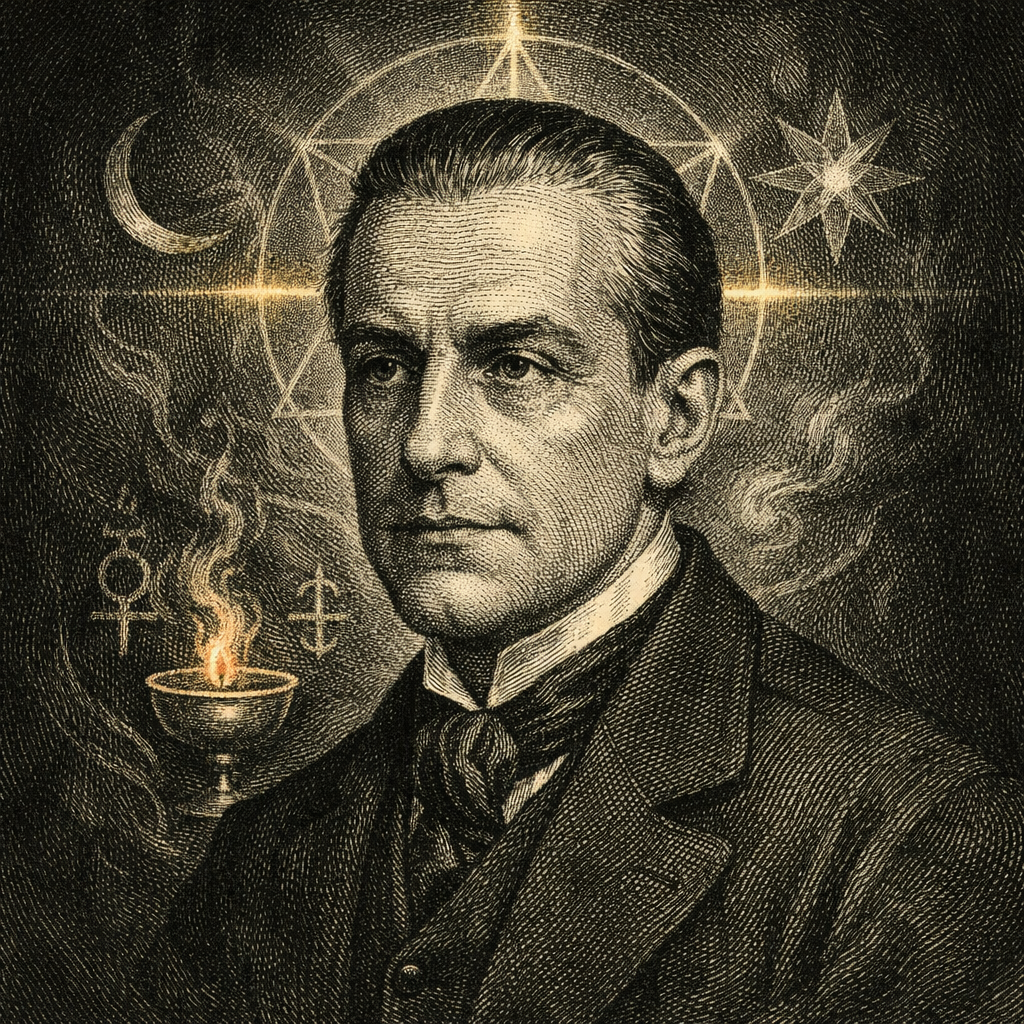
Date range: 1898–1974
Brief Biography
Julius Evola was an Italian philosopher, esoteric writer, artist, political theorist, and controversial exponent of Traditionalist and anti-modern thought. Born in Rome, he first moved through avant-garde artistic and philosophical circles before turning increasingly toward esotericism, Hermeticism, Buddhism, Tantra, myth, and the critique of modern civilisation. His writings attempted to recover what he regarded as an aristocratic, initiatory, and supra-historical tradition standing above ordinary religion, democracy, materialism, and modern egalitarian culture. Evola remains a difficult and ethically charged figure because his esoteric and metaphysical writings cannot be cleanly separated from his reactionary politics, racial theories, and fascist-era associations. Yet within the history of Western esotericism, works such as The Hermetic Tradition are significant for their interpretation of alchemy as an inner initiatory science rather than a primitive chemistry or merely symbolic psychology.
Works and Texts
- The Crisis of the Modern World
- The Hermetic Tradition
Place in the Western Esoteric Tradition
Evola’s place in the Western Esoteric Tradition lies in his attempt to reinterpret Hermeticism, alchemy, Tantra, and initiatory symbolism through the lens of Traditionalist anti-modernism. The supplied antecedent tradition, the Theosophical Society, and the related figures Annie Besant, Charles Webster Leadbeater, and Helena Petrovna Blavatsky mark the broader modern esoteric field from which many of his concerns emerged, even when Evola rejected Theosophical universalism, spiritual evolutionism, and sentimentalised occultism. His work sought to strip esoteric traditions of what he regarded as devotional, moralistic, or modern accretions, recovering instead a doctrine of heroic ascent, metaphysical sovereignty, and initiatory transformation. His contribution is therefore double-edged: intellectually important for the modern interpretation of alchemy and tradition, but inseparable from a severe anti-modern worldview whose political afterlife requires careful handling.
Evola’s Mystical System
Julius Evola’s mystical system is an austere doctrine of initiatory transcendence. Its central premise is that modern civilisation represents a fall from a higher spiritual order, and that authentic esotericism preserves techniques, symbols, and doctrines through which a differentiated individual may recover vertical contact with the transcendent. Evola does not present mysticism as consolation, moral improvement, or devotional surrender. He treats it as a path of inner sovereignty, discipline, and metaphysical transformation. This gives his esoteric writings their force, but also their severity.
The governing idea in Evola’s thought is Tradition, usually understood with a capital letter. Tradition is not custom, folklore, inherited opinion, or nostalgia for old social habits. It is a supra-historical principle: a timeless metaphysical order that has been expressed in different civilisations, myths, initiatory systems, and sacred sciences. For Evola, ancient societies possessed forms of hierarchy, ritual kingship, sacred authority, and spiritual knowledge that reflected this order more directly than the modern world. Modernity, by contrast, is marked by materialism, egalitarianism, secularism, economic reduction, and the loss of vertical orientation. His esotericism is therefore inseparable from a critique of the modern age.
This critique is not merely cultural pessimism. Evola interprets history through a doctrine of decline, influenced by cyclic models also found in Traditionalist thought. Civilisation descends from ages of spiritual authority into progressively more material and chaotic conditions. The modern world is not viewed as progress but as dissolution. The individual who seeks initiation must therefore resist the gravitational pull of the age. The path is not collective uplift, democratic spiritual education, or evolutionary optimism. It is separation, discipline, and inward ascent.
This is one of the major points at which Evola differs from Theosophical currents. Theosophy frequently presented spiritual evolution as a broad cosmic process involving humanity’s gradual ascent through planes, races, and cycles under the guidance of adepts or masters. Evola rejected what he considered the softening and popularising tendencies of modern occultism. He was suspicious of mediumship, sentimental spirituality, humanitarian moralism, and doctrines that seemed to dissolve hierarchy into vague universal brotherhood. Where Theosophy often imagined spiritual development as expansive and pedagogical, Evola imagined it as selective and initiatory.
His interpretation of Hermeticism and alchemy is the most important part of his esoteric system for the Western tradition. In The Hermetic Tradition, Evola argues that alchemy should not be reduced to the prehistory of chemistry, nor treated only as a set of psychological symbols. He reads it as an initiatory science concerned with the transformation of the practitioner’s being. The metals, operations, vessels, fires, and substances of alchemical texts are interpreted as signs of inner processes. The opus is a work upon the subtle constitution of the human being, directed toward the recovery of an immortal, solar, or transcendent state.
The alchemical work, in Evola’s reading, is not a passive unfolding. It demands will, concentration, separation from ordinary nature, and mastery over the lower elements of the self. The initiate must pass through dissolution, purification, fixation, and rebirth, but these are understood less as therapeutic integration than as the conquest of conditioned existence. Evola is drawn to images of fire, gold, solarity, virility, and royal power because they express his ideal of an awakened centre that stands above flux, desire, and sentimental dependence. The perfected being is stable, luminous, and sovereign.
This solar symbolism is crucial. Evola frequently contrasts solar and lunar modes of spirituality. The lunar is receptive, devotional, passive, ecstatic, or dependent upon forces beyond the self. The solar is active, regal, centred, and transcendent. This distinction shapes much of his reading of initiation. He favours paths that emphasise heroic self-transcendence, ascetic control, and direct realisation over those centred on surrender, emotional devotion, or visionary passivity. The result is a highly selective interpretation of esoteric traditions, often powerful in its internal coherence but narrow in its sympathies.
Evola’s use of Tantra and Eastern traditions follows a similar pattern. He is drawn to doctrines and practices that appear to overcome duality, awaken latent power, and transmute desire into spiritual force. Yet he reads these materials through his own aristocratic and initiatory framework. The East is not for him a zone of gentle mysticism or universal compassion, but a repository of techniques for transcendence and liberation from ordinary human limitation. As with his treatment of alchemy, this can produce striking insights while also imposing a severe interpretive grid on traditions more varied than his presentation allows.
The concept of the differentiated man is another key to his system. In a world he considers spiritually ruined, the individual of higher type must inwardly detach from prevailing values. This does not necessarily mean physical withdrawal. It means maintaining an interior axis untouched by the surrounding disorder. Later Evola describes this stance as “riding the tiger”: confronting the destructive forces of modernity without being inwardly consumed by them. The phrase captures his ideal of disciplined detachment, though it also reveals the bleakness of his historical imagination. The world is not to be saved so much as endured, mastered, or transcended.
The ethical problem in Evola’s thought is serious. His language of hierarchy, superiority, aristocracy, race, and anti-democratic order was not merely metaphorical, and his political writings have been used by extremist and far-right movements. A responsible account of his esotericism cannot pretend that these elements are incidental decoration. They shape his interpretation of spiritual authority, initiation, and tradition. His work often confuses metaphysical hierarchy with social and political hierarchy, and that confusion has had consequences. The fact that he wrote intelligently on Hermetic symbolism does not absolve the ideological darkness that runs through much of his broader project.
Yet it would also be too simple to dismiss his esoteric writings as nothing more than politics in occult costume. Evola’s readings of alchemy, initiation, and tradition remain significant because they articulate a rigorous alternative to both materialist reduction and soft occult eclecticism. He insists that esotericism concerns transformation of being, not entertainment, belief, or decorative symbolism. He understands that initiatory language is demanding and often dangerous. He recognises that alchemical texts encode a discipline of inner change rather than a quaint museum of pre-scientific errors. These insights help explain why his work continues to attract attention, even among readers who reject his politics.
Evola’s mystical system may therefore be described as initiatory traditionalism centred on transcendence, sovereignty, and alchemical transformation. It seeks an escape from modern dissolution through contact with a supra-historical order and through the hardening of the self into a vehicle of spiritual ascent. Its strengths are seriousness, symbolic intensity, and refusal of trivial occultism. Its dangers are elitism, ideological contamination, and a repeated tendency to translate spiritual hierarchy into worldly domination. In the Western Esoteric Tradition, Evola stands as a warning and a resource: a writer who understood the gravity of initiation, and who also demonstrates how easily the language of transcendence can become entangled with the ugliest dreams of power.
Antecedent Figures
- Annie Besant; Charles Webster Leadbeater; Helena Petrovna Blavatsky
Antecedent Traditions
- Theosophical Society
Succeeding Figures
- —
Succeeding Traditions
- —