John Dee
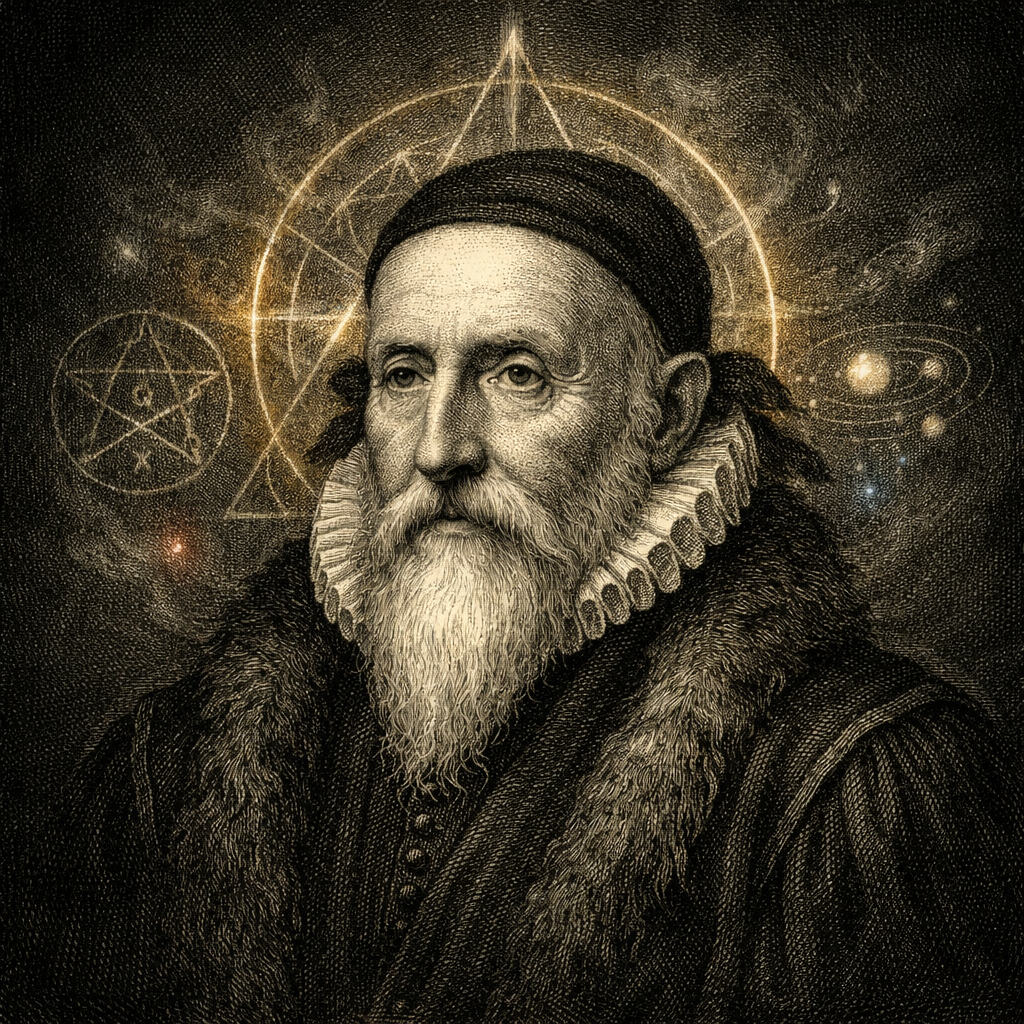
Date range: 1527–1608/1609
Brief Biography
John Dee was an English mathematician, astrologer, natural philosopher, court adviser, imperial theorist, and one of the most complex learned magi of the Elizabethan age. Educated at Cambridge and active within the intellectual world of Renaissance humanism, Dee combined mathematics, navigation, astronomy, antiquarianism, Christian Kabbalah, Hermetic philosophy, and angelic communication into a vast programme of sacred knowledge. He served as an adviser to Elizabeth I, assembled one of the greatest private libraries in England, and pursued both practical and esoteric forms of wisdom with unusual intensity. His Monas Hieroglyphica presented a dense symbolic synthesis of cosmic, alchemical, mathematical, and theological meaning, while his angelic diaries recorded the visionary work conducted with scryers, most famously Edward Kelley. Dee died in poverty and relative neglect, but his symbolic and angelic systems became central to later occult revival and ceremonial magical traditions.
Works and Texts
- Monas Hieroglyphica
- Dee's Enochian Diaries
Place in the Western Esoteric Tradition
Dee occupies a major place in the Western Esoteric Tradition as one of the most ambitious representatives of Renaissance Christian Hermeticism and learned magic. Drawing upon Christian Kabbalah, Hermetic philosophy, mathematical cosmology, astrology, alchemy, and Renaissance theories of symbol and correspondence, he sought a unified wisdom capable of disclosing the divine order of creation. His work received and reconfigured influences associated with Ficino, Pico, Reuchlin, Agrippa, and Bruno, while his angelic operations and symbolic language later became especially important to Rosicrucian and Golden Dawn currents. Dee’s distinctive contribution lies in his conviction that mathematics, sacred signs, imperial destiny, angelic revelation, and spiritual reform belonged to one coherent intellectual and religious project.
Dee’s Mystical System
John Dee’s mystical system is a learned Christian Hermeticism organised around number, symbol, angelic mediation, and the recovery of divine wisdom. Dee did not see the world as divided between practical science and sacred knowledge. Mathematics, astronomy, navigation, alchemy, theology, imperial policy, and angelic communication all belonged to a single search for the hidden order established by God. His project is therefore difficult to classify according to modern categories, which is inconvenient for tidy minds and apparently one of history’s little amusements. Dee lived before those categories had hardened, and his work shows what learned inquiry could look like when geometry, prayer, empire, and apocalypse still shared a table.
The foundation of Dee’s system is the belief that creation is structured mathematically. Number and proportion are not merely human instruments for measuring the world; they disclose the order by which the world is made intelligible. Dee’s famous “Mathematical Preface” to Euclid’s Elements shows the seriousness with which he regarded mathematics as the key to natural philosophy, mechanical arts, astronomy, music, architecture, and navigation. In an esoteric context, this mathematical worldview also supports the doctrine of correspondence. If all levels of reality are ordered by divine reason, then symbolic relations between them may be discovered, contemplated, and used.
The Monas Hieroglyphica gives this principle its most concentrated symbolic expression. The monad glyph combines signs associated with the sun, moon, elements, Aries, the cross, and other symbolic structures into a single compressed emblem. Dee presents it as a key to cosmic, alchemical, and theological meaning. The glyph is not a decorative cipher. It is a symbolic machine, designed to gather multiple levels of reality into one contemplative form. Through it, Dee attempts to show how the many are rooted in the one, and how the visible symbols of astronomy, alchemy, and sacred geometry reveal an underlying unity.
This makes Dee’s thought deeply emblematic. The symbol is not merely a sign that points to an absent idea. It participates in a structure of meaning. Properly understood, it becomes a means of intellectual ascent. Dee’s monad requires the reader to move through layers of analogy, calculation, and spiritual interpretation. It embodies the Renaissance confidence that hidden wisdom may be recovered through the disciplined reading of signs. The cosmos is written in a language of number and symbol, and the learned magus is one who can begin to read that language.
Christianity remains the governing frame of Dee’s system. Although he drew from Hermetic, Kabbalistic, Platonic, and alchemical sources, he did not present his project as a rival religion. He understood his work as a restoration of sacred knowledge within a Christian universe. Divine wisdom had been fragmented, obscured, and corrupted across time; the task of the true philosopher was to recover it in service of God. This aspiration links Dee to the broader Renaissance ideal of prisca theologia, the ancient theology supposedly preserved in partial form by sages, prophets, philosophers, and inspired traditions.
Dee’s angelic work is the most dramatic and controversial part of his mystical system. Beginning in the 1580s, he undertook a series of visionary operations with scryers, especially Edward Kelley, seeking communication with angels. The resulting diaries record complex conversations, tables, divine names, calls, angelic hierarchies, and an unfamiliar sacred language later known as Enochian. Dee did not regard these communications as casual spirit contact. He sought a purified revelation from divine messengers, capable of restoring wisdom, correcting religious error, and preparing humanity for a providential transformation.
Angelic mediation in Dee’s system reflects a larger metaphysical assumption. The distance between God and humanity is crossed through ordered hierarchies of intelligence. Angels are not decorative figures in stained glass, patiently waiting for theologians to domesticate them. They are mediators of knowledge, messengers of divine command, and guardians of the hidden architecture of creation. Dee’s angelic operations sought access to the higher structures of language, cosmology, and spiritual authority. The goal was not mere marvel-seeking, though the operations certainly contain enough marvels to keep several generations of occultists busily overexcited. The aim was reforming revelation.
The Enochian material is especially important because it presents language itself as a sacred technology. The angelic calls and tables suggest that words, letters, and names can open relations between the human and divine orders. This places Dee in continuity with Christian Kabbalah and Renaissance linguistic mysticism, while giving the theme a distinctive visionary form. Reuchlin had treated Hebrew and divine names as keys to sacred truth; Dee’s angelic work sought a language beyond ordinary human corruption, disclosed by heavenly intelligences. Later magical orders would develop this material into elaborate ritual systems, sometimes with far more confidence than caution, because restraint has rarely been occultism’s favourite virtue.
Dee’s alchemical and apocalyptic concerns also belong to the system. Alchemy, for Dee, was not simply metallurgical curiosity. It belonged to the broader work of transformation and restoration. The reform of nature, knowledge, and the soul were linked. Likewise, the apocalyptic tone of parts of the angelic diaries reflects the urgency of his project. Dee believed he was living in a time of possible divine intervention, religious crisis, and imperial destiny. His interest in British empire, navigation, and Elizabethan expansion was not separate from his esotericism. He imagined England as having a providential role in the unfolding of sacred history.
This imperial dimension must be handled carefully. Dee’s concept of a British imperial destiny helped shape early modern geopolitical imagination, and it sits uneasily beside the more contemplative aspects of his work. Yet for Dee these themes belonged together. The recovery of divine wisdom was not merely personal enlightenment. It had consequences for kingdom, church, and world. Sacred knowledge was meant to order human affairs according to divine law. The magus, in this sense, was not a recluse but an adviser, reformer, and servant of providential monarchy.
Dee’s mystical system therefore has several interlocking parts: mathematical cosmology, symbolic synthesis, Christian Kabbalah, angelic revelation, alchemical transformation, and providential reform. Its unity lies in the idea that divine order is real, hidden, and recoverable through disciplined inquiry and sacred mediation. The human mind can ascend through number and symbol; the soul can be instructed through angelic communication; the world can be read as a hierarchy of signs; and history itself may be directed toward restoration.
His influence on later esotericism was enormous, though uneven. Rosicrucian writers inherited the dream of a reformed wisdom uniting piety, nature, and hidden knowledge. Robert Fludd drew upon related symbolic and Hermetic structures. The Hermetic Order of the Golden Dawn later made Dee’s Enochian material into one of the most elaborate ritual technologies of modern ceremonial magic. Figures such as Mathers, Westcott, and Waite received Dee through this occult revival lens, often emphasising the magical and angelic dimensions more than the full range of his mathematical, political, and scholarly concerns.
Dee’s enduring importance lies in the scale of his ambition. He sought nothing less than a universal Christian science of divine order, grounded in mathematics, expanded through symbol, confirmed through angelic revelation, and directed toward spiritual and civil reform. His life ended without the worldly restoration he hoped for, and his angelic work left behind as many problems as solutions. Yet the power of his vision remains. Dee stands as one of the great examples of the Renaissance magus: learned, devout, daring, impractical, brilliant, credulous, disciplined, and hazardous in exactly the proportions that make him historically unforgettable.
Antecedent Figures
- Giordano Bruno; Giovanni Pico della Mirandola; Heinrich Cornelius Agrippa; Johannes Reuchlin; Marsilio Ficino
Antecedent Traditions
- Renaissance Christian Kabbalah & Hermetic Magic
Succeeding Figures
- Arthur Edward Waite; Johann Valentin Andreae; Michael Maier; Robert Fludd; S.L. MacGregor Mathers; William Wynn Westcott
Succeeding Traditions
- Rosicrucianism; Hermetic Order of the Golden Dawn