Johannes Reuchlin
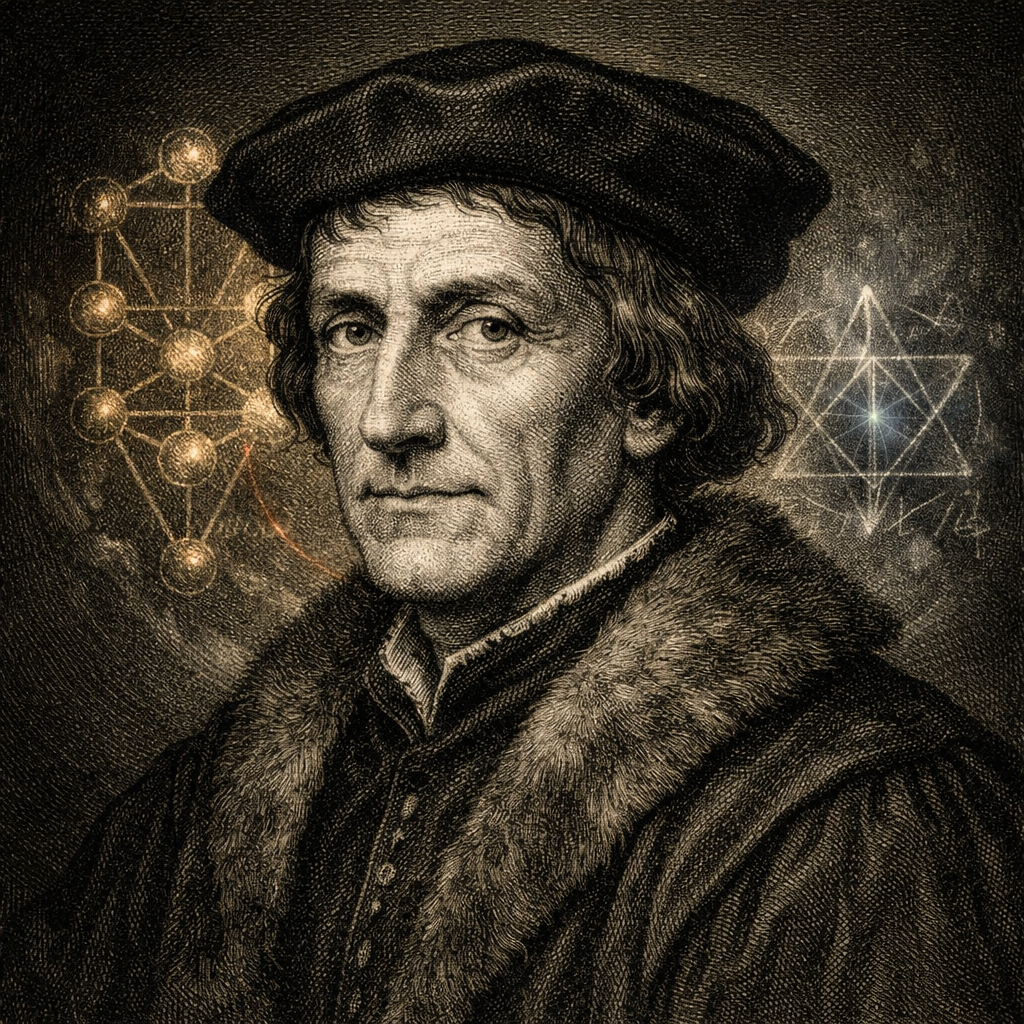
Date range: 1455–1522
Brief Biography
Johannes Reuchlin was a German humanist, jurist, Hebraist, and Christian scholar whose work played a decisive role in introducing Kabbalistic thought into Renaissance Christian intellectual culture. Active during the late fifteenth and early sixteenth centuries, he belonged to the first generation of northern European humanists and became renowned for his defence of Hebrew learning, his engagement with Jewish texts, and his efforts to show that ancient wisdom traditions could illuminate Christian theology. Best known in esoteric history for De verbo mirifico and De arte cabalistica, Reuchlin sought to interpret sacred language, divine names, and Kabbalistic symbolism as keys to the deeper structure of revelation. He died in 1522, having helped establish one of the most important channels through which Christian Kabbalah entered the Western Esoteric Tradition.
Works and Texts
- De occulta philosophia libri tres
- Oration on the Dignity of Man
- De arte cabalistica
- De vita libri tres
- De Umbris Idearum
- The Expulsion of the Triumphant Beast
Place in the Western Esoteric Tradition
Reuchlin occupies a central place in the Western Esoteric Tradition as one of the principal architects of Christian Kabbalah. Drawing upon medieval Kabbalah, late antique Hermetic and related currents, scholastic theology, and the wider Renaissance recovery of ancient wisdom, he helped create a learned Christian esoteric language in which Hebrew letters, divine names, and symbolic interpretation could be integrated into a theology of sacred knowledge. His work stood at an early and influential point in a chain of transmission that later affected Paracelsianism, Rosicrucianism, Dee’s angelic and linguistic speculations, and the broader symbolic world from which speculative Freemasonry would eventually draw. Reuchlin’s distinctive contribution was to treat language itself as a sacred medium through which metaphysical and theological realities might be disclosed.
Reuchlin’s Mystical System
Johannes Reuchlin’s mystical system is founded upon the conviction that divine truth is encoded in sacred language, and that the study of Hebrew and Kabbalah can open hidden dimensions of Christian revelation. His thought belongs to the Renaissance project of recovering ancient wisdom, but it gives that project a distinctly philological and theological form. Reuchlin is less concerned with visionary ecstasy or ritual operation than with the sacred depth of names, letters, and scriptural structures. In his hands, language becomes more than a tool of communication. It becomes a symbolic medium through which the divine order may be approached.
At the heart of Reuchlin’s system lies a profound respect for Hebrew. For him, Hebrew is not simply one language among others, valuable only for historical or grammatical reasons. It has a privileged relation to revelation. The divine names, scriptural words, and letter-combinations of Hebrew preserve mysteries that cannot be adequately conveyed through translation alone. This does not mean that every Hebrew word is a magical formula in a crude sense. Rather, it means that sacred language has ontological depth. Words given in revelation participate in the realities they signify. To study them is therefore to enter a more intimate relation with divine wisdom.
This belief led Reuchlin to Christian Kabbalah. Medieval Jewish Kabbalah had developed complex interpretive methods concerning divine emanation, the sefirot, letter symbolism, and the hidden structure of Torah. Reuchlin approached this material as a Christian humanist persuaded that Judaism preserved important traces of primordial wisdom. He did not receive Kabbalah on its own terms in a modern comparative sense. Instead, he reinterpreted it within a Christian theological framework, arguing that it contained veiled confirmations of Christian truth. The hidden wisdom of the Jews, once properly understood, could illuminate doctrines such as the Trinity, the incarnation, and the structure of divine mediation.
This interpretive move is the essence of Reuchlin’s esotericism. He treats Kabbalah as a sacred science whose meanings are concealed beneath the surface of scripture and tradition. The visible text does not exhaust revelation. Beneath its literal meaning lie symbolic, numerical, and linguistic depths. This layered view of scripture made Kabbalah immensely attractive to Renaissance thinkers who believed that ancient wisdom had been scattered across traditions and required learned recovery. Reuchlin helped legitimise this approach by presenting it not as theological eccentricity, but as a serious mode of Christian scholarship.
The doctrine of divine names is especially important in his system. Names of God are not merely conventional labels. They express different modes of divine relation and disclose aspects of the structure of reality. Reuchlin’s discussion of the Tetragrammaton and related sacred names reflects a broader Renaissance fascination with the power of naming, but for him the issue is primarily theological. The divine name gathers together metaphysical truth, scriptural authority, and symbolic depth. To contemplate or analyse such names is to confront the mystery of God’s presence in language. This theme later proved immensely fertile for Christian Kabbalists, ceremonial magicians, and angelic speculators such as John Dee.
His De verbo mirifico and De arte cabalistica together reveal another major feature of his thought: the relation between logos and salvation. Reuchlin’s mystical theology is not purely speculative. It is Christological. The “wonder-working word” is not simply a powerful utterance, but an indication that the divine Word stands at the centre of history and revelation. The hidden wisdom of names and letters is oriented toward the incarnation. Kabbalah, in this reading, becomes a preparation for recognising Christ as the fulfilment of sacred language. Reuchlin thus integrates humanist philology, mystical linguistics, and Christian doctrine into a single interpretive programme.
The philosophical atmosphere surrounding this programme is distinctly Renaissance. Reuchlin lived in a world where Platonism, Hermetic enthusiasm, scholastic theology, and humanist textual recovery all mingled. He shares with that environment the belief that truth is ancient, that symbols bear metaphysical meaning, and that the wise interpreter may recover forms of knowledge obscured by time. Yet his own emphasis remains disciplined and learned. He is not constructing a free-floating occult synthesis from whatever glittering fragments happen to lie at hand. He is attempting to ground esoteric interpretation in rigorous engagement with texts, languages, and inherited traditions.
This is one reason his importance extends beyond Christian Kabbalah narrowly considered. Reuchlin helped establish a model of learned esotericism: scholarship in the service of hidden wisdom. Later esoteric thinkers often preferred a more expansive or flamboyant style, but many of them remained indebted to the intellectual space he helped create. Paracelsianism inherited the conviction that hidden wisdom could illuminate nature and medicine. Rosicrucianism drew strength from the broader ideal of recovered ancient knowledge serving reform. Dee’s angelic and linguistic investigations developed within a culture already persuaded that sacred language possessed extraordinary importance. Even later symbolic traditions such as speculative Freemasonry benefited indirectly from the prestige attached to ideas of ancient wisdom, sacred signs, and interpretive depth.
Reuchlin’s defence of Jewish books also has a wider significance. In opposing efforts to destroy Hebrew literature, he implicitly defended the principle that Christian learning could be deepened through engagement with non-Christian sources. This stance was controversial, and it placed him in conflict with powerful opponents. Yet it also marked an important turning point in the history of esotericism. Western Christian seekers after hidden wisdom repeatedly looked beyond confessional boundaries, whether to Jewish Kabbalah, Arabic philosophy, Egyptian lore, or other imagined repositories of antiquity. Reuchlin helped make such crossings intellectually respectable, even when he himself subordinated them to Christian theology.
His mystical system may therefore be described as a theology of sacred language. Letters, names, and textual structures become avenues of ascent; Kabbalah becomes a science of hidden correspondences; philology becomes a mode of spiritual inquiry. The aim is not occult curiosity in isolation, but the recovery of a wisdom that confirms and deepens Christian understanding. Reuchlin does not present the adept as magician or ecstatic seer. He presents the learned interpreter as someone standing before the mystery of revelation, tracing in the architecture of sacred language the outlines of divine truth. In the history of Western esotericism, that was an innovation of lasting consequence. He gave later traditions permission to believe that the deepest secrets of the cosmos might lie, not only in stars or furnaces, but in words.
Antecedent Figures
- Abraham Abulafia; Albertus Magnus; Hermes Trismegistus; Moses de León; Thomas Aquinas
Antecedent Traditions
- Late Antique Hermeticism & Gnosticism; Medieval Kabbalah; Islamic Astral Magic; Scholastic Theology
Succeeding Figures
- Edward Kelley; Elias Ashmole; James Anderson; Johann Valentin Andreae; John Dee; Michael Maier; Paracelsus; Robert Fludd; William Preston
Succeeding Traditions
- Paracelsianism; Rosicrucianism; John Dee's Angelic Magic; Speculative Freemasonry