Johann Arndt
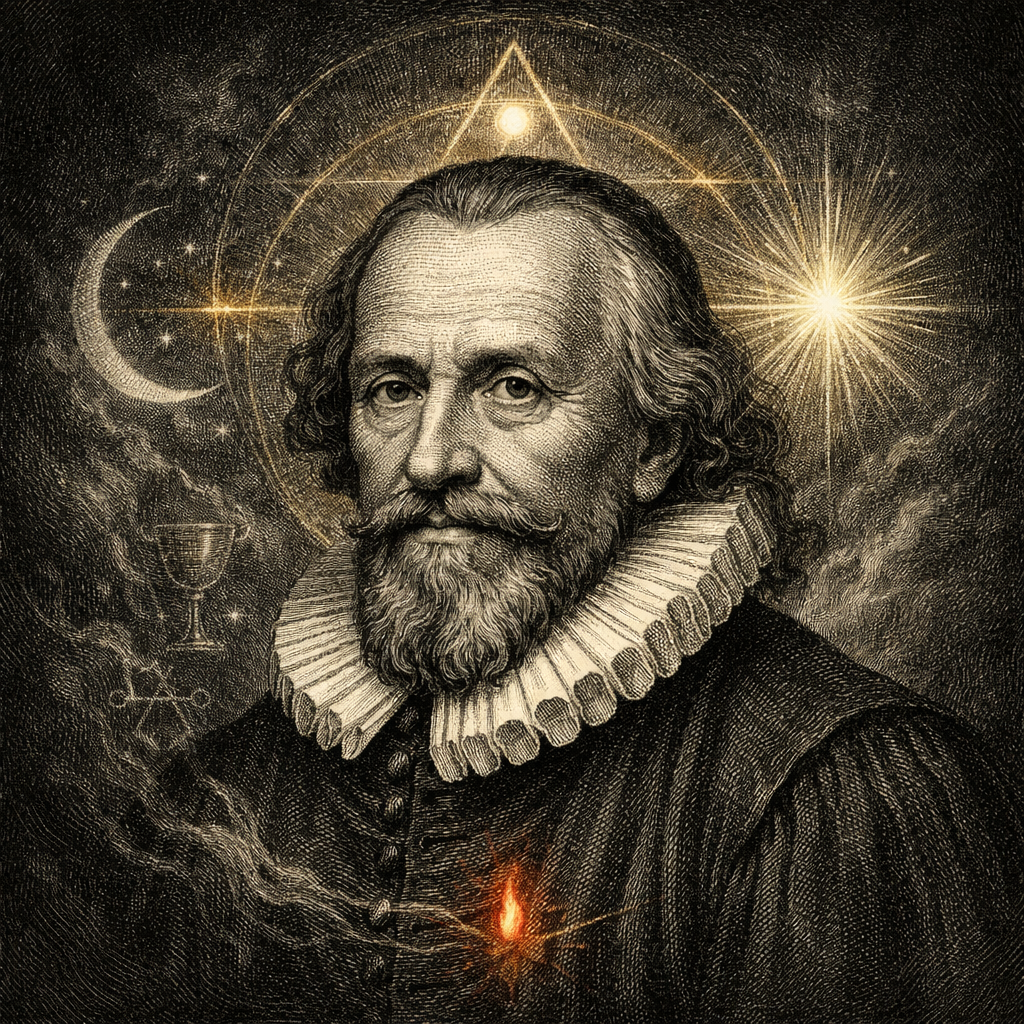
Date range: 1555–1621
Brief Biography
Johann Arndt was a German Lutheran pastor, devotional writer, and one of the most important figures in the development of early modern Protestant spirituality. Writing in the late sixteenth and early seventeenth centuries, he sought to renew Lutheran Christianity by emphasising inward regeneration, repentance, the imitation of Christ, and the transformation of the whole person through divine grace. His major work, True Christianity, became a classic of Lutheran devotion and exerted deep influence on Pietism, Christian theosophy, and later esoteric currents that treated inner rebirth as the foundation of spiritual knowledge. Arndt was not an occultist in the narrow sense, yet his intensely interior Christianity helped prepare the devotional and symbolic atmosphere in which Rosicrucian, theosophical, and illuminist traditions could imagine wisdom as a work of spiritual regeneration rather than doctrinal possession.
Works and Texts
- True Christianity
- Pia Desideria
Place in the Western Esoteric Tradition
Arndt’s place in the Western Esoteric Tradition rests on the spiritual vocabulary he gave to inward Christianity: rebirth, illumination, repentance, divine indwelling, and the restoration of the image of God within the soul. Although his writings belong first to Lutheran devotional theology, their influence reached beyond conventional confessional boundaries into Rosicrucianism and later Christian theosophy. His emphasis on lived transformation helped shape a Protestant esoteric sensibility in which wisdom was not simply hidden in ancient texts or ritual structures, but awakened through moral purification and interior renewal. Later figures associated with theosophy, Rosicrucian symbolism, and spiritual reform found in Arndt a language for regeneration that could be joined to more speculative accounts of nature, cosmos, and divine manifestation.
Arndt’s Mystical System
Johann Arndt’s mystical system is a theology of inward Christianity. Its centre is the transformation of the human person through repentance, rebirth, and conformity to Christ. Unlike the more elaborate cosmological systems of Boehme or the ritual structures of later Masonic and illuminist traditions, Arndt’s spirituality is grounded in devotional discipline and moral regeneration. Yet this very inwardness gave his work unusual power in the history of Christian esotericism. He made the restored soul, rather than the speculative intellect or the ritual chamber, the primary site of divine knowledge.
The foundation of Arndt’s thought is the conviction that Christianity must be lived inwardly. External confession, doctrinal correctness, ecclesiastical membership, and public religious conformity are insufficient unless the soul is renewed. Arndt wrote in a Lutheran world deeply concerned with orthodoxy, controversy, and confessional boundary-making. His response was not to abandon doctrine, but to insist that true doctrine must become life. The Christian faith is not fulfilled in argument, ceremony, or institutional identity. It must take root in the heart and produce a new creature.
This gives Arndt’s work its distinctive intensity. He repeatedly returns to repentance as the gateway to transformation. Repentance is not merely regret for wrongdoing; it is a fundamental turning of the soul away from self-will and toward God. The fallen human being is marked by pride, attachment, vanity, and spiritual blindness. The old Adam must die if the new life in Christ is to be born. This language of death and rebirth became one of the major channels through which Arndt influenced later theosophical and esoteric currents. Spiritual knowledge begins with inward crisis and purification.
The imitation of Christ is central to this process. Arndt does not treat Christ only as an external saviour whose merits are legally imputed to the believer. Christ must also be formed within the soul. The Christian life is therefore a process of inner conformity: humility, patience, love, obedience, and self-surrender become the signs of regeneration. This emphasis gave Arndt’s Lutheran mysticism a practical character. It is not visionary spectacle, nor a search for hidden powers. It is the disciplined formation of a life capable of receiving and reflecting divine grace.
Arndt’s understanding of the image of God is especially important. Humanity was created to bear the divine image, but sin has obscured and distorted it. Redemption restores that image. The soul becomes a mirror in which divine light may be reflected. This motif connects Arndt to older mystical and devotional traditions while also anticipating later Christian theosophical concerns. In the restored human being, divine wisdom is not merely believed; it is manifested. The regenerated person becomes a living testimony to the order and goodness of God.
Nature also has a place in Arndt’s spirituality, though it is less speculative than in Boehme. Creation can disclose divine wisdom when viewed through a purified heart. The natural world bears witness to God’s providence, beauty, and order. Yet Arndt’s primary emphasis is not on occult correspondences or hidden signatures. Nature becomes spiritually intelligible when the soul itself is rightly ordered. The outer world teaches most clearly when the inward eye has been cleansed. This gives his theology a restrained but real affinity with later esoteric readings of nature as a divine book.
The mystical element in Arndt is therefore ethical and participatory. The soul does not approach God by speculation alone. It participates in divine life through love, humility, prayer, and self-denial. Arndt’s Christianity is deeply affective, but not sentimental. It requires discipline and amendment of life. He distrusts religious knowledge that does not transform conduct. This suspicion of merely external or verbal religion became a major feature of Pietism and influenced wider currents of Protestant spirituality. The regenerated heart, rather than the disputing theologian, becomes the true witness to divine truth.
Arndt’s influence on Rosicrucianism and Christian theosophy is best understood through this ideal of inner reformation. The early seventeenth century was filled with calls for religious, intellectual, and social renewal. Rosicrucian manifestos spoke of reform and hidden wisdom; theosophical writers explored the relation between God, nature, and the soul; Pietist currents sought a more heartfelt Christianity. Arndt’s work contributed to the devotional soil from which these aspirations grew. He supplied a model of reform that began with inward regeneration and extended outward into knowledge, conduct, and community.
His relationship to Johann Valentin Andreae and the broader Rosicrucian atmosphere is especially suggestive. Andreae’s world was one of learned piety, reforming ambition, symbolic imagination, and Christian moral seriousness. Arndt’s True Christianity belonged to the same longing for a faith renewed from within. Even where direct dependence is difficult to specify, the spiritual kinship is clear. The hidden wisdom sought by later esoteric writers could not be separated from the purification of the seeker. The reform of knowledge required the reform of the person.
Arndt’s significance for later figures such as Boehme, Swedenborg, Saint-Martin, Pasqually, Maier, and Fludd lies in the way his devotional theology could be expanded into more speculative structures. Boehme would give inward regeneration a vast metaphysical drama of divine manifestation, fire, light, and Sophia. Saint-Martin and related illuminist currents would speak of inward repair and the return of the soul to its divine principle. Rosicrucian and theosophical writers would explore the hidden wisdom of nature and scripture. Arndt did not build all these systems, and would likely have regarded some of their more adventurous developments with pastoral alarm. Human beings, naturally, took a call to humility and eventually surrounded it with diagrams, degrees, and cosmic machinery.
Yet Arndt’s contribution remains essential because he insisted that the deepest mystery is enacted in the regenerated life. The soul must become what it seeks to know. This is the point at which devotional Christianity enters the esoteric field without ceasing to be devotional. Divine wisdom is not merely a secret doctrine entrusted to the few; it is the life of God restored within the human being. The path is not hidden because it is theatrically obscure, but because pride, distraction, and self-will prevent the soul from seeing what is nearest.
Arndt’s mystical system may therefore be described as inward regenerative Christianity. Its primary elements are repentance, rebirth, imitation of Christ, restoration of the divine image, and the transformation of knowledge into life. It lacks the grand symbolic architecture of later occult systems, but it provides something more foundational: the disciplined interiority without which such systems easily collapse into vanity. In the history of the Western Esoteric Tradition, Arndt stands as a reminder that hidden wisdom, if it is to be more than ornament, must first become the reformation of the heart.
Antecedent Figures
- —
Antecedent Traditions
- —
Succeeding Figures
- Emanuel Swedenborg; Jacob Boehme; Johann Valentin Andreae; Louis-Claude de Saint-Martin; Martinez de Pasqually; Michael Maier; Robert Fludd
Succeeding Traditions
- Rosicrucianism; Illuminism & Christian Theosophy