Jean-Baptiste Alliette (Etteilla)
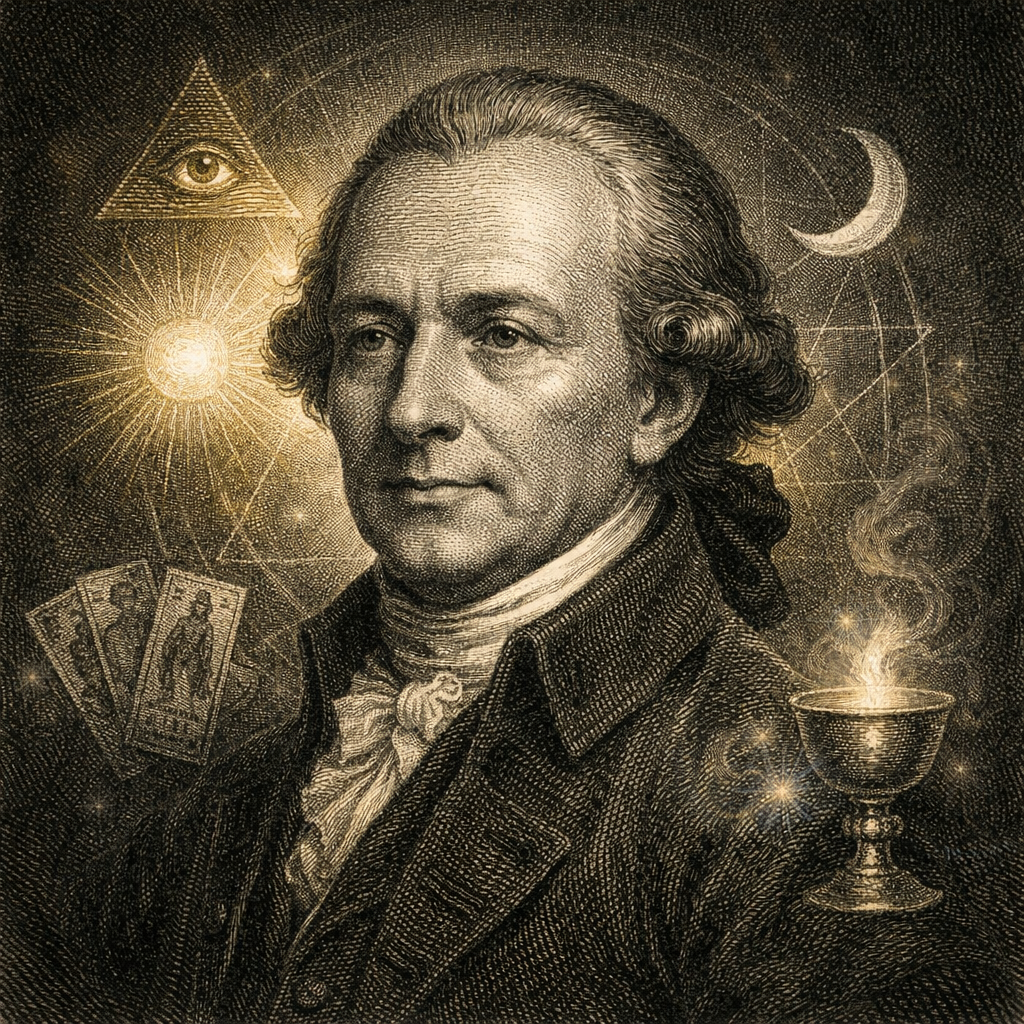
Date range: 1738–1791
Brief Biography
Jean-Baptiste Alliette, better known by the pseudonym Etteilla, was a French occultist, cartomancer, publisher, and one of the most important figures in the early history of esoteric tarot. Active in late eighteenth-century Paris, he transformed playing-card divination and tarot interpretation into a structured occult practice with specialised meanings, methods, and instructional texts. His work appeared in the atmosphere created by Enlightenment antiquarianism, Egyptianising speculation, fortune-telling, Freemasonry, and the broader fascination with hidden wisdom that surrounded pre-Revolutionary France. Although later occultists often criticised or revised his system, Etteilla was the first major writer to produce a complete tarot divination method and to present the tarot as an ancient book of wisdom available through disciplined interpretive practice. He died in 1791, shortly after the Revolution had begun to reshape the world in which his occult enterprise had emerged.
Works and Texts
- Le Monde Primitif
- Manière de se récréer avec le jeu de cartes nommées Tarots
Place in the Western Esoteric Tradition
Etteilla occupies a distinctive place in the Western Esoteric Tradition as the practical founder of occult tarot divination. Earlier antiquarian speculation had linked tarot to ancient wisdom, but Etteilla gave the cards a working esoteric system, complete with meanings, spreads, reversals, cosmological associations, and a professional divinatory method. His importance lies in the shift from tarot as a game and speculative curiosity to tarot as a disciplined instrument of occult knowledge. Through his work, cartomancy entered the developing field of modern ritual magic and occult revival thought, later influencing figures such as Éliphas Lévi and Papus, even when they rejected aspects of his method or recast tarot through Kabbalistic, magical, and initiatory frameworks.
Etteilla’s Mystical System
Etteilla’s mystical system is centred on the transformation of the tarot into a book of divinatory wisdom. His work marks a decisive moment in the history of Western esotericism because it turns a set of playing cards into a structured instrument for reading fate, character, hidden causes, and spiritual order. Later occultists would develop more elaborate philosophical systems around tarot, especially by linking it to Kabbalah, ceremonial magic, astrology, and initiation. Etteilla’s achievement was more practical and foundational: he made tarot divination into a method.
The background to Etteilla’s system is the eighteenth-century fascination with origins. European intellectual and esoteric culture was preoccupied with ancient Egypt, primordial language, sacred symbols, lost wisdom, and the possibility that modern traditions preserved fragments of a much older revelation. Antoine Court de Gébelin’s Le Monde Primitif helped popularise the claim that tarot cards contained remnants of ancient Egyptian wisdom. Etteilla took such claims in a more operational direction. For him, tarot was not simply an antiquarian curiosity or symbolic monument. It was a usable oracle.
At the heart of Etteilla’s method is the conviction that the cards possess fixed meanings capable of being interpreted through disciplined arrangement. This is a major step in the history of divination. Earlier forms of card reading existed, but Etteilla systematised the practice. He assigned meanings to individual cards, explained how cards modified one another, and gave methods by which a reader could draw structured conclusions. The card spread became a kind of symbolic field. Meaning did not arise from a single sign in isolation, but from placement, relation, sequence, and orientation.
The use of reversed meanings was especially important. By treating upright and reversed cards as distinct interpretive conditions, Etteilla increased the semantic range of the deck and made the reading more dynamic. The card became a double sign, capable of expressing fulfilment or obstruction, harmony or disorder, promise or danger. This dual movement suited the divinatory imagination. Human life rarely presents itself as simple assertion. It unfolds through tendency, resistance, delay, concealment, and reversal. Etteilla’s system gave the reader a grammar for those ambiguities.
His tarot also reflects a moral and cosmological view of life. The cards are not merely tokens for prediction in the narrow sense. They describe states of fortune, temperament, social relation, spiritual condition, and worldly circumstance. The diviner reads the visible arrangement of cards as a sign of invisible patterns. In this respect, Etteilla belongs to the wider esoteric assumption that reality is legible through correspondences. The surface event has a hidden structure; the random draw is not meaningless chance; the symbolic image can disclose relations not immediately available to ordinary perception.
Etteilla’s understanding of tarot was also shaped by the claim that the deck preserved ancient wisdom, especially Egyptian wisdom. This historical claim does not withstand modern scrutiny in the form he presented it, but its symbolic function was powerful. By attaching tarot to imagined antiquity, he elevated card reading above common fortune-telling and placed it within a lineage of sacred knowledge. The cards became fragments of a primordial book, damaged perhaps by time, but still readable by those instructed in their true meanings. This move gave tarot an authority it had not previously possessed in the same form.
The idea of tarot as a book is central. Unlike an ordinary book, however, tarot does not speak in fixed sequence. It is shuffled, drawn, arranged, and interpreted anew each time. Its wisdom is combinatory. Meaning emerges from the meeting of symbolic order and contingent circumstance. This makes tarot an unusually flexible esoteric instrument. It can speak to personal destiny, practical affairs, moral questions, relationships, dangers, opportunities, and hidden influences. Etteilla’s system helped define this flexibility as a strength rather than a weakness.
His work also professionalised the role of the tarot reader. Etteilla did not present the reader as a passive observer of superstition, but as a trained interpreter. Divination required knowledge of meanings, method, judgement, and experience. This is an important feature of his legacy. By producing instructional material and promoting a codified system, he helped create a new occult profession: the modern tarot practitioner. Naturally, humanity responded by turning symbolic discipline into both a spiritual art and a business model, because apparently no revelation is safe from commerce.
Etteilla’s relationship to later occult tarot is complicated. Éliphas Lévi and subsequent occultists often preferred more philosophical, Kabbalistic, and magical readings of the tarot, sometimes treating Etteilla’s system as insufficiently elevated or too bound to fortune-telling. Yet those later systems depended upon the terrain he had opened. Once tarot had been established as an occult instrument, it could be reinterpreted through grander metaphysical schemes. Lévi could connect tarot with the Hebrew alphabet, magic, and the structure of initiation; Papus could elaborate tarot as a key to occult science; later esoteric orders could incorporate it into ritual and contemplative practice. Etteilla made the instrument available.
The mystical dimension of Etteilla’s system lies in its claim that symbolic images can mediate hidden knowledge. It is not mystical in the mode of ecstatic union or metaphysical ascent. It is divinatory, interpretive, and procedural. The seeker approaches the unknown through a structured encounter with symbols. The shuffled deck becomes a mirror of unseen order. The reader’s task is to translate image, position, and relation into intelligible counsel. This is a modest form of esoteric practice compared with grand systems of theurgy or alchemical regeneration, but it proved enormously durable.
Etteilla also helped shift esotericism toward a more accessible public form. Tarot could be learned, purchased, practised, and performed outside clerical, academic, or closed initiatory institutions. This accessibility contributed to its popularity and to the suspicion with which more hierarchical occultists sometimes viewed it. Yet the very portability of tarot made it one of the most successful symbolic systems in modern esotericism. It could move across salons, print culture, occult schools, private consultations, and later popular spirituality with remarkable ease.
Etteilla’s mystical system may therefore be described as practical symbolic divination grounded in the myth of ancient wisdom. Its main elements are fixed card meanings, reversed meanings, structured spreads, Egyptianising antiquity, and the conviction that symbolic combinations reveal hidden patterns in human life. Its claims about history are often fragile; its influence is not. By giving tarot a method, Etteilla made it possible for later occultists to give tarot a metaphysics. The modern esoteric tarot begins with him, even when it later pretends, with the usual occult family embarrassment, that a more respectable ancestor must surely be hiding somewhere in Egypt.
Antecedent Figures
- —
Antecedent Traditions
- —
Succeeding Figures
- Papus (Gérard Encausse); Éliphas Lévi
Succeeding Traditions
- Occult Revival & Ritual Magic