James Anderson
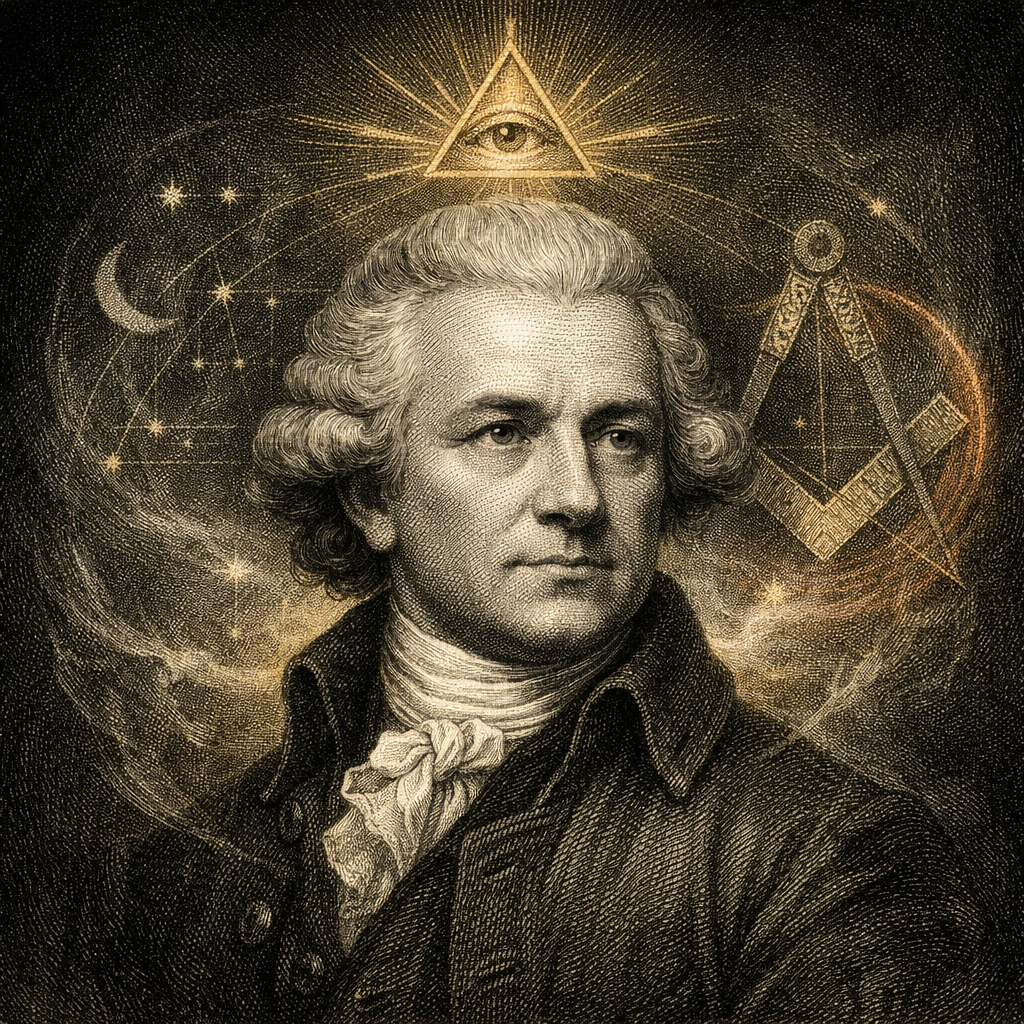
Date range: c. 1679/1680–1739
Brief Biography
James Anderson was a Scottish Presbyterian minister, writer, genealogist, and Masonic author best known for compiling The Constitutions of the Free-Masons, first published in London in 1723. Working in the early decades of organised speculative Freemasonry, he helped give the new Grand Lodge movement a printed history, regulatory framework, and public identity. His account blended biblical chronology, legendary craft history, operative guild memory, Enlightenment sociability, and the moral language of fraternity into a foundational document for modern Freemasonry. Although Anderson was not a systematic esoteric philosopher in the manner of a Boehme or a Lévi, his work became crucial to the later symbolic and institutional self-understanding of Freemasonry, especially as Masonic traditions expanded into high-degree systems, chivalric mythologies, and occult interpretations during the eighteenth and nineteenth centuries.
Works and Texts
- The Constitutions of the Free-Masons
- Illustrations of Masonry
- Theatrum Chemicum Britannicum
Place in the Western Esoteric Tradition
Anderson’s role in the Western Esoteric Tradition lies less in the invention of doctrine than in the codification of a symbolic institution through which esoteric, moral, architectural, and initiatory themes could later be transmitted. His Constitutions helped define speculative Freemasonry as an ordered fraternity rooted in ancient wisdom, moral discipline, architectural symbolism, and legendary continuity. The traditions supplied as antecedents — Rosicrucianism, operative Masonic guilds, and Renaissance Christian Kabbalah and Hermetic magic — form the broad imaginative world within which later readers placed Masonic origins and symbolism. Through the institutional stability and mythic history Anderson helped articulate, Freemasonry became a major vessel for high-degree Masonry, Christian theosophy, Illuminist speculation, and occult revival currents, even when those later developments moved well beyond Anderson’s own sober Presbyterian and regulatory concerns.
Anderson’s Mystical System
James Anderson’s mystical system must be understood in a broad and institutional sense. He was not a visionary metaphysician, ecstatic mystic, or occult magician. His importance lies in the way he helped furnish speculative Freemasonry with a usable sacred history, a moral grammar, and a symbolic identity capable of supporting later initiatory interpretation. Anderson’s work transformed Masonic memory into a structured narrative: ancient architecture, biblical patriarchs, sacred building, craft discipline, lawful society, and moral brotherhood were drawn together into a framework through which Freemasonry could imagine itself as heir to an immemorial wisdom.
The centre of Anderson’s system is the idea of Masonry as moralised architecture. Building is never simply technical. The craft of construction becomes a symbolic language for the formation of the human person and the ordering of society. The mason is a worker in stone, but also a worker upon the self. The lodge is a social assembly, but also an ordered moral space. The rules of architecture become analogies for proportion, harmony, discipline, and truth. This movement from operative craft to speculative meaning is the essential transition that Anderson’s Constitutions helped to stabilise in print.
Anderson’s legendary history begins with a sweeping account of the craft across sacred and ancient time. Biblical figures, patriarchs, kings, architects, and builders are arranged into a genealogy of Masonic wisdom. This history is not modern critical historiography, and it was never likely to survive the tedious attentions of archival scholarship unbruised. Its function is symbolic and legitimising. It places Freemasonry within a providential account of human civilisation, presenting the craft as a bearer of order, geometry, piety, and useful knowledge from the earliest ages. Through this narrative, Masonry becomes more than a London fraternity of the early eighteenth century. It becomes the visible continuation of a venerable moral and architectural science.
Geometry occupies a particularly important place in this vision. In Masonic tradition, geometry is both a practical discipline and a sign of divine order. It governs proportion, measurement, building, and design, but it also points toward the intelligibility of creation. Anderson’s Masonic world is one in which lawful order matters: in nature, in architecture, in society, and in the conduct of the brethren. Geometry thus becomes a symbolic guarantee that the universe is not chaotic and that human beings may participate in order through disciplined labour and moral rectitude. This is not occult speculation in a flamboyant sense, but it gives later esoteric Masonry a powerful conceptual foundation.
The Constitutions also articulate a theology of moral universality. Anderson’s famous religious formulation sought to move beyond sectarian division by requiring Masons to adhere to that religion in which all men agree, while leaving particular opinions to themselves. This was not modern secularism, and it should not be mistaken for indifference to religion. It was an attempt to establish a shared moral and theistic foundation suitable for men of differing confessions in a fractured post-Reformation world. The lodge could then function as a disciplined space of concord, where religious difference was restrained in favour of ethical fraternity. Such a principle later allowed Freemasonry to become unusually adaptable across national, confessional, and philosophical contexts.
In Anderson’s system, fraternity is not mere sociability. It is an ordered moral relation. The brethren are bound by obligations, charges, offices, rituals, and mutual duties. The lodge is therefore a miniature commonwealth governed by law, memory, rank, and ceremony. This institutional structure gave Masonic symbolism durability. Esoteric ideas require vessels if they are to survive more than one generation of enthusiasts, and Freemasonry’s genius lay partly in its ability to preserve symbolic forms through regular meeting, initiation, ritual repetition, and governance. Anderson’s work belongs to this practical architecture of continuity.
The myth of ancient continuity is central to the later esoteric power of Freemasonry. Anderson’s history connected the craft to Adam, Noah, Moses, Solomon, classical antiquity, medieval rulers, and English legendary history. In strict historical terms, these claims are not evidence of institutional continuity from primordial times to eighteenth-century London. Their value lies in the symbolic horizon they created. By presenting Masonry as the custodian of ancient arts and moral sciences, Anderson helped make the fraternity available to later interpretations involving temple symbolism, Hermetic wisdom, Rosicrucian reform, chivalric restoration, and the recovery of lost knowledge.
This is why Anderson’s work proved so consequential for traditions that were more explicitly esoteric than his own. High-degree Masonry, Strict Observance systems, Martinist currents, Rosicrucian degrees, and occult revivalists could all find in Masonic myth a ready-made language of antiquity, secrecy, initiation, and restoration. The temple of Solomon, the lost word, the ancient charges, the craft lineage, and the brotherhood of builders could be expanded into elaborate systems of spiritual ascent and symbolic recovery. Anderson did not design all of this. Humanity’s talent for taking a tidy institutional framework and filling it with metaphysical furniture is apparently inexhaustible. Yet his codification helped make it possible.
Anderson’s moral system is also marked by moderation. The Mason is expected to be peaceful, loyal, discreet, law-abiding, and committed to brotherly conduct. This ethos matters because it distinguishes early speculative Freemasonry from more radical forms of esoteric enthusiasm. The lodge was not presented as a revolutionary cell or magical order, but as a disciplined fraternity aligned with civility and public order. Later esoteric developments sometimes strained against that restraint, yet they continued to depend on the credibility, structure, and symbolic inheritance of the institution Anderson helped articulate.
His use of history also reveals an important feature of early modern esoteric culture: the past was a source of authority, but also a symbolic medium. Ancientness conferred legitimacy. To claim descent from primordial builders, sacred architects, and wise legislators was to claim participation in a chain of wisdom older than modern controversy. Anderson’s narrative therefore performs an act of mythic ordering. It arranges scattered guild traditions, biblical themes, architectural lore, and national legends into a single ceremonial memory. In this sense, his work is less a mystical doctrine than a mythopoetic constitution.
The relationship between Anderson and Western esotericism must therefore be handled carefully. He should not be inflated into a hidden adept or an occult master in clerical disguise. His achievement is subtler and perhaps more important. He helped give speculative Freemasonry the printed form through which it could become an enduring symbolic institution. That institution then became one of the great theatres of modern esoteric interpretation. The later currents supplied in the succeeding tradition field — high-degree Masonry, Illuminism, Christian theosophy, and occult revival magic — drew upon Masonic forms because those forms were stable, prestigious, and adaptable.
Anderson’s mystical system, broadly construed, is the symbolic constitution of moral architecture. It imagines human beings as builders under divine order, bound together in fraternity, instructed by geometry, and linked to a sacred history of wisdom transmitted through the craft. Its mysticism is restrained, institutional, and encoded in legend rather than visionary revelation. The stone, the rule, the charge, the lodge, and the ancient builder become signs of a larger moral cosmos. Later esoteric traditions would raise far more elaborate structures upon that foundation, but Anderson’s importance lies in the laying of the printed cornerstone.
Antecedent Figures
- Giordano Bruno; Giovanni Pico della Mirandola; Heinrich Cornelius Agrippa; Johann Valentin Andreae; Johannes Reuchlin; King Athelstan (Legendary); Marsilio Ficino; Michael Maier; Robert Fludd
Antecedent Traditions
- Rosicrucianism; Operative Masonic Guilds; Renaissance Christian Kabbalah & Hermetic Magic
Succeeding Figures
- Andrew Michael Ramsay; Emanuel Swedenborg; Jacob Boehme; Jean-Baptiste Willermoz; Louis-Claude de Saint-Martin; Martinez de Pasqually; Papus (Gérard Encausse); Éliphas Lévi
Succeeding Traditions
- High-Degree Masonry; Illuminism & Christian Theosophy; Occult Revival & Ritual Magic