Jacob Boehme
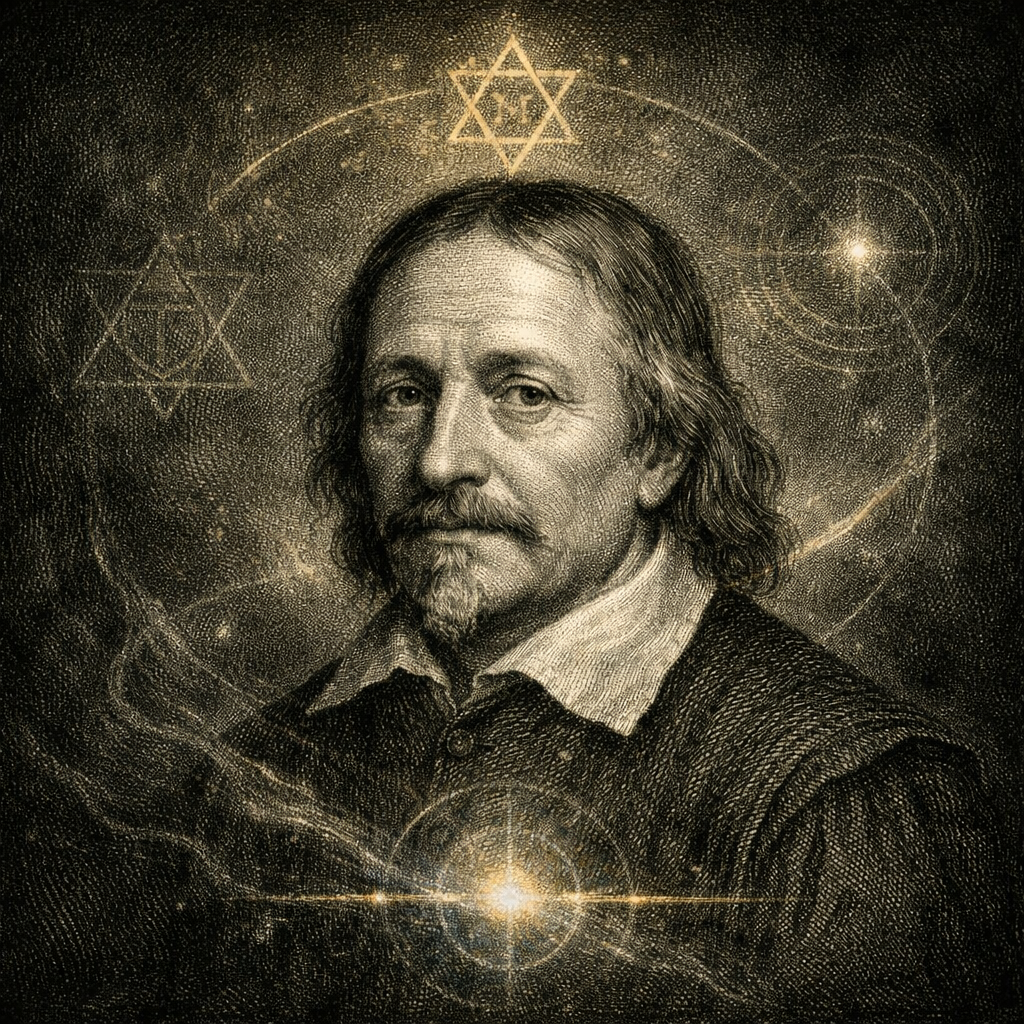
Date range: 1575–1624
Brief Biography
Jacob Boehme was a German Lutheran mystic, visionary theologian, and theosophical writer whose works became among the most influential sources for later Christian esotericism. Born near Görlitz in Silesia and trained as a shoemaker rather than as a university theologian, he developed an intensely symbolic account of God, nature, evil, creation, and spiritual regeneration after a series of visionary experiences. His first major work, Aurora, brought him into conflict with Lutheran authorities, yet his writings circulated widely and became central to the development of German theosophy, Pietism, Romantic Naturphilosophie, and later occult and esoteric movements. Boehme died in 1624, but his highly charged language of divine depths, contraries, birth, fire, light, and inward transformation continued to shape speculative religion for centuries.
Works and Texts
- Aurora
- Heaven and Hell
- Treatise on the Reintegration of Beings
- Tableau Naturel
Place in the Western Esoteric Tradition
Boehme’s place in the Western Esoteric Tradition lies in his transformation of Lutheran piety into a profound symbolic metaphysics of divine manifestation and spiritual rebirth. His writings drew upon currents of Lutheran mysticism and devotional inwardness while entering the broader field of Rosicrucian, Masonic, and high-degree speculative traditions through later readers who found in him a language for regeneration, fall, reintegration, and hidden divine wisdom. His work gave subsequent esoteric thought a powerful model of nature as the self-expression of divine life, and of the human soul as a site where cosmic and theological conflict is inwardly enacted. Through later Romantic, occult revival, and Theosophical receptions, Boehme became a major authority for traditions seeking to interpret creation as a dynamic drama of darkness, fire, light, desire, and redemption.
Boehme’s Mystical System
Jacob Boehme’s mystical system is a visionary theosophy of divine self-manifestation. Its central concern is the emergence of creation, consciousness, evil, and redemption from the hidden depths of God. Boehme does not treat theology as an abstract exercise in doctrinal classification. He writes as a seer attempting to describe the living process by which the divine mystery becomes manifest in nature, spirit, and the regenerated soul. His language is dense, symbolic, and often turbulent, because the reality he describes is itself a drama of tensions: darkness and light, wrath and love, fire and illumination, contraction and expansion, hunger and fulfilment.
At the foundation of Boehme’s system stands the Ungrund, the unground or abyssal nothingness of the divine before manifestation. This does not mean simple emptiness. It signifies the unfathomable depth of God beyond form, quality, distinction, and created being. God in this hidden depth is beyond ordinary predication; yet Boehme’s central insight is that divine reality comes into manifestation through an inner process. God is not a static object of thought, but living, self-revealing mystery. Creation is therefore not an external manufacture, as though the world were merely placed beside God. It is the outward expression of a dynamic divine life.
This process unfolds through contraries. Boehme’s universe is not built upon a simple opposition between good spirit and evil matter. Instead, manifestation requires tension. Darkness provides the condition in which light may be revealed; contraction gives rise to expansion; fire becomes the ground of illumination. The divine wrath, a term Boehme uses with startling force, is not evil in itself but the severe, astringent, fiery principle through which life becomes active and distinct. Love is disclosed through the overcoming and transfiguration of this severity. His thought therefore turns upon a paradox of generation: harmony arises through conflict, and spiritual light is born through the transformation of fire.
Nature occupies a central role in this vision. Boehme’s nature is not dead mechanism. It is a living signature of divine process, a symbolic field in which the spiritual structure of reality becomes visible. Metals, elements, stars, plants, bodily processes, and inward states can all disclose aspects of the same divine drama. This places Boehme within the broad current of early modern esotericism, where nature was read as a book of signs. Yet his reading of nature is distinctively theosophical. Natural forms do not merely correspond to higher realities; they express the very tensions through which divine life becomes manifest.
The human being is the microcosmic theatre of this entire process. In the soul, the conflict of darkness and light is no mere metaphor. The fall of humanity, for Boehme, is an inward disordering of desire, a turning away from divine harmony into selfhood, possessiveness, and fragmentation. The fallen soul becomes trapped in the harshness of its own will. It seeks to possess life for itself and thereby loses its proper participation in divine love. Redemption is therefore not simply juridical pardon. It is regeneration: the rebirth of the divine life within the soul.
This gives Boehme’s Christianity its strong inward character. Christ is not only the historical redeemer, but the divine life that must be born within the human being. The true Christian life is a process of dying to self-will and being reborn in divine love. The soul must pass through its own fire. It must encounter the severity of wrath, the bitterness of selfhood, and the anguish of division, before the light of love can become active within it. Boehme’s mysticism is therefore neither sentimental nor tranquil. It is a demanding account of transformation through inward crisis.
The doctrine of Sophia is also significant in Boehme’s system. Divine Wisdom appears as a feminine principle of beauty, harmony, and spiritual illumination. Sophia is the mirror of divine splendour and the lost companion of the soul. The fall involves the soul’s estrangement from this wisdom; regeneration restores the soul’s relation to her. Later esoteric and theosophical traditions found this theme especially fertile, because it gave symbolic form to the recovery of spiritual wholeness. Sophia is not merely an allegorical ornament. She represents the luminous order of divine wisdom toward which the soul must be reoriented.
Boehme’s account of evil is one of his most important contributions. Evil is not an independent principle equal to God, nor is it simply a created substance. It arises from the disordering of will, from the turning of desire into self-enclosed possessiveness. The same fiery principle that can become life and illumination becomes torment when severed from love. This makes evil intelligible without making it ultimate. It is a distortion of divine energies, a misdirection of the will, a darkened use of powers that belong properly to the manifestation of life. Later readers would find in this a profound resource for esoteric psychology and spiritual anthropology.
His influence on later traditions came partly through the extraordinary symbolic density of his writings. Boehme gave esoteric Christianity a language capable of linking cosmology, psychology, soteriology, and nature. The fall of Lucifer, the fall of humanity, the anguish of the soul, the structure of the elements, and the hidden life of God could all be described through a common symbolic grammar. This made his work adaptable to many later currents: Pietist inwardness, Romantic philosophy of nature, speculative Masonry, Martinism, Theosophy, and occult revival magic. Each found in him a way to think of spiritual life as reintegration after division.
Boehme’s relation to Rosicrucian and Masonic currents is largely one of reception and resonance rather than simple institutional connection. Later esoteric readers saw in him a witness to hidden Christian wisdom and a profound interpreter of regeneration. His thought harmonised with Rosicrucian concerns about divine wisdom, nature, reform, and spiritual science. It also lent itself to high-degree Masonic and Martinist themes of fall, loss, restoration, and the reintegration of beings. Even where direct influence is hard to establish, his vocabulary of inward transformation helped shape the imaginative world in which such systems became meaningful.
The mystical system of Jacob Boehme is therefore a theology of dynamic regeneration. It begins in the hidden abyss of divine possibility, unfolds through the tensions of manifestation, reads nature as the living signature of God, and locates the drama of redemption within the human soul. Its great insight is that spiritual light is not merely opposed to darkness from outside, but is born through the transfiguration of the dark, fiery, desirous ground of life. For all the difficulty of his prose, Boehme remains one of the most powerful visionary thinkers in the Christian esoteric tradition. He gave later esotericism a language of depth, conflict, wisdom, and rebirth that could survive well beyond the confessional world that first tried, rather predictably, to silence him.
Antecedent Figures
- Andrew Michael Ramsay; Elias Ashmole; James Anderson; Jean-Baptiste Willermoz; Johann Arndt; Johann Valentin Andreae; Michael Maier; Philipp Jakob Spener; Robert Fludd; William Preston
Antecedent Traditions
- Rosicrucianism; Speculative Freemasonry; High-Degree Masonry; Lutheran Mysticism & Pietism
Succeeding Figures
- Annie Besant; Charles Webster Leadbeater; Helena Petrovna Blavatsky; Papus (Gérard Encausse); Éliphas Lévi
Succeeding Traditions
- Romanticism; Occult Revival & Ritual Magic; Theosophical Society