Islamic Astral Magic
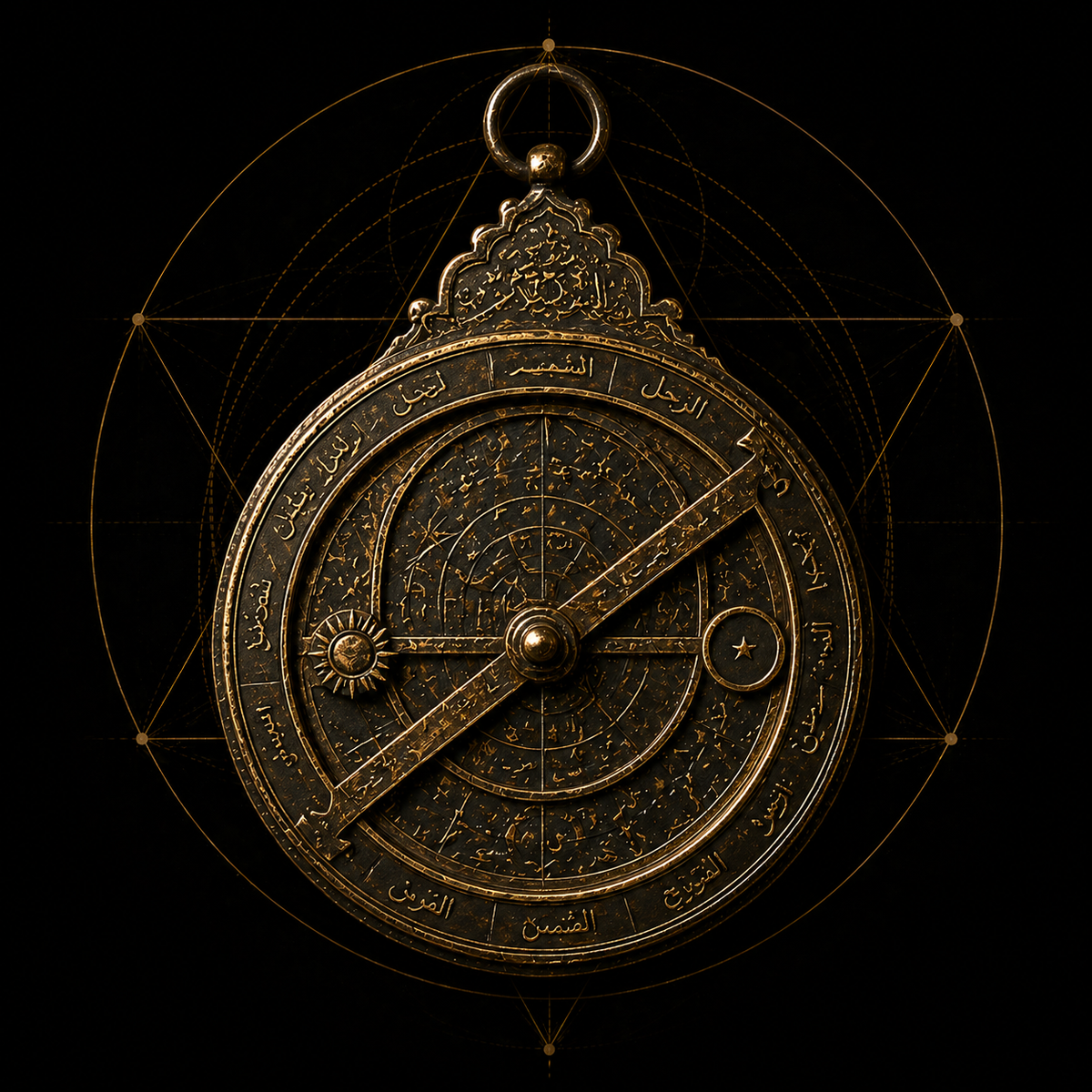
Islamic astral magic occupies a vital place in the transmission of ancient cosmology, astrology, and magical theory into the later Western Esoteric Tradition. It developed within the intellectual world of medieval Islam, especially during and after the great translation movements that brought Greek, Persian, Indian, and late antique materials into Arabic. This was not a simple act of preservation, as though Islamic civilisation functioned merely as a filing cabinet for Greek antiquity, which would be both historically lazy and professionally embarrassing. Rather, scholars, philosophers, astrologers, physicians, mathematicians, and occult practitioners translated, interpreted, criticised, expanded, and systematised inherited traditions. In doing so, they produced one of the major channels through which astral and talismanic magic entered medieval and Renaissance Europe.
The foundations of Islamic astral magic lie partly in Hellenistic philosophy and astrology. Late antique thinkers had already imagined the cosmos as an ordered hierarchy in which celestial bodies influenced the sublunary world. The planets and stars were not merely physical objects, but signs and agents within a living cosmos. Their movements corresponded to changes in earthly life, bodily temperament, political events, minerals, plants, animals, and human affairs. This worldview depended upon a universe bound together by analogy, sympathy, and graded causation. Islamic scholars inherited these assumptions through Greek astrological and philosophical texts, but they reworked them within their own intellectual and religious environments.
Late Antique Hermeticism and Gnosticism also contributed to this world of astral speculation. Hermetic writings offered a vision of the cosmos as animated by divine intelligence and structured through planetary powers. The ascent of the soul through the celestial spheres, the role of divine names, and the possibility of working with cosmic correspondences all entered the broader late antique inheritance received in Arabic translation and adaptation. In Islamic astral magic, this inheritance was often combined with technical astrology, mathematical astronomy, talismanic images, and theories of spiritual forces. The result was a learned magical cosmology in which celestial order could be read, timed, and ritually engaged.
The most famous source associated with this tradition is the Picatrix, known in Arabic as the Ghayat al-Hakim, or “The Aim of the Sage.” Composed in the Islamic world and later translated into Latin and Castilian, it became one of the most influential manuals of astral magic in medieval and Renaissance Europe. The Picatrix presents a complex system of talismanic practice, planetary correspondences, ritual timing, invocations, suffumigations, images, and philosophical justifications. It assumes that celestial forces can be attracted, concentrated, and directed through carefully constructed material forms under appropriate astrological conditions. This is not folk magic in a casual sense, but an elaborate ritual technology grounded in cosmology.
The talisman is central to Islamic astral magic. A talismanic image is not merely symbolic decoration. It is a crafted object designed to receive and focus celestial influence. Its material, image, inscription, timing, planetary association, and ritual preparation are all significant. The practitioner must know when a planet is properly placed, what substances correspond to it, what images or forms embody its powers, and how ritual action aligns earthly matter with heavenly force. This model would become deeply influential in Renaissance magic, especially in the works of Marsilio Ficino and later occult philosophers who sought to reconcile astral influence with Christian theology and natural philosophy.
A major issue in Islamic astral magic is the boundary between lawful knowledge of nature and illicit spiritual practice. Islamic intellectual culture was not uniformly accepting of magic. Legal, theological, and philosophical debates surrounded astrology, talismans, divination, and spirit invocation. Some thinkers rejected such practices as impious or deceptive; others defended aspects of astrology or talismanic practice as part of the study of natural causes created by God. This tension is important because it anticipates similar debates in Latin Christendom. The problem was not simply whether the heavens influenced the earth, since many accepted some form of celestial influence. The sharper question was whether human beings could legitimately manipulate these forces, and whether such operations involved natural causation, angelic mediation, jinn, demons, or forbidden acts.
Islamic astral magic also drew strength from the mathematical and astronomical sophistication of the medieval Islamic world. Precise planetary calculation, astronomical tables, and astrological timing were essential to many forms of talismanic practice. The celestial world was not approached only through mythic imagination, but through computation, observation, and technical discipline. This fusion of mathematics, cosmology, and ritual is one reason the tradition became so attractive to Renaissance intellectuals. It offered a form of magic that could present itself as learned, systematic, and grounded in the order of the heavens rather than in mere superstition. Humans do enjoy making elaborate tables before doing questionable things, but in this case the tables mattered.
The transmission of Islamic astral magic into Europe was historically decisive. Through translation centres in Spain, Sicily, and elsewhere, Arabic works on astrology, astronomy, natural philosophy, medicine, alchemy, and magic entered the Latin West. The Picatrix became especially important for later Renaissance magical theory. It influenced the development of talismanic magic, astral medicine, planetary correspondences, and the broader Renaissance belief that the learned practitioner could work within the hidden sympathies of the cosmos. Renaissance Christian Kabbalah and Hermetic magic did not simply revive classical antiquity directly; they received much of antiquity through Arabic mediation, enriched by centuries of Islamic interpretation and development.
The influence of Islamic astral magic on Renaissance grimoires is also significant. While grimoire traditions drew on many sources, including Solomonic legends, Christian liturgical forms, angelology, and folk ritual, the astral and talismanic dimensions of learned magic were strongly shaped by Arabic materials. Planetary timing, celestial images, suffumigations, seals, and the connection between cosmic powers and material operations all became part of the broader magical repertoire. The line between astral magic and ceremonial magic was never perfectly clean, because history apparently refuses to respect modern filing systems, but the contribution of Islamic astral traditions is unmistakable.
Its broader importance within the Western Esoteric Tradition lies in its role as a bridge between late antique cosmology and Renaissance occult philosophy. Islamic astral magic preserved and transformed Hellenistic astrology, Hermetic cosmology, and theories of celestial influence, then transmitted them into medieval and early modern Europe in a highly developed form. It taught later esoteric thinkers to imagine the cosmos as an interdependent hierarchy in which heavenly powers shape earthly life, and in which the trained practitioner may align matter, image, word, and time with celestial forces. This vision would become central to Renaissance magic and would continue to echo in later occult systems of correspondence.
Islamic astral magic should therefore be understood as one of the major intellectual and practical conduits of Western esotericism. Its significance is not merely that it preserved earlier material, but that it refined the technical, mathematical, and ritual dimensions of astral practice. It stands at the meeting point of philosophy, astrology, natural science, image magic, and ritual power. Through it, the heavens became not only objects of contemplation, but a structured field of influence capable of being read, timed, and ritually engaged by those who claimed the necessary knowledge.
Antecedent Traditions
· Hellenistic Philosophy
· Late Antique Hermeticism & Gnosticism
Succeeding Traditions
· Renaissance Christian Kabbalah & Hermetic Magic
· Renaissance Grimoires