Iamblichus
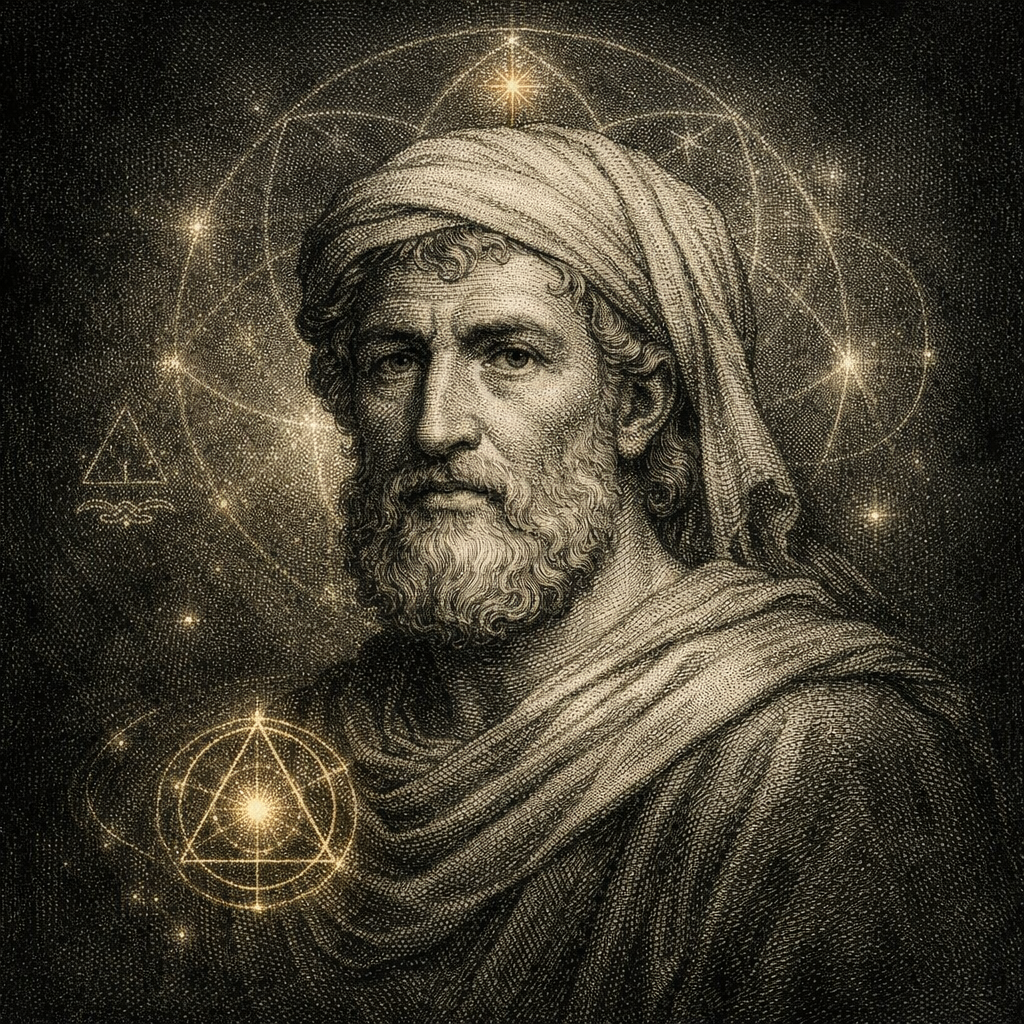
Date range: c. 245–c. 325 CE
Brief Biography
Iamblichus was a Syrian Neoplatonist philosopher and religious thinker of late antiquity whose work profoundly reshaped Platonism by giving ritual, divine mediation, and sacred symbolism a central place in the ascent of the soul. Born in Chalcis in Coele-Syria and educated within the Platonic tradition descending from Plotinus and Porphyry, he became one of the great systematisers of pagan theology in the eastern Roman world. His writings sought to defend traditional cult, explain the structure of the divine hierarchy, and show how the soul might be elevated beyond merely discursive thought through theurgy, prayer, and ritual participation. Although many of his works survive only in fragments or through later testimony, his influence on later esoteric and philosophical traditions was immense, and he remained a commanding authority for those who believed that divine realities are approached not only by contemplation, but by sanctified action.
Works and Texts
- The Enneads
- De Mysteriis Aegyptiorum
- The Elements of Theology
Place in the Western Esoteric Tradition
Iamblichus occupies a crucial place in the Western Esoteric Tradition as one of the principal architects of a sacralised Platonism in which philosophy, ritual, cosmology, and divine mediation form a unified path of ascent. He stands in late antiquity at a point where philosophical theology and religious practice were drawn tightly together, and his defence of theurgy helped shape later understandings of ritual efficacy, symbolic correspondence, and hierarchies of spiritual beings. His influence extended into late antique Hermetic and related currents, and much later into traditions concerned with astral influence, sacred intermediaries, and the ascent of the soul through ordered levels of reality. In this sense, Iamblichus helped establish one of the enduring assumptions of esoteric thought: that the visible and invisible worlds are joined through a structured and participatory sacred order.
Iamblichus’ Mystical System
Iamblichus’ mystical system is founded upon a decisive claim: the human soul cannot return to the divine by intellectual contemplation alone. Thought is necessary, philosophy is noble, and metaphysical understanding has a real place in the spiritual life, but the soul’s restoration requires more than reasoning about first principles. It requires participation in the divine order through rites, symbols, invocations, and sacred operations that Iamblichus gathered under the name of theurgy. This conviction distinguishes him from earlier Neoplatonists, especially Porphyry, and gives his philosophy its distinctive religious and esoteric power.
At the centre of his system lies a strongly hierarchical universe. Reality proceeds from the ineffable One, the supreme principle beyond being and thought, from which there unfolds an immense order of divine and cosmic levels. These include intelligible gods, intellectual gods, celestial powers, daemons, heroes, souls, and the material world. This hierarchy is not decorative metaphysics. It explains how the transcendent can be present within the world without ceasing to transcend it. It also explains how the soul may ascend, for each level of reality mediates between what is above and what is below.
For Iamblichus, the human being is situated within this cosmic structure in a condition of fragmentation and descent. The soul has become entangled with generation, multiplicity, and embodied limitation. It retains a divine origin, but its present condition is marked by forgetfulness and dispersal. The task of spiritual life is therefore a work of reordering. The soul must be gathered back toward its source, not by rejecting the cosmos as evil, but by learning to inhabit the cosmos as a sacred hierarchy in which every level can become a vehicle of return.
This is the setting in which theurgy becomes intelligible. Theurgy is often translated as “divine work”, but in Iamblichus it means more than ritual technique. It is the set of sacred actions by which the soul is aligned with divine powers and elevated beyond the limitations of ordinary cognition. The crucial point is that the efficacy of theurgy does not arise because human beings manipulate the gods. That would reduce religion to coercive magic and the divine to a set of responsive mechanisms. Iamblichus insists instead that the gods act through their own symbols, signs, and presences. The sacred rites work because they participate in a divine economy already established by the gods themselves.
This gives ritual a profound ontological dignity. Material objects, statues, names, numbers, sacrifices, gestures, prayers, and invocations are not spiritually empty externals. They can serve as receptacles or vehicles of divine presence because the cosmos itself is ordered by likeness and participation. Matter is not outside the reach of the sacred. On the contrary, matter may be consecrated and become the medium through which higher realities descend. This is one of Iamblichus’ most important contributions to later esoteric thought. He provides a rigorous philosophical basis for the claim that symbols are efficacious because they belong to a living chain of correspondences linking the visible and invisible worlds.
His defence of Egyptian wisdom in De Mysteriis Aegyptiorum is especially revealing here. The text is framed as a response to Porphyry’s doubts about ritual religion and the invocation of divine powers. Iamblichus answers by arguing that the traditional rites of the Egyptians and other sacred peoples are not primitive superstitions to be discarded by superior philosophy. They are embodiments of a deeper wisdom, preserving modes of relation to the divine that discursive reasoning alone cannot produce. Sacred names and ritual forms are powerful not because they are arbitrary inventions, but because they are rooted in the divine structure of reality.
Knowledge therefore has more than one mode. Discursive philosophy may clarify metaphysical truths, but there is also a higher kind of knowing that occurs through participation, illumination, and union. The soul does not merely analyse the divine order; it becomes attuned to it. This is why prayer has such importance in Iamblichus’ system. Prayer is not merely petition. It is a mode of elevation, a means by which the soul is stretched toward the gods and prepared for divine presence. In true prayer, the soul is recollected, purified, and harmonised with the higher powers.
Purification itself is indispensable. The lower soul, attached to bodily passions and worldly multiplicity, must be disciplined if it is to rise. Yet Iamblichus does not suggest that embodiment is simply a prison to be despised. Because the world is structured by divine procession, even embodied life takes place within a meaningful sacred order. The problem lies not in creation as such, but in disorder and forgetfulness. The aim is not annihilation of the self, but restoration of right relation: soul to intellect, intellect to the gods, and all things to the transcendent source.
Another striking feature of Iamblichus’ mystical system is its respect for multiplicity within unity. The divine world is richly articulated. Gods are many, powers are various, and levels of mediation are numerous. Yet this plurality does not compromise metaphysical unity. It reveals the abundance of divine manifestation. Later esoteric traditions found this immensely fruitful, because it allowed for elaborate symbolic and ritual systems without abandoning a higher theology. Theurgy, astrology, sacred mathematics, ritual invocations, and hierarchies of intermediaries could all be understood as aspects of a cosmos ordered from above.
Iamblichus also helped to redefine what philosophy itself could be. In his hands, philosophy is not simply the love of abstract wisdom, nor an ethical discipline of self-mastery alone. It becomes a way of life integrated with sacred science and ritual practice. The philosopher is not merely a dialectician, but a participant in divine realities. This broadened understanding of wisdom was one reason later Hermetic, theurgical, and magical traditions found him so congenial. He offered intellectual seriousness without disenchantment, and metaphysical rigour without evacuating the world of sacred presence.
His influence reached far beyond the schools of late antiquity. Through later Platonism, Byzantine and Arabic receptions of ancient philosophy, Renaissance revivals of theurgy and Hermeticism, and the broader history of ceremonial and astral traditions, Iamblichus became one of the key sources for the idea that sacred symbols operate within a real cosmological hierarchy. Much of later esotericism depends, directly or indirectly, on the assumption that ritual can be transformative because reality itself is symbolically ordered. Iamblichus gave that assumption one of its strongest classical formulations.
Iamblichus’ mystical system may therefore be described as a theology of mediated ascent. The soul rises not by private inspiration or autonomous speculation, but by entering the divine order through purification, prayer, and theurgical participation. The cosmos is not an obstacle to God, but the articulated field of return. Through sacred symbols, divine names, and ritually activated correspondences, the human being is drawn beyond the merely human toward communion with the gods. It is an austere and exalted vision, but one with lasting consequences: it made ritual intellectually respectable within the Platonic tradition, and gave later esoteric thought one of its most durable accounts of how heaven may act through earth.
Antecedent Figures
- —
Antecedent Traditions
- —
Succeeding Figures
- Hermes Trismegistus
Succeeding Traditions
- Late Antique Hermeticism & Gnosticism; Islamic Astral Magic