Hermes Trismegistus
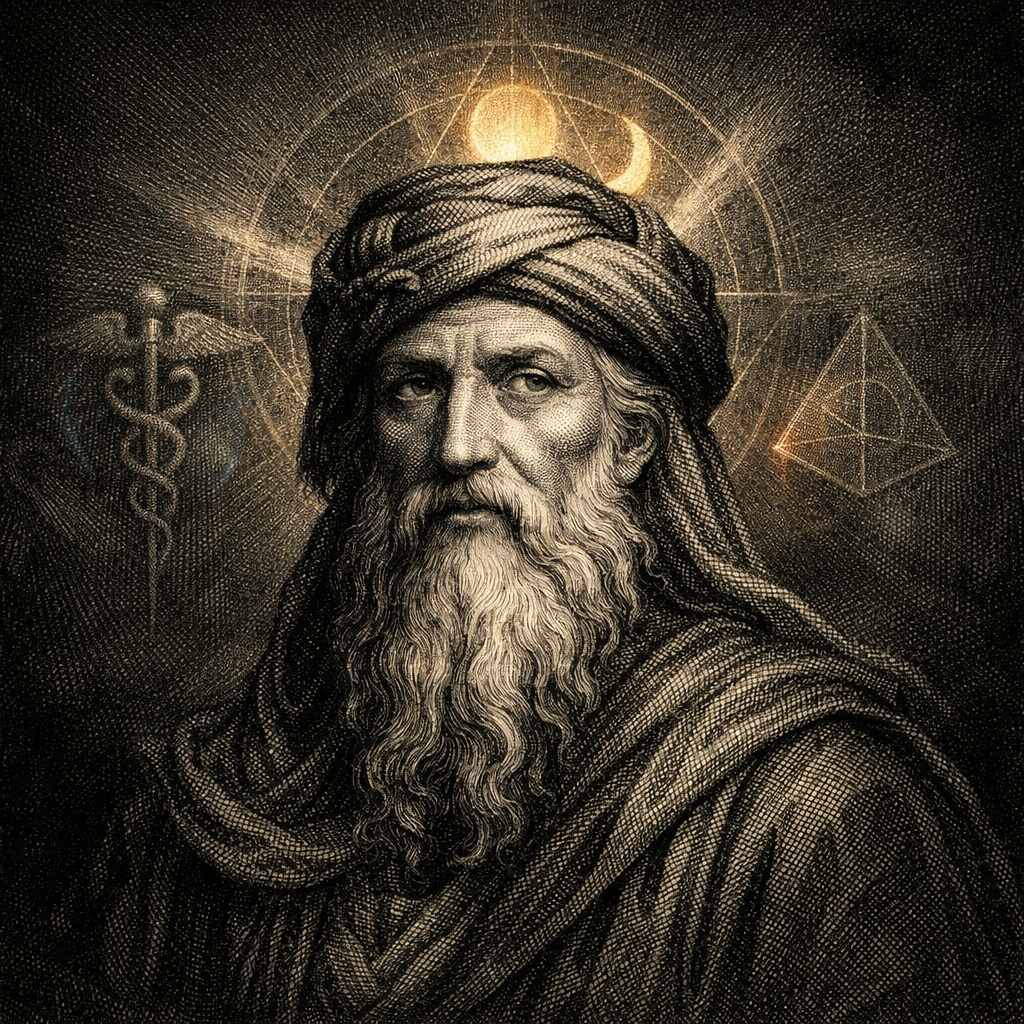
Date range: Legendary figure of Hellenistic Egypt; texts attributed c. 1st–3rd centuries CE
Brief Biography
Hermes Trismegistus is a legendary sage formed through the syncretic identification of the Greek god Hermes with the Egyptian god Thoth, and became one of the most influential authorities in the history of esoteric thought. Although presented in later tradition as an ancient priest, philosopher, and revealer of sacred wisdom, the writings attributed to him emerged in the Hellenistic and Roman worlds, especially in Egypt, where Greek philosophy, Egyptian religion, and broader currents of late antique spirituality met and mingled. The Hermetic writings present dialogues on God, cosmos, mind, soul, and spiritual rebirth, and they would later be received as repositories of primordial wisdom. Whether treated as divine revelation, philosophical theology, or sacred cosmology, Hermes became a foundational name in the Western Esoteric Tradition and one of its great imagined authorities.
Works and Texts
- Corpus Hermeticum
- Asclepius
- Nag Hammadi Library
- The Chaldean Oracles
Place in the Western Esoteric Tradition
Hermes Trismegistus occupies a foundational place in the Western Esoteric Tradition as the imagined revealer of a sacred wisdom joining cosmology, theology, spiritual anthropology, and ritual or contemplative ascent. The Hermetic current emerged from the meeting of Hellenistic philosophy, Egyptian religious imagination, and related late antique forms of mystical speculation, and later became a major resource for Islamic astral magic, Kabbalah, and Renaissance Hermeticism. The authority of Hermes derived less from a stable historical personality than from the conviction that his writings preserved an ancient and holy understanding of the cosmos and the human soul. Through this authority, Hermetic thought became one of the principal channels through which ideas of correspondence, divine intellect, spiritual rebirth, and sacred mediation entered later esoteric traditions.
Hermes Trismegistus’ Mystical System
The mystical system associated with Hermes Trismegistus is a theology of awakening. At its heart lies the conviction that the human being has forgotten its divine origin and must recover it through knowledge, purification, and inward rebirth. The Hermetic writings do not present a systematic doctrine in the modern sense; they are dialogical, visionary, and sometimes aphoristic. Yet taken together they form a recognisable spiritual worldview in which God, cosmos, mind, soul, and nature are bound together within a living hierarchy of being.
The first principle of this worldview is the supremacy of the divine source. In the Hermetic texts, God is the One, the Good, the source of all life and intelligibility. This divine reality exceeds ordinary language, yet manifests itself through the ordered beauty of the cosmos. The world is not treated as an accident or a fallen wreck devoid of sacred meaning. It is a living image of divine power, a radiant and intelligible expression of a higher order. To contemplate the world rightly is therefore to begin to perceive the mind of its maker.
This leads to the second major principle: the cosmos is alive, ordered, and filled with meaning. The Hermetic universe is not made of inert matter. It is animated, hierarchical, and permeated by soul and intelligence. Stars, planets, elemental realms, living creatures, and human beings all participate in a cosmic structure that is at once metaphysical and spiritual. This vision gave later esoteric thought one of its most durable assumptions: that reality is woven together through correspondences, and that knowledge of one level of being may disclose truths about another. The macrocosm and the microcosm belong to the same intelligible whole.
Human beings occupy a distinctive place within this order. Hermetic anthropology holds that the human being is double in nature: mortal in body, but inwardly linked to intellect and divine reality. The body belongs to the world of generation and change; the higher mind opens toward eternity. This duality is not merely a tension between flesh and spirit. It is a drama of remembrance. Human beings become trapped through attachment to the lower world, to passions, appetites, illusion, and forgetfulness. The task of spiritual life is therefore to awaken to one’s higher nature and recover the knowledge of one’s true origin.
Knowledge in the Hermetic sense is never mere information. It is gnosis: transformative insight into God, cosmos, and self. To know is to become changed by what is known. The Hermetic seeker does not accumulate doctrine as though stocking a shelf. He undergoes a conversion of consciousness. Several Hermetic texts describe this as a new birth, an inward regeneration in which the soul is illumined and the mind comes alive to divine reality. This rebirth is one of the central mystical themes of the tradition. Salvation is not simply moral improvement, nor adherence to a communal creed, but an ontological awakening.
The path to this awakening involves purification. The passions cloud perception and bind the soul to the lower order of existence. Ignorance is not simply lack of education; it is a condition of entanglement. The seeker must therefore cultivate reverence, discipline, and contemplative understanding. Prayer, praise, instruction, and inward ascent all belong to the Hermetic life. The texts often move between philosophical exposition and devotional language, because thought and worship are not sharply separated. To know the divine order rightly is already to enter into praise.
Another important feature of the Hermetic system is its understanding of mediation. Divine reality is transcendent, yet it is disclosed through mind, logos, nature, and cosmic order. Revelation descends through levels, and ascent retraces that order upward. Later traditions would expand this tendency into elaborate doctrines of astral influence, magical correspondence, and ritual mediation, but the Hermetic foundation is already present: the visible world is not spiritually mute. It can be read. It can be interpreted. It can become the occasion for ascent. This is one reason Hermes became so important to later magicians, philosophers, and theurgists. His authority suggested that nature itself was a sacred text.
The famous formula “as above, so below,” though not stated in that exact form in the philosophical Hermetica, expresses something essential to the broader Hermetic imagination. The human being reflects the cosmos, and the cosmos reflects divine order. This relation does not abolish difference, but it makes analogy possible. It implies that spiritual knowledge is structured by resonance rather than brute separation. Later esoteric systems of astrology, alchemy, ritual magic, and symbolic interpretation all drew strength from this underlying assumption.
Hermetic piety is also marked by a positive valuation of intellect. The mind is the organ of spiritual apprehension. Yet this intellect is not cold rationalism. It is illuminated understanding, the power by which the soul perceives truth beyond the senses. In this respect Hermetic spirituality differs from purely anti-intellectual mysticism. Thought, when purified and raised toward its source, becomes a mode of communion. The contemplative life is thus an exercise in becoming what one truly is: an image of divine mind within a living cosmos.
The later history of Hermes Trismegistus is almost as important as the original texts. In late antiquity, the Middle Ages, and the Renaissance, Hermes was often received as an ancient theologian whose wisdom anticipated or paralleled other sacred traditions. This granted Hermetic texts enormous prestige. Thinkers in Islamic astral magic, Jewish and Christian esotericism, and Renaissance magic read Hermes as a witness to primordial truth. Marsilio Ficino’s translation of the Corpus Hermeticum was especially decisive, helping to make Hermes a central authority for Renaissance philosophers and magi. Agrippa, Bruno, Reuchlin, and many others inherited a world in which Hermetic ideas about divine intellect, cosmic sympathy, and spiritual ascent remained vibrant and generative.
Hermes Trismegistus’ mystical system therefore rests upon several interlocking themes: a transcendent yet manifest divine source, a living and meaningful cosmos, the dual nature of the human being, salvation through transformative knowledge, and ascent through purification and contemplative awakening. Its historical texture is late antique, but its imaginative authority proved remarkably durable. Hermes became the voice of sacred philosophy, the patron of hidden wisdom, and the emblem of an ancient theology in which God, world, and soul could still be read together. If later generations often asked him to bear more than history could support, that too is part of his significance. Hermes is one of the great names under which the Western Esoteric Tradition learned to imagine wisdom as both ancient and ever renewable.
Antecedent Figures
- Iamblichus; Plotinus; Proclus; Thoth (Hermes-Thoth)
Antecedent Traditions
- Hellenistic Philosophy; Egyptian Religion; Early Jewish Mysticism
Succeeding Figures
- Abraham Abulafia; Giordano Bruno; Giovanni Pico della Mirandola; Heinrich Cornelius Agrippa; Johannes Reuchlin; Marsilio Ficino; Moses de León
Succeeding Traditions
- Islamic Astral Magic; Medieval Kabbalah; Renaissance Christian Kabbalah & Hermetic Magic