Helena Petrovna Blavatsky
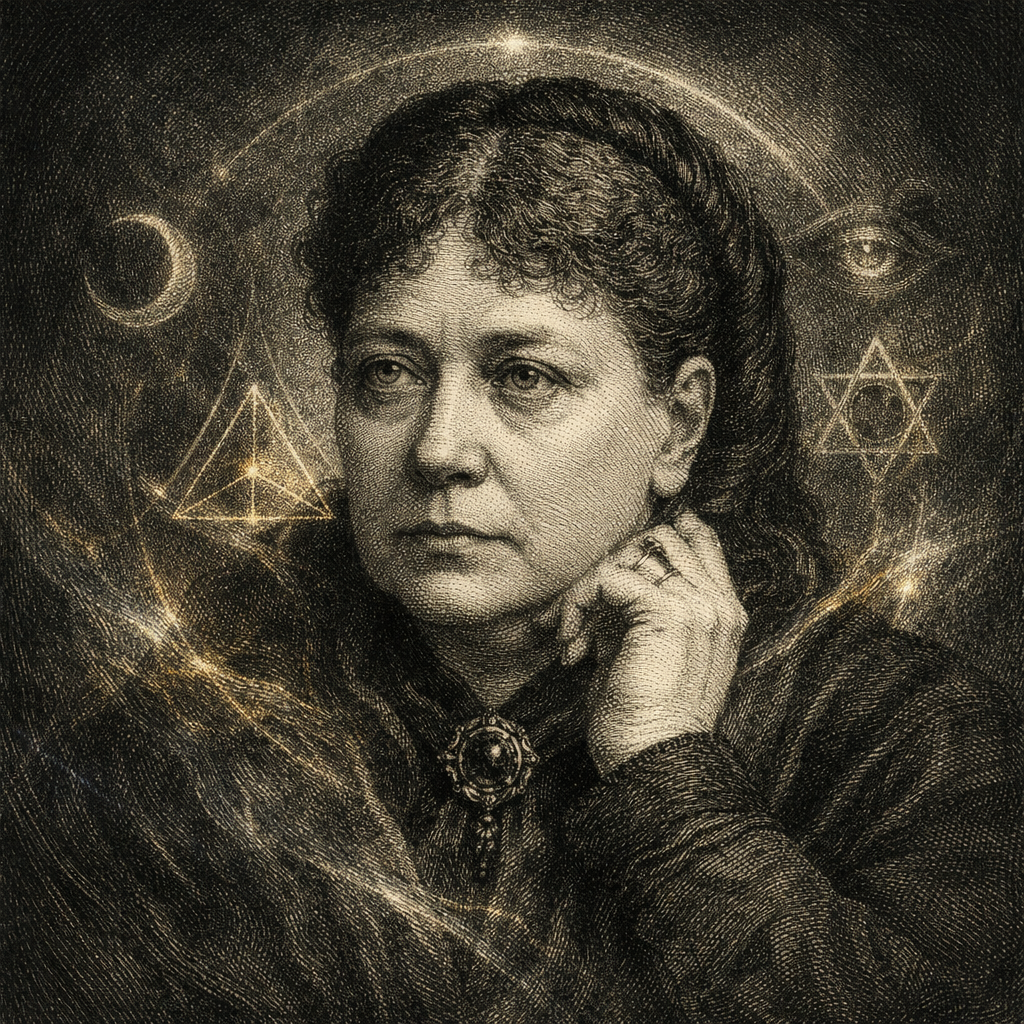
Date range: 1831–1891
Brief Biography
Helena Petrovna Blavatsky was a Russian-born occultist, writer, traveller, and co-founder of the Theosophical Society, one of the most influential esoteric movements of the modern period. Active in the second half of the nineteenth century, she emerged from a world shaped by Spiritualism, comparative religion, Orientalist scholarship, mesmerism, occult revivalism, and the continuing fascination with hidden masters and ancient wisdom. Through works such as Isis Unveiled and The Secret Doctrine, Blavatsky sought to present a universal esoteric philosophy underlying the world’s religions, mythologies, and metaphysical systems. Her ideas were controversial, expansive, and frequently difficult to disentangle from the intellectual assumptions of her age, yet her influence on modern occultism, Theosophy, ritual magic, esoteric Buddhism, Anthroposophy, and later New Age thought was immense. She died in London in 1891, leaving behind a movement whose afterlife was larger than even its formidable founder could fully control.
Works and Texts
- Isis Unveiled
- The Secret Doctrine
- Thought-Forms
Place in the Western Esoteric Tradition
Blavatsky marks a major reconfiguration of the Western Esoteric Tradition in the modern age, shifting its centre of gravity from Renaissance Hermeticism, Christian theosophy, and ceremonial magic toward a globalised esoteric synthesis framed through ancient wisdom, Eastern religion, occult evolution, and hidden adepts. Her work drew upon earlier currents associated with Illuminism, Christian theosophy, Spiritualism, and the nineteenth-century occult revival, while also absorbing and reshaping European interpretations of Hinduism, Buddhism, and esoteric antiquity. She provided later figures and movements with a vast symbolic vocabulary: root races, cosmic cycles, subtle planes, occult masters, initiatory evolution, and the idea of a primordial doctrine concealed beneath religious difference. Through Theosophy, her influence passed into Anthroposophy, the New Age movement, the Traditionalist School, and the Hermetic Order of the Golden Dawn, where her synthesis continued to stimulate, provoke, and complicate modern esoteric thought.
Blavatsky’s Mystical System
Helena Petrovna Blavatsky’s mystical system is built upon the claim that beneath the diversity of religions, myths, symbols, and philosophies lies a single archaic wisdom tradition. This wisdom is not presented as a private revelation in the narrow sense, nor as a new religion founded upon personal authority alone. Blavatsky frames it as the recovery of an ancient doctrine, partially preserved in the sacred literatures of India, Tibet, Egypt, Greece, Chaldea, and other civilisations, and transmitted through initiates who guarded its deeper meanings across the ages. Her system is therefore archaeological, comparative, cosmological, and initiatory at once, though its archaeology is symbolic rather than modernly historical.
The foundation of Blavatsky’s thought is the idea of an esoteric unity behind exoteric religion. Public religions, in this view, are partial expressions of a deeper metaphysical truth. Myths are veiled teachings; symbols are fragments of a hidden language; scriptures are layered documents whose surface meanings conceal occult doctrine. This approach allowed Blavatsky to read across traditions with boldness and considerable imaginative range. Egyptian religion, Hindu metaphysics, Buddhist cosmology, Neoplatonism, Gnosticism, Kabbalah, Hermeticism, and Christian esotericism could all be treated as variant expressions of a primordial wisdom. The result was a vast comparative system that gave modern occultism a new scale and ambition.
Central to this system is the doctrine of cosmic evolution. Blavatsky’s universe unfolds through immense cycles of manifestation and withdrawal, often described through the language of rounds, chains, races, planes, and hierarchies. Creation is not a single event but a rhythmic process in which consciousness and matter evolve together. The cosmos descends into differentiation and materiality, then gradually returns toward spiritual realisation. Humanity participates in this drama. Human beings are not merely earthly organisms, but complex spiritual entities whose present condition reflects a long evolutionary journey through states of consciousness, embodiment, and moral development.
This doctrine gives Blavatsky’s system its distinctive combination of metaphysics and history. Human history becomes a visible fragment of a much larger occult chronology. Civilisations rise and fall as expressions of hidden cycles. Myths of lost continents, ancient initiates, divine teachers, and prehistoric wisdom are woven into a grand narrative of spiritual evolution. The controversial doctrine of root races belongs to this structure. It attempts to describe successive stages in the development of humanity, though it also reflects nineteenth-century racial theories and hierarchies that are now ethically and intellectually untenable. Any serious account of Blavatsky must recognise both the imaginative power of her system and the historical limitations embedded within it.
Another major feature of Blavatsky’s mystical system is its teaching on planes of existence and subtle constitution. Reality is stratified. The visible world is only one level within a larger order of being, extending through astral, psychic, mental, and spiritual dimensions. Human beings likewise possess multiple principles or vehicles, from the physical body to higher spiritual faculties. This layered anthropology became one of Theosophy’s most influential contributions to later esotericism. It offered a framework for explaining clairvoyance, dreams, apparitions, initiation, post-mortem states, spiritual development, and the relation between ordinary consciousness and higher knowledge.
The figure of the hidden master is equally important. Blavatsky presented the Theosophical teaching as connected to a brotherhood of advanced adepts, sometimes called Mahatmas or Masters, who had attained extraordinary wisdom and guided spiritual evolution from behind the scenes. These figures occupy a role similar to that of initiatory authorities, angelic mediators, or secret chiefs in other esoteric traditions. They validate the doctrine, embody its goal, and represent the possibility that human development may advance beyond ordinary limits. Their presence also gave Theosophy a dramatic initiatory structure, in which spiritual knowledge was not simply studied but received through discipline, testing, and alignment with a higher order.
Blavatsky’s relation to Eastern religions is one of the defining features of her work. She helped redirect Western esoteric attention toward India and Tibet, presenting Hindu and Buddhist concepts as central to the recovery of ancient wisdom. Karma, reincarnation, maya, cycles of manifestation, and liberation were taken up into a new Western occult vocabulary. This was not a neutral transmission of Asian traditions. It was a creative, selective, and often highly interpretive reconstruction shaped by European scholarship, colonial encounters, and Blavatsky’s own metaphysical agenda. Yet its impact was enormous. Theosophy helped make reincarnation, karma, subtle bodies, and spiritual evolution familiar concepts in Western alternative religion.
Her system also reworked earlier Western esoteric currents. From Swedenborgian and Christian theosophical traditions came the idea of hidden spiritual worlds and correspondences. From Spiritualism came interest in unseen intelligences, mediumship, and communication beyond ordinary perception, although Blavatsky was often sharply critical of what she considered naïve Spiritualist practice. From Lévi and the occult revival came a renewed language of magic, symbol, astral forces, and initiatory secrecy. From Romantic and post-Enlightenment thought came a suspicion that modern materialism had narrowed the human understanding of reality. Blavatsky gathered these elements into a new esoteric synthesis with a global and evolutionary scope.
The mystical aim of Blavatsky’s system is not merely the acquisition of occult powers. She repeatedly framed true occultism as a path of discipline, impersonality, self-transcendence, and service to humanity. The lower psychic faculties could mislead; the pursuit of phenomena could become vanity; curiosity about hidden powers could degrade the spiritual quest into spectacle. Higher knowledge required moral purification and philosophical seriousness. This tension between sensational occultism and austere spiritual discipline runs throughout her legacy. Theosophy attracted seekers fascinated by marvels, but its central teaching insisted that wisdom demanded ethical transformation.
Blavatsky’s importance lies in the scale of her synthesis. She transformed Western esotericism by giving it a universal history, a vast cosmology, and a comparative religious framework suited to the modern age. Her work is often difficult, uneven, polemical, and burdened by the assumptions of nineteenth-century thought. It is also one of the great engines of modern esoteric imagination. Later movements accepted, revised, rejected, or purified her ideas, but few could ignore them. Anthroposophy developed partly through Rudolf Steiner’s departure from Theosophy; the Golden Dawn worked in an atmosphere shaped by Theosophical revivalism; New Age spirituality inherited much of its language of evolution, planes, masters, and hidden wisdom; the Traditionalist School reacted against modernity through a different but related appeal to primordial truth.
Blavatsky’s mystical system therefore stands as a decisive modern reorganisation of the esoteric field. It took older Western concerns with hidden wisdom, correspondences, initiation, and spiritual worlds, then expanded them through a global mythology of cosmic evolution and ancient doctrine. Its difficulties are real, and its historical claims often require careful handling. Yet its imaginative force is beyond dispute. Blavatsky gave modern occultism a cosmos large enough to contain Atlantis, Tibet, Egypt, India, angels, adepts, karma, reincarnation, and the secret destiny of humanity. That the resulting structure sometimes groans under its own weight is part of its character; it is a cathedral of occult synthesis built in an age that had begun to mistake gaslight for enlightenment.
Antecedent Figures
- Emanuel Swedenborg; Jacob Boehme; Louis-Claude de Saint-Martin; Martinez de Pasqually; Papus (Gérard Encausse); Éliphas Lévi
Antecedent Traditions
- Illuminism & Christian Theosophy; Occult Revival & Ritual Magic; Eastern Religions; Spiritualism
Succeeding Figures
- Arthur Edward Waite; Julius Evola; René Guénon; Rudolf Steiner; S.L. MacGregor Mathers; William Wynn Westcott
Succeeding Traditions
- Anthroposophy; New Age Movement; Traditionalist School; Hermetic Order of the Golden Dawn