Heinrich Khunrath
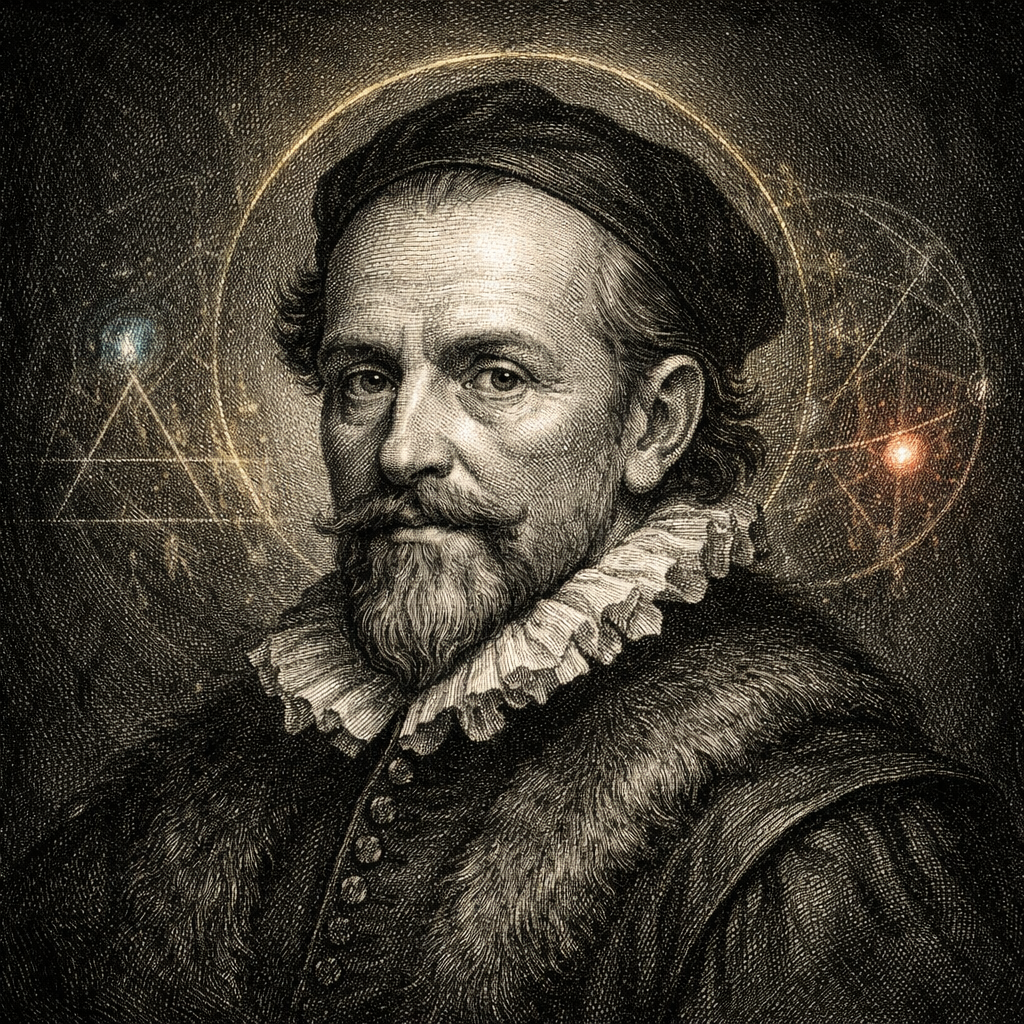
Date range: c. 1560–1605
Brief Biography
Heinrich Khunrath was a German physician, Paracelsian thinker, Christian Kabbalist, and alchemical writer active in the late sixteenth and early seventeenth centuries. Educated in medicine and shaped by the intellectual ferment of post-Reformation Germany, he sought to unite laboratory alchemy, devotional Christianity, natural philosophy, and visionary symbolism into a single path of wisdom. His most important work, Amphitheatrum Sapientiae Aeternae, presents the pursuit of divine wisdom through a striking fusion of image, prayer, experiment, and contemplative discipline. Khunrath died in 1605, shortly before the emergence of the Rosicrucian manifestos, but his symbolic universe helped prepare the imaginative and doctrinal ground in which Rosicrucianism would later flourish.
Works and Texts
- Amphitheatrum Sapientiae Aeternae
- Atalanta Fugiens
- Symbola Aureae Mensae
Place in the Western Esoteric Tradition
Khunrath occupies a crucial position in the movement from Renaissance learned magic and Paracelsian natural philosophy toward the explicitly Rosicrucian imagination of the early seventeenth century. His work presents alchemy as a sacred discipline in which the purification of matter, the illumination of the intellect, and the regeneration of the soul belong to the same process. Through his engravings and dense symbolic architecture, he helped establish a form of Christian esotericism in which the laboratory, the study, and the place of prayer are complementary theatres of transformation. His relation to Rosicrucianism is especially important because later Rosicrucian writers would inherit many of his central concerns: the reform of knowledge, the sanctification of nature, the union of piety and experiment, and the conviction that wisdom is hidden in both scripture and creation.
Khunrath’s Mystical System
Heinrich Khunrath’s mystical system is best understood as a form of contemplative Christian alchemy in which the search for the philosopher’s stone is inseparable from the search for divine wisdom. His thought belongs to the late Renaissance world of correspondences, signatures, hidden virtues, angelic intelligences, and sacred hierarchies, but its centre of gravity is profoundly devotional. For Khunrath, alchemy was not a merely technical art of furnaces, vessels, and substances. It was a disciplined encounter with the divine order concealed within nature, requiring purification of the practitioner as much as manipulation of matter.
The key to his system is the union of the oratory and the laboratory. This pairing, made visually memorable in the celebrated engravings associated with the Amphitheatrum Sapientiae Aeternae, expresses a whole theology of esoteric practice. The oratory represents prayer, humility, repentance, scriptural meditation, and dependence upon divine grace. The laboratory represents experiment, observation, transformation, and the practical investigation of nature’s hidden powers. Khunrath refuses to separate these spheres. The alchemist who works without prayer risks becoming a mere technician of curiosity or greed; the contemplative who neglects nature fails to recognise the divine wisdom written into creation. True wisdom requires both pious ascent and material engagement.
This synthesis reflects the strong Paracelsian current in Khunrath’s thought. Like Paracelsus, he saw nature as a living book filled with signs, virtues, and occult correspondences placed there by God. The physician and alchemist must learn to read this book through a combination of experience, illumination, and disciplined interpretation. Disease, matter, metals, minerals, and cosmic influences are not inert objects in a dead universe. They are elements within a spiritually charged creation. The world is intelligible because it is created through divine wisdom; it is transformative because the same wisdom works within the human being.
Khunrath’s alchemy therefore has a strong anthropological dimension. The work upon matter mirrors the work upon the soul. Calcination, dissolution, separation, conjunction, and perfection are chemical operations, but they also describe the spiritual drama of repentance, cleansing, discernment, reintegration, and illumination. The adept’s labour is outwardly enacted in vessels and furnaces, yet inwardly it unfolds as moral and intellectual regeneration. The true alchemist must become fit to receive what he seeks. Wisdom is not simply discovered; it is granted to the purified mind and the rightly ordered will.
The Amphitheatrum gives this vision an architectural and theatrical form. Its title evokes a sacred arena in which eternal wisdom is displayed through emblem, text, doctrine, and image. Khunrath’s engravings do not simply illustrate ideas; they stage an initiatory imagination. Tables, instruments, inscriptions, divine names, symbolic gates, and sacred spaces turn knowledge into a kind of contemplative landscape. The viewer is invited to move through layers of meaning, from visible form to invisible principle. This visual method is central to Khunrath’s esotericism. Symbol does not decorate doctrine; it activates understanding.
His use of Christian Kabbalistic and theosophical motifs further deepens this structure. Divine names, sacred letters, celestial hierarchies, and the wisdom tradition associated with Solomon all appear within a Christian framework of salvation and illumination. Khunrath does not present Kabbalah as an independent Jewish tradition, but as part of a Christianised sacred science through which the hidden structure of scripture and creation may be discerned. This was characteristic of much Renaissance Christian esotericism, yet in Khunrath it becomes especially vivid because it is joined to alchemical practice. Language, matter, prayer, and cosmic order are drawn into a single symbolic economy.
The figure of wisdom is central. Khunrath’s concern is not knowledge as accumulation, but sapientia: wisdom as divine, transformative, and salvific. The human intellect must be illuminated by God if it is to perceive the inner order of things. This distinguishes his system from any purely empirical account of alchemy. Experience matters, and experiment is indispensable, but the highest knowledge is not produced by technique alone. It requires revelation, moral discipline, and spiritual receptivity. The alchemist is a servant of wisdom before he is a master of nature.
This helps explain Khunrath’s later importance for Rosicrucian currents. The early Rosicrucian imagination was preoccupied with universal reform, hidden brotherhoods, sacred science, medicine, alchemy, and the renewal of Christianity through divine wisdom. Khunrath did not create Rosicrucianism, but his work gave powerful form to several of its preoccupations. His fusion of piety, alchemy, emblematic instruction, and reforming aspiration made him one of the most resonant precursors of that movement. The Rosicrucian manifestos would later transform such themes into the myth of a secret fraternity and a programme of spiritual-intellectual renewal.
Khunrath’s mystical system is therefore neither laboratory alchemy with religious ornament nor devotional mysticism with chemical metaphors pasted upon it. It is a coherent vision in which the world is a divine text, the alchemist a disciplined interpreter, and transformation the governing law of both nature and the soul. His work belongs to a period when the boundaries between science, theology, medicine, and esotericism had not yet hardened into modern categories. In that fluid intellectual world, Khunrath imagined the adept as physician, priest, philosopher, and craftsman of regeneration. The result is one of the great symbolic syntheses of Christian alchemy: demanding, ornate, and frequently obscure, but animated throughout by the conviction that eternal wisdom may be approached through prayerful labour in the created world.
Antecedent Figures
- —
Antecedent Traditions
- —
Succeeding Figures
- Johann Valentin Andreae; Michael Maier; Robert Fludd
Succeeding Traditions
- Rosicrucianism