Heinrich Cornelius Agrippa
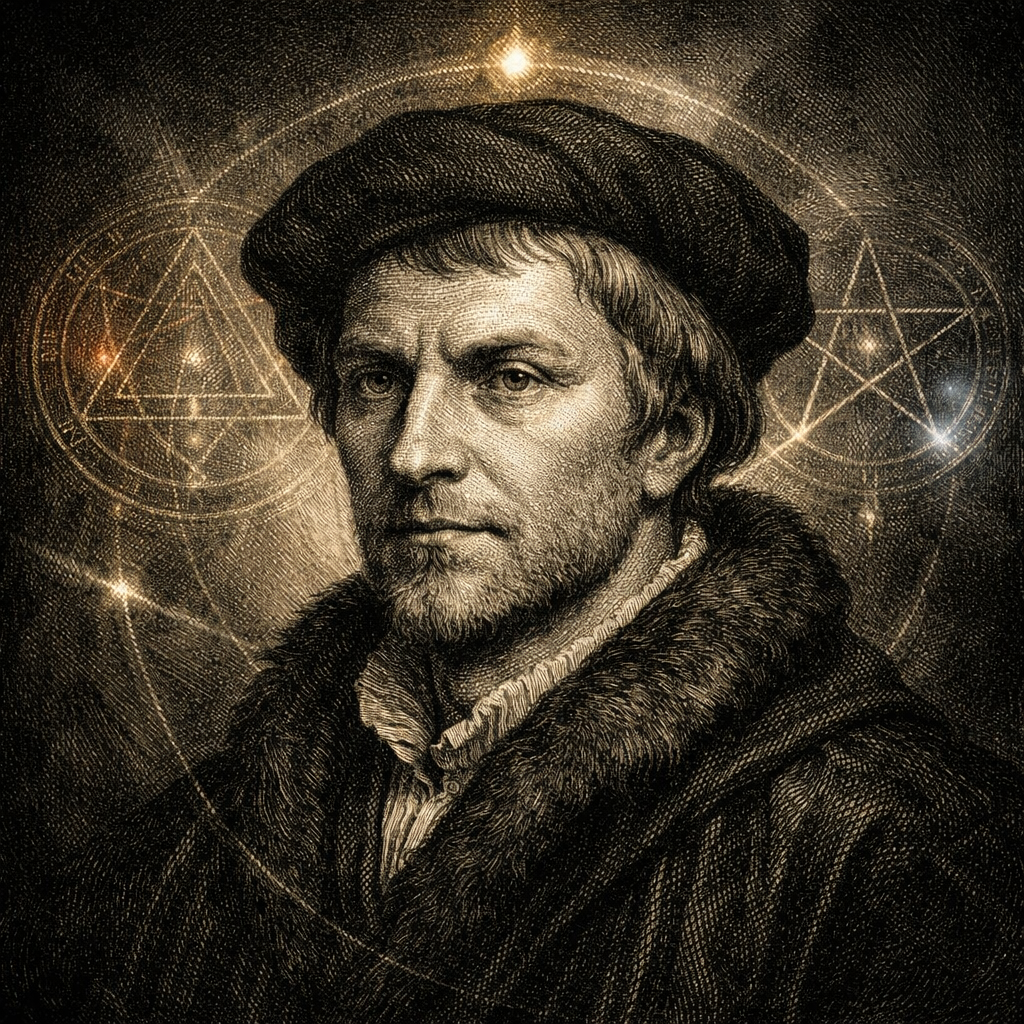
Date range: 1486–1535
Brief Biography
Heinrich Cornelius Agrippa von Nettesheim was a German polymath, lawyer, physician, theologian, soldier, occult philosopher, and one of the most influential writers on Renaissance magic. Born near Cologne in 1486, he moved through the learned and political worlds of early sixteenth-century Europe, serving patrons, teaching, practising medicine, and repeatedly attracting controversy. His most important work, De occulta philosophia libri tres, offered the most ambitious synthesis of learned magic produced in the Renaissance, drawing together Hermeticism, Kabbalah, astrology, angelology, natural philosophy, number symbolism, and ceremonial practice. Agrippa also wrote sceptically about human knowledge and institutional authority, which has made his intellectual position both fertile and maddeningly difficult to pin down. He died in 1535, leaving a body of work that became foundational for later ceremonial magic, Rosicrucian speculation, angelic magic, and occult philosophy.
Works and Texts
- De occulta philosophia libri tres
- Oration on the Dignity of Man
- De arte cabalistica
- De vita libri tres
- De Umbris Idearum
- The Expulsion of the Triumphant Beast
Place in the Western Esoteric Tradition
Agrippa occupies a central place in the Western Esoteric Tradition because he gave Renaissance magic its most systematic and influential formulation. His work arranged the magical universe into a threefold structure of elemental, celestial, and intellectual realities, linking natural philosophy, astrology, angelology, sacred language, numbers, ritual, and divine names within a single framework. Drawing from late antique Hermeticism, medieval Kabbalah, astral magic, and scholastic theology, Agrippa presented magic as a learned discipline concerned with the hidden bonds between all levels of creation. His synthesis became a major source for later magical and esoteric currents, including Paracelsianism, Rosicrucianism, angelic magic, and the symbolic traditions that fed into speculative Freemasonry.
Agrippa’s Mystical System
Heinrich Cornelius Agrippa’s mystical system is organised around the correspondence between three worlds: the elemental, the celestial, and the intellectual. This structure gives De occulta philosophia libri tres its enduring power. The material world, the heavenly world, and the world of intelligences are not separate territories sealed from one another. They are interrelated levels of a single created order, joined by sympathies, influences, signs, numbers, words, and hidden bonds. Magic is the learned art of understanding and operating within these relations.
The first world is the elemental or natural world. It includes the visible realm of bodies, plants, stones, animals, metals, herbs, and physical qualities. Agrippa treats nature as a field of concealed virtues. Things possess powers not always apparent to ordinary perception: magnetic attractions, healing properties, poisonous effects, generative capacities, and symbolic affinities. Natural magic begins from the study of these hidden virtues. It seeks to understand how the properties placed in creation may be lawfully known and used.
The second world is the celestial world. Here Agrippa draws on astrology, planetary influence, zodiacal symbolism, and the idea that heavenly bodies shape the lower world through rays, motions, and formal powers. The planets and stars are not merely distant objects. They are mediating forces within the cosmic hierarchy. Their influences help explain the hidden sympathies among earthly things. A plant, stone, colour, metal, animal, or human temperament may be linked to a planet or sign through shared qualities. The magician learns to recognise these correspondences and to work at the proper times, under the proper celestial conditions.
The third world is the intellectual or angelic world. This is the realm of divine names, intelligences, angels, spiritual hierarchies, sacred numbers, and theological realities. Agrippa’s magic reaches its highest level here, where the operator moves from natural and astral forces toward the powers of mind, spirit, and divine order. Sacred language becomes especially important. Names are not treated as arbitrary labels. Divine and angelic names disclose power, relation, and authority. To know the right name, within the right order, is to participate in a hierarchy of intelligibility and command.
This threefold structure allows Agrippa to join many inherited traditions into one system. Hermeticism contributes the image of a cosmos alive with divine intelligence and accessible to the purified mind. Kabbalah contributes sacred language, divine names, letters, numbers, and angelic hierarchies. Astrology contributes the doctrine of celestial mediation. Scholastic theology contributes the hierarchical ordering of creation and the concern to distinguish licit knowledge from demonic error. Agrippa’s originality lies in arranging these materials into a coherent magical philosophy.
The principle of correspondence is the working foundation of the system. Lower things reflect higher things. Earthly forms answer to celestial powers; celestial powers answer to intellectual and divine realities. The universe is readable because it is ordered by analogy. A sign, plant, number, colour, word, angel, or planet may belong to the same chain of relation. The magician is therefore a reader of hidden patterns. Magical operation begins in interpretation, because action without knowledge of order is only noise wearing ceremonial clothing.
Agrippa’s magician is a learned and disciplined figure. Magical power is not gained by curiosity alone, nor by the mechanical use of recipes. It requires knowledge of nature, mathematics, astrology, theology, sacred languages, ritual purity, and moral formation. The operator must understand the structure of the cosmos and the proper place of human agency within it. Agrippa repeatedly presents magic as the highest part of natural philosophy, elevated by religion and completed by contemplation. It is an intellectual and spiritual discipline before it is an operative art.
At the same time, Agrippa’s work preserves a deep tension. His De vanitate scientiarum sharply criticises the vanity of human arts and sciences, including many forms of learned knowledge. This has led to long debate about whether Agrippa later rejected magic or used scepticism as a religious and rhetorical counterweight to intellectual pride. The tension is real and productive. Agrippa’s thought holds together a vast confidence in hidden correspondences with an equally sharp awareness of human folly. Renaissance magic, in his hands, is both magnificent and precarious.
This tension gives his system a theological seriousness. Magic must remain subordinate to God. The created order contains hidden powers, but those powers are not autonomous divinities. Angels, stars, names, numbers, and natural virtues all belong within divine providence. The magician’s danger lies in mistaking participation for domination. Lawful magic cooperates with the order of creation; unlawful magic seeks power severed from wisdom and divine authority. Agrippa’s hierarchy is therefore moral as well as cosmological.
The influence of De occulta philosophia on later Western esotericism was immense. It became a major sourcebook for learned magic, supplying later thinkers with a structure for correspondences, planetary magic, angelic orders, divine names, talismans, and ceremonial theory. Rosicrucian writers inherited Agrippa’s sense of hidden wisdom and cosmic order. Angelic and ceremonial magicians drew on his hierarchies and symbolic associations. Later occult revivalists treated him as one of the great authorities of the magical tradition, even when they rearranged his system to suit their own enthusiastic machinery.
Agrippa’s mystical system may therefore be understood as a hierarchical science of correspondences. The universe is ordered through three interrelated worlds. Hidden virtues operate in nature; celestial powers mediate influence; divine names and intelligences govern the higher structures of reality. The magician studies these relations in order to act within them, seeking knowledge, transformation, and lawful participation in the divine order. Agrippa gave Renaissance magic its grand architecture: learned, symbolic, theological, ambitious, and permanently vulnerable to the excesses of those who mistake classification for wisdom.
His enduring significance lies in the clarity with which he made magic intellectually comprehensive. He did not leave occult knowledge as a scattered collection of charms, invocations, and fragments. He arranged it as a disciplined philosophy of nature, heaven, and spirit. Through that synthesis, Agrippa became one of the indispensable architects of the Western magical imagination.
Antecedent Figures
- Abraham Abulafia
- Albertus Magnus
- Hermes Trismegistus
- Moses de León
- Thomas Aquinas
Antecedent Traditions
- Late Antique Hermeticism & Gnosticism
- Medieval Kabbalah
- Islamic Astral Magic
- Scholastic Theology
Succeeding Figures
- Edward Kelley
- Elias Ashmole
- James Anderson
- Johann Valentin Andreae
- John Dee
- Michael Maier
- Paracelsus
- Robert Fludd
- William Preston
Succeeding Traditions
- Paracelsianism
- Rosicrucianism
- John Dee's Angelic Magic
- Speculative Freemasonry