Giovanni Pico della Mirandola
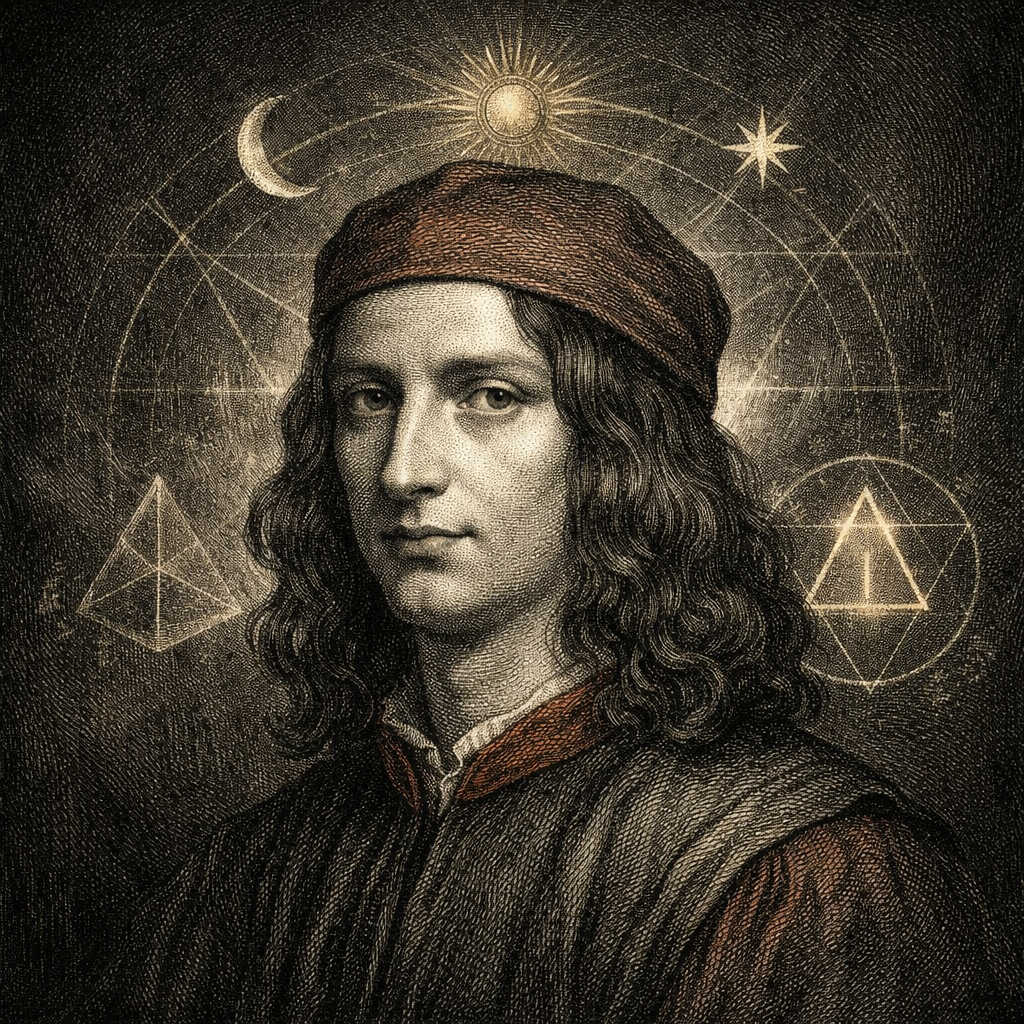
Date range: 1463–1494
Brief Biography
Giovanni Pico della Mirandola was an Italian Renaissance philosopher, nobleman, humanist, and one of the defining figures in the emergence of Christian Kabbalah. Born into the ruling family of Mirandola in 1463, he studied widely across the universities and courts of Italy, absorbing scholastic philosophy, Platonism, Aristotelianism, Hebrew learning, Arabic philosophy, Kabbalah, and Hermetic materials. His famous Oration on the Dignity of Man introduced a bold vision of human freedom and intellectual ascent, while his proposed nine hundred theses attempted to reconcile diverse philosophical and theological traditions within a single universal wisdom. Pico’s engagement with Kabbalah was especially influential, since he argued that Jewish mystical traditions could confirm and illuminate Christian doctrine. He died young in 1494, but his synthesis of humanism, theology, magic, and Kabbalah became one of the major foundations of Renaissance esotericism.
Works and Texts
- De occulta philosophia libri tres
- Oration on the Dignity of Man
- De arte cabalistica
- De vita libri tres
- De Umbris Idearum
- The Expulsion of the Triumphant Beast
Place in the Western Esoteric Tradition
Pico occupies a central place in the Western Esoteric Tradition because he gave Renaissance Christian Kabbalah one of its decisive intellectual forms. His project sought to reconcile ancient theology, scholastic philosophy, Platonism, Aristotelianism, Hermetic wisdom, and Jewish Kabbalah within a universal account of truth. Pico’s importance lies in his conviction that hidden correspondences joined diverse traditions and that the human intellect could ascend through them toward divine knowledge. His use of Kabbalah as a Christian theological and magical resource shaped later Renaissance esotericism, influencing currents that led toward Paracelsianism, Rosicrucianism, angelic magic, and speculative Freemasonry. His work helped establish the Renaissance image of the learned magus as philosopher, theologian, interpreter, and spiritual aspirant.
Pico’s Mystical System
Giovanni Pico della Mirandola’s mystical system is grounded in the dignity, freedom, and transformative capacity of the human being. His thought begins from a striking claim: humanity has no fixed place in the hierarchy of creation. The human person stands at the centre of the created order with the capacity to descend toward the lower forms of life or ascend toward angelic and divine realities. This freedom is not simply moral choice in the ordinary sense. It is metaphysical openness. Human nature is unfinished, plastic, and capable of self-transformation.
The Oration on the Dignity of Man gives this vision its most famous expression. Pico presents the human being as a creature able to shape itself through intellect, discipline, contemplation, and spiritual ascent. The human person may become bestial through appetite, rational through philosophy, angelic through contemplation, and united with the divine through mystical knowledge. This anthropology gave Renaissance esotericism one of its central ideals: the human being as mediator between worlds, capable of gathering the powers of nature, intellect, and revelation into a single ascent toward God.
Pico’s system is also a project of concord. He believed that truth could be found across multiple philosophical and religious traditions. Plato and Aristotle, Moses and Hermes, scholastic theology and ancient wisdom, Hebrew Kabbalah and Christian doctrine could be brought into relation through learned interpretation. This was not simple eclecticism. Pico sought a deeper unity beneath apparent contradiction. The labour of the philosopher was to uncover the hidden agreement among traditions and to show how each preserved part of a larger divine wisdom.
Kabbalah occupies a privileged place in this project. Pico was among the first major Christian thinkers to treat Jewish Kabbalah as a key to Christian theology. He argued that Kabbalistic doctrines, properly interpreted, confirmed the mysteries of Christianity. Hebrew letters, divine names, angelic hierarchies, sefirotic structures, and scriptural exegesis became instruments through which Christian truth could be disclosed at a deeper level. This move was historically consequential. It opened a path by which Kabbalah entered Renaissance Christian esotericism and became central to later occult philosophy.
For Pico, sacred language carries metaphysical force. Names, letters, and numbers are not arbitrary signs. They participate in the structure of reality and may disclose the hidden relations between God, creation, and the human soul. This view links him to earlier traditions of letter mysticism and to the broader Renaissance search for a primordial language. The divine name, especially, becomes a point of concentration where theology, magic, and contemplation meet. To know sacred language is to approach the architecture of creation.
Magic also has a place in Pico’s thought, though it is framed carefully. He distinguished between illicit demonic magic and a higher natural or divine magic grounded in the lawful structure of creation. True magic, for Pico, is the practical part of natural philosophy. It operates through sympathies, correspondences, and the hidden powers placed in nature by God. The magus does not rebel against divine order; he studies and cooperates with it. This idea would become fundamental to Renaissance occult philosophy, where magic could be presented as learned, pious, and philosophical rather than as superstition or sorcery.
The relation between magic and Kabbalah gives Pico’s system its esoteric charge. Natural magic works through the hidden powers of created things. Kabbalah works through sacred language, divine names, and the higher structures of revelation. Together they form a ladder of ascent from nature to scripture, from symbols to divine realities, from intellectual inquiry to mystical union. The human being, placed at the centre of the cosmos, is capable of moving through these levels because the human mind reflects the order it seeks to understand.
Pico’s debt to scholastic theology remains important. His thought is not a rejection of medieval intellectual discipline. He worked through scholastic methods, disputed in theses, engaged Aristotelian categories, and remained concerned with doctrinal truth. His originality lies in expanding the range of authorities that could be brought into theological conversation. Scholastic precision is joined to humanist breadth and esoteric ambition. The result is a system in which university disputation, mystical exegesis, magical theory, and humanist rhetoric occupy the same intellectual field.
His relation to Hermeticism is equally significant. Renaissance Hermetic texts presented ancient wisdom as a sacred philosophy reaching back toward the earliest ages of revelation. Pico drew upon this atmosphere of ancient theology, though he gave Kabbalah a higher authority than many other non-Christian sources. Hermeticism contributed to the image of the wise ancient theologian and to the belief that philosophy, religion, and magic had once formed a unified wisdom. Pico’s project sought to recover that unity through disciplined interpretation.
The later influence of Pico’s system was immense. Christian Kabbalah became a major current in Renaissance esotericism, shaping the work of later occult philosophers and contributing to the symbolic universe inherited by Rosicrucian, magical, and Masonic traditions. His anthropology of human freedom also gave esotericism a heroic image of the aspirant: the human being as self-fashioning, world-mediating, and capable of ascent through knowledge. Later figures would develop these themes in more magical, cosmological, or ritual directions, but Pico helped give them philosophical legitimacy.
Pico’s mystical system may therefore be understood as a theology of human ascent through concordant wisdom. The human person stands at the centre of creation with the capacity for transformation. The traditions of the world preserve fragments of a deeper unity. Kabbalah and sacred language disclose hidden structures of revelation. Magic, rightly understood, cooperates with the lawful powers of nature. Philosophy becomes a discipline of reconciliation, and contemplation becomes the path by which the soul rises toward divine truth.
His enduring importance lies in the confidence with which he joined intellectual breadth to spiritual ambition. Pico imagined the learned person as a mediator of traditions, a reader of hidden correspondences, and a participant in the ascent of the soul. In his work, Renaissance humanism becomes esoteric: the dignity of man is not simply cultural refinement, but the terrifying freedom to become what one contemplates.
Antecedent Figures
- Abraham Abulafia
- Albertus Magnus
- Hermes Trismegistus
- Moses de León
- Thomas Aquinas
Antecedent Traditions
- Late Antique Hermeticism & Gnosticism
- Medieval Kabbalah
- Islamic Astral Magic
- Scholastic Theology
Succeeding Figures
- Edward Kelley
- Elias Ashmole
- James Anderson
- Johann Valentin Andreae
- John Dee
- Michael Maier
- Paracelsus
- Robert Fludd
- William Preston
Succeeding Traditions
- Paracelsianism
- Rosicrucianism
- John Dee's Angelic Magic
- Speculative Freemasonry