Giordano Bruno
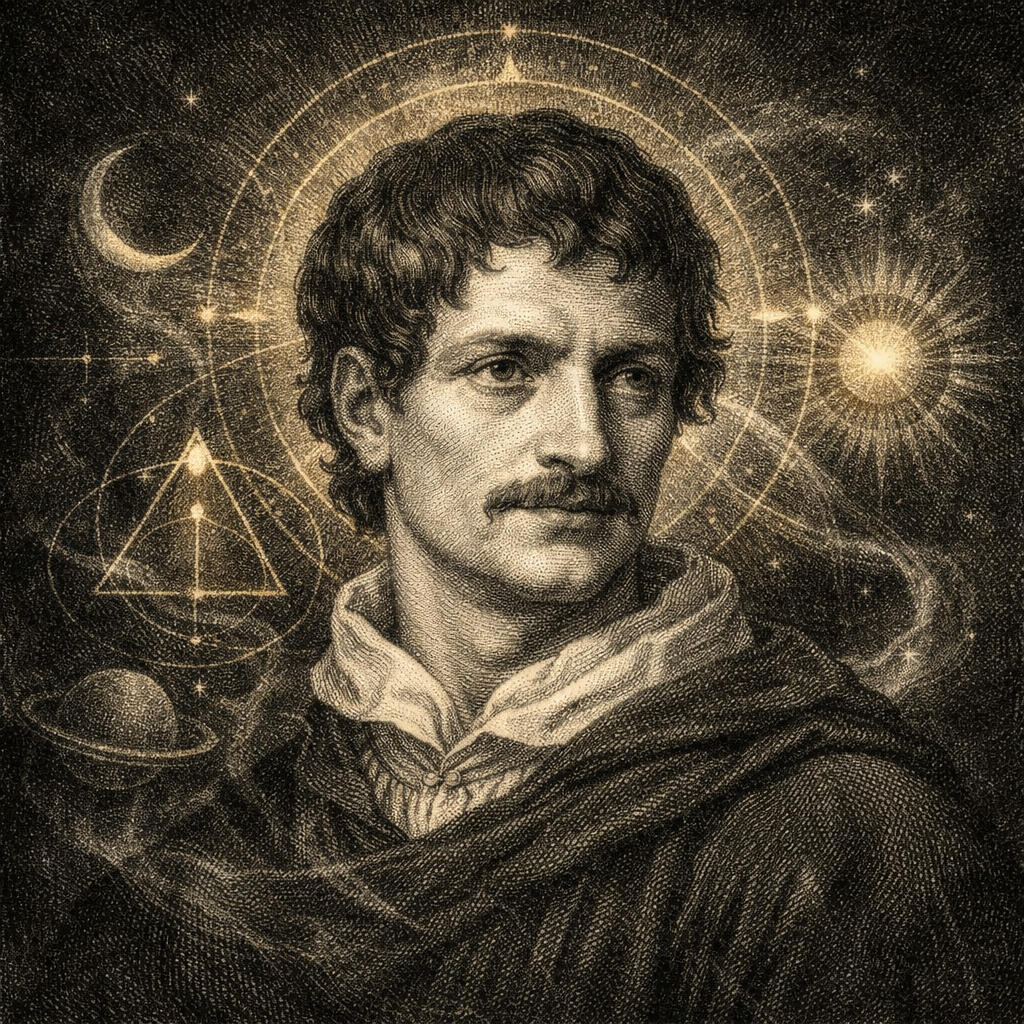
Date range: 1548–1600
Brief Biography
Giordano Bruno was an Italian philosopher, former Dominican friar, cosmologist, memory theorist, and esoteric thinker whose work stands at one of the most charged intersections of Renaissance philosophy, Hermetic speculation, magical theory, and religious controversy. Born Filippo Bruno in Nola in 1548, he entered the Dominican order in Naples before leaving amid accusations of heterodoxy. He spent much of his adult life travelling through Italy, France, England, Germany, and Central Europe, writing on cosmology, memory, religion, metaphysics, and moral reform. Bruno is best known for his defence of an infinite universe and innumerable worlds, but his thought cannot be reduced to astronomy. His cosmology was bound to a larger vision of divine immanence, intellectual ascent, magical imagination, and the reform of the human spirit. Tried by the Roman Inquisition, he was executed in Rome in 1600, becoming one of the most contested symbols of intellectual freedom, heresy, and Renaissance esoteric audacity.
Works and Texts
- De occulta philosophia libri tres
- Oration on the Dignity of Man
- De arte cabalistica
- De vita libri tres
- De Umbris Idearum
- The Expulsion of the Triumphant Beast
Place in the Western Esoteric Tradition
Bruno occupies a decisive place in the Western Esoteric Tradition because he transformed inherited Hermetic, magical, mnemonic, and philosophical materials into a radical vision of an infinite, living cosmos. He drew from late antique Hermeticism, medieval Kabbalah, astral magic, scholastic theology, and Renaissance occult philosophy, yet pushed these materials toward a far more expansive metaphysical horizon. In Bruno’s world, the cosmos is not a closed hierarchy descending from a distant divine source, but an infinite field of divine vitality, animated by intelligible forces and accessible through disciplined imagination. His influence lies partly in this enlargement of the esoteric imagination: magic, memory, cosmology, and spiritual reform become parts of a single project of intellectual liberation.
Bruno’s Mystical System
Giordano Bruno’s mystical system is built around the idea of an infinite, animated universe. The cosmos is not a finite enclosure surrounding a single privileged world. It is an immeasurable field of worlds, forms, powers, and divine presence. This vision gives Bruno’s thought its extraordinary force. Infinity is not merely a mathematical proposition. It is a metaphysical and spiritual principle. The universe discloses the inexhaustibility of divine being.
Bruno’s cosmology is therefore inseparable from his theology. Divine reality is not confined beyond the world as an absent ruler looking down upon creation. It is immanent within the living order of nature. Every form participates in the one life of the universe. Matter is not dead receptacle but fertile potency. Nature is not a fallen mechanism but a dynamic expression of divine activity. This gives Bruno’s philosophy a strongly vitalist character. The world lives, changes, generates, transforms, and reveals.
His debt to Renaissance Hermeticism is central to this vision. Hermetic texts had presented humanity as capable of contemplating the divine order and participating intellectually in the structure of the cosmos. Bruno radicalised that inheritance. The human mind, properly trained, may mirror the infinity and dynamism of the universe. To know the world is not simply to classify objects. It is to enter into an active relation with the living order that sustains them. Knowledge becomes a form of participation.
Memory plays a crucial role in this process. Bruno’s art of memory, developed in works such as De Umbris Idearum, is not a simple mnemonic convenience. It is a magical and philosophical discipline. Images, signs, wheels, arrangements, and symbolic correspondences are used to organise the mind so that it may grasp the hidden relations of things. The trained memory becomes an interior theatre of the cosmos. Through it, the intellect learns to move among images that reflect the deeper structures of reality.
This gives Bruno’s system a distinctive theory of imagination. Imagination is not dismissed as fantasy or subjective ornament. It is a mediating faculty. Properly disciplined, it links sense, memory, intellect, and cosmic order. The magical image is powerful because it draws the mind into relation with the forces and forms it represents. Bruno’s use of images is therefore both contemplative and operative. The image shapes consciousness, and consciousness becomes capable of recognising and engaging the patterns of the world.
Magic, in Bruno’s thought, is tied to bonds. The universe is woven through attractions, sympathies, correspondences, desires, and hidden relations. To understand these bonds is to understand how things act upon one another. Magical knowledge is the science of these relations, especially as they move through imagination, affection, language, and symbol. Bruno’s magic does not depend only on ritual formulae. It depends on the perception and direction of the links that bind beings together within the living cosmos.
This concern with bonds also has ethical and political implications. Human beings are moved by images, passions, beliefs, and social forms. The reform of consciousness therefore requires the reform of imagination. Bruno’s The Expulsion of the Triumphant Beast presents a symbolic and moral programme in which false virtues, corrupt powers, and degraded forms of religion are displaced in favour of a purified intellectual and spiritual order. The heavens themselves become a theatre of reform. Myth and cosmology are used to dramatise the transformation of the soul and society.
Bruno’s relation to Kabbalah and Christian esoteric traditions is complex. He worked within a Renaissance environment in which Kabbalah, Hermeticism, Neoplatonism, astrology, and magic could be drawn together as witnesses to ancient wisdom. He inherited this syncretic ambition, though his own use of such materials was often idiosyncratic and subordinated to his larger philosophical vision. Kabbalah contributed to the atmosphere of sacred language, hidden correspondences, and symbolic interpretation. Hermeticism contributed the image of the divinised intellect contemplating and participating in cosmic life.
His break with scholastic limits is equally important. Bruno knew the world of Aristotelian and scholastic categories, but he found the finite, hierarchical cosmos associated with medieval philosophy too narrow for his vision. The infinite universe shattered the old architecture. It displaced the earth from metaphysical centrality, multiplied worlds beyond measure, and made divine creativity inexhaustible. This was not merely a scientific disagreement. It was an esoteric and theological reorientation. A larger cosmos demanded a larger account of divinity, mind, nature, and human destiny.
The later significance of Bruno lies in this expansive power. Paracelsianism, Rosicrucianism, angelic magic, and speculative Freemasonry each developed in different ways, but all participated in a post-Renaissance world increasingly fascinated by hidden correspondences, cosmic reform, sacred science, and the recovery of ancient wisdom. Bruno’s thought helped intensify that climate. He became a model of the philosopher-magician: learned, defiant, cosmological, symbolic, and dangerously unwilling to keep inherited boundaries intact.
Bruno’s mystical system may therefore be understood as magical cosmological vitalism. The universe is infinite and alive. Nature is divine expression. Images and memory train the mind to participate in cosmic order. Magic operates through bonds and correspondences. Spiritual reform requires the reordering of imagination, intellect, and moral life. His work carries the intensity of a thinker attempting to enlarge every inherited frame at once. This is rarely safe, academically or personally, and Bruno’s own life proves the point with unnecessary brutality.
His enduring importance rests on the unity he forged between cosmology and transformation. The infinite universe was not only a new picture of space. It was a new discipline for the soul. To contemplate infinity was to loosen the mind from confinement, to recognise the divine vitality of nature, and to enter a more expansive relation with reality. In Bruno, the Western Esoteric Tradition becomes cosmic, intellectual, magical, and revolutionary in a single movement.
Antecedent Figures
- Abraham Abulafia
- Albertus Magnus
- Hermes Trismegistus
- Moses de León
- Thomas Aquinas
Antecedent Traditions
- Late Antique Hermeticism & Gnosticism
- Medieval Kabbalah
- Islamic Astral Magic
- Scholastic Theology
Succeeding Figures
- Edward Kelley
- Elias Ashmole
- James Anderson
- Johann Valentin Andreae
- John Dee
- Michael Maier
- Paracelsus
- Robert Fludd
- William Preston
Succeeding Traditions
- Paracelsianism
- Rosicrucianism
- John Dee's Angelic Magic
- Speculative Freemasonry