Gerald Gardner
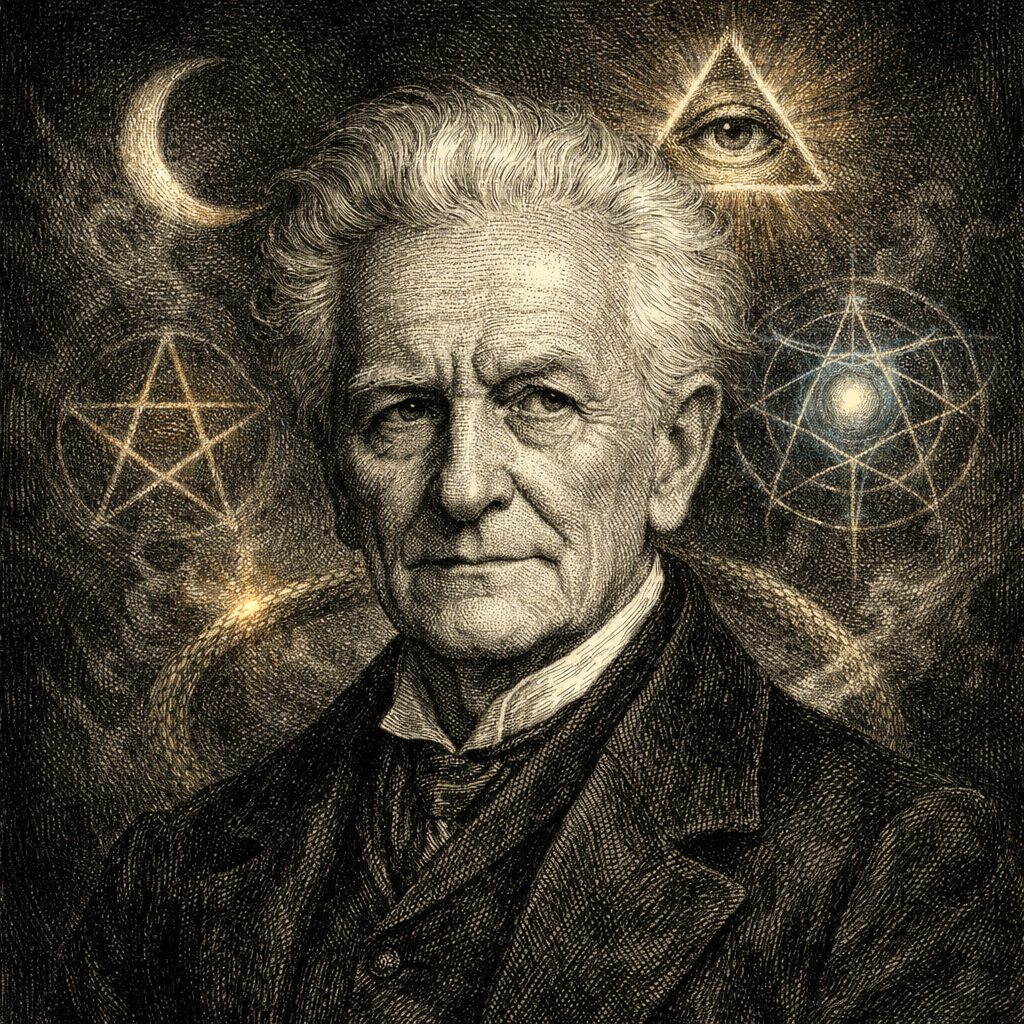
Date range: 1884–1964
Brief Biography
Gerald Gardner was an English civil servant, amateur anthropologist, folklorist, occultist, and central figure in the public emergence of modern Wicca. Born in 1884, he spent much of his early life outside Britain, particularly in Ceylon, Borneo, and Malaya, before returning to England with interests in folklore, ritual, magic, and alternative religion. Gardner became involved in British occult and esoteric circles and later claimed initiation into a surviving witch-cult in the New Forest. His writings, especially Witchcraft Today, presented witchcraft as an ancient pagan religion preserved in secrecy and newly able to emerge after the repeal of the Witchcraft Act. He died in 1964, leaving a contested but enduring legacy as the principal public founder of modern Wicca.
Works and Texts
- Witchcraft Today
Place in the Western Esoteric Tradition
Gardner occupies an important place in the Western Esoteric Tradition because he helped transform witchcraft from a category of folklore, demonology, and historical persecution into a modern initiatory religion. His work drew on the occult revival, ritual magic, ceremonial structures, folklore, pagan romanticism, and esoteric ideas circulating through late nineteenth- and early twentieth-century Britain. Although Gardner presented Wicca as the survival of an ancient pre-Christian religion, its modern form bears clear marks of the occult milieu from which it emerged. His significance lies in the creation and public articulation of a ritual system that joined magic, seasonal religion, goddess spirituality, initiation, polarity, and coven-based practice. Modern pagan witchcraft owes much of its public shape to Gardner’s synthesis.
Gardner’s Mystical System
Gerald Gardner’s mystical system is centred on the revival and ritualisation of witchcraft as a living pagan religion. In Witchcraft Today, he presents witchcraft as an ancient fertility cult that had survived in secrecy beneath the surface of Christian Europe. Modern scholarship treats this survival claim with caution, and often with deep scepticism. The historical importance of Gardner’s work, however, does not depend solely on the literal accuracy of that claim. Its importance lies in the religious and ritual form he helped bring into being.
Gardnerian witchcraft is built around initiation, coven practice, seasonal ritual, magical operation, and reverence for divine polarity. The coven is the central ritual community. It is small, intimate, initiatory, and bound by shared practice rather than by public creed. Within the coven, ritual creates a sacred space in which the participants encounter divine forces, celebrate the cycles of nature, and perform magic. This gives Gardner’s system a strongly embodied character. Religion is enacted through gesture, circle, chant, symbol, touch, movement, and seasonal observance.
The ritual circle is one of the fundamental structures of Gardner’s system. It marks out a consecrated space between ordinary life and sacred action. Within it, the participants invoke divine presence, raise power, perform rites, and return that power toward a desired spiritual or magical end. The circle is protective, symbolic, and operative. It defines the boundary of the rite and gathers the group into a shared magical field. In this sense, Gardner’s witchcraft inherits much from ceremonial magic while reshaping it into a more intimate and nature-centred form.
The divine structure of Gardnerian Wicca is usually expressed through the Goddess and the God. Their relation is not simply doctrinal. It is ritual, seasonal, erotic, and cosmological. The Goddess embodies fertility, wisdom, mystery, lunar rhythm, birth, death, and renewal. The God is associated with vitality, the hunt, sacrifice, vegetation, and the turning of the year. Together they express a sacred polarity through which life is generated, sustained, and renewed. This polarity became one of the defining marks of Gardnerian religious thought.
Seasonal ritual gives Gardner’s system its temporal structure. The year is understood as a sacred cycle marked by festivals that honour natural change and mythic renewal. The movement from growth to harvest, decline, death, and return becomes a religious drama. This places Wicca within a wider modern re-enchantment of nature. The natural world is not treated as a neutral backdrop to human belief. It is the visible field of sacred process. The wheel of the year becomes a ritual calendar of participation in the rhythms of life.
Magic in Gardner’s system is practical but not merely instrumental. It involves the raising, shaping, and directing of power through ritual concentration, group energy, symbol, and intention. This magical practice owes much to the broader occult revival and to ceremonial currents associated with figures such as Lévi, Papus, Waite, Mathers, and Westcott. Yet Gardner reframed magical work through the language of witchcraft, folk practice, goddess religion, and coven ritual. The result is less hierarchical and less heavily textual than much ceremonial magic. It is closer to embodied rite, shared power, and religious drama.
Initiation is crucial. Gardnerian Wicca is not presented simply as a set of beliefs one may adopt privately. It is a mystery tradition entered through ritual transmission. Initiation places the candidate within a lineage, a coven, and a body of practice. It confers belonging and opens access to deeper ritual knowledge. This initiatory structure links Gardner’s system to the broader Western esoteric pattern of graded or transmitted knowledge, while grounding that pattern in witchcraft identity rather than in lodge, temple, or church.
Gardner’s system also depends on secrecy and revelation. Much of its authority came from the claim that ancient rites had been preserved privately and could now be cautiously disclosed. Secrecy gave the tradition depth, danger, and dignity. Publication gave it reach. This tension shaped the early history of Wicca. Gardner revealed enough to attract attention and establish public identity, while maintaining the aura of a deeper initiatory current reserved for the coven. As usual, the hidden tradition managed to stay hidden by publishing just enough to make everyone insufferably curious.
The relationship between Gardnerian Wicca and the Hermetic Order of the Golden Dawn is indirect but important. Gardner’s world was shaped by the same British occult environment in which Golden Dawn ritualism, tarot, ceremonial magic, Kabbalah, Rosicrucian symbolism, and magical orders had circulated widely. Wicca absorbed and transformed elements of this environment: ritual tools, consecrated space, invocation, magical intention, initiation, and symbolic correspondences. These materials were recast through the language of witchcraft, fertility religion, and pagan survival.
Gardner’s enduring significance lies in this act of synthesis. He did not merely describe witchcraft; he helped create a modern religious form capable of being practised, transmitted, adapted, and expanded. His work gave twentieth-century paganism a ritual centre and a public identity. It also changed the meaning of witchcraft in modern culture. The witch became not only a figure of fear, folklore, or persecution, but a religious practitioner, initiate, magical worker, and celebrant of nature’s sacred cycles.
Gardner’s mystical system may therefore be understood as initiatory pagan ritual magic. It joins seasonal religion, coven structure, divine polarity, embodied rite, magical practice, and claims of ancient continuity into a modern esoteric form. Its historical narratives remain contested, but its religious consequences are plain. Gardner helped bring into being one of the most influential new religious movements of the twentieth century, and through it he permanently altered the landscape of modern Western esotericism.
Antecedent Figures
- Arthur Edward Waite
- Papus (Gérard Encausse)
- S.L. MacGregor Mathers
- William Wynn Westcott
- Éliphas Lévi
Antecedent Traditions
- Occult Revival & Ritual Magic
- Hermetic Order of the Golden Dawn
Succeeding Figures
- —
Succeeding Traditions
- —